
Publications Lake Research
Selected Publications
Increasing exposure to global climate change and hopes for the era of climate adaptation: An aquatic perspective
Karsten Rinke, Chenxi Mi, Madeline R. Magee, Cayelan C. Carey
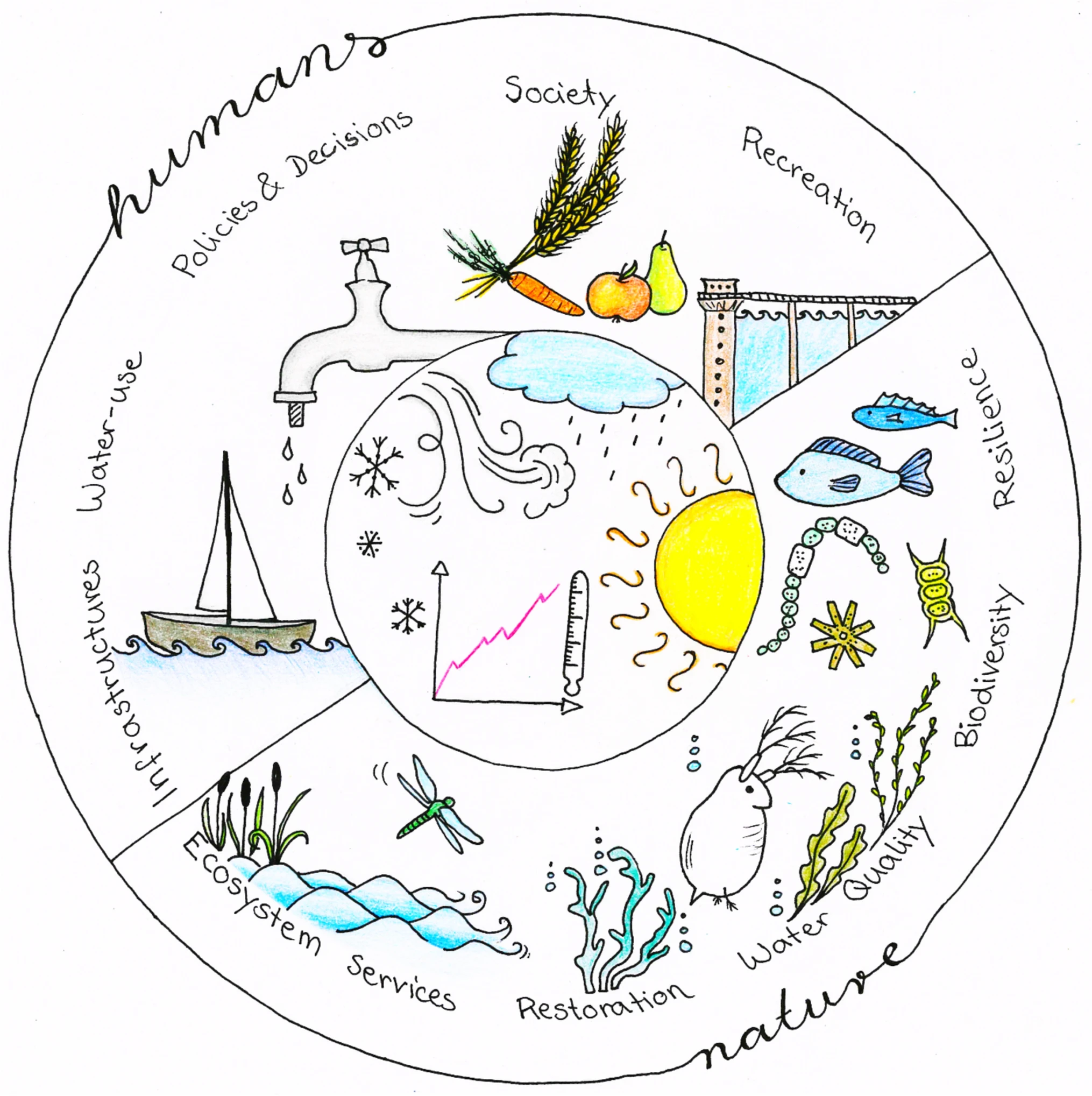
Traditional water management needs an update towards developing and implementing new adaptation strategies that mitigate negative impacts of climate change, make freshwater ecosystems more resilient, and secure human use. Climate adaptation of our inland waters require process knowledge and reliable predictions as scientific basis, robust water management strategies, adjusted infrastructures for new engineering strategies, as well as societal integration and wise decision-making for sustainable socioeconomic welfare. In the ideal case, human water uses for water supply, food production, recreation, and the corresponding infrastructures do not harm biodiversity, self-purification, and ecosystem health. Whether this becomes real or remains an unrealised utopia will be one of the key challenges of our century.
Link to the article
How efficient are pre-dams as reservoir guardians? A long-term study on nutrient retention
Taynara Fernandes, Tom Shatwell, Martin Schultze, Chenxi Mi, Maria Determann, Karsten Rinke

Pre-dams - small reservoirs at inflow points - play an important role in protecting downstream lakes by retaining nutrients. Long-term monitoring of nine German pre-dams shows they are particularly effective at retaining phosphorus (around 40-44 %), while nitrate and silica retention is much lower (around 15 %). Retention is higher in warm seasons due to increased algal uptake and sedimentation, and longer hydraulic residence times improve efficiency. Overall, pre-dams are a practical measure for reducing nutrient loads, including from diffuse sources.
Link to the article
Invariable selection of compounds from organic matter by stream microbes
Jörg Tittel, Volker Lüderitz, Sabine Radke, Yvonne Rosenlöcher, Oliver J. Lechtenfeld

Rivers recycle organic carbon (OC) rapidly, contributing significantly to CO2 emissions, but it remains unclear which compounds are most readily decomposed. Laboratory experiments show that microorganisms respire a narrow range of DOC ages, regardless of the overall age of stream or soil-derived DOC, suggesting that chemical properties, rather than age alone, limit decomposition. Analysis of previous studies indicates that while some older OC is decomposed, there is no consistent preference for younger or older material due to factors like the freshwater reservoir effect. Overall, intrinsic chemical quality and microbial strategies jointly determine which DOC compounds are utilized.
Link to the article
Complete Publication List
Index:
- 2026 (39)
- 2025 (54)
- 2024 (51)
- 2023 (58)
- 2022 (53)
- 2021 (54)
- 2020 (39)
- 2019 (23)
- 2018 (20)
- 2017 (34)
- 2016 (24)
- 2015 (19)
- 2014 (24)
- 2013 (16)
- 2012 (39)
- 2011 (15)
- 2010 (26)
- 2009 (25)
- 2008 (19)
- 2007 (22)
- 2006 (22)
- 2005 (32)
- 2004 (36)
- 2003 (29)
- 2002 (32)
- 2001 (33)
- 2000 (34)
- 1999 (24)
- 1998 (26)
- 1997 (21)
- 1996 (4)
- 1995 (2)
You could use our publication index for further requests.
2026 (39)
- Atton Beckmann, D., Werther, M., Shatwell, T., Spyrakos, E., Hunter, P., Jones, I.D. (2026):
How climate change erodes short-term lake-temperature predictability: Informing climate resilient lake forecasting
Water Res. X 30 , art. 100457
10.1016/j.wroa.2025.100457 - Du, C., Kong, X., Zhang, C., Xue, B., Zhang, F., Sun, D., Jiang, Q., Yao, S., Lin, Y. (2026):
Reconstructing anthropocene carbon dynamics: Tracking sedimentary organic matter sources with multiple proxies in a temperate semi-arid lake (Hulun, northern China)
Catena 267 , art. 109997
10.1016/j.catena.2026.109997 - Duan, Z., Gao, W., Kong, X., MacIsaac, H.J., Jeppesen, E., Hilt, S., Hamilton, D.P., Wilhelm, S.W., McKay, R.M., Zhang, Y., Qin, B., Liu, Y., Wang, H., Pan, M., Xia, T., Wu, F., Paerl, H.W., Chang, X. (2026):
Eutrophic lake restoration requires multidimensional approaches to stressor management
Environ. Sci. Technol. 60 (4), 3170 - 3185
10.1021/acs.est.5c11422 - Engelmann, C., Binder, M., Rinke, K., Berendonk, T., Walther, M. (2026):
Raising awareness on algal toxins—a discussion on potential pathways of microcystins to urban groundwater systems [Sensibilisierung für Algentoxine – Eine Diskussion über mögliche Wege von Mikrocystinen in städtische Grundwassersysteme]
Grundwasser 31 , 135 - 145
10.1007/s00767-025-00600-4 - Figary, S.E., Meyer, M.F., Pilla, R.M., Currie, W.J.S., Alcocer, J., Alfonso, M.B., Tittel, J., Urrutia-Cordero, P., et al. (2026):
The Zooplankton International Geospatial dataset: A global repository of spatiotemporal freshwater zooplankton community composition data from lakes and reservoirs to support ecological research (ver. 4)
EDI Data Portal
10.6073/pasta/a3b54599e2066b04819df04a24dc9e34 - Figary, S.E., Meyer, M.F., Pilla, R.M., Currie, W.J.S., Alcocer, J., Alfonso, M.B., Tittel, J., Urrutia-Cordero, P., et al. (2026):
The Zooplankton International Geospatial dataset: A global repository of spatiotemporal freshwater zooplankton community composition data from lakes and reservoirs to support ecological research
Limnol. Oceanogr. Lett. 11 (5), e70152
10.1002/lol2.70152 - Gevorgyan, G., Khachikyan, T., Mamyan, A., Aghayan, S., Belykh, O., Rinke, K., Schultze, M., Lipko, I., Kan, G., Zimens, E., Potapov, S., Sorokovikova, E., Krasnopeev, A., Tikhonova, I. (2026):
The first high-throughput sequencing of bacterioplankton sheds light on bacterial and cyanobacterial diversity in high-altitude Lake Sevan, Armenia
Sci. Rep. 16 , art. 12480
10.1038/s41598-026-42528-6 - Jahnke, A., Bai, Y., Brack, W., Carney Almroth, B., Diamond, M.L., Dragsdahl, A.L.S.T., Escher, B.I., Fantke, P., Kühnel, D., MacLeod, M., Ragas, A.M.J., Sakschewski, B., Schmidt, C., Strauss, V., Treu, G., Villarrubia-Gómez, P., Wang, Z., Wendt-Potthoff, K., Ågerstrand, M., Caesar, L. (2026):
Planetary boundary for novel entities: time for a reboot
Environ. Sci. Technol. 60 (28), 19761 - 19770
10.1021/acs.est.6c03044 - Kamjunke, N., Herzsprung, P., von Tümpling, W., Matoušů, A., Znachor, P., Sanders, T., Brix, H., Bussmann, I., Weitere, M., Lechtenfeld, O.J. (2026):
Longitudinal dynamics and transformation of riverine dissolved organic matter from source to sea
Water Res. 288, Part A , art. 124613
10.1016/j.watres.2025.124613 - Khachatryan, G., Gevorgyan, A., Vaseashta, A., Misakyan, A., Rinke, K., Gevorgyan, A., Ghukasyan, L., Gevorgyan, G. (2026):
Climate change and thermal dynamics of the Lake Sevan basin (Armenia): Observational insights and future projections
Water 18 (3), art. 352
10.3390/w18030352 - Koschorreck, M., Aurich, P., Spank, U. (2026):
Temporal dynamics of CO2 emissions from dry reservoir sediments
J. Soils Sediments 26 (3), art. 77
10.1007/s11368-026-04293-x - Koschorreck, M., Aurich, P., Waldemer, C., Keller, P., Lange, J., Spank, U. (2026):
Treibhausgasfreisetzung aus deutschen Talsperren: Mechanismen, Messung und Bewertung
WasserWirtschaft 116 (2-3), 40 - 45
10.1007/s35147-026-2628-0 - Koschorreck, M., Schütze, C., Ködel, U., Bussmann, I., Kamjunke, N. (2026):
Phytoplankton and temperature control seasonal dynamics of greenhouse gases in a large river
J. Geophys. Res.-Biogeosci. 131 (5), e2025JG009300
10.1029/2025JG009300 - Koschorreck, M. (2026):
Treibhausgas-Ausgasung an Stauhaltungen. Wie klimaneutral sind kleine Wasserkraftanlagen?
In: Sommerhäuser, M., Junghardt, S. (Hrsg.)
Frei fließende Flüsse
Limnologie aktuell 16
Schweizerbart, Stuttgart, S. 101 - 111 - Marks, J., Chikita, K.A., Boehrer, B. (2026):
Thermobaric circulation induced by cabbeling in a deep freshwater lake: a conceptual 1D model
Hydrol. Earth Syst. Sci. 30 (6), 1503 - 1521
10.5194/hess-30-1503-2026 - Meyer, M.F., Mesman, J.P., Barbosa, C.C., Borrelli, J.J., Feldbauer, J., Harlan, M.E., Hensley, R.T., Kuyumcu, B., Ladwig, R., Oleksy, I.A., Pilla, R.M., Zwart, J.A., Biddle, M.M., Kinzel, P.J., Legleiter, C.J., Moore, T.N., Murray, T.W., Nkwalale, L.G.T., Overstreet, B.T., Rumman, M.H., Woelmer, W.M. (2026):
The 2025 “Hacking Limnology” Workshop Series and DSOS Virtual Summit: A half decade of data-intensive aquatic science
Limnology and Oceanography Bulletin 35 (1), 43 - 45
10.1002/lob.70017 - Mi, C., Gai, B., Kong, X., Jiang, Y., Chan, C.N., Rinke, K. (2026):
Four decades of full-depth profiles reveal layer-resolved drivers of reservoir thermal regimes and episodic hypolimnetic warming
Hydrol. Earth Syst. Sci. 30 (14), 4611 - 4628
10.5194/hess-30-4611-2026 - Movsisyan, V., Madoyan, H., Shahnazaryan, G., Zatikyan, A., Arakelyan, A., von Tümpling, W., Schultze, M. (2026):
Using chemical monitoring data to distinguish natural background concentrations and anthropogenic impacts in Lake Sevan tributaries, Armenia
Water 18 (16), art. 1971
10.3390/w18161971 - Nkwalale, L.G.T., Rinke, K., Feldbauer, J., Mesman, J., Bucak, T., Shatwell, T., Mercado-Bettin, D., Ladwig, R. (2026):
Code for manuscript 'Intensification of lake anoxia under climate change.'
Version: v3 Zenodo
10.5281/zenodo.19543982 - Nkwalale, L., Rinke, K., Feldbauer, J., Mesman, J.P., Bucak, T., Shatwell, T., Mercado-Bettin, D., Ladwig, R. (2026):
Global lake anoxia is projected to intensify under climate change
Commun. Sustain. 1 , art. 86
10.1038/s44458-026-00093-z - Ouattara, B. (2026):
From satellite data to soil security: Closing the science–policy gap in soil erosion monitoring in West Africa
Soil Security 22 , art. 100224
10.1016/j.soisec.2026.100224 - Ouattara, B., Touré, N., Danumah, J., Liu, T., Mouillot, F. (2026):
When less burning does not mean cleaner air: Decoupling of burned area, fire-related PM2.5 emissions, and population exposure in West Africa
Environmental Challenges 22 , art. 101424
10.1016/j.envc.2026.101424 - Ouattara, B., Touré, N., Danumah, J., Liu, T., Mouillot, F. (2026):
Corrigendum to “When less burning does not mean cleaner air: decoupling of burned area, fire-related PM2.5 emissions, and population exposure in West Africa” [Environmental Challenges, Volume 22 (2026), 101424]
Environmental Challenges 23 , art. 101487
10.1016/j.envc.2026.101487 - Rabaey, J.S., Lewis, A.S.L., Attermeyer, K., Aurich, P., Bansal, S., Bartosiewicz, M., Bertolet, B.L., Bussmann, I., Cadieux, S.B., Calamita, E., Capelli, C., Carey, C.C., Cillero, C., Clayer, F., D'Ambrosio, S.L., Davidson, T.A., Deemer, B.R., Denfeld, B.A., Eckert, W., Esposito, C., Ford, P., Gorsky, A., Griffiths, N.A., Grossart, H.-P., Hamilton, D.P., Holgerson, M.A., Huser, B.J., Iwata, T., Jansen, J., Jones, S.E., Juutinen, S., Kortelainen, P., Koschorreck, M., Kragh, T., Laas, A., Larmola, T., Läubli, S., Laurion, I., Lehmann, M.F., Liu, L., Martikainen, P.J., Matoušů, A., McCord, S.A., Montes-Pérez, J.J., Nizzoli, D., Ordóñez, C., Peacock, M., Pilla, R.M., Prėskienis, V., Pu, J., Riis, T., Saarela, T., Santoso, A.B., Schubert, C.J., Sepulveda-Jauregui, A., Sherman, B.S., Sø, J.S., Stenehjem, K.J., Strock, K.E.D., Tsuchiya, K., Wendt-Potthoff, K., Weyhenmeyer, G.A., Znachor, P., Zopfi, J. (2026):
Depth-resolved carbon dioxide and methane concentrations in 522 lakes, ponds, and reservoirs worldwide
Sci. Data 13 , art. 483
10.1038/s41597-026-06751-0 - Rabaey, J.S., Lewis, A.S.L., Attermeyer, K., Aurich, P., Bansal, S., Bartosiewicz, M., Bertolet, B.L., Bussmann, I., Cadieux, S.B., Calamita, E., Capelli, C., Carey, C.C., Cillero, C., Clayer, F., D'Ambrosio, S.L., Davidson, T.A., Deemer, B.R., Denfeld, B.A., Eckert, W., Esposito, C., Ford, P., Gorsky, A., Griffiths, N.A., Grossart, H.-P., Hamilton, D.P., Holgerson, M.A., Huser, B.J., Iwata, T., Jansen, J., Jones, S., Juutinen, S., Kortelainen, P., Koschorreck, M., Kragh, T., Laas, A., Larmola, T., Läubli, S., Laurion, I., Lehmann, M.F., Liu, L., Martikainen, P.J., Matoušů, A., McCord, S.A., Montes-Pérez, J.J., Nizzoli, D., Ordóñez, C., Peacock, M., Pilla, R.M., Prėskienis, V., Pu, J., Riis, T., Saarela, T., Santoso, A.B., Schubert, C.J., Sepulveda-Jauregui, A., Sherman, B.S., Sø, J.S., Stenehjem, K.J., Strock, K.E.D., Tsuchiya, K., Wendt-Potthoff, K., Weyhenmeyer, G.A., Znachor, P., Zopfi, J. (2026):
GHG-depths: Greenhouse gas depth-profile data in 522 lakes worldwide
EDI Data Portal
10.6073/pasta/2b72b89bbfbb3da0e198f392a9cbad18 - Rocha Vogel, A., Götze, H., Gasparian Amirkhanian, A., Mkrtchyan, A., Gevorgyan, G., von Tümpling, W. (2026):
Wastewater inflows can promote Cd and Zn mobilization from tire and road wear particles in rivers
Environ. Pollut. 410 , art. 129113
10.1016/j.envpol.2026.129113 - Schreckinger, J., Koschorreck, M., Marcon-Henge, L., Brauns, M., Rudolph, S., Osorio-Pelaez, C., Meador, T.B., Mendoza-Lera, C. (2026):
Flume experiment data on O₂, CO₂, CH₄, N₂O, δ¹⁵N-N₂, and sediment nutrient dynamics under six flow velocities and two flow-resumption modes using dried Queich River sediment (Germany) [dataset bundled publication]
PANGAEA
10.1594/PANGAEA.987877 - Schreckinger, J., Koschorreck, M., Marcon-Henge, L., Brauns, M., Rudolph, S., Osorio-Pelaez, C., Meador, T., Mendoza-Lera, C. (2026):
Sediment transport outweighs flow resumption mode as a driver of river carbon and nitrogen dynamics in a temporary stream
Limnol. Oceanogr. 71 (7), e70459
10.1002/lno.70459 - Selyakov, I., Hrdlicka, L., Boehrer, B. (2026):
Sound speed contributions of solutes in water
Limnol. Oceanogr. Meth. , e70080
10.1002/lom3.70080 - Sharma, K., Brothers, S., Bernal, S., Catalán, N., Keller, P., Koschorreck, M., Kosten, S., Leigh, C., von Schiller, D., Pastor, A., Larrañaga, A., Arı, A., Camacho-Santamans, A., Grinham, A., Lupon, A., Linkhorst, A., Elosegi, A., Obrador, B., Eyre, B.D., Trochine, C., Muniz, C.C., Feijoo, C., Duvert, C., Moreno-Ostos, E., Garcia, E., Sobreira Oliveira, E., Cuassolo, F., Fernandez, H.R., Yeo, J., Oakes, J., Paranaíba, J.R., Pegg, J., Anselmo, J., Montes-Perez, J.J., van den Heuvel, L., Ran, L., Wilkinson, L.L., Gómez-Gener, L., Arroita, M., Shanafield, M., de Lourdes Gultemirian, M., Arce, M.I., Cobo, M., Sánchez-Montoya, M.M., Barros, N., Wells, N., Karakaya, N., Ertürk Arı, P., Struik, Q., Aben, R., Rimas, R., Kumar, S., Bansal, S., Sarkar, S., Rodríguez-Gómez, S., Huang, T., Silverthorn, T., Datry, T., Diaz Villanueva, V., Marcé, R. (2026):
Net CO2 emissions from dry inland waters persist in the presence of vegetation
Glob. Biogeochem. Cycles 40 (3), e2025GB008801
10.1029/2025GB008801 - Soares, L.M.V., Fernandes, T., das Graças Silva, T., Rinke, K., do Carmo Calijuri, M. (2026):
Connected reservoirs: Modeling aquatic ecosystems along a cascade system in Brazil
Limnol. Oceanogr. Lett. 11 (3), e70122
10.1002/lol2.70122 - Soares, L.M.V., Fernandes, T., das Graças Silva, T., Rinke, K., do Carmo Calijuri, M. (2026):
Datasets for manuscript "Connected reservoirs: modelling aquatic ecosystems along a cascade system in Brazil"
Zenodo
10.5281/zenodo.16888636 - Wachholz, A., Schmidt, S.I., Arle, J., Völker, J. (2026):
The German small lake and pond inventory
Earth Syst. Sci. Data 18 (1), 117 - 129
10.5194/essd-18-117-2026 - Wachs, D., Spagnesi, A., Bohleber, P., Fischer, A., Stocker-Waldhuber, M., Junkermann, A., Kindermann, C., Langenbacher, L., Mandaric, N., Marks, J., Meienburg, F., Jenk, T.M., Oberthaler, M.K., Aeschbach, W. (2026):
A continuous 6000 a age depth relationship for the remainder of the Weißseespitze summit glacier based on 39Ar and 14C dating
Clim. Past. 22 (1), 173 - 185
10.5194/cp-22-173-2026 - Waldemer, C., Koschorreck, M. (2026):
Corrigendum to ‘Spatial and temporal variability of greenhouse gas ebullition from temperate freshwater fish ponds’ [Aquaculture, volume 574, 15 September 2023, 739656]
Aquaculture 614 , art. 743475
10.1016/j.aquaculture.2025.743475 - Yaghouti, M., Ayala, A.I., Mesman, J.P., Pierson, D.C., Shatwell, T., Nkwalale, L.G.T., Rinke, K., Shi, H., Jennings, E., Hunter, P., Woolway, R.I., Jones, I.D. (2026):
A lightweight deepwater oxygen model for investigating lake responses to future climate
Environ. Modell. Softw. 200 , art. 106941
10.1016/j.envsoft.2026.106941 - Yu, Y., Zhang, M., Liang, Z., Qu, F., Wang, Y., Kong, X., Rinke, K., Chen, N. (2026):
Deep forecasting architectures mirror ecological time scales in water quality prediction
Environ. Sci. Ecotechnol. 33 , art. 100755
10.1016/j.ese.2026.100755 - Zacharias, S., Lumpi, T., Weldon, J., Dirnböck, T., Gaillardet, J., Haase, P., Kühn, I., Vereecken, H., Bäck, J., Bergami, C., Bertsch‐Höermann, B., Braud, I., Cools, N., Dick, J., Dor Haim, S., Forsius, M., Futter, M.N., Gaube, V., Groner, E., Halada, L., Kauppi, L., Lami, A., Lindholm, T., Marangi, C., Matteucci, G., Méndez, P.F., Mueller, C., Monteith, D., Nejstgaard, J.C., Nikolaidis, N.P., Oggioni, A., Orenstein, D.E., Piscart, C., Pons, M.-N., Ptacnik, R., Rinke, K., Sandén, T., Schaub, M., Schrön, M., Schütze, C., Siebert, C., Spiegel, A., Thornton, J.M., Vogel, H.-J., Mirtl, M. (2026):
Achieving harmonized and integrated long-term environmental observation of essential ecosystem variables - The eLTER Framework of Standard Observations
Earth Future 14 (4), e2025EF006743
10.1029/2025EF006743 - Zonkpoedjre, S., Zonkpoedjre, S., Fink, P., Wendt-Potthoff, K. (2026):
Plastic physical properties and season influence macroplastic litter colonization by freshwater biota
Environ. Pollut. 408 , art. 128901
10.1016/j.envpol.2026.128901
2025 (54)
- Ague, S.K.d.L., Rinke, K., Mama, D., Koschorreck, M. (2025):
Greenhouse gas emissions from a large and shallow tropical African lake: contribution of different gases and emission pathways
J. Geophys. Res.-Biogeosci. 130 (10), e2024JG008572
10.1029/2024JG008572 - Aurich, P., Spank, U., Koschorreck, M. (2025):
Surface CO2 gradients challenge conventional CO2 emission quantification in lentic water bodies under calm conditions
Biogeosciences 22 (6), 1697 - 1709
10.5194/bg-22-1697-2025 - Boehrer, B., Shatwell, T., Damoah, A., Aurich, P., Determann, M., Sanful, P., von Tümpling, W. (2025):
Gas accumulation in Lake Bosumtwi deep waters and its potential to contribute to fish kills
Environ. Sci. Pollut. Res. 32 (9), 5371 - 5380
10.1007/s11356-025-36032-z - Cao, Y., Scharfenberger, U., Shatwell, T., Adrian, R., Agasild, H., Angeler, D.G., Beklioğlu, M., Çakıroğlu, A.I., Hejzlar, J., Papastergiadou, E., Šorf, M., Stefanidis, K., Søndergaard, M., Zingel, P., Jeppesen, E. (2025):
Predicting daily net ecosystem production in shallow lakes from dissolved oxygen saturation levels: a pan-European mesocosm experiment and modelling approach
Hydrobiologia 852 (2), 471 - 487
10.1007/s10750-024-05714-z - Coder, L., Musolff, A., Kronsbein, P.M., Knöller, K., Büttner, O., Rinke, K., Tittel, J. (2025):
How anthropogenic modification of riverscapes reduces the resilience of floodplain water bodies to drought
Ecol. Eng. 219 , art. 107686
10.1016/j.ecoleng.2025.107686 - Damoah, A., Snanful, P., Davidson, T.A., Trolle, D., Nielsen, A., Shatwell, T., Boehrer, B. (2025):
Changes in the stratification and mixing patterns of Lake Bosumtwi due to climate warming
Fundam. Appl. Limnol. 197 (4), 293 - 310
10.1127/fal/1527 - de Eyto, E., Smyth, R.L., Pilla, R.M., Laas, A., Shahabinia, A.R., Baldocchi, A., Desai, A.R., Lupon, A., Lohila, A., Doyle, B.C., Obrador, B., Denfeld, B.A., Carey, C.C., Reed, D., Bastviken, D., Rudberg, D., Rõõm, E.-I., Clayer, F., Weyhenmeyer, G.A., Chmiel, H.E., Grossart, H.P., de Wit, H.A., Kokorite, I., Rusak, J.A., Thrane, J.-E., Bikše, J., Fernández, J.E., Bezerra-Neto, J.F., Brighenti, L.S., Koschorreck, M., Aurela, M., Barros, N., Keller, P.S., Woolway, R.I., Marcé, R., McClure, R.P., Haverinen, S., Juutinen, S., Kosten, S., Sadro, S. (2025):
DC Flux - Diel CO2 Flux data from inland waters, 2016-2018
Data Catalogue Marine Institute, Ireland
10/pqcm - de Eyto, E., Smyth, R.L., Pilla, R.M., Laas, A., Shahabinia, A.R., Baldocchi, A., Desai, A.R., Lupon, A., Lohila, A., Obrador, B., Denfeld, B.A., Carey, C.C., Bastviken, D., Reed, D., Rudberg, D., Rõõm, E.-I., Clayer, F., Weyhenmeyer, G.A., Chmiel, H.E., Grossart, H.P., de Wit, H.A., Kokorite, I., Thrane, J.-E., Bikše, J., Rusak, J.A., Fernández, J.E., Bezerra-Neto, J.F., Brighenti, L.S., Koschorreck, M., Aurela, M., Barros, N., Keller, P.S., Woolway, R.I., Marcé, R., McClure, R.P., Haverinen, S., Juutinen, S., Kosten, S., Sadro, S., Doyle, B.C. (2025):
Diel variation in CO2 flux is substantial in many lakes
Limnol. Oceanogr. Lett. 10 (6), 977 - 989
10.1002/lol2.70066 - Dordoni, M., Musolff, A., Knöller, K., Coder, L., Krauss, M., Rosenlöcher, Y., Büttner, O., Tittel, J. (2025):
Lake–groundwater biogeochemical interactions in a river-delimited system: the Groundwater and Lakes Urban Observatory (GLUO)
Int. Rev. Hydrobiol. 110 (2), 123 - 150
10.1002/iroh.70025 - Du, C., Kong, X., Sun, D., Xue, Y., Zhang, C., Xue, B. (2025):
Stable isotope characteristics and recharge mechanisms of river, lake and groundwater by precipitation in the Hulun Lake basin
Hydrol. Process. 39 (6), e70174
10.1002/hyp.70174 - Fárez-Román, V., Rinke, K., Dunker, S., Hampel, H., Shatwell, T. (2025):
Phytoplankton community dynamics and vertical nutrient fluxes during the winter‐to‐spring transition in a monomictic temperate reservoir
Limnol. Oceanogr. 70 (6), 1678 - 1692
10.1002/lno.70082 - Fazi, S., Cabassi, J., Capecchiacci, F., Callieri, C., Eckert, E.M., Amalfitano, S., Pasquini, L., Bertoni, R., Vaselli, O., Tassi, F., Boehrer, B., Pecoraino, G., Vigni, L.L., Calabrese, S., Procesi, M., Paternoster, M. (2025):
Biogeochemical and microbial community structure differently modulates CO2 and CH4 dynamics in two adjacent volcanic lakes (Monticchio, Italy)
Ecohydrol. Hydrobiol. 25 (1), 42 - 53
10.1016/j.ecohyd.2023.12.003 - Fernandes, T., Shatwell, T., Schultze, M., Mi, C., Determann, M., Rinke, K. (2025):
How efficient are pre-dams as reservoir guardians? A long-term study on nutrient retention
Water Res. 272 , art. 122864
10.1016/j.watres.2024.122864 - Fonvielle, J., Thuile Bistarelli, L., Tao, Y., Woodhouse, J.N., Shatwell, T., Villalba, L.A., Berger, S.A., Kyba, C.C.M., Nejstgaard, J.C., Jechow, A., Kupprat, F., Stephan, S., Walles, T.J.W., Wollrab, S., Hölker, F., Dittmar, T., Gessner, M.O., Singer, G.A., Grossart, H.-P. (2025):
Skyglow increases cyanobacteria abundance and organic matter cycling in lakes
Water Res. 278 , art. 123315
10.1016/j.watres.2025.123315 - Friese, K., Schmidt, S.I., Schröder, T., Laue, P., Kutzner, R.D., Dietrich, D., Wolf, T., Blohm, W., Rinke, K. (2025):
Nutzung von Satellitendaten in der behördlichen Überwachung der Gewässergüte von Seen und Talsperren in Deutschland - Ergebnisse eines Projekts zum Binnengewässer-Monitoring mit Satellitenfernerkundung (BIGFE)
KW Korrespondenz Wasserwirtschaft 18 (1), 17 - 24
10.3243/kwe2025.01.001 - Gai, B., Kumar, R., Hüesker, F., Mi, C., Kong, X., Boehrer, B., Rinke, K., Shatwell, T. (2025):
Catchments amplify reservoir thermal response to climate warming
Water Resour. Res. 61 (1), e2023WR036808
10.1029/2023WR036808 - Geller, W., Hupfer, M. (2025):
Seeökosysteme V: Synökologie (Teil 2) – Planktongemeinschaften und Sukzessionen
In: Calmano, W., Hupfer, M., Fischer, H., Klapper, H. (Hrsg.)
Handbuch Angewandte Limnologie: Grundlagen ‐ Gewässerbelastung ‐ Restaurierung ‐ Aquatische Ökotoxikologie ‐ Bewertung ‐ Gewässerschutz
Wiley-VCH, Weinheim,
10.1002/9783527678488.hbal2025001 - Geller, W., Hupfer, M. (2025):
Seeökosysteme V: Synökologie (Teil 3) – Nahrungsketten und invasive Arten
In: Hupfer, M., Calmano, W., Fischer, H., Klapper, H. (Hrsg.)
Handbuch Angewandte Limnologie: Grundlagen ‐ Gewässerbelastung ‐ Restaurierung ‐ Aquatische Ökotoxikologie ‐ Bewertung ‐ Gewässerschutz
Wiley-VCH, Weinheim,
10.1002/9783527678488.hbal2025002 - Herzsprung, P., Sobolev, A., Kaesler, J.M., von Tümpling, W., Kamjunke, N., Lechtenfeld, O.J. (2025):
Liquid chromatography Fourier transform ion cyclotron resonance mass spectrometry (LC-FT-ICR MS) data from photo-irradiated wastewater treatment effluent (Version 1.0) [Data set]
Data Investigation Portal UFZ
10.48758/ufz.15776 - Herzsprung, P., Sobolev, A., von Tümpling, W., Kamjunke, N., Schwidder, M., Lechtenfeld, O.J. (2025):
Temporal dynamics and intermediate product formation in DOM phototransformation revealed by liquid chromatography ultrahigh-resolution mass spectrometry
Environ. Sci. Technol. 59 (27), 13787 - 13797
10.1021/acs.est.5c01986 - Herzsprung, P., Waldemer, C., Koschorreck, M., Lechtenfeld, O.J. (2025):
Methane ebullition from freshwater aquaculture pond and the corresponding natural organic matter composition in sediments
Wasserbewirtschaftung im Einzugsgebiet der Elbe gestern, heute und morgen ~ Tagungsband. Magdeburger Gewässerschutzseminar 2025 = Magdeburský seminář o ochraně vod 2025, 8.-9.10.2025
Internationale Kommission zum Schutz der Elbe (IKSE), Magdeburg, p. 116 - 117 - Jahnke, A., Beck, A.J., Becker, R.L., Bedulina, D., Braun, U., Gerdts, G., Hildebrandt, L., Joerss, H., Klein, O., Korduan, J., Laforsch, C., Lannig, G., Leslie, H.A., Lips, S., Menger, F., Nabi, D., Oberbeckmann, S., Primpke, S., Pröfrock, D., Ramsperger, A.F.R.M., Römerscheid, M., Schmitt-Jansen, M., Scholz-Böttcher, B.M., Tröppner, O., Wendt-Potthoff, K., Kühnel, D. (2025):
Perspective article: Multisectoral considerations to enable a circular economy for plastics
J. Hazard. Mater. 496 , art. 139326
10.1016/j.jhazmat.2025.139326 - Kamjunke, N., Herzsprung, P., von Tümpling, W., Matoušů, A., Znachor, P., Sanders, T., Brix, H., Bussmann, I., Weitere, M., Lechtenfeld, O.J. (2025):
Transformation of riverine nutrients and dissolved organic matter from source to sea
Wasserbewirtschaftung im Einzugsgebiet der Elbe gestern, heute und morgen ~ Tagungsband. Magdeburger Gewässerschutzseminar 2025 = Magdeburský seminář o ochraně vod 2025, 8.-9.10.2025
Internationale Kommission zum Schutz der Elbe (IKSE), Magdeburg, p. 14 - 15 - Kamjunke, N., von Tümpling, W., Hoff, A., Koschorreck, M. (2025):
Water chemistry of Lagrangian samplings of Inland Elbe 2024 (MOSES Hydrological Extremes) [dataset]
PANGAEA
10.1594/PANGAEA.984513 - Kong, X.-Z., Wang, Z.-Y., Wang, H.-J., Gui, J.-F. (2025):
Harmonizing biodiversity, environment, and economy: A coordinative framework for aquatic conservation
The Innovation 6 (12), art. 101071
10.1016/j.xinn.2025.101071 - Koschorreck, M., Schütze, C., Ködel, U., Bussmann, I., Kamjunke, N. (2025):
Greenhouse gases in the River Elbe, 2020-2024 [dataset]
PANGAEA
10.1594/PANGAEA.984194 - Laue, P., Blohm, W., Schmidt, S.I., Schröder, T., Kutzner, R.D., Wolf, T., Dietrich, D., Friese, K., Rinke, K. (2025):
Satelliten-basierte Überwachung der Wasserqualität von Stand- und Fließgewässern in Deutschland
KW Korrespondenz Wasserwirtschaft 18 (2), 77 - 86
10.3243/kwe2025.02.001 - Lechtenfeld, O., Kaesler, J.M., Herzsprung, P., Kamjunke, N. (2025):
Fourier transform ion cyclotron resonance mass spectrometry (FT-ICR MS) data of DOM from a transect of the river Elbe [Data set]
Data Investigation Portal UFZ
10.48758/ufz.16090 - Leng, P., Rode, M., Koschorreck, M. (2025):
Summer drought enhances diurnal amplitude of CO2 in two German rivers of different size
Water Res. 271 , art. 122870
10.1016/j.watres.2024.122870 - Meyer, M., Koschorreck, M., Weitere, M., Kneis, D., Graeber, D., Perujo, N. (2025):
Local controls rather than short-term drought regulate microbial phosphorus and greenhouse gas dynamics in floodplain sediments
Biogeochemistry 168 (6), art. 98
10.1007/s10533-025-01295-8 - Meyer, M., Koschorreck, M., Weitere, M., Kneis, D., Graeber, D., Perujo, N. (2025):
Local controls rather than short-term drought regulate microbial phosphorus and greenhouse gas dynamics in floodplain sediments [Data set]
Zenodo
10.5281/zenodo.16117586 - Mi, C., Shatwell, T., Kong, X., Rinke, K. (2025):
Cascading climate effects in deep reservoirs: Full assessment of physical and biogeochemical dynamics under ensemble climate projections and ways towards adaptation
Ambio 54 (3), 385 - 401
10.1007/s13280-023-01950-0 - Rinke, K., Fernandes, T., Schultze, M. (2025):
Begrenzung externer Nährstoffbelastungen durch Vorsperren [Reducing external nutrient loading into reservoirs by small pre-dams]
WasserWirtschaft 115 (2-3), 62 - 65
10.1007/s35147-025-2476-3 - Rinke, K., Mi, C., Magee, M.R., Carey, C.C. (2025):
Increasing exposure to global climate change and hopes for the era of climate adaptation: An aquatic perspective
Ambio 54 (3), 379 - 384
10.1007/s13280-024-02125-1 - Rozemeijer, J., Jordan, P., Hooijboer, A., Kronvang, B., Glendell, M., Hensley, R., Rinke, K., Stutter, M., Bieroza, M., Turner, R., Mellander, P.E., Thorburn, P., Cassidy, R., Appels, J., Ouwerkerk, K., Rode, M. (2025):
Best practice in high-frequency water quality monitoring for improved management and assessment; a novel decision workflow
Environ. Monit. Assess. 197 (4), art. 353
10.1007/s10661-025-13795-z - Schreyers, L., Kirschke, S., Pinto, R., Wendt-Potthoff, K., Schmidtke, L., Schmidt, C., van Emmerik, T.H.M. (2025):
Dataset underlying the publication "Suitability of river plastic monitoring methods for citizen science"
4TU.ResearchData
10.4121/d109d044-0032-4e6d-9a5a-16182fb20c79.v1 - Schreyers, L., van Emmerik, T.H.M., Kirschke, S., Pinto, R., Schmidtke, L., Schmidt, C., Wendt-Potthoff, K. (2025):
Suitability of river plastic monitoring methods for citizen science
Cambridge Prisms-Plastics 3 , e31
10.1017/plc.2025.10027 - Schwefel, R., Nkwalale, L.G.T., Jordan, S., Rinke, K., Hupfer, M. (2025):
Temperatures and hypolimnetic oxygen in German lakes: Observations, future trends and adaptation potential
Ambio 54 (3), 428 - 447
10.1007/s13280-024-02046-z - Selyakov, I. (2025):
Sound_Speed_Contributions_of_Solutes_in_Water V1
Mendeley Data
10.17632/htxyb7ww9z.1 - Sharma, K., Brothers, S., Bernal, S., Catalán, N., Keller, P., Koschorreck, M., Kosten, S., Leigh, C., von Schiller, D., Pastor, A., Larrañaga, A., Arı, A., Camacho-Santamans, A., Grinham, A., Lupon, A., Linkhorst, A., Elosegi, A., Obrador, B., Eyre, B.D., Trochine, C., Muniz, C.C., Feijoo, C., Duvert, C., Moreno-Ostos, E., Garcia, E., Sobreira Oliveira, E., Cuassolo, F., Fernandez, H.R., Yeo, J., Oakes, J., Paranaíba, J.R., Pegg, J., Anselmo, J., Montes-Perez, J.J., van den Heuvel, L., Ran, L., Wilkinson, L.L., Gómez-Gener, L., Arroita, M., Shanafield, M., de Lourdes Gultemirian, M., Arce, M.I., Cobo, M., Sánchez-Montoya, M.M., Barros, N., Wells, N., Karakaya, N., Ertürk Arı, P., Struik, Q., Aben, R., Rimas, R., Kumar, S., Bansal, S., Sarkar, S., Rodríguez-Gómez, S., Huang, T., Silverthorn, T., Datry, T., Diaz Villanueva, V., Marcé, R. (2025):
Net CO2 emissions from dry inland waters persist in the presence of vegetation [Data set]
Zenodo
10.5281/zenodo.17961916 - Siebers, M.A.C., Werther, M., Werther, D., Mackay, E., May, L., Shatwell, T., Jones, I., Blake, M., Hunter, P.D. (2025):
Improving algal bloom modelling in eutrophic lakes by calibrating the General Lake Model with satellite remote sensing products
Water Res. X 28 , art. 100386
10.1016/j.wroa.2025.100386 - Soares, L.M.V., Fernandes, T., Silva, T.F.G., do Carmo Calijuri, M. (2025):
Connected reservoirs: modelling aquatic ecosystems along a cascade system in Brazil
EGU General Assembly 2025, Vienna, Austria, 27 Apr–2 May 2025
EGUsphere
Copernicus Publications, EGU25-14268
10.5194/egusphere-egu25-14268 - Soares, L.M.V., Thouillot, M., Frossard, V., Desgué-Itier, O., Barouillet, C., Baulaz, Y., Clément, J.-C., Domaizon, I., Dorioz, J.-M., Goulon, C., Guillard, J., Jacquet, S., Réalis, E., Tran Khac, V., Jenny, J.-P. (2025):
Expanding the European water Framework Directive indicators to address long-term climate change impacts on lakes using mechanistic lake models
Ecol. Indic. 172 , art. 113220
10.1016/j.ecolind.2025.113220 - Soulignac, F., Anneville, O., Bolognesi, T., da Costa, P., Ibelings, B.W., Richard, A., Soares, L.M.V., Vinçon-Leite, B., Dorioz, J.-M., Jacquet, S. (2025):
A global overview of the impacts of phytoplankton blooms on lake and reservoir ecosystem services
Environ. Res. Lett. 20 (12), art. 123005
10.1088/1748-9326/ae2696 - Spank, U., Koschorreck, M., Aurich, P., Sanchez Higuera, A.M., Raabe, A., Holstein, P., Bernhofer, C., Mauder, M. (2025):
Rethinking evaporation measurement and modelling from inland waters − A discussion of the challenges to determine the actual values on the example of a shallow lowland reservoir
J. Hydrol. 651 , art. 132530
10.1016/j.jhydrol.2024.132530 - Tammeorg, O., Kragh, T., Nürnberg, G.K., Carvalho, L., Huser, B., Jilbert, T., Augustyniak-Tunowska, R., Dadi, T., Friese, K., Grinberga, L., Grochowska, J.K., Haande, S., Härkönen, L.H., Hupfer, M., Irvine, K., Jamwal, P., Klamt, A.-M., Liu, Z., McElarney, Y., Mucci, M., Özkundakci, D., Ozoliņš, D., Polauke, E., Portilla, K., Reitzel, K., Rinke, K., Sammalkorpi, I., Sarvala, J., Schampera, C., Silva, A.M.M., Skuja, A., Spears, B.M., Tammeorg, P., Wang, H., Zhang, P., Lürling, M. (2025):
Towards sustainable lake restoration
Sci. Total Environ. 994 , art. 180001
10.1016/j.scitotenv.2025.180001 - Tao, Y., Zhang, Y., Kong, X., Zhang, S., Xue, Y., Ao, W., Pang, B., Dou, H., Xue, B. (2025):
Record-setting cyanobacterial bloom in the largest freshwater lake in northern China caused by joint effects of hydrological variations and nutrient enrichment
Environ. Res. 268 , art. 120813
10.1016/j.envres.2025.120813 - Tittel, J., Coder, L., Büttner, O., Knöller, K., Kronsbein, P.M., Rinke, K., Musolff, A. (2025):
Anthropogenic modification of riverscapes reduces the resilience of floodplain water bodies to drought
Wasserbewirtschaftung im Einzugsgebiet der Elbe gestern, heute und morgen ~ Tagungsband. Magdeburger Gewässerschutzseminar 2025 = Magdeburský seminář o ochraně vod 2025, 8.-9.10.2025
Internationale Kommission zum Schutz der Elbe (IKSE), Magdeburg, p. 21 - Tittel, J., Lüderitz, V., Radke, S., Rosenlöcher, Y., Lechtenfeld, O.J. (2025):
Invariable selection of compounds from organic matter by stream microbes
Geochim. Cosmochim. Acta 392 , 107 - 118
10.1016/j.gca.2024.12.003 - Wachs, D., Spagnesi, A., Bohleber, P., Fischer, A., Stocker-Waldhuber, M., Junkermann, A., Kindermann, C., Langenbacher, L., Mandaric, N., Marks, J., Meienburg, F., Jenk, T.M., Oberthaler, M.K., Aeschbach, W. (2025):
dataset Wachs et al., 2025 "A continuous 6000 year age depth relationship for the remainder of the Weißseespitze summit glacier based on 39Ar and 14C dating" (1.1) [Data set]
Zenodo
10.5281/zenodo.17699143 - Wendt-Potthoff, K., Mi, C., Ahmadi, P., Fleckenstein, J.H., Rinke, K. (2025):
Trapping of microplastic particles in Germany’s largest drinking water reservoir: a simulation study
Environ. Sci. Eur. 37 , art. 150
10.1186/s12302-025-01192-9 - Wilson, H., Raasakka, N., Spyrakos, E., Millar, D., Neely, M.B., Salyani, A., Pawar, S., Chernov, I., de Lespérance Ague, S.K., Aguilar Vega, X., Akinsemolu, A., Baltodano Martínez, A., Cillero Castro, C., Del Valle, M., Fadlelseed, M., Ferral, A., Hassen, J.M., Jiang, D., Mubambi, T.K., La Fuente, S., Lateef, L.O., Lobo, F.d.L., Marty, J., Nkwasa, A., Obuya, J.A., Ogashawara, I., Reusen, I., Rogers, A., Schmidt, S.I., Sharma, K., Simis, S.G.H., Wang, S., Warner, S., Tyler, A. (2025):
Unlocking the global benefits of Earth Observation to address the SDG 6 in situ water quality monitoring gap
Front. Remote Sens. 6 , art. 1549286
10.3389/frsen.2025.1549286 - Xue, Y., Kong, X., Mao, Z., Zhang, C., Xue, B., Shi, X., Gu, X. (2025):
Hydrological variation drives changes in food web structure and ecosystem function with potential hysteresis in a large temperate shallow lake
J. Hydrol. 650 , art. 132463
10.1016/j.jhydrol.2024.132463 - Xue, Y., Kong, X., Xue, B., Yi, Y., van Wijk, D. (2025):
Unraveling the role of natural attributes in driving lake ecosystem response patterns to nutrient variations
Ecosyst. Health Sustain. 11 , art. 0376
10.34133/ehs.0376
2024 (51)
- Ague, S.K.d.L., Rinke, K., Mama, D., Koschorreck, M. (2024):
Greenhouse Gases Data for Lake Nokoué (Benin, West Africa) [Data set]
Zenodo
10.5281/zenodo.13918373 - Asmaryan, S., Khlghatyan, A., Hovsepyan, A., Muradyan, V., Avetisyan, R., Gevorgyan, G., Hayrapetyan, A., Eissa, M.M.A.A., Bernert, H., Schultze, M., Rinke, K. (2024):
Satellite-based detection of algal blooms in large alpine Lake Sevan: Can satellite data overcome the unavoidable limitations in field observations?
Remote Sens. 16 (19), art. 3734
10.3390/rs16193734 - Chen, H., Luo, A., Mi, C., Lu, Y., Xue, Y., Jin, L., Zhang, H., Yang, J. (2024):
Climate-driven decline in water level causes earlier onset of hypoxia in a subtropical reservoir
Water Res. 267 , art. 122445
10.1016/j.watres.2024.122445 - Dordoni, M., Tittel, J., Rosenlöcher, Y., Rinke, K., Barth, J.A.C. (2024):
Metabolic activity of Planktothrix rubescens and its consequences on oxygen dynamics in laboratory experiment: A stable isotope study
J. Phycol. 60 (3), 642 - 653
10.1111/jpy.13455 - Du, Y., Liu, X., Hu, M., Liu, X., Peng, W., Liu, C., Rinke, K., Boehrer, B., Wang, Y. (2024):
Resolving spatially complex interactions between hydrodynamics and biogeochemical processing in a large reservoir with metalimnetic oxygen deficits
J. Hydrol. 644 , art. 132060
10.1016/j.jhydrol.2024.132060 - Escher, B.I., Ahlheim, J., Böhme, A., Borchardt, D., Brack, W., Braun, G., Colbourne, J.K., Dann, J.P., Gessner, J., Jahnke, A., König, M., Klüver, N., Krauss, M., Lee, J., Li, X., Lips, S., Orsini, L., Rinke, K., Schmitt-Jansen, M., Scholz, S., Schulze, T., Spahr, S., Ulrich, N., Weitere, M., Varga, E. (2024):
Mixtures of organic micropollutants exacerbated in vitro neurotoxicity of prymnesins and contributed to aquatic toxicity during a toxic algal bloom
Nat. Water 2 (9), 889 - 898
10.1038/s44221-024-00297-4 - Gai, B., Boehrer, B., Sun, J., Li, Y., Lin, B., Shatwell, T. (2024):
Vertical water age and water renewal in a large riverine reservoir
J. Hydrol. 631 , art. 130701
10.1016/j.jhydrol.2024.130701 - Gai, B., Kumar, R., Hüesker, F., Mi, C., Kong, X., Boehrer, B., Rinke, K., Shatwell, T. (2024):
GOTM model setup and climate projections for Rappbode Reservoir
Zenodo
10.5281/zenodo.14191748 - Gao, S., Jennings, E., Han, L., Koch, B.P., Herzsprung, P., Lechtenfeld, O.J. (2024):
Detection and exclusion of false-positive molecular formula assignments via mass error distributions in UHR mass spectra of natural organic matter
Anal. Chem. 96 (25), 10210 - 10218
10.1021/acs.analchem.4c00489 - Geller, W., Hupfer, M. (2024):
Seeökosysteme
Wiley-VCH, Weinheim, 560 S. - Graeber, D., McCarthy, M.J., Shatwell, T., Borchardt, D., Jeppesen, E., Søndergaard, M., Lauridsen, T.L., Davidson, T.A. (2024):
Consistent stoichiometric long-term relationships between nutrients and chlorophyll-a across shallow lakes
Nat. Commun. 15 , art. 809
10.1038/s41467-024-45115-3 - Hromova, Y., Brauns, M., Kamjunke, N. (2024):
Lagrangian dynamics of the spring zooplankton community in a large river
Hydrobiologia 851 , 3603 - 3621
10.1007/s10750-024-05520-7 - Kamjunke, N., Herzsprung, P., von Tümpling, W., Lechtenfeld, O.J. (2024):
Photochemical and microbial degradation of deadwood leachate
J. Geophys. Res.-Biogeosci. 129 (12), e2024JG008184
10.1029/2024jg008184 - Kamjunke, N., Kaesler, J.M., Herzsprung, P., Lechtenfeld, O. (2024):
Fourier-transform ion cyclotron resonance mass spectrometry (FT-ICR MS) data of dissolved organic matter (DOM) leached from deadwood and incubated with stream water. (Version 1.0) [Data set]
Data Investigation Portal UFZ
10.48758/UFZ.14794 - Koschorreck, M., Kamjunke, N., Koedel, U., Rode, M., Schuetze, C., Bussmann, I. (2024):
Diurnal versus spatial variability of greenhouse gas emissions from an anthropogenically modified lowland river in Germany
Biogeosciences 21 (6), 1613 - 1628
10.5194/bg-21-1613-2024 - Lechtenfeld, O., Kaesler, J.M., Waldemer, C., Gao, S., Herzsprung, P. (2024):
Fourier-transform ion cyclotron resonance mass spectrometry (FT-ICR MS) data of water extracted sediments from a fish pond
Data Investigation Portal UFZ
10.48758/ufz.15122 - Lehmann, C., Bilke, L., Buchwald, J., Graebling, N., Grunwald, N., Heinze, J., Meisel, T., Lu, R., Naumov, D., Rink, K., Sen, Ö.O., Selzer, P., Shao, H., Wang, W., Zill, F., Nagel, T., Kolditz, O. (2024):
OpenWorkFlow — Development of an open-source synthesis-platform for safety investigations in the site selection process
Grundwasser 29 (1), 31 - 47
10.1007/s00767-024-00566-9 - McCullough, C.D., Schultze, M., Vandenberg, J., Castendyk, D. (2024):
Mine waste disposal in pit lakes: a good practice guide
In: Fourie, A.B., Tibbett, M., Boggs, G. (eds.)
Mine Closure 2024: Proceedings of the 17th International Conference on Mine Closure
Australian Centre for Geomechanics (ACG), Nedlands, p. 1063 - 1076
10.36487/ACG_repo/2415_76 - Menger, F., Römerscheid, M., Lips, S., Klein, O., Nabi, D., Gandrass, J., Joerss, H., Wendt-Potthoff, K., Bedulina, D., Zimmermann, T., Schmitt-Jansen, M., Huber, C., Böhme, A., Ulrich, N., Beck, A.J., Pröfrock, D., Achterberg, E.P., Jahnke, A., Hildebrandt, L. (2024):
Screening the release of chemicals and microplastic particles from diverse plastic consumer products into water under accelerated UV weathering conditions
J. Hazard. Mater. 477 , art. 135256
10.1016/j.jhazmat.2024.135256 - Mesman, J.P., Barbosa, C.C., Lewis, A.S.L., Olsson, F., Calhoun-Grosch, S., Grossart, H.-P., Ladwig, R., La Fuente, R.S., Münzner, K., Nkwalale, L.G.T., Pilla, R.M., Suresh, K., Wain, D.J. (2024):
Challenges of open data in aquatic sciences: issues faced by data users and data providers
Front. Environ. Sci. 12 , art. 1497105
10.3389/fenvs.2024.1497105 - Meyer, M., Koschorreck, M., Weitere, M., Kneis, D., Perujo, N. (2024):
Dissolved organic matter quality, hydrological connectivity and microbial activity shape phosphorus buffering in river-floodplain systems
Sci. Total Environ. 957 , art. 177452
10.1016/j.scitotenv.2024.177452 - Mi, C., Rinke, K., Shatwell, T. (2024):
Optimizing selective withdrawal strategies to mitigate hypoxia under water-level reduction in Germany's largest drinking water reservoir
J. Environ. Sci. 146 , 127 - 139
10.1016/j.jes.2023.06.025 - Mi, C., Tilahun, A.B., Flörke, M., Dürr, H.H., Rinke, K. (2024):
Climate warming effects in stratified reservoirs: Thorough assessment for opportunities and limits of machine learning techniques versus process-based models in thermal structure projections
J. Clean Prod. 454 , art. 142347
10.1016/j.jclepro.2024.142347 - Musolff, A., Tarasova, L., Rinke, K., Ledesma, J.L.J. (2024):
Forest dieback alters nutrient pathways in a temperate headwater catchment
Hydrol. Process. 38 (10), e15308
10.1002/hyp.15308 - Protasov, O.O., Novosolova, T.M., Hromova, Y. (2024):
Ecological continuum and discontinuum in the river − Nuclear power station cooling pond system
Hydrobiol. J. 60 (2), 3 - 23
10.1615/HydrobJ.v60.i2.10 - Rinke, K. (2024):
Klimaanpassungen im Wasserqualitätsmanagement unserer Trinkwassertalsperren: Forschungsergebnisse und Synergien zwischen Praxis und Forschung
Energie-, Wasser-Praxis 75 (9), 66 - 73 - Rosado, D., Fárez-Román, V., Müller, F., Nambi, I., Fohrer, N. (2024):
Rethinking urban water management through Drivers-Pressures-States-Impacts-Responses framework application in Chennai, India
Environ. Manage. 74 (5), 970 - 988
10.1007/s00267-024-02022-z - Saccò, M., Mammola, S., Altermatt, F., Alther, R., Bolpagni, R., Brancelj, A., Brankovits, D., Fišer, C., Gerovasileiou, V., Griebler, C., Guareschi, S., Hose, G.C., Korbel, K., Lictevout, E., Malard, F., Martínez, A., Niemiller, M.L., Robertson, A., Tanalgo, K.C., Bichuette, M.E., Borko, S., Brad, T., Campbell, M.A., Cardoso, P., Celico, F., Cooper, S.J.B., Culver, D., Di Lorenzo, T., Galassi, D.M.P., Guzik, M.T., Hartland, A., Humphreys, W.F., Ferreira, R.L., Lunghi, E., Nizzoli, D., Perina, G., Raghavan, R., Richards, Z., Reboleira, A.S.P.S., Rohde, M.M., Sánchez Fernández, D., Schmidt, S.I., van der Heyde, M., Weaver, L., White, N.E., Zagmajster, M., Hogg, I., Ruhi, A., Gagnon, M.M., Allentoft, M.E., Reinecke, R. (2024):
Groundwater is a hidden global keystone ecosystem
Glob. Change Biol. 30 (1), e17066
10.1111/gcb.17066 - Scales, B.S., Hassenrück, C., Moldaenke, L., Hassa, J., Rückert-Reed, C., Rummel, C., Völkner, C., Rynek, R., Busche, T., Kalinowski, J., Jahnke, A., Schmitt-Jansen, M., Wendt-Potthoff, K., Oberbeckmann, S. (2024):
Hunting for pigments in bacterial settlers of the Great Pacific Garbage Patch
Environ. Microbiol. 26 (6), e16639
10.1111/1462-2920.16639 - Schmidt, C., Kühnel, D., Materić, D., Stubenrauch, J., Schubert, K., Luo, A., Wendt-Potthoff, K., Jahnke, A. (2024):
A multidisciplinary perspective on the role of plastic pollution in the triple planetary crisis
Environ. Int. 193 , art. 109059
10.1016/j.envint.2024.109059 - Schmidt, C., Kühnel, D., Materić, D., Stubenrauch, J., Schubert, K., Luo, A., Wendt-Potthoff, K., Jahnke, A. (2024):
Supporting data of the Short communication: A multidisciplinary perspective on the role of plastic pollution in the triple planetary crisis [Dataset]
Zenodo
10.5281/zenodo.12794921 - Schmidt, S.I., Fluksová, H., Grill, S., Kopáček, J. (2024):
The significance of tree height as a predictor of tree mortality during bark beetle outbreaks in a small catchment
Forests 15 (5), art. 803
10.3390/f15050803 - Schmidt, S.I., Schröder, T., Kutzner, R.D., Laue, P., Bernert, H., Stelzer, K., Friese, K., Rinke, K. (2024):
Evaluating satellite-based water quality sensing of inland waters on basis of 100+ German water bodies using 2 different processing chains
Remote Sens. 16 , art. 3416
10.3390/rs16183416 - Schmidt, S.I., Svátková, M., Kodeš, V., Shabarova, T. (2024):
Correlations between the increase in atmospheric CO2 and temperature, and the subsequent increase in silica, and groundwater organisms
Sci. Total Environ. 955 , art. 176970
10.1016/j.scitotenv.2024.176970 - Schmidtke, L., van Emmerik, T.H.M., Pinto, R.B., Pinto, L.J., Schmidt, C., Wendt-Potthoff, K., Kirschke, S. (2024):
Sustainable implementation of citizen-based plastic monitoring of fresh waters in Western Africa
Sustainability 16 (12), art. 10007
10.3390/su162210007 - Schröder, T., Schmidt, S.I., Kutzner, R.D., Bernert, H., Stelzer, K., Friese, K., Rinke, K. (2024):
Exploring spatial aggregations and temporal windows for water quality match-up analysis using Sentinel-2 MSI and Sentinel-3 OLCI data
Remote Sens. 16 (15), art. 2798
10.3390/rs16152798 - Schrön, M., Rasche, D., Weimar, J., Köhli, M., Herbst, K., Boehrer, B., Hertle, L., Kögler, S., Zacharias, S. (2024):
Buoy-based detection of low-energy cosmic-ray neutrons to monitor the influence of atmospheric, geomagnetic, and heliospheric effects
Earth Space Sci. 11 (6), e2023EA003483
10.1029/2023ea003483 - Schultze, M., Vandenberg, J., Castendyk, D., Schleußner, H.-P., McCullough, C.D. (2024):
Monitoring for pit lake planning, filling and use: Why? When? What?
In: Fourie, A.B., Tibbett, M., Boggs, G. (eds.)
Mine Closure 2024: Proceedings of the 17th International Conference on Mine Closure
Australian Centre for Geomechanics (ACG), Nedlands, p. 1049 - 1062
10.36487/ACG_repo/2415_75 - Shikhani, M. (2024):
Muhammed-Shikhani/Sevan_Ensemble_Modeling: Sevan CORDEX coupling (Sevan_WRR)
Zenodo
10.5281/zenodo.13921630 - Shikhani, M., Feldbauer, J., Ladwig, R., Mercado-Bettin, D., Moore, T.N., Gevorgyan, A., Misakyan, A., Mi, C., Schultze, M., Boehrer, B., Shatwell, T., Barfus, K., Rinke, K. (2024):
Combining a multi-lake model ensemble and a multi-domain CORDEX climate data ensemble for assessing climate change impacts on Lake Sevan
Water Resour. Res. 60 (11), e2023WR036511
10.1029/2023wr036511 - Shikhani, M., Reinschke, L., Aurich, P., Waldemer, C., Koschorreck, M., Boehrer, B. (2024):
Composition of photosynthetic gas bubbles from submerged macrophytes
Water Resour. Res. 60 (1), e2022WR034010
10.1029/2022WR034010 - Shrestha, P.K., Samaniego, L., Rakovec, O., Kumar, R., Mi, C., Rinke, K., Thober, S. (2024):
Toward improved simulations of disruptive reservoirs in global hydrological modeling
Water Resour. Res. 60 (4), e2023WR035433
10.1029/2023WR035433 - Spank, U., Mauder, M., Aurich, P., Bernhofer, C., Koschorreck, M. (2024):
Müssen Treibhausgasemissionen und Verdunstungsraten über dem Freiwasserbereich ausgedehnter Wasserflächen neu bewertet werden?
In: Busch, U. (Hrsg.)
10. Fachtagung BIOMET des Fachausschusses Biometeorologie der DMG e.V.: 19. bis 21. März 2024 in Offenbach; Programm und Zusammenfassungen
Annalen der Meteorologie 53
Deutscher Wetterdienst, Offenbach am Main, S. 62 - 65 - Tittel, J., Lechtenfeld, O.J., Kaesler, J.M., Rosenlöcher, Y., Radke, S., Lüderitz, V. (2024):
Fourier-transform ion cyclotron resonance mass spectrometry (FT-ICR MS), chemistry, and radiocarbon data of topsoil and subsoil dissolved organic matter (DOM) incubated with an inoculum from surface water. (Version 1.0) [Data set]
Data Investigation Portal UFZ
10.48758/ufz.14722 - Tittel, J., Rosenlöcher, Y., Dadi, T., Lechtenfeld, O., Simon, C. (2024):
The age of buried carbon changes the greenhouse gas budget of a dam
J. Geophys. Res.-Biogeosci. 129 (6), e2023JG007979
10.1029/2023jg007979 - Tittel, J., Rosenlöcher, Y., Dadi, T., Lechtenfeld, O., Simon, C. (2024):
Fourier-transform ion cyclotron resonance mass spectrometry (FT-ICR MS) measured by laser desorption ionization (LDI), chemistry, and radiocarbon data of sequentially extracted sediment samples from the Rappbode predam reservoir. (Version 1.0) [Data set]
Data Investigation Portal UFZ
10.48758/ufz.14903 - van Wijk, D., Kong, X., Knap, H., Janssen, A.B.G. (2024):
A serious game approach for lake modeling and management: The EscapeBLOOM
Environ. Modell. Softw. 173 , art. 105941
10.1016/j.envsoft.2024.105941 - van Wijk, D., Kong, X., Knap, H., Janssen, A.B.G. (2024):
Software and data underlying the article 'A serious game approach for lake modeling and management: the EscapeBLOOM'. In Environmental Modelling and Software
Version: v1 Zenodo
10.5281/zenodo.8116796 - Waldemer, C., Lechtenfeld, O.J., Gao, S., Koschorreck, M., Herzsprung, P. (2024):
Anaerobic degradation of excess protein-rich fish feed drives CH4 ebullition in a freshwater aquaculture pond
Sci. Total Environ. 954 , art. 176514
10.1016/j.scitotenv.2024.176514 - Waldemer, C., Schwarz, M., Lorke, A., Boehrer, B., Koschorreck, M. (2024):
Bubble sizes inferred from bubble gas composition in a temperate freshwater fish pond
Inland Waters 14 (1-2), 1 - 14
10.1080/20442041.2024.2327974 - Zacharias, S., Loescher, H.W., Bogena, H., Kiese, R., Schrön, M., Attinger, S., Blume, T., Borchardt, D., Borg, E., Bumberger, J., Chwala, C., Dietrich, P., Fersch, B., Frenzel, M., Gaillardet, J., Groh, J., Hajnsek, I., Itzerott, S., Kunkel, R., Kunstmann, H., Kunz, M., Liebner, S., Mirtl, M., Montzka, C., Musolff, A., Pütz, T., Rebmann, C., Rinke, K., Rode, M., Sachs, T., Samaniego, L., Schmid, H.P., Vogel, H.-J., Weber, U., Wollschläger, U., Vereecken, H. (2024):
Fifteen years of integrated Terrestrial Environmental Observatories (TERENO) in Germany: Functions, services and lessons learned
Earth Future 12 (6), e2024EF004510
10.1029/2024ef004510
2023 (58)
- Adrian, R., Gsell, A.S., Shatwell, T., Scharfenberger, U. (2023):
Linking theory with empirical data: Improving prediction through mechanistic understanding of lake ecosystem complexity under global change
Fundam. Appl. Limnol. 196 (3-4), 179 - 194
10.1127/fal/2022/1457 - Bao, Q., Liu, C., Friese, K., Dadi, T., Yu, J., Fan, C., Shen, Q. (2023):
Understanding the heavy metal pollution pattern in sediments of a typical small- and medium-sized reservoir in China
Int. J. Environ. Res. Public Health 20 (1), art. 708
10.3390/ijerph20010708 - Berger, S.A., Bumberger, J., Dörnhöfer, K., Friese, K., Herzog, M., Jechow, A., Klinger, P., Kormann, B., Lentz, M., Moll, V., Remmler, P., Rinke, K., Röttgers, R., Schultze, M. (2023):
Results of lake water analysis from Kelbra Reservoir in Saxony-Anhalt during the Inland Water Remote Sensing Validation Campaign 2017
PANGAEA
10.1594/PANGAEA.894817 - Bucher, S.F., Uhde, L., Weigelt, A., Cesarz, S., Eisenhauer, N., Gebler, A., Kyba, C., Römermann, C., Shatwell, T., Hines, J. (2023):
Artificial light at night decreases plant diversity and performance in experimental grassland communities
Philos. Trans. R. Soc. B-Biol. Sci. 378 (1892), art. 20220358
10.1098/rstb.2022.0358 - Bumberger, J., Bannehr, L., Berger, S.A., Dörnhöfer, K., Fritz, C., Gerasch, B., Heege, T., Herzog, M., Hieronymi, M., Hupfer, M., Jechow, A., Jordan, S., Klinger, P., Korff, T., Kormann, B., Kotas, H., Krawczyk, H., Kuehn, B., Lausch, A., Lentz, M., Moll, V., Pflug, B., Rahn, K., Remmler, P., Rinke, K., Röttgers, R., Schneider, T., Schoßland, A., Schultze, M., Stelzer, K., Ulrich, C., von Hoff, M., Werther, M., Wieprecht, M., Witt, H., Friese, K. (2023):
Inland Water Remote Sensing Validation Campaign 2017
PANGAEA
10.1594/PANGAEA.906153 - Bumberger, J., Berger, S.A., Dörnhöfer, K., Fritz, C., Gerasch, B., Hieronymi, M., Hupfer, M., Jechow, A., Jordan, S., Klinger, P., Krawczyk, H., Kuehn, B., Lentz, M., Moll, V., Remmler, P., Rinke, K., Röttgers, R., Schneider, T., Werther, M., Witt, H., Friese, K. (2023):
Intercalibration campaign Lake Süßer See (Germany) in Saxony-Anhalt during the Inland Water Remote Sensing Validation Campaign 2017
PANGAEA
10.1594/PANGAEA.911798 - Bumberger, J., Friese, K., Gerasch, B., Herzog, M., Jechow, A., Kormann, B., Kotas, H., Krawczyk, H., Kuehn, B., Moll, V., Pflug, B., Remmler, P., Rinke, K., Schoßland, A., von Hoff, M., Witt, H., Röttgers, R. (2023):
Results of lake water analysis from Lake Süßer See in Saxony-Anhalt during the Inland Water Remote Sensing Validation Campaign 2017
PANGAEA
10.1594/PANGAEA.894935 - Clayer, F., Jackson-Blake, L., Mercado-Bettín, D., Shikhani, M., French, A., Moore, T., Sample, J., Norling, M., Frias, M.-D., Herrera, S., de Eyto, E., Jennings, E., Rinke, K., van der Linden, L., Marcé, R. (2023):
Sources of skill in lake temperature, discharge and ice-off seasonal forecasting tools
Hydrol. Earth Syst. Sci. 27 (6), 1361 - 1381
10.5194/hess-27-1361-2023 - Dadi, T., Friese, K., Wendt-Potthoff, K., Marcé, R., Koschorreck, M. (2023):
Oxygen dependent temperature regulation of benthic fluxes in reservoirs
Glob. Biogeochem. Cycles 37 (4), e2022GB007647
10.1029/2022GB007647 - Dadi, T., Rinke, K., Balzer, L., Kaligatla, R., Köhler, J., Schubert, H., Shen, Q., Friese, K. (2023):
High-frequency soluble reactive phosphorus in-situ analysis in lakes
Ecol. Indic. 157 , art. 111221
10.1016/j.ecolind.2023.111221 - Dadi, T., Schultze, M., Kong, X., Seewald, M., Rinke, K., Friese, K. (2023):
Sudden eutrophication of an aluminum sulphate treated lake due to abrupt increase of internal phosphorus loading after three decades of mesotrophy
Water Res. 235 , art. 119824
10.1016/j.watres.2023.119824 - de Carvalho Bueno, R., Bleninger, T., Boehrer, B., Lorke, A. (2023):
Physical mechanisms of internal seiche attenuation for non-ideal stratification and basin topography
Environ. Fluid Mech. 23 (3), 689 - 710
10.1007/s10652-023-09928-y - Determann, M., Musolff, A., Frassl, M.A., Rinke, K., Shatwell, T. (2023):
Nutrient retention in a small reservoir under changed variability of inflow nutrient concentration
Inland Waters 13 (4), 560 - 575
10.1080/20442041.2024.2305105 - Dörnhöfer, K., Bumberger, J., Friese, K., Fritz, C., Herzog, M., Hieronymi, M., Klinger, P., Kormann, B., Moll, V., Rahn, K., Remmler, P., Rinke, K., Schneider, T., Schultze, M., Röttgers, R. (2023):
Results of lake water analysis from Lake Geiseltal in Saxony-Anhalt during the Inland Water Remote Sensing Validation Campaign 2017
PANGAEA
10.1594/PANGAEA.894746 - Dyer, A., Ryser, R., Brose, U., Amyntas, A., Bodnar, N., Boy, T., Bucher, S.F., Cesarz, S., Eisenhauer, N., Gebler, A., Hines, J., Kyba, C.C.M., Menz, M.H.M., Rackwitz, K., Shatwell, T., Terlau, J.F., Hirt, M.R. (2023):
Insect communities under skyglow: diffuse night-time illuminance induces spatio-temporal shifts in movement and predation
Philos. Trans. R. Soc. B-Biol. Sci. 378 (1892), art. 20220359
10.1098/rstb.2022.0359 - Elçi, S., Rinke, K. (2023):
Factors influencing the cyanobacterial dominance in lakes: Analysis of lakes in Central Germany
In: Habersack, H., Tritthart, M., Waldenberger, L. (eds.)
40th IAHR World Congress 2023, Vienna, 21-25 August 2023
Proceedings of the IAHR World Congress
International Association for Hydraulic Engineering and Research (IAHR), Madrid, p. 1728 - 1735
10.3850/978-90-833476-1-5_iahr40wc-p0153-cd - Evens, R., Lathouwers, M., Pradervand, J.-N., Jechow, A., Kyba, C.C.M., Shatwell, T., Jacot, A., Ulenaers, E., Kempenaers, B., Eens, M. (2023):
Skyglow relieves a crepuscular bird from visual constraints on being active
Sci. Total Environ. 900 , art. 165760
10.1016/j.scitotenv.2023.165760 - Gai, B., Sun, J., Lin, B., Li, Y., Mi, C., Shatwell, T. (2023):
Vertical mixing and horizontal transport unravel phytoplankton blooms in a large riverine reservoir
J. Hydrol. 627, Part B , art. 130430
10.1016/j.jhydrol.2023.130430 - Gevorgyan, G., von Tuempling, W., Shahnazaryan, G., Friese, K., Schultze, M. (2023):
Lake-wide assessment of trace elements in surface sediments and water of Lake Sevan
J. Limnol. 81 (S1), art. 2096
10.4081/jlimnol.2022.2096 - Herzsprung, P., Kamjunke, N., Wilske, C., Friese, K., Boehrer, B., Rinke, K., Lechtenfeld, O.J., von Tümpling, W. (2023):
Data evaluation strategy for identification of key molecular formulas in dissolved organic matter as proxies for biogeochemical reactivity based on abundance differences from ultrahigh resolution mass spectrometry
Water Res. 232 , art. 119672
10.1016/j.watres.2023.119672 - Hieronymi, M., Bumberger, J., Friese, K., Herzog, M., Kormann, B., Kuehn, B., Werther, M., Wieprecht, M., Rinke, K. (2023):
Results from lake water analysis from Rappbode Reservoir in Saxony-Anhalt during the Inland Water Remote Sensing Validation Campaign 2017
PANGAEA
10.1594/PANGAEA.895383 - Hirwa, H., Li, F., Measho, S., Chen, G., Muhirwa, F., Zhang, Q., Kayiranga, A., Qiao, Y., Leng, P., Tian, C., Yang, G., Baranyika, J.B., Wang, S., Habimana Simbi, C., Izerimana, E., Peng, Y., Ngwijabagabo, H., Niyonzima, T. (2023):
Understanding grain virtual water flux dynamics and drivers from a socio-ecohydrological perspective: A case study of landlocked developing countries of Africa
J. Clean Prod. 413 , art. 137555
10.1016/j.jclepro.2023.137555 - Hupfer, M., Bumberger, J., Friese, K., Herzog, M., Jordan, S., Kormann, B., Rinke, K. (2023):
Results of lake water analysis from Lake Arendsee in Saxony-Anhalt during the Inland Water Remote Sensing Validation Campaign 2017
PANGAEA
10.1594/PANGAEA.894693 - Kamjunke, N., von Tümpling, W., Hoff, A., Koschorreck, M. (2023):
Water chemistry of Lagrangian samplings of Inland Elbe 2023 (MOSES Hydrological Extremes)
PANGAEA
10.1594/PANGAEA.963359 - Kamjunke, N., von Tümpling, W., Hoff, A., Koschorreck, M. (2023):
Water chemistry of Lagrangian samplings of Inland Elbe 2022 (MOSES Hydrological Extremes)
PANGAEA
10.1594/PANGAEA.963358 - Kirschke, S., van Emmerik, T.H.M., Nath, S., Schmidt, C., Wendt-Potthoff, K. (2023):
Barriers to plastic monitoring in freshwaters in the Global South
Environ. Sci. Policy 146 , 162 - 170
10.1016/j.envsci.2023.05.011 - Klinger, P., Bumberger, J., Friese, K., Heege, T., Rinke, K. (2023):
Satellite data sets of Landsat 8 (LSAT8A) from 5 transects during the Inland Water Remote Sensing Validation Campaign 2017
PANGAEA
10.1594/PANGAEA.911804 - Kong, X., Determann, M., Andersen, T.K., Barbosa, C.C., Dadi, T., Janssen, A.B.G., Paule-Mercado, M.C., Pujoni, D.G., Schultze, M., Rinke, K. (2023):
Synergistic effects of warming and internal nutrient loading interfere with the long-term stability of lake restoration and induce sudden re-eutrophication
Environ. Sci. Technol. 57 (9), 4003 - 4013
10.1021/acs.est.2c07181 - Kong, X., Determann, M., Andersen, T.K., Barbosa, C.C., Dadi, T., Janssen, A.B.G., Paule-Mercado, M.C., Pujoni, D.G., Schultze, M., Rinke, K. (2023):
Synergistic effects of warming and internal nutrient loading interfere with the long-term stability of lake restoration and induce sudden re-eutrophication (1.0) [Data set]
Zenodo
10.5281/zenodo.7580961 - Kuizenga, B., Tasseron, P.F., Wendt-Potthoff, K., van Emmerik, T.H.M. (2023):
From source to sea: Floating macroplastic transport along the Rhine river
Front. Environ. Sci. 11 , art. 1180872
10.3389/fenvs.2023.1180872 - Kuizenga, B., Wendt-Potthoff, K., van Emmerik, T.H.M., Tasseron, P.F. (2023):
Visual counting dataset and calculations supplementary to the paper "From source to sea: Floating macroplastic transport along the Rhine river". Version 1
4TU.ResearchData
10.4121/12c007a2-7ef1-43c4-9d55-948e9c0404eb.v1 - Leng, P., Koschorreck, M. (2023):
Metabolism and carbonate buffering drive seasonal dynamics of CO2 emissions from two German reservoirs
Water Res. 242 , art. 120302
10.1016/j.watres.2023.120302 - Leng, P., Li, Z., Zhang, Q., Koschorreck, M., Li, F., Qiao, Y., Xia, J. (2023):
Deciphering large-scale spatial pattern and modulators of dissolved greenhouse gases (CO2, CH4, and N2O) along the Yangtze River, China
J. Hydrol. 623 , art. 129710
10.1016/j.jhydrol.2023.129710 - Nkwalale, L., Schwefel, R., Yaghouti, M., Rinke, K. (2023):
A simple model for predicting oxygen depletion in lakes under climate change
Inland Waters 13 (4), 576 - 595
10.1080/20442041.2024.2306113 - Nyamweya, C., Lawrence, T.J., Ajode, M.Z., Smith, S., Achieng, A.O., Barasa, J.E., Masese, F.O., Taabu-Munyaho, A., Mahongo, S., Kayanda, R., Rukunya, E., Kisaka, L., Manyala, J., Medard, M., Otoung, S., Mrosso, H., Sekadende, B., Walakira, J., Mbabazi, S., Kishe, M., Shoko, A., Dadi, T., Gemmell, A., Nkalubo, W. (2023):
Lake Victoria: Overview of research needs and the way forward
J. Gt. Lakes Res. 49 (6), art. 102211
10.1016/j.jglr.2023.06.009 - Plamper, P., Lechtenfeld, O., Herzsprung, P., Groß, A. (2023):
Temporal graph model on DOM (tegrom)
Version: v3.10-23 Zenodo
10.5281/zenodo.10025073 - Plamper, P., Lechtenfeld, O.J., Herzsprung, P., Groß, A. (2023):
A temporal graph model to predict chemical transformations in complex dissolved organic matter
Environ. Sci. Technol. 57 (46), 18116 - 18126
10.1021/acs.est.3c00351 - Plisnier, P.-D., Kayanda, R., MacIntyre, S., Obiero, K., Okello, W., Vodacek, A., Cocquyt, C., Abegaz, H., Achieng, A., Akonkwa, B., Albrecht, C., Balagizi, C., Barasa, J., Bashonga, R.A., Bishobibiri, A.B., Bootsma, H., Borges, A.V., Chavula, G., Dadi, T., De Keyzer, E.L.R., Doran, P.J., Gabagambi, N., Gatare, R., Gemmell, A., Getahun, A., Haambiya, L.H., Higgins, S.N., Hyangya, B.L., Irvine, K., Isumbisho, M., Jonasse, C., Katongo, C., Katsev, S., Keyombe, J., Kimirei, I., Kisekelwa, T., Kishe, M., Koding, S.O.A., Kolding, J., Kraemer, B.M., Limbu, P., Lomodei, E., Mahongo, S.B., Malala, J., Mbabazi, S., Masilya, P.M., McCandless, M., Medard, M., Ajode, Z.M., Mrosso, H.D., Mudakikwa, E.R., Mulimbwa, N., Mushagalusa, D., Muvundja, F., Nankabirwa, A., Nahimana, D., Ngatunga, B.P., Ngochera, M., Nicholson, S., Nshombo, M., Ntakimazi, G., Nyamweya, C., Nyeko, J.I., Olago, D., Olbamo, T., O'Reilly, C.M., Pasche, N., Phiri, H., Raasakka, N., Salyani, A., Sibomana, C., Silsbe, G.M., Smith, S., Sterner, R.W., Thiery, W., Tuyisenge, J., Van der Knaap, M., Van Steenberge, M., van Zwieten, P.A.M., Verheyen, E., Wakjira, M., Walakira, J., Wembo, O.N., Lawrence, T. (2023):
Need for harmonized long-term multi-lake monitoring of African Great Lakes
J. Gt. Lakes Res. 49 (6), art. 101988
10.1016/j.jglr.2022.01.016 - Protasov, O.O., Novosolova, T.M., Hromova, Y. (2023):
Екологічний континуум та дисконтинуум в системі річка — водойма-охолоджувач АЕС. Ecological continuum and discontinuum in the river — NPP cooling pond system
Gidrobiologičeskij žurnal 59 (6), 3 - 24 - Rinke, K., Globevnik, L., Šubelj, G., Snoj, L. (2023):
Satellite-based monitoring of cyanobacteria in bathing waters
ETC/ICM Technical Report 7/2022
European Topic Centre on Inland, Coastal and Marine Waters, Helmholtz Centre for Environmental Research GmbH – UFZ, Magdeburg, 34 pp. - Rinke, K., Schultze, M., Thober, S., Mi, C., Cöster, D., Shatwell, T. (2023):
Auswirkungen des Klimawandels auf Talsperren und mögliche Anpassungsstrategien
WasserWirtschaft 113 (6), 20 - 23
10.1007/s35147-023-1811-9 - Rode, M., Tittel, J., Reinstorf, F., Schubert, M., Knöller, K., Gilfedder, B., Merensky-Pöhlein, F., Musolff, A. (2023):
Seasonal variation and release of soluble reactive phosphorus in an agricultural upland headwater in central Germany
Hydrol. Earth Syst. Sci. 27 (6), 1261 - 1277
10.5194/hess-27-1261-2023 - Schmidt, L., Schäfer, D. (2023):
System for automated Quality Control (SaQC) to enable traceable and reproducible data streams in environmental science - Supplementary Material (1.0)
Zenodo
10.5281/zenodo.8092119 - Schmidt, L., Schäfer, D., Geller, J., Lünenschloß, P., Palm, B., Rinke, K., Rebmann, C., Rode, M., Bumberger, J. (2023):
System for automated Quality Control (SaQC) to enable traceable and reproducible data streams in environmental science
Environ. Modell. Softw. 169 , art. 105809
10.1016/j.envsoft.2023.105809 - Schmidt, S.I. (2023):
Using satellite data on forest state to predict stream water chemical components in the Elbe catchment
Extreme hydrologische Ereignisse und deren Folgen im Einzugsgebiet der Elbe. Magdeburger Gewässerschutzseminar 2023 = Magdeburský seminář o ochraně vod 2023, 11.–12.10.2023
Povodí Ohře (státní podnik), Chomutov, p. 91 - 94 - Schwenk, C., Negele, S., Balagizi, C.M., Aeschbach, W., Boehrer, B. (2023):
Warum fehlen Edelgase im Tiefenwasser des Kivusees? Eine quantitative Analyse von Temperatureffekten im Gegensatz zu Ausgasung. Why are noble gas levels low in the deep water of Lake Kivu? A quantitative analysis of temperature effects in contrast with outgassing
KW Korrespondenz Wasserwirtschaft 16 (4), 230 - 235
10.3243/kwe2023.04.001 - Seipel, K., Cöster, D., Rinke, K. (2023):
Gewässergütemonitoring der Rappbodetalsperre in Echtzeit. Water quality monitoring of the Rappbode Dam in real time
GWF Wasser, Abwasser 164 (5), 61 - 65 - Shikhani, M. (2023):
Release_to_publish_data_for_bubble_MS
Version: 0.2 Zenodo
10.5281/zenodo.10185404 - Spank, U., Bernhofer, C., Mauder, M., Keller, P.S., Koschorreck, M. (2023):
Contrasting temporal dynamics of methane and carbon dioxide emissions from a eutrophic reservoir detected by eddy covariance measurements
Meteorol. Z. 32 (4), 317 - 342
10.1127/metz/2023/1162 - Stelzer, K., Bumberger, J., Friese, K., Rinke, K. (2023):
Satellite data sets of Landsat 8 (LSAT8B) from 5 transects during the Inland Water Remote Sensing Validation Campaign 2017
PANGAEA
10.1594/PANGAEA.912219 - Ulrich, C., Bannehr, L., Bumberger, J., Friese, K., Lausch, A., Rinke, K. (2023):
Hyperspectral data, digital surface model and digital orthophoto from gyrocopter overflights during the Inland Water Remote Sensing Validation Campaign 2017
PANGAEA
10.1594/PANGAEA.955224 - van Emmerik, T.H.M., Kirschke, S., Schreyers, L.J., Nath, S., Schmidt, C., Wendt-Potthoff, K. (2023):
Estimating plastic pollution in rivers through harmonized monitoring strategies
Mar. Pollut. Bull. 196 , art. 115503
10.1016/j.marpolbul.2023.115503 - Vystavna, Y., Paule-Mercado, M.C., Schmidt, S.I., Hejzlar, J., Porcal, P., Matiatos, I. (2023):
Nutrient dynamics in temperate European catchments of different land use under changing climate
J. Hydrol. Reg. Stud. 45 , art. 101288
10.1016/j.ejrh.2022.101288 - Waldemer, C., Koschorreck, M. (2023):
Spatial and temporal variability of greenhouse gas ebullition from temperate freshwater fish ponds
Aquaculture 574 , art. 739656
10.1016/j.aquaculture.2023.739656 - Wendt-Potthoff, K., Wissing, M., Gabel, F. (2023):
Mikroplastik in gestauten Gewässern in Nordrhein-Westfalen - Ergebnisse aus dem Projekt MikroPlaTaS
Natur in NRW 48 (1), 24 - 28 - Yao, C., Han, C., Wang, Z., Friese, K., Wang, Y., Zuo, S., Kimirei, I.A., Kishe, M.A., Gao, Q., Xiong, C., Guo, Z., Yuan, Y., Zhang, J., Zhang, L., Chen, S.S., Shen, Q. (2023):
Water quality degradation in urban rivers of Dar es Salaam, Tanzania: changes, status, and causes
Water Air Soil Pollut. 234 (4), art. 224
10.1007/s11270-023-06237-4 - Zhang, C., Kong, X., Xue, B., Zhao, C., McGowan, S., Lin, Q., Zhang, K., Shen, J. (2023):
Double-edged effects of anthropogenic activities on lake ecological dynamics in northern China: Evidence from palaeolimnology and ecosystem modelling
Freshw. Biol. 68 (6), 940 - 955
10.1111/fwb.14077 - Zhang, C., Kong, X., Xue, B., Zhao, C., Yang, X., Cheng, L., Lin, Q., Zhang, K., Shen, J. (2023):
Synergistic effects of climate warming and atmospheric nutrient deposition on the alpine lake ecosystem in the south-eastern Tibetan Plateau during the Anthropocene
Front. Ecol. Evol. 11 , art. 1119840
10.3389/fevo.2023.1119840
2022 (53)
- Bertling, R., Bannick, C.G., Barkmann, L., Braun, U., Knoblauch, D., Kraas, C., Mederake, L., Nosić, F., Philipp, B., Rabe, M., Sartorius, I., Schritt, H., Stein, U., Wencki, K., Wendt-Potthoff, K., Woidasky, J. (2022):
Kunststoff in der Umwelt: Ein Kompendium. 2. überarbeitete Auflage
Ecologic Institut, Berlin, 55 S.
10.24406/umsicht-n-647638 - Bussmann, I., Koedel, U., Schütze, C., Kamjunke, N., Koschorreck, M. (2022):
Hydrographic parameters, dissolved CH4, atmospheric CH4 and CO2 along the river Elbe, August 2020
PANGAEA
10.1594/PANGAEA.939900 - Bussmann, I., Koedel, U., Schütze, C., Kamjunke, N., Koschorreck, M. (2022):
Spatial variability and hotspots of methane concentrations in a large temperate river
Front. Environ. Sci. 10 , art. 833936
10.3389/fenvs.2022.833936 - Butturini, A., Herzsprung, P., Lechtenfeld, O.J., Alcorlo, P., Benaiges-Fernandez, R., Berlanga, M., Boadella, J., Freixinos Campillo, Z., Gomez, R.M., Sanchez-Montoya, M.M., Urmeneta, J., Romaní, A.M. (2022):
Origin, accumulation and fate of dissolved organic matter in an extreme hypersaline shallow lake
Water Res. 221 , art. 118727
10.1016/j.watres.2022.118727 - Dadi, T., von Tümpling, W., Mi, C., Schultze, M., Friese, K. (2022):
Assessment of phosphorus behavior in sediments of Lake Sevan, Armenia
J. Limnol. 81 (s1), art. 2132
10.4081/jlimnol.2022.2132 - Deering, N., Hutley, N., Grinham, A., Albert, S., Boehrer, B., Lemckert, C., Gibbes, B. (2022):
Exploring the effects of future climate on lake and reservoir circulation in a tropical lake system: Lake Barrine
40th Hydrology and Water Resources Symposium, HWRS 2022, Brisbane, 30 November-2 December 2022
Engineers Australia, p. 580 - 589 - Dordoni, M., Seewald, M., Rinke, K., Friese, K., van Geldern, R., Schmidmeier, J., Barth, J.A.C. (2022):
Mineralization of autochthonous particulate organic carbon is a fast channel of organic matter turnover in Germany's largest drinking water reservoir
Biogeosciences 19 (22), 5343 - 5355
10.5194/bg-19-5343-2022 - Dordoni, M., Seewald, M., Rinke, K., Schmidmeier, J., Barth, J.A.C. (2022):
Novel evaluations of sources and sinks of dissolved oxygen via stable isotopes in lentic water bodies
Sci. Total Environ. 838, Part 3 , art. 156541
10.1016/j.scitotenv.2022.156541 - dos Santos Machado, L., Dörr, F., Dörr, F.A., Frascareli, D., Melo, D.S., Gontijo, E.S.J., Friese, K., Pinto, E., Rosa, A.H., Pompêo, M.M., Moschini-Carlos, V. (2022):
Permanent occurrence of Raphidiopsis raciborskii and cyanotoxins in a subtropical reservoir polluted by domestic effluents (Itupararanga reservoir, São Paulo, Brazil)
Environ. Sci. Pollut. Res. 29 (13), 18653 - 18664
10.1007/s11356-021-16994-6 - Dunker, S., Boyd, M., Durka, W., Erler, S., Harpole, W.S., Henning, S., Herzschuh, U., Hornick, T., Knight, T., Lips, S., Mäder, P., Motivans Švara, E., Mozarowski, S., Rakosy, D., Römermann, C., Schmitt-Jansen, M., Stoof-Leichsenring, K., Stratmann, F., Treudler, R., Virtanen, R., Wendt-Potthoff, K., Wilhelm, C. (2022):
The potential of multispectral imaging flow cytometry for environmental monitoring
Cytom. Part A 101 (9), 782 - 799
10.1002/cyto.a.24658 - Frascareli, D., Cardoso-Silva, S., Gontijo, E.S.J., Melo, D.S., Macedo, J.C.A., Guandique, M.E.G., Moschini Carlos, V., Friese, K., Rosa, A.H. (2022):
Benthic fluxes in a subtropical reservoir estimated by pore-water diffusion calculation
Water Air Soil Pollut. 233 (4), art. 104
10.1007/s11270-022-05573-1 - Frascareli, D., Sartori Jeunon Gontijo, E., Cardoso Silva, S., Silveira Melo, D., de Castro Bueno, C., Simonetti, V.C., Barth, J.A.C., Moschini Carlos, V., Rosa, A.H., Friese, K. (2022):
Statistical approaches link sources of sediment contamination in subtropical reservoirs to land use: an example from the Itupararanga Reservoir (Brazil)
Water Air Soil Pollut. 233 (4), art. 142
10.1007/s11270-022-05574-0 - Gabrielyan, B., Khosrovyan, A., Schultze, M. (2022):
A review of anthropogenic stressors on Lake Sevan, Armenia
J. Limnol. 81 (S1), art. 2061
10.4081/jlimnol.2022.2061 - Geller, W. (2022):
On ten high-mountain lakes of Corsica island (France) – a delayed report of an investigation in summer 1970
Limnologica 96 , art. 126006
10.1016/j.limno.2022.126006 - Golub, M., Thiery, W., Marcé, R., Pierson, D., Vanderkelen, I., Mercado-Bettin, D., Woolway, R.I., Grant, L., Jennings, E., Kraemer, B.M., Schewe, J., Zhao, F., Frieler, K., Mengel, M., Bogomolov, V.Y., Bouffard, D., Côté, M., Couture, R.-M., Debolskiy, A.V., Droppers, B., Gal, G., Guo, M., Janssen, A.B.G., Kirillin, G., Ladwig, R., Magee, M., Moore, T., Perroud, M., Piccolroaz, S., Vinnaa, L.R., Schmid, M., Shatwell, T., Stepanenko, V.M., Tan, Z., Woodward, B., Yao, H., Adrian, R., Allan, M., Anneville, O., Arvola, L., Atkins, K., Boegman, L., Carey, C., Christianson, K., de Eyto, E., DeGasperi, C., Grechushnikova, M., Hejzlar, J., Markensten, H., McBride, C., Özkundakci, D., Potes, M., Rinke, K., Robertson, D., Rusak, J.A., Salgado, R., van der Linden, L., Verburg, P., Wain, D., Ward, N.K., Wollrab, S., Zdorovennova, G. (2022):
A framework for ensemble modelling of climate change impacts on lakes worldwide: the ISIMIP Lake Sector
Geosci. Model Dev. 15 (11), 4597 - 4623
10.5194/gmd-15-4597-2022 - Hayrapetyan, A., Gevorgyan, G., Schultze, M., Shikhani, M., Khachikyan, T., Krylov, A., Rinke, K. (2022):
Contemporary community composition, spatial distribution patterns, and biodiversity characteristics of zooplankton in large alpine Lake Sevan, Armenia
J. Limnol. 81 (S1), art. 2150
10.4081/jlimnol.2022.2150 - Hose, G.C., Chariton, A., Daam, M.A., Di Lorenzo, T., Galassi, D.M.P., Halse, A.S., Reboleira, A.S.P.S., Robertson, A.L., Schmidt, S.I., Korbel, K.L. (2022):
Invertebrate traits, diversity and the vulnerability of groundwater ecosystems
Funct. Ecol. 36 (9), 2200 - 2214
10.1111/1365-2435.14125 - Hromova, Y., Abramyuk, I.I. (2022):
Зоо- та іхтіопланктон заростей водних рослин та прилеглих ділянок літоралі водойм різного типу пониззя р. Десни. Zoo- and ichthyoplankton of aquatic plant thickets and adjacent areas of the littoral in different types of bodies downstream the Desna river
Gidrobiologičeskij žurnal 58 (6), 21 - 40 - Jackson-Blake, L.A., Clayer, F., de Eyto, E., French, A.S., Frías, M.D., Mercado-Bettín, D., Moore, T., Puértolas, L., Poole, R., Rinke, K., Shikhani, M., van der Linden, L., Marcé, R. (2022):
Opportunities for seasonal forecasting to support water management outside the tropics
Hydrol. Earth Syst. Sci. 26 (5), 1389 - 1406
10.5194/hess-26-1389-2022 - Kamjunke, N., Beckers, L.-M., Herzsprung, P., von Tümpling, W., Lechtenfeld, O., Tittel, J., Risse-Buhl, U., Rode, M., Wachholz, A., Kallies, R., Schulze, T., Krauss, M., Brack, W., Comero, S., Gawlik, B.M., Skejo, H., Tavazzi, S., Mariani, G., Borchardt, D., Weitere, M. (2022):
Lagrangian profiles of riverine autotrophy, organic matter transformation, and micropollutants at extreme drought
Sci. Total Environ. 828 , art. 154243
10.1016/j.scitotenv.2022.154243 - Khasanov, S., Li, F., Kulmatov, R., Zhang, Q., Qiao, Y., Odilov, S., Yu, P., Leng, P., Hirwa, H., Tian, C., Yang, G., Liu, H., Akhmatov, D. (2022):
Evaluation of the perennial spatio-temporal changes in the groundwater level and mineralization, and soil salinity in irrigated lands of arid zone: as an example of Syrdarya Province, Uzbekistan
Agric. Water Manage. 263 , art. 107444
10.1016/j.agwat.2021.107444 - Kipping, L., Gossner, M.M., Koschorreck, M., Muszynski, S., Maurer, F., Weiser, W., Jehmlich, N., Noll, M. (2022):
Emission of CO2 and CH4 from 13 deadwood tree species is linked to tree species identity and management intensity in forest and grassland habitats
Glob. Biogeochem. Cycles 36 (5), e2021GB007143
10.1029/2021GB007143 - Kong, X., Ghaffar, S., Determann, M., Friese, K., Jomaa, S., Mi, C., Shatwell, T., Rinke, K., Rode, M. (2022):
Reservoir water quality deterioration due to deforestation emphasizes the indirect effects of global change [Data set]. In Water Research (1.0, Vol. 221, Number 118721)
Zenodo
10.5281/zenodo.6617108 - Kong, X., Ghaffar, S., Determann, M., Friese, K., Jomaa, S., Mi, C., Shatwell, T., Rinke, K., Rode, M. (2022):
Reservoir water quality deterioration due to deforestation emphasizes the indirect effects of global change
Water Res. 221 , art. 118721
10.1016/j.watres.2022.118721 - Koschorreck, M., Knorr, K.H., Teichert, L. (2022):
Temporal patterns and drivers of CO2 emission from dry sediments in a groyne field of a large river
Biogeosciences 19 (22), 5221 - 5236
10.5194/bg-19-5221-2022 - La Fuente, S., Jennings, E., Gal, G., Kirillin, G., Shatwell, T., Ladwig, R., Moore, T., Couture, R.-M., Côté, M., Vinnå, C.L.R., Woolway, R.I. (2022):
Multi-model projections of future evaporation in a sub-tropical lake
J. Hydrol. 615 , art. 128729
10.1016/j.jhydrol.2022.128729 - Leiser, R. (2022):
Shewanella oneidens microcosms laboratory data
Data Investigation Portal UFZ
10.48758/ufz.11330 - Leiser, R., Wendt-Potthoff, K. (2022):
Microbial iron reduction does not release microplastics from organo-metallic aggregates
Limnol. Oceanogr. Lett. 7 (3), 244 - 250
10.1002/lol2.10253 - Leng, P., Li, Z., Zhang, Q., Li, F., Koschorreck, M. (2022):
Fluvial CO2 and CH4 in a lowland agriculturally impacted river network: Importance of local and longitudinal controls
Environ. Pollut. 303 , art. 119125
10.1016/j.envpol.2022.119125 - Liu, X., Wendt-Potthoff, K., Barth, J.A.C., Friese, K. (2022):
Post-depositional alteration of stable isotope signals by preferential degradation of algae-derived organic matter in reservoir sediments
Biogeochemistry 159 (3), 315 - 336
10.1007/s10533-022-00930-y - Mammola, S., Meierhofer, M.B., Borges, P.A.V., Colado, R., Culver, D.C., Deharveng, L., Delić, T., Di Lorenzo, T., Dražina, T., Ferreira, R.L., Fiasca, B., Fišer, C., Galassi, D.M.P., Galassi, L., Gerovasileiou, V., Griebler, C., Halse, S., Howarth, F.G., Isaia, M., Johnson, J.S., Komerički, A., Martínez, A., Milano, F., Moldovan, O.T., Nanni, V., Nicolosi, G., Niemiller, M.L., Pallarés, S., Pavlek, M., Piano, E., Pipan, T., Sanchez-Fernandez, D., Santangeli, A., Schmidt, S.I., Wynne, J.J., Zagmajster, M., Zakšek, V., Cardoso, P. (2022):
Data for "Towards evidence-based conservation of subterranean ecosystems" (1.0) [Data set]
Zenodo
10.5281/zenodo.6088818 - Mammola, S., Meierhofer, M.B., Borges, P.A.V., Colado, R., Culver, D.C., Deharveng, L., Delić, T., Di Lorenzo, T., Dražina, T., Ferreira, R.L., Fiasca, B., Fišer, C., Galassi, D.M.P., Galassi, L., Gerovasileiou, V., Griebler, C., Halse, S., Howarth, F.G., Isaia, M., Johnson, J.S., Komerički, A., Martínez, A., Milano, F., Moldovan, O.T., Nanni, V., Nicolosi, G., Niemiller, M.L., Pallarés, S., Pavlek, M., Piano, E., Pipan, T., Sanchez-Fernandez, D., Santangeli, A., Schmidt, S.I., Wynne, J.J., Zagmajster, M., Zakšek, V., Cardoso, P. (2022):
Towards evidence-based conservation of subterranean ecosystems
Biol. Rev. 97 (4), 1476 - 1510
10.1111/brv.12851 - Mi, C., Hamilton, D.P., Frassl, M.A., Shatwell, T., Kong, X., Boehrer, B., Li, Y., Donner, J., Rinke, K. (2022):
Controlling blooms of Planktothrix rubescens by optimized metalimnetic water withdrawal: a modelling study on adaptive reservoir operation
Environ. Sci. Eur. 34 , art. 34
10.1186/s12302-022-00683-3 - Paranaíba, J.R., Aben, R., Barros, N., Quadra, G., Linkhorst, A., Amado, A.M., Brothers, S., Catalán, N., Condon, J., Finlayson, C.M., Grossart, H.-P., Howitt, J., Oliveira Junior, E.S., Keller, P.S., Koschorreck, M., Laas, A., Leigh, C., Marcé, R., Mendonça, R., Muniz, C.C., Obrador, B., Onandia, G., Raymundo, D., Reverey, F., Roland, F., Rõõm, E.-I., Sobek, S., von Schiller, D., Wang, H., Kosten, S. (2022):
Cross-continental importance of CH4 emissions from dry inland-waters
Sci. Total Environ. 814 , art. 151925
10.1016/j.scitotenv.2021.151925 - Premke, K., Wurzbacher, C., Felsmann, K., Fabian, J., Taube, R., Bodmer, P., Attermeyer, K., Nitzsche, K.N., Schroer, S., Koschorreck, M., Hübner, E., Mahmoudinejad, T.H., Kyba, C.C.M., Monaghan, M.T., Hölker, F. (2022):
Large-scale sampling of the freshwater microbiome suggests pollution-driven ecosystem changes
Environ. Pollut. 308 , art. 119627
10.1016/j.envpol.2022.119627 - Qin, B., Kong, X., Wang, R., Zhao, Y., Yang, X. (2022):
Lake restoration time of Lake Taibai (China): a case study based on paleolimnology and ecosystem modeling
J. Paleolimn. 68 (1), 25 - 38
10.1007/s10933-020-00165-7 - Sartori Jeunon Gontijo, E., Monteiro, A.S.C., Tonello, P.S., Roeser, H.M.P., Friese, K., Rosa, A.H. (2022):
Analyses of colloidal, truly dissolved, and DGT-labile metal species and phosphorus in mining area surrounded by tailing dams using self-organising maps
Chemosphere 303, Part 2 , art. 135003
10.1016/j.chemosphere.2022.135003 - Schmidt, S.I. (2022):
A plea for considering processes that take place on the micrometer scale in modelling the groundwater ecosystems’ functions
Water 14 (12), art. 1850
10.3390/w14121850 - Schmidt, S.I., Cuthbert, M.O., Schwientek, M. (2022):
Importance of the micro-scale for the macro-scale — What can we learn from groundwater ecosystems?
In: Mehner, T., Tockner, K. (eds.)
Encyclopedia of inland waters (Second edition). Volume 3
p. 523 - 536
10.1016/B978-0-12-819166-8.00117-1 - Schmidt, S.I., Hejzlar, J., Kopáček, J., Paule-Mercado, M.C., Porcal, P., Vystavna, Y., Lanta, V. (2022):
Forest damage and subsequent recovery alter the water composition in mountain lake catchments
Sci. Total Environ. 827 , art. 154293
10.1016/j.scitotenv.2022.154293 - Schultze, M., Vandenberg, J., McCullough, C.D., Castendyk, D. (2022):
The future direction of pit lakes: part 1, Research needs
Mine Water Environ. 41 (2), 533 - 543
10.1007/s10230-022-00850-1 - Schwenk, C., Freundt, F., Aeschbach, W., Boehrer, B. (2022):
Extending noble gas solubilities in water to higher temperatures for environmental application
J. Chem. Eng. Data 67 (5), 1164 - 1173
10.1021/acs.jced.2c00009 - Schwenk, C., Negele, S., Balagizi, C.M., Aeschbach, W., Boehrer, B. (2022):
High temperature noble gas thermometry in Lake Kivu, East Africa
Sci. Total Environ. 837 , art. 155859
10.1016/j.scitotenv.2022.155859 - Shahnazaryan, G., Schultze, M., Rinke, K., Gabrielyan, B. (2022):
Lake Sevan. Past, present, and future state of a unique alpine lake
J. Limnol. 81 (S1), art. 2168
10.4081/jlimnol.2022.2168 - Shen, Q., Friese, K., Gao, Q., Kimirei, I.A., Kishe, M.A., Chen, C., Zhang, L., Yu, C., Wu, G., Liu, Y. (2022):
Accumulation characteristics and ecological implications of heavy metals in surface sediments of the Mwanza Gulf, Lake Victoria
Environ. Monit. Assess. 194 (10), art. 756
10.1007/s10661-022-10452-7 - Shen, Q., Friese, K., Gao, Q., Yu, C., Kimirei, I.A., Kishe-Machumu, M.A., Zhang, L., Wu, G., Liu, Y., Zhang, J., Mgana, H., Dadi, T., Mpanda, D.W., Chen, S.S. (2022):
Status and changes of water quality in typical near-city zones of three East African Great Lakes in Tanzania
Environ. Sci. Pollut. Res. 29 (23), 34105 - 34118
10.1007/s11356-021-18079-w - Shikhani, M., Mi, C., Gevorgyan, A., Gevorgyan, G., Misakyan, A., Azizyan, L., Barfus, K., Schultze, M., Shatwell, T., Rinke, K. (2022):
Simulating thermal dynamics of the largest lake in the Caucasus region: The mountain Lake Sevan
J. Limnol. 81 (S1), art. 2024
10.4081/jlimnol.2021.2024 - Tittel, J., Büttner, O., Friese, K., Lechtenfeld, O.J., Schuth, S., von Tümpling, W., Musolff, A. (2022):
Iron exports from catchments are constrained by redox status and topography
Glob. Biogeochem. Cycles 36 (1), e2021GB007056
10.1029/2021GB007056 - Tittel, J., Musolff, A., Rinke, K., Büttner, O. (2022):
Anthropogenic transformation disconnects a lowland river from contemporary carbon stores in its catchment
Ecosystems 25 (3), 618 - 632
10.1007/s10021-021-00675-z - Vandenberg, J., Schultze, M., McCullough, C.D., Castendyk, D. (2022):
The future direction of pit lakes: Part 2, Corporate and regulatory closure needs to improve management
Mine Water Environ. 41 (2), 544 - 556
10.1007/s10230-022-00868-5 - Vatova, M., Rubin, C., Grossart, H.-P., Gonçalves, S.C., Schmidt, S.I., Jarić, I. (2022):
Aquatic fungi: largely neglected targets for conservation
Front. Ecol. Environ. 20 (4), 207 - 209
10.1002/fee.2495 - Wagner, S., Klöckner, P., Reemtsma, T. (2022):
Corrigendum to “Aging of tire and road wear particles in terrestrial and freshwater environments – A review on processes, testing, analysis and impact” [Chemosphere 288 (2022) 132467]
Chemosphere 291, Part 3 , art. 133150
10.1016/j.chemosphere.2021.133150 - Zhan, Q., Kong, X., Rinke, K. (2022):
High-frequency monitoring enables operational opportunities to reduce the dissolved organic carbon (DOC) load in Germany’s largest drinking water reservoir
Inland Waters 12 (2), 245 - 260
10.1080/20442041.2021.1987796
2021 (54)
- Baborowski, M., Rupp, H., Wendt-Potthoff, K., Tauchnitz, N., Meissner, R. (2021):
Factors affecting spatial and temporal variability of metals in drainage water from arable fields
CLEAN-Soil Air Water 49 (6), art. 2000364
10.1002/clen.202000364 - Boehrer, B., Jordan, S., Leng, P., Waldemer, C., Schwenk, C., Hupfer, M., Schultze, M. (2021):
Gas pressure dynamics in small and mid-size lakes
Water 13 (13), art. 1824
10.3390/w13131824 - Boehrer, B., Saiki, K., Ohba, T., Tanyileke, G., Rouwet, D., Kusakabe, M. (2021):
Carbon dioxide in Lake Nyos, Cameroon, estimated quantitatively from sound speed measurements
Front. Earth Sci. 9 , art. 645011
10.3389/feart.2021.645011 - Brix, H., Kamjunke, N., Bussmann, I., Achterberg, E., Dietrich, P., Fischer, P., Flöser, G., Geißler, F., Koedel, U., Koschorreck, M., Rewrie, L., Schütze, C. (2021):
Elbe 2020 – investigating a river-sea system from upstream into the North Sea
EGU General Assembly 2021, online, 19–30 Apr 2021
EGUsphere
Copernicus Publications, EGU21-8721
10.5194/egusphere-egu21-8721 - Bussmann, I., Brix, H., Kamjunke, N., Ködel, U., Koschorreck, M., Schütze, C. (2021):
Characteristics of dissolved and atmospheric methane concentrations along a freshwater-seawater transect from the River Elbe into the North Sea
EGU General Assembly 2021, online, 19–30 Apr 2021
EGUsphere
Copernicus Publications, EGU21-8270
10.5194/egusphere-egu21-8270 - Fazia, S., Amalfitano, S., Venturi, S., Pacini, N., Vazquez, S., Olaka, L.A., Tassi, F., Crognale, S., Herzsprung, P., Lechtenfeld, O.J., Cabassi, J., Capecchiacci, F., Rossetti, S., Yakimov, M.M., Vaselli, O., Harper, D.M., Butturini, A. (2021):
High concentrations of dissolved biogenic methane associated with cyanobacterial blooms in East African lake surface water
Commun. Biol. 4 , art. 845
10.1038/s42003-021-02365-x - Fei, M., Kong, X. (2021):
Prey preference of top predators manipulates the functioning and stability of multi-trophic ecosystems
Ecol. Complex. 45 , art. 100908
10.1016/j.ecocom.2021.100908 - Geller, W., Hupfer, M. (2021):
Seeökosysteme V: Synökologie (Teil 1)
In: Hupfer, M., Calmano, W., Fischer, H., Klapper, H. (Hrsg.)
Handbuch Angewandte Limnologie: Grundlagen ‐ Gewässerbelastung ‐ Restaurierung ‐ Aquatische Ökotoxikologie ‐ Bewertung ‐ Gewässerschutz
36. Erg. Lfg. 1/21
Wiley-VCH, Weinheim, S. IV-1.1.8
10.1002/9783527678488.hbal2021002 - Graeber, D., Tenzin, Y., Stutter, M., Weigelhofer, G., Shatwell, T., von Tümpling, W., Tittel, J., Wachholz, A., Borchardt, D. (2021):
Bioavailable DOC: reactive nutrient ratios control heterotrophic nutrient assimilation—An experimental proof of the macronutrient-access hypothesis
Biogeochemistry 155 (1), 1 - 20
10.1007/s10533-021-00809-4 - Herzsprung, P., Kamjunke, N., von Tümpling, W., Wilske, C., Reemtsma, T., Lechtenfeld, O.J. (2021):
Judgement and assessment of high resolution mass spectrometry investigations of DOM – Examples for identification of biogeochemical processes in waters
Vom Wasser 119 (2), 47 - 51
10.1002/vomw.202100009 - Hülsmann, S., Rinke, K., Paul, L., Diez Santos, C. (2021):
Storage reservoir operation and management
In: Bogardi, J.J., Gupta, J., Wasantha Nandalal, K.D., Salamé, L., van Nooijen, R.R.P., Kumar, N., Tingsanchali, T., Bhaduri, A., Kolechkina, A.G. (eds.)
Handbook of water resources management: Discourses, concepts and examples
Springer Nature, Cham, p. 777 - 799
10.1007/978-3-030-60147-8_24 - Janssen, A.B.G., Droppers, B., Kong, X., Teurlincx, S., Tong, Y., Kroeze, C. (2021):
Characterizing 19 thousand Chinese lakes, ponds and reservoirs by morphometric, climate and sediment characteristics
Water Res. 202 , art. 117427
10.1016/j.watres.2021.117427 - Jechow, A., Schreck, G., Kyba, C.C.M., Berger, S.A., Bistarelli, L.T., Bodenlos, M., Gessner, M.O., Grossart, H.-P., Kupprat, F., Nejstgaard, J.C., Pansch, A., Penske, A., Sachtleben, M., Shatwell, T., Singer, G.A., Stephan, S., Walles, T.J.W., Wollrab, S., Zielinska-Dabkowska, K., Hölker, F. (2021):
Design and implementation of an illumination system to mimic skyglow at ecosystem level in a large-scale lake enclosure facility
Sci. Rep. 11 , art. 23478
10.1038/s41598-021-02772-4 - Keller, P.S., Marcé, R., Obrador, B., Koschorreck, M. (2021):
Global carbon budget of reservoirs is overturned by the quantification of drawdown areas
Nat. Geosci. 14 (6), 402 - 408
10.1038/s41561-021-00734-z - Kirillin, G.B., Shatwell, T., Wen, L. (2021):
Ice-covered lakes of Tibetan Plateau as solar heat collectors
Geophys. Res. Lett. 48 (14), e2021GL093429
10.1029/2021GL093429 - Kong, X., Seewald, M., Dadi, T., Friese, K., Mi, C., Boehrer, B., Schultze, M., Rinke, K., Shatwell, T. (2021):
Unravelling winter diatom blooms in temperate lakes using high frequency data and ecological modeling
Water Res. 190 , art. 116681
10.1016/j.watres.2020.116681 - Koschorreck, M., Prairie, Y.T., Kim, J., Marcé, R. (2021):
Technical note: CO2 is not like CH4 – limits of and corrections to the headspace method to analyse pCO2 in fresh water
Biogeosciences 18 (5), 1619 - 1627
10.5194/bg-18-1619-2021 - Kuhlicke, C., Albert, C., Bachmann, D., Birkmann, J., Borchardt, D., Fekete, A., Greiving, S., Hansjürgens, B., Jüpner, R., Kabisch, S., Krellenberg, K., Merz, B., Müller, R., Rink, D., Rinke, K., Schwarze, R., Teutsch, G., Thieken, A., Ueberham, M., Voss, M. (2021):
Fünf Prinzipien für klimasichere Kommunen und Städte
KW Korrespondenz Wasserwirtschaft 14 (9), 537 - 539 - Leiser, R., Drago, C., Weithoff, G., Wendt-Potthoff, K. (2021):
Einfluss von Biofilmbesiedlung und biogeochemischen Prozessen auf die Aggregation und Sedimentation von Mikroplastik: erste Erkenntnisse aus dem Projekt MikroPlaTaS. Impact of biofilm settling and biogeochemical processes on microplastic aggregation and sedimentation: Initial insights from the MikroPlaTaS project
KW Korrespondenz Wasserwirtschaft 14 (3), 162 - 167
10.3243/kwe2021.03.004 - Leiser, R., Jongsma, R., Bakenhus, I., Möckel, R., Philipp, B., Neu, T.R., Wendt-Potthoff, K. (2021):
Interaction of cyanobacteria with calcium facilitates the sedimentation of microplastics in a eutrophic reservoir
Water Res. 189 , art. 116582
10.1016/j.watres.2020.116582 - Leiser, R., Schumann, M., Dadi, T., Wendt-Potthoff, K. (2021):
Burial of microplastics in freshwater sediments facilitated by iron-organo flocs
Sci. Rep. 11 , art. 24072
10.1038/s41598-021-02748-4 - Leng, P., Kamjunke, N., Li, F., Koschorreck, M. (2021):
Temporal patterns of methane emissions from two streams with different riparian connectivity
J. Geophys. Res.-Biogeosci. 126 (8), e2020JG006104
10.1029/2020JG006104 - Leng, P., Zhang, Q., Kulmatov, R., Wang, G., Qiao, Y., Wang, J., Peng, Y., Tian, C., Zhu, N., Hirwa, H., Khasanov, S. (2021):
Agricultural impacts drive longitudinal variations of riverine water quality of the Aral Sea basin (Amu Darya and Syr Darya Rivers), Central Asia
Environ. Pollut. 284 , art. 117405
10.1016/j.envpol.2021.117405 - Mercado-Bettín, D., Clayer, F., Shikhani, M., Moore, T.N., Frías, M.D., Jackson-Blake, L., Sample, J., Iturbide, M., Herrera, S., French, A.S., Norling, M.D., Rinke, K., Marcé, R. (2021):
Forecasting water temperature in lakes and reservoirs using seasonal climate prediction
Water Res. 201 , art. 117286
10.1016/j.watres.2021.117286 - Meyer, M.F., Ladwig, R., Dugan, H.A., Anderson, A., Bah, A.R., Boehrer, B., Borre, L., Chapina, R.J., Doyle, C., Favot, E.J., Flaim, G., Forsberg, P., Hanson, P.C., Ibelings, B.W., Isles, P., Lin, F.-P., Lofton, D., Moore, T.N., Peel, S., Peters, J.A., Pierson, D., De Senerpont Domis, L.N., Schloss, J.A., Shikhani, M., Smagula, A.P., Stockwell, J.D., Thomas, P., Thomas, R.Q., Tietjen, T., Weathers, K.C. (2021):
Virtual growing pains: Initial lessons learned from organizing virtual workshops, summits, conferences, and networking events during a global pandemic
Limnology and Oceanography Bulletin 30 (1), 1 - 11
10.1002/lob.10431 - Meyer, M.F., Ladwig, R., Mesman, J.P., Oleksy, I.A., Barbosa, C.C., Cawley, K.M., Cramer, A.N., Feldbauer, J., Tran, P.Q., Zwart, J.A., López Moreira M., G.A., Shikhani, M., Gurung, D., Hensley, R.T., Matta, E., McClure, R.P., Petzoldt, T., Sánchez-López, N., Soetaert, K., Thomas, M.K., Topp, S.N., Yang, X. (2021):
The AEMON-J “Hacking Limnology” Workshop Series & Virtual Summit: Incorporating data science and open science in aquatic research
Limnology and Oceanography Bulletin 30 (4), 140 - 143
10.1002/lob.10475 - Mi, C., Frassl, M., Hamilton, D., Shatwell, T., Kong, X., Boehrer, B., Li, Y., Rinke, K. (2021):
Controlling metalimnetic bloom of Planktothrix rubescens by a novel water withdrawal strategy: a modelling study
EGU General Assembly 2021, online, 19–30 Apr 2021
EGUsphere
Copernicus Publications, EGU21-4053
10.5194/egusphere-egu21-4053 - Moore, T.N., Mesman, J.P., Ladwig, R., Feldbauer, J., Olsson, F., Pilla, R.M., Shatwell, T., Venkiteswaran, J.J., Delany, A.D., Dugan, H., Rose, K.C., Read, J.S. (2021):
LakeEnsemblR: An R package that facilitates ensemble modelling of lakes
Environ. Modell. Softw. 143 , art. 105101
10.1016/j.envsoft.2021.105101 - Musolff, A., Zhan, Q., Dupas, R., Minaudo, C., Fleckenstein, J.H., Rode, M., Dehaspe, J., Rinke, K. (2021):
Spatial and temporal variability in concentration-discharge relationships at the event scale
Water Resour. Res. 57 (10), e2020WR029442
10.1029/2020WR029442 - Qin, N., Kong, X.-Z., He, W., He, Q.-S., Liu, W.-X., Xu, F.-L. (2021):
Dustfall-bound polycyclic aromatic hydrocarbons (PAHs) over the fifth largest Chinese lake: residual levels, source apportionment, and correlations with suspended particulate matter (SPM)-bound PAHs in water
Environ. Sci. Pollut. Res. 28 (39), 55388 - 55400
10.1007/s11356-021-14873-8 - Ribbe, N., Arinaitwe, K., Dadi, T., Friese, K., von Tümpling, W. (2021):
Trace‑element behaviour in sediments of Ugandan part of Lake Victoria: results from sequential extraction and chemometrical evaluation
Environ. Earth Sci. 80 (8), art. 323
10.1007/s12665-021-09554-1 - Rinke, K., Büttner, O., Borchardt, D. (2021):
Was bleibt zur Bewässerung?
DLG-Mitteilungen 135 (6), 18 - 21 - Rinke, K., Chenxi, M., Matthes, M., Dietze, M. (2021):
Neue Strategien für die Bewirtschaftung der Rappbodetalsperre
Wasserwirtschaft, Wassertechnik wwt 70 (3), 33 - 37 - Rinke, K., Mietz, S.-C., Schneppmüller, M. (2021):
Auswirkungen der Dürreverhältnisse 2018-2020 auf die Grundwasserstände in Mitteldeutschland. The effects of the record-setting drought from 2018 to 2020 on ground water tables in Central Germany
WasserWirtschaft 111 (11), 49 - 56
10.1007/s35147-021-0908-2 - Rönicke, H., Frassl, M.A., Rinke, K., Tittel, J., Beyer, M., Kormann, B., Gohr, F., Schultze, M. (2021):
Suppression of bloom-forming colonial cyanobacteria by phosphate precipitation: A 30 years case study in Lake Barleber (Germany)
Ecol. Eng. 162 , art. 106171
10.1016/j.ecoleng.2021.106171 - Rousso, B.Z., Bertone, E., Stewart, R.A., Rinke, K., Hamilton, D.P. (2021):
Light-induced fluorescence quenching leads to errors in sensor measurements of phytoplankton chlorophyll and phycocyanin
Water Res. 198 , art. 117133
10.1016/j.watres.2021.117133 - Rummel, C.D., Lechtenfeld, O.J., Kallies, R., Benke, A., Herzsprung, P., Rynek, R., Wagner, S., Potthoff, A., Jahnke, A., Schmitt-Jansen, M. (2021):
Conditioning film and early biofilm succession on plastic surfaces
Environ. Sci. Technol. 55 (16), 11006 - 11018
10.1021/acs.est.0c07875 - Sartori Jeunon Gontijo, E., Herzsprung, P., Lechtenfeld, O.J., de Castro Bueno, C., Barth, J.A.C., Rosa, A.H., Friese, K. (2021):
Multi-proxy approach involving ultrahigh resolution mass spectrometry and self-organising maps to investigate the origin and quality of sedimentary organic matter across a subtropical reservoir
Org. Geochem. 151 , art. 104165
10.1016/j.orggeochem.2020.104165 - Shatwell, T., Kong, X., Seewald, M., Dadi, T., Friese, K., Mi, C., Boehrer, B., Schultze, M., Rinke, K. (2021):
Unravelling winter diatom blooms in temperate lakes using high frequency data and ecological modeling
EGU General Assembly 2021, online, 19–30 Apr 2021
EGUsphere
Copernicus Publications, EGU21-8051
10.5194/egusphere-egu21-8051 - Simonetti, V.C., Frascareli, D., Gontijo, E.S.J., Melo, D.S., Friese, K., Silva, D.C.C., Rosa, A.H. (2021):
Water quality indices as a tool for evaluating water quality and effects of land use in a tropical catchment
Int. J. River Basin Manag. 19 (2), 157 - 168
10.1080/15715124.2019.1672706 - Song, F., Su, F., Mi, C., Sun, D. (2021):
Analysis of driving forces on wetland ecosystem services value change: A case in Northeast China
Sci. Total Environ. 751 , art. 141778
10.1016/j.scitotenv.2020.141778 - Stasik, S., Schmidt, J., Wendt-Potthoff, K. (2021):
High potential for anaerobic microbial sulfur oxidation in oil sands tailings ponds
Microorganisms 9 (12), art. 2529
10.3390/microorganisms9122529 - Tong, Y., Sun, J., Uddin, M., Kong, X., Lin, Y., Wang, M., Zhang, H., Xu, X., Wu, Z. (2021):
Perspectives and challenges of applying the water-food-energy nexus approach to lake eutrophication modelling
Water Secur. 14 , art. 100095
10.1016/j.wasec.2021.100095 - Wang, B., Lin, J., Wu, X., Xue, Y., Han, C., Zhang, Z., Ren, J., Shen, Q. (2021):
Spatial distributions and risk assessments of nutrients and heavy metalsin sediments from an impounded lake of China’s South-to-North Water Diversion Project
Environ. Sci. Pollut. Res. 28 (44), 63305 - 63318
10.1007/s11356-021-14949-5 - Weitere, M., Altenburger, R., Anlanger, C., Baborowski, M., Bärlund, I., Beckers, L.-M., Borchardt, D., Brack, W., Brase, L., Busch, W., Chatzinotas, A., Deutschmann, B., Eligehausen, J., Frank, K., Graeber, D., Griebler, C., Hagemann, J., Herzsprung, P., Hollert, H., Inostroza, P.A., Jäger, C.G., Kallies, R., Kamjunke, N., Karrasch, B., Kaschuba, S., Kaus, A., Klauer, B., Knöller, K., Koschorreck, M., Krauss, M., Kunz, J.V., Kurz, M.J., Liess, M., Mages, M., Müller, C., Muschket, M., Musolff, A., Norf, H., Pöhlein, F., Reiber, L., Risse-Buhl, U., Schramm, K.-W., Schmitt-Jansen, M., Schmitz, M., Strachauer, U., von Tümpling, W., Weber, N., Wild, R., Wolf, C., Brauns, M. (2021):
Disentangling multiple chemical and non-chemical stressors in a lotic ecosystem using a longitudinal approach
Sci. Total Environ. 769 , art. 144324
10.1016/j.scitotenv.2020.144324 - Wendt-Potthoff, K., Avellán, T., van Emmerik, T., Hamester, M., Kirschke, S., Kitover, D., Schmidt, C. (2021):
Monitoring plastics in rivers and lakes: guidelines for the harmonization of methodologies
United Nations Environment Programme (UNEP), 97 pp. - Wendt-Potthoff, K., Avellán, T., van Emmerik, T., Hamester, M., Kirschke, S., Kitover, D., Schmidt, C. (2021):
Monitoring plastics in rivers and lakes: guidelines for the harmonization of methodologies - Technical summary for policy makers
United Nations Environment Programme (UNEP), 21 pp. - Wentzky, V., Tittel, J., Borchardt, D., Jäger, C., Donner, J., Rinke, K. (2021):
Funktionale Klassifikation von Phytoplankton-Gemeinschaften als innovative Erweiterung taxonomischer Bewertungsverfahren. Functional classification of phytoplankton communities as an innovative way to expand taxonomic analysis methods
KW Korrespondenz Wasserwirtschaft 14 (5), 295 - 300
10.3243/kwe2021.05.003 - Wilske, C., Herzsprung, P., Lechtenfeld, O.J., Kamjunke, N., Einax, J.W., von Tümpling, W. (2021):
New insights into the seasonal variation of DOM quality of a humic-rich drinking-water reservoir—coupling 2D-fluorescence and FTICR MS measurements
Water 13 (12), art. 1703
10.3390/w13121703 - Woolway, R.I., Jennings, E., Shatwell, T., Golub, M., Pierson, D.C., Maberly, S.C. (2021):
Lake heatwaves under climate change
Nature 589 (7842), 402 - 407
10.1038/s41586-020-03119-1 - Woolway, R.I., Sharma, S., Weyhenmeyer, G.A., Debolskiy, A., Golub, M., Mercado-Bettín, D., Perroud, M., Stepanenko, V., Tan, Z., Grant, L., Ladwig, R., Mesman, J., Moore, T.N., Shatwell, T., Vanderkelen, I., Austin, J.A., DeGasperi, C.L., Dokulil, M., La Fuente, S., Mackay, E.B., Schladow, S.G., Watanabe, S., Marcé, R., Pierson, D.C., Thiery, W., Jennings, E. (2021):
Phenological shifts in lake stratification under climate change
Nat. Commun. 12 , art. 2318
10.1038/s41467-021-22657-4 - Wu, A., Wang, Y., Friese, K., Zhang, L., Han, C., Kang, D., Shen, Q. (2021):
Spatial and seasonal distribution of 2-methylisoborneol in a large eutrophic shallow lake, China
Water Air Soil Pollut. 232 (9), art. 387
10.1007/s11270-021-05340-8 - Zhang, L., Liu, C., He, K., Shen, Q., Zhong, J. (2021):
Dramatic temporal variations in methane levels in black bloom prone areas of a shallow eutrophic lake
Sci. Total Environ. 767 , art. 144868
10.1016/j.scitotenv.2020.144868 - Zhang, X., Wang, K., Boehrer, B. (2021):
Variability in observed snow depth over China from 1960 to 2014
Int. J. Climatol. 41 (1), 374 - 392
10.1002/joc.6625
2020 (39)
- Bärenbold, F., Boehrer, B., Grilli, R., Mugisha, A., von Tümpling, W., Umutoni, A., Schmid, M. (2020):
No increasing risk of a limnic eruption at Lake Kivu: Intercomparison study reveals gas concentrations close to steady state
PLOS One 15 (8), e0237836
10.1371/journal.pone.0237836 - Bueno, C.C., Frascareli, D., Gontijo, E.S.J., van Geldern, R., Rosa, A.H., Friese, K., Barth, J.A.C. (2020):
Dominance of in situ produced particulate organic carbon in a subtropical reservoir inferred from carbon stable isotopes
Sci. Rep. 10 , art. 13187
10.1038/s41598-020-69912-0 - Butturini, A., Amalfitano, S., Herzsprung, P., Lechtenfeld, O.J., Venturi, S., Olaka, L.A., Pacini, N., Harper, D.M., Tassi, F., Fazi, S. (2020):
Dissolved organic matter in continental hydro-geothermal systems: Insights from two hot springs of the East African Rift Valley
Water 12 (12), art. 3512
10.3390/w12123512 - Butturini, A., Herzsprung, P., Lechtenfeld, O.J., Venturi, S., Amalfitano, S., Vazquez, E., Pacini, N., Harper, D.M., Tassi, F., Fazi, S. (2020):
Dissolved organic matter in a tropical saline-alkaline lake of the East African Rift Valley
Water Res. 173 , art. 115532
10.1016/j.watres.2020.115532 - Carr, M.K., Sadeghian, A., Lindenschmidt, K.-E., Rinke, K., Morales-Marin, L. (2020):
Impacts of varying dam outflow elevations on water temperature, dissolved oxygen, and nutrient distributions in a large prairie reservoir
Environ. Eng. Sci. 37 (1), 78 - 97
10.1089/ees.2019.0146 - Dadi, T., Rinke, K., Friese, K. (2020):
Trajectories of sediment-water interactions in reservoirs as a result of temperature and oxygen conditions
Water 12 (4), art. 1065
10.3390/w12041065 - Dai, L., Dai, H., Liu, H., Wang, Y., Guo, J., Cai, Z., Mi, C. (2020):
Development of an optimal model for the Xiluodu-Xiangjiaba cascade reservoir system considering the downstream environmental flow
Sustainability 12 (3), art. 966
10.3390/su12030966 - de Oliveira Soares-Silva Mizael, J., Cardoso-Silva, S., Frascareli, D., Pompêo, M.L.M., Moschini-Carlos, V. (2020):
Ecosystem history of a tropical reservoir revealed by metals, nutrients and photosynthetic pigments preserved in sediments
Catena 184 , art. 104242
10.1016/j.catena.2019.104242 - Dong, F., Mi, C., Hupfer, M., Lindenschmidt, K.-E., Peng, W., Liu, X., Rinke, K. (2020):
Assessing vertical diffusion in a stratified lake using a 3D hydrodynamic model
Hydrol. Process. 34 (5), 1131 - 1143
10.1002/hyp.13653 - Geller, W., Hupfer, M. (2020):
Seeökosysteme IV (Teil 2): Populationsökologie der mehrzelligen, aquatischen Tiere (Metazoen)
In: Hupfer, M., Calmano, W., Fischer, H., Klapper, H. (Hrsg.)
Handbuch Angewandte Limnologie: Grundlagen ‐ Gewässerbelastung ‐ Restaurierung ‐ Aquatische Ökotoxikologie ‐ Bewertung ‐ Gewässerschutz
35. Erg. Lfg. 1/20
Wiley-VCH, Weinheim, S. IV-1.1.7
10.1002/9783527678488.hbal2019001 - Gevorgyan, G., Rinke, K., Schultze, M., Mamyan, A., Kuzmin, A., Belykh, O., Sorokovikova, E., Hayrapetyan, A., Hovsepyan, A., Khachikyan, T., Aghayan, S., Fedorova, G., Krasnopeev, A., Potapov, S., Tikhonova, I. (2020):
First report about toxic cyanobacterial bloom occurrence in Lake Sevan, Armenia
Int. Rev. Hydrobiol. 105 (5-6), 131 - 142
10.1002/iroh.202002060 - Halbedel, S., Herzsprung, P. (2020):
Short communication on “Differentiating with fluorescence spectroscopy the sources of dissolved organic matter in soils subjected to drying” [Zsolnay et al. Chemosphere 38, 45-50, 1999]
Chemosphere 239 , art. 124818
10.1016/j.chemosphere.2019.124818 - Herzsprung, P., Wentzky, V.C., Kamjunke, N., von Tümpling, W., Wilske, C., Friese, K., Boehrer, B., Reemtsma, T., Rinke, K., Lechtenfeld, O.J. (2020):
Improved understanding of dissolved organic matter processing in freshwater using complementary experimental and machine learning approaches
Environ. Sci. Technol. 54 (21), 13556 - 13565
10.1021/acs.est.0c02383 - Kamjunke, N., Lechtenfeld, O.J., Herzsprung, P. (2020):
Quality of dissolved organic matter driven by autotrophic and heterotrophic microbial processes in a large river
Water 12 (6), art. 1577
10.3390/w12061577 - Keller, P.S., Catalán, N., von Schiller, D., Grossart, H.-P., Koschorreck, M., Obrador, B., Frassl, M.A., Karakaya, N., Barros, N., Howitt, J.A., Mendoza-Lera, C., Pastor, A., Flaim, G., Aben, R., Riis, T., Arce, M.I., Onandia, G., Paranaíba, J.R., Linkhorst, A., del Campo, R., Amado, A.M., Cauvy-Fraunié, S., Brothers, S., Condon, J., Mendonça, R.F., Reverey, F., Rõõm, E.-I., Datry, T., Roland, F., Laas, A., Obertegger, U., Park, J.-H., Wang, H., Kosten, S., Gómez, R., Feijoó, C., Elosegi, A., Sánchez-Montoya, M.M., Finlayson, C.M., Melita, M., Oliveira Junior, E.S., Muniz, C.C., Gómez-Gener, L., Leigh, C., Zhang, Q., Marcé, R. (2020):
Global CO2 emissions from dry inland waters share common drivers across ecosystems
Nat. Commun. 11 , art. 2126
10.1038/s41467-020-15929-y - Koschorreck, M., Downing, A.S., Hejzlar, J., Marcé, R., Laas, A., Arndt, W.G., Keller, P.S., Smolders, A.J.P., van Dijk, G., Kosten, S. (2020):
Hidden treasures: Human-made aquatic ecosystems harbour unexplored opportunities
Ambio 49 (2), 531 - 540
10.1007/s13280-019-01199-6 - Kyba, C.C.M., Conrad, J., Shatwell, T. (2020):
Lunar illuminated fraction is a poor proxy for moonlight exposure
Nat. Ecol. Evol. 4 (3), 318 - 319
10.1038/s41559-020-1096-7 - Leiser, R., Wu, G.-M., Neu, T.R., Wendt-Potthoff, K. (2020):
Biofouling, metal sorption and aggregation are related to sinking of microplastics in a stratified reservoir
Water Res. 176 , art. 115748
10.1016/j.watres.2020.115748 - Leng, P., Li, F., Du, K., Li, Z., Gu, C., Koschorreck, M. (2020):
Flow velocity and nutrients affect CO2 emissions from agricultural drainage channels in the North China Plain
Environ. Sci. Eur. 32 , art. 146
10.1186/s12302-020-00426-2 - Liu, X., Hilfert, L., Barth, J.A.C., van Geldem, R., Friese, K. (2020):
Isotope alteration caused by changes in biochemical composition of sedimentary organic matter
Biogeochemistry 147 (3), 277 - 292
10.1007/s10533-020-00640-3 - Mallast, U., Staniek, M., Koschorreck, M. (2020):
Spatial upscaling of CO2 emissions from exposed river sediments of the Elbe River during an extreme drought
Ecohydrology 13 (6), e2216
10.1002/eco.2216 - McCullough, C.D., Schultze, M., Vandenberg, J. (2020):
Realizing beneficial end uses from abandoned pit lakes
Minerals 10 (2), art. 133
10.3390/min10020133 - Mi, C., Shatwell, T., Ma, J., Wentzky, V.C., Boehrer, B., Xu, Y., Rinke, K. (2020):
The formation of a metalimnetic oxygen minimum exemplifies how ecosystem dynamics shape biogeochemical processes: A modelling study
Water Res. 175 , art. 115701
10.1016/j.watres.2020.115701 - Mi, C., Shatwell, T., Ma, J., Xu, Y., Su, F., Rinke, K. (2020):
Ensemble warming projections in Germany's largest drinking water reservoir and potential adaptation strategies
Sci. Total Environ. 748 , art. 141366
10.1016/j.scitotenv.2020.141366 - Qin, N., He, W., Liu, W., Kong, X., Xu, F., Giesy, J.P. (2020):
Tissue distribution, bioaccumulation, and carcinogenic risk of polycyclic aromatic hydrocarbons in aquatic organisms from Lake Chaohu, China
Sci. Total Environ. 749 , art. 141577
10.1016/j.scitotenv.2020.141577 - Sánchez-España, J., Falagán, C., Ayala, D., Wendt-Potthoff, K. (2020):
Adaptation of Coccomyxa sp. to extremely low light conditions causes deep chlorophyll and oxygen maxima in acidic pit lakes
Microorganisms 8 , art. 1218
10.3390/microorganisms8081218 - Sánchez‑España, J., Yusta, I., Boehrer, B. (2020):
Degassing pit lakes: Technical issues and lessons learnt from the HERCO2 project in the Guadiana open pit (Herrerías mine, SW Spain)
Mine Water Environ. 39 (3), 517 - 534
10.1007/s10230-020-00654-1 - Spank, U., Hehn, M., Keller, P.S., Koschorreck, M., Bernhofer, C. (2020):
A season of eddy‑covariance fluxes above an extensive water body based on observations from a floating platform
Bound.-Layer Meteor. 174 (3), 433 - 464
10.1007/s10546-019-00490-z - Stockwell, J.D., Doubek, J.P., Adrian, R., Anneville, O., Carey, C.C., Carvalho, L., De Senerpont Domis, L.N., Dur, G., Frassl, M.A., Grossart, H.-P., Ibelings, B.W., Lajeunesse, M.J., Lewandowska, A.M., Llames, M.E., Matsuzaki, S.-I.S., Nodine, E.R., Nõges, P., Patil, V.P., Pomati, F., Rinke, K., Rudstam, L.G., Rusak, J.A., Salmaso, N., Seltmann, C.T., Straile, D., Thackeray, S.J., Thiery, W., Urrutia‐Cordero, P., Venail, P., Verburg, P., Woolway, R.I., Zohary, T., Andersen, M.R., Bhattacharya, R., Hejzlar, J., Janatian, N., Kpodonu, A.T.N.K., Williamson, T.J., Wilson, H.L. (2020):
Storm impacts on phytoplankton community dynamics in lakes
Glob. Change Biol. 26 (5), 2756 - 2784
10.1111/gcb.15033 - Tong, Y., Wang, M., Peñuelas, J., Liu, X., Paerl, H.W., Elser, J.J., Sardans, J., Couture, R.-M., Larssen, T., Hu, H., Dong, X., He, W., Zhang, W., Wang, X., Zhang, Y., Liu, Y., Zeng, S., Kong, X., Janssen, A.B.G., Lin, Y. (2020):
Improvement in municipal wastewater treatment alters lake nitrogen to phosphorus ratios in populated regions
Proc. Natl. Acad. Sci. U.S.A. 117 (21), 11566 - 11572
10.1073/pnas.1920759117 - Wang, Y., Kong, X., Peng, Z., Zhang, H., Liu, G., Hu, W., Zhou, X. (2020):
Retention of nitrogen and phosphorus in Lake Chaohu, China: implications for eutrophication management
Environ. Sci. Pollut. Res. 27 (33), 41488 - 41502
10.1007/s11356-020-10024-7 - Wang, Z., Shen, Q., Hua, P., Jiang, S., Li, R., Li, Y., Fan, G., Zhang, J., Krebs, P. (2020):
Characterizing the anthropogenic-induced trace elements in an urban aquatic environment: A source apportionment and risk assessment with uncertainty consideration
J. Environ. Manage. 275 , art. 111288
10.1016/j.jenvman.2020.111288 - Weise, H., Auge, H., Baessler, C., Bärlund, I., Bennett, E.M., Berger, U., Bohn, F., Bonn, A., Borchardt, D., Brand, F., Chatzinotas, A., Corstanje, R., De Laender, F., Dietrich, P., Dunker, S., Durka, W., Fazey, I., Groeneveld, J., Guilbaud, C.S.E., Harms, H., Harpole, S., Harris, J., Jax, K., Jeltsch, F., Johst, K., Joshi, J., Klotz, S., Kühn, I., Kuhlicke, C., Müller, B., Radchuk, V., Reuter, H., Rinke, K., Schmitt-Jansen, M., Seppelt, R., Singer, A., Standish, R.J., Thulke, H.-H., Tietjen, B., Weitere, M., Wirth, C., Wolf, C., Grimm, V. (2020):
Resilience trinity: safeguarding ecosystem functioning and services across three different time horizons and decision contexts
Oikos 129 (4), 445 - 456
10.1111/oik.07213 - Weitere, M., Brauns, M., Rinke, K., Borchardt, D., Wentzky, V. (2020):
Wasserqualität und Biodiversität – eine enge wechselseitige Beziehung
In: Spreen, D., Kandarr, J., Jorzik, O. (Hrsg.)
Biodiversität im Meer und an Land: vom Wert biologischer Vielfalt, (ESKP-Themenspezial: Biodiversität)
ESKP Earth System Knowledge Platform Wissensplattform Erde und Umwelt, Potsdam, S. 54 - 57
10.2312/eskp.2020.1.2.4 - Wendt-Potthoff, K., Gabel, F. (2020):
Plastics in freshwater ecosystems. Editorial to the thematic corner
Fundam. Appl. Limnol. 194 (1), 33 - 35
10.1127/fal/2020/1350 - Wentzky, V.C., Tittel, J., Jäger, C.G., Bruggeman, J., Rinke, K. (2020):
Seasonal succession of functional traits in phytoplankton communities and their interaction with trophic state
J. Ecol. 108 (4), 1649 - 1663
10.1111/1365-2745.13395 - Wilske, C., Herzsprung, P., Lechtenfeld, O.J., Kamjunke, N., von Tümpling, W. (2020):
Photochemically induced changes of dissolved organic matter in a humic‐rich and forested stream
Water 12 , art. 331
10.3390/w12020331 - Xiong, C., Guo, Z., Chen, S.S., Gao, Q., Kishe, M.A., Shen, Q. (2020):
Understanding the pathway of phosphorus metabolism in urban household consumption system: A case study of Dar es Salaam, Tanzania
J. Clean Prod. 274 , art. 122874
10.1016/j.jclepro.2020.122874 - Zhang, X., Wang, K., Frassl, M.A., Boehrer, B. (2020):
Reconstructing six decades of surface temperatures at a shallow lake
Water 12 (2), art. 405
10.3390/w12020405
2019 (23)
- Boehrer, B., von Tümpling, W., Mugisha, A., Rogemont, C., Umutoni, A. (2019):
Reliable reference for the methane concentrations in Lake Kivu at the beginning of industrial exploitation
Hydrol. Earth Syst. Sci. 23 (11), 4707 - 4716
10.5194/hess-23-4707-2019 - Brauns, M., Brabender, M., Gehre, M., Rinke, K., Weitere, M. (2019):
Organic matter resources fuelling food webs in a human-modified lowland river: importance of habitat and season
Hydrobiologia 841 (1), 121 - 131
10.1007/s10750-019-04011-4 - Deicke, M., Mohr, J.F., Roy, S., Herzsprung, P., Bellenger, P., Wichard, T. (2019):
Metallophore profiling of nitrogen-fixing Frankia spp. to understand metal management in the rhizosphere of actinorhizal plants
Metallomics 11 , 810 - 821
10.1039/c8mt00344k - He, W., Kong, X., Qin, N., He, Q., Liu, W., Bai, Z., Wang, Y., Xu, F. (2019):
Combining species sensitivity distribution (SSD) model and thermodynamic index (exergy) for system-level ecological risk assessment of contaminates in aquatic ecosystems
Environ. Int. 133, Part B , art. 105275
10.1016/j.envint.2019.105275 - Hipsey, M.R., Bruce, L.C., Boon, C., Busch, B., Carey, C.C., Hamilton, D.P., Hanson, P.C., Read, J.S., de Sousa, E., Weber, M., Winslow, L.A. (2019):
A General Lake Model (GLM 3.0) for linking with high-frequency sensor data from the Global Lake Ecological Observatory Network (GLEON)
Geosci. Model Dev. 12 (1), 473 - 523
10.5194/gmd-12-473-2019 - Hülsmann, S., Sušnik, J., Rinke, K., Langan, S., van Wijk, D., Janssen, A.B.G., Mooij, W.M. (2019):
Integrated modelling and management of water resources: the ecosystem perspective on the nexus approach
Curr. Opin. Environ. Sustain. 40 , 14 - 20
10.1016/j.cosust.2019.07.003 - Janssen, A.B.G., Janse, J.H., Beusen, A.H.W., Chang, M., Harrison, J.A., Huttunen, I., Kong, X., Rost, J., Teurlincx, S., Troost, T.A., van Wijk, D., Mooij, W.M. (2019):
How to model algal blooms in any lake on earth
Curr. Opin. Environ. Sustain. 36 , 1 - 10
10.1016/j.cosust.2018.09.001 - Kamjunke, N., Hertkorn, N., Harir, M., Schmitt-Kopplin, P., Griebler, C., Brauns, M., von Tümpling, W., Weitere, M., Herzsprung, P. (2019):
Molecular change of dissolved organic matter and patterns of bacterial activity in a stream along a land-use gradient
Water Res. 164 , art. 114919
10.1016/j.watres.2019.114919 - Kolditz, O., Berendonk, T.U., Chen, C., Fuchs, L., Haase, M., Jungmann, D., Kalbacher, T., Krebs, P., Moldaenke, C., Müller, R., Neubert, F., Rink, K., Rinke, K., Sachse, A., Walther, M. (2019):
Managing water resources for urban catchments
In: Sachse, A., Liao, Z., Zhu, W., Dai, X., Kolditz, O. (eds.)
Chinese water systems. Volume 2: Managing water resources for urban catchments: Chaohu
Terrestrial Environmental Sciences
Springer Nature, Cham, p. 35 - 85
10.1007/978-3-319-97568-9_2 - Kong, X., Koelmans, A.A. (2019):
Modeling decreased resilience of shallow lake ecosystems toward eutrophication due to microplastic ingestion across the food web
Environ. Sci. Technol. 53 (23), 13822 - 13831
10.1021/acs.est.9b03905 - Kong, X., Zhan, Q., Boehrer, B., Rinke, K. (2019):
High frequency data provide new insights into evaluating and modeling nitrogen retention in reservoirs
Water Res. 166 , art. 115017
10.1016/j.watres.2019.115017 - Marcé, R., Obrador, B., Gómez-Gener, L., Catalán, N., Koschorreck, M., Arce, M.I., Singer, G., von Schiller, D. (2019):
Emissions from dry inland waters are a blind spot in the global carbon cycle
Earth-Sci. Rev. 188 , 240 - 248
10.1016/j.earscirev.2018.11.012 - Mi, C., Sadeghian, A., Lindenschmidt, K.-E., Rinke, K. (2019):
Variable withdrawal elevations as a management tool to counter the effects of climate warming in Germany’s largest drinking water reservoir
Environ. Sci. Eur. 31 , art. 19
10.1186/s12302-019-0202-4 - Mooij, W.M., van Wijk, D., Beusen, A.H.W., Brederveld, R.J., Chang, M., Cobben, M.M.P., DeAngelis, D.L., Downing, A.S., Green, P., Gsell, A.S., Huttunen, I., Janse, J.H., Janssen, A.B.G., Hengeveld, G.M., Kong, X., Kramer, L., Kuiper, J.J., Langan, S.J., Nolet, B.A., Nuijten, R.J.M., Strokal, M., Troost, T.A., Van Dam, A.A., Teurlincx, S. (2019):
Modeling water quality in the Anthropocene: directions for the next-generation aquatic ecosystem models
Curr. Opin. Environ. Sustain. 36 , 85 - 95
10.1016/j.cosust.2018.10.012 - Rinke, K., Keller, P.S., Kong, X., Borchardt, D., Weitere, M. (2019):
Ecosystem services from inland waters and their aquatic ecosystems
In: Schröter, M., Bonn, A., Klotz, S., Seppelt, R., Baessler, C. (eds.)
Atlas of ecosystem services : drivers, risks, and societal responses
Springer International Publishing, Cham, p. 191 - 192
10.1007/978-3-319-96229-0_30 - Rybicki, M., Moldaenke, C., Rinke, K., Dahlhaus, H., Klingbeil, K., Holtermann, P.L., Hu, W., Wang, H.-Z., Wang, H., Liu, M., Zhu, J., Ye, Z., Peng, Z., Boehrer, B., Jungmann, D., Berendonk, T.U., Kolditz, O., Frassl, M.A. (2019):
WP-C: A step towards secured drinking water: Development of an early warning system for lakes
In: Sachse, A., Liao, Z., Zhu, W., Dai, X., Kolditz, O. (eds.)
Chinese water systems. Volume 2: Managing water resources for urban catchments: Chaohu
Terrestrial Environmental Sciences
Springer Nature, Cham, p. 159 - 205
10.1007/978-3-319-97568-9_5 - Schultze, M., Brode, E., Benthaus, F.-C., Rinke, K. (2019):
Wasserqualität in als Speicher genutzten Tagebauseen. Water quality in pit lakes used as reservoirs
WasserWirtschaft 109 (5), 38 - 41
10.1007/s35147-019-0040-8 - Shatwell, T., Thiery, W., Kirillin, G. (2019):
Future projections of temperature and mixing regime of European temperate lakes
Hydrol. Earth Syst. Sci. 23 (3), 1533 - 1551
10.5194/hess-23-1533-2019 - Silveira Melo, D., Gontijo, E.S.J., Frascareli, D., Simonetti, V.C., Machado, L.S., Barth, J.A.C., Moschini-Carlos, V., Pompêo, M.L., Rosa, A.H., Friese, K. (2019):
Self‐organizing maps for evaluation of biogeochemical processes and temporal variations in water quality of subtropical reservoirs
Water Resour. Res. 55 (12), 10268 - 10281
10.1029/2019WR025991 - Tittel, J., Hüls, M., Koschorreck, M. (2019):
Terrestrial vegetation drives methane production in the sediments of two German reservoirs
Sci. Rep. 9 , art. 15944
10.1038/s41598-019-52288-1 - Weber, M., Boehrer, B., Rinke, K. (2019):
Minimizing environmental impact whilst securing drinking water quantity and quality demands from a reservoir
River Res. Appl. 35 (4), 365 - 374
10.1002/rra.3406 - Wentzky, V.C., Frassl, M.A., Rinke, K., Boehrer, B. (2019):
Metalimnetic oxygen minimum and the presence of Planktothrix rubescens in a low-nutrient drinking water reservoir
Water Res. 148 , 208 - 218
10.1016/j.watres.2018.10.047 - Weyhenmeyer, G.A., Hartmann, J., Hessen, D.O., Kopáček, J., Hejzlar, J., Jacquet, S., Hamilton, S.K., Verburg, P., Leach, T.H., Schmid, M., Flaim, G., Nõges, T., Nõges, P., Wentzky, V.C., Rogora, M., Rusak, J.A., Kosten, S., Paterson, A.M., Teubner, K., Higgins, S.N., Lawrence, G., Kangur, K., Kokorite, I., Cerasino, L., Funk, C., Harvey, R., Moatar, F., de Wit, H.A., Zechmeister, T. (2019):
Widespread diminishing anthropogenic effects on calcium in freshwaters
Sci. Rep. 9 , art. 10450
10.1038/s41598-019-46838-w
2018 (20)
- Bruce, L.C., Frassl, M.A., Arhonditsis, G.B., Gal, G., Hamilton, D.P., Hanson, P.C., Hetherington, A.L., Melack, J.M., Read, J.S., Rinke, K., Rigosi, A., Trolle, D., Winslow, L., Adrian, R., Ayala, A.I., Bocaniov, S.A., Boehrer, B., Boon, C., Brookes, J.D., Bueche, T., Busch, B.D., Copetti, D., Cortés, A., de Eyto, E., Elliott, J.A., Gallina, N., Gilboa, Y., Guyennon, N., Huang, L., Kerimoglu, O., Lenters, J.D., MacIntyre, S., Makler-Pick, V., McBride, C.G., Moreira, S., Ozkundakci, D., Pilotti, M., Rueda, F.J., Rusak, J.A., Samal, N.R., Schmid, M., Shatwell, T., Snorthheim, C., Soulignac, F., Valerio, G., van der Linden, L., Vetter, M., Vinçon-Leite, B., Wang, J., Weber, M., Wickramaratne, C., Woolway, R.I., Yao, H., Hipsey, M.R. (2018):
A multi-lake comparative analysis of the General Lake Model (GLM): Stress-testing across a global observatory network
Environ. Modell. Softw. 102 , 274 - 291
10.1016/j.envsoft.2017.11.016 - Dupas, R., Tittel, J., Jordan, P., Musolff, A., Rode, M. (2018):
Non-domestic phosphorus release in rivers during low-flow: Mechanisms and implications for sources identification
J. Hydrol. 560 , 141 - 149
10.1016/j.jhydrol.2018.03.023 - Frassl, M.A., Boehrer, B., Holtermann, P.L., Zhu, W., Klingbeil, K., Peng, Z., Zhu, J., Rinke, K. (2018):
Opportunities and limits of using meteorological reanalysis data for simulating seasonal to sub-daily water temperature dynamics in a large shallow lake
Water 10 (5), art. 594
10.3390/w10050594 - Frassl, M.A., Hamilton, D.P., Denfeld, B.A., de Eyto, E., Hampton, S.E., Keller, P.S., Sharma, S., Lewis, A.S.L., Weyhenmeyer, G.A., O’Reilly, C.M., Lofton, M.E., Catalán, N. (2018):
Ten simple rules for collaboratively writing a multi-authored paper. Editorial
PLoS Comput. Biol. 14 (11), e1006508
10.1371/journal.pcbi.1006508 - Geller, W., Hupfer, M. (2018):
Seeökosysteme IV: Populationsökologie - Dichte, Wachstum, Reproduktion und Mortalität der Populationen (Teil 1)
In: Hupfer, M., Calmano, W., Fischer, H., Klapper, H. (Hrsg.)
Handbuch Angewandte Limnologie: Grundlagen - Gewässerbelastung - Restaurierung - Aquatische Ökotoxikologie - Bewertung - Gewässerschutz
34. Erg. Lfg. 1/18
Wiley-VCH, Weinheim, S. IV-1.1.6
10.1002/9783527678488.hbla2018004 - Hollert, H., Crawford, S.E., Brack, W., Brinkmann, M., Fischer, E., Hartmann, K., Keiter, S., Ottermanns, R., Ouellet, J.D., Rinke, K., Rösch, M., Roß-Nickoll, M., Schäffer, A., Schüth, C., Schulze, T., Schwarz, A., Seiler, T.-B., Wessels, M., Hinderer, M., Schwalb, A. (2018):
Looking back - Looking forward: A novel multi-time slice weight-of-evidence approach for defining reference conditions to assess the impact of human activities on lake systems
Sci. Total Environ. 626 , 1036 - 1046
10.1016/j.scitotenv.2018.01.113 - McCullough, C.D., Schultze, M. (2018):
Engineered river flow-through to improve mine pit lake and river values
Sci. Total Environ. 640–641 , 217 - 231
10.1016/j.scitotenv.2018.05.279 - McCullough, C.D., Schultze, M. (2018):
Risks and rewards of pit lakes
AusIMM Bulletin (December), 38 - 41 - McCullough, C.M., Schultze, M., Vandenberg, J. (2018):
Realising beneficial end uses for pit lakes
In: Drebenstedt, C., von Bismarck, F., Fourie, A., Tibbett, M. (eds.)
Mine Closure 2018 : Proceedings of the 12th International Conference on Mine Closure, 3 – 7 September 2018, Leipzig, Germany
TU Bergakademie Freiberg, Freiberg, p. 487 - 494 - Mi, C., Frassl, M.A., Boehrer, B., Rinke, K. (2018):
Episodic wind events induce persistent shifts in the thermal stratification of a reservoir (Rappbode Reservoir, Germany)
Int. Rev. Hydrobiol. 103 (3-4), 71 - 82
10.1002/iroh.201701916 - Montero, J.I.Z., Monteiro, A.S.C., Gontijo, E.S.J., Bueno, C.C., de Moraes, M.A., Rosa, A.H. (2018):
High efficiency removal of As(III) from waters using a new and friendly adsorbent based on sugarcane bagasse and corncob husk Fe-coated biochars
Ecotox. Environ. Safe. 162 , 616 - 624
10.1016/j.ecoenv.2018.07.042 - Musolff, A., Fleckenstein, J.H., Opitz, M., Büttner, O., Kumar, R., Tittel, J. (2018):
Spatio-temporal controls of dissolved organic carbon stream water concentrations
J. Hydrol. 566 , 205 - 215
10.1016/j.jhydrol.2018.09.011 - Obrador, B., von Schiller, D., Marcé, R., Gómez-Gener, L., Koschorreck, M., Borrego, C., Catalán, N. (2018):
Dry habitats sustain high CO2 emissions from temporary ponds across seasons
Sci. Rep. 8 , art. 3015
10.1038/s41598-018-20969-y - Rink, K., Chen, C., Bilke, L., Liao, Z., Rinke, K., Frassl, M., Yue, T., Kolditz, O. (2018):
Virtual geographic environments for water pollution control
Int. J. Digit. Earth 11 (4), 397 - 407
10.1080/17538947.2016.1265016 - Schultze, M., Jolas, P., Weber, L. (2018):
Filling, remediation and management of pit lakes by using mine water – an update
In: Drebenstedt, C., von Bismarck, F., Fourie, A., Tibbett, M. (eds.)
Mine Closure 2018 : Proceedings of the 12th International Conference on Mine Closure, 3 – 7 September 2018, Leipzig, Germany
TU Bergakademie Freiberg, Freiberg, p. 495 - 502 - Siddique, T., Stasik, S., Shahimin, M.F.M., Wendt-Potthoff, K. (2018):
Microbial communities in oil sands tailings: Their implications in biogeochemical processes and tailings management
In: McGenity, T.J. (ed.)
Microbial communities utilizing hydrocarbons and lipids: Members, metagenomics and ecophysiology
Handbook of Hydrocarbon and Lipid Microbiology
Springer International Publishing, Cham,
10.1007/978-3-319-60063-5_10-1 - Stabenau, N., Zehnsdorf, A., Rönicke, H., Wedwitschka, H., Moeller, L., Ibrahim, B., Stinner, W. (2018):
A potential phosphorous fertilizer for organic farming: recovery of phosphorous resources in the course of bioenergy production through anaerobic digestion of aquatic macrophytes
Energy Sustain. Soc. 8 , art. 16
10.1186/s13705-018-0155-2 - Steinberg, C., Calmano, W., Klapper, H., Wilken, R.D. (Hrsg., 2018):
Handbuch angewandte Limnologie: Grundlagen, Gewässerbelastung, Restaurierung, aquatische Ökotoxikologie, Bewertung, Gewässerschutz
Printausgabe, Grundwerk bis einschließlich 34. Ergänzungslieferung 1/2018
ecomed, Landsberg am Lech, 900 S.
10.1002/9783527678488 - Wang, Y., Hu, W., Peng, Z., Zeng, Y., Wang, Y., Wang, Z., Rinke, K. (2018):
Predicting lake eutrophication responses to multiple scenarios of lake restoration: A three-dimensional modeling approach
Water 10 (8), art. 994
10.3390/w10080994 - Wentzky, V.C., Tittel, J., Jäger, C.G., Rinke, K. (2018):
Mechanisms preventing a decrease in phytoplankton biomass after phosphorus reductions in a German drinking water reservoir—results from more than 50 years of observation
Freshw. Biol. 63 (9), 1063 - 1076
10.1111/fwb.13116
2017 (34)
- Baborowski, M., Rupp, H., Wendt-Potthoff, K., Tauchnitz, N., Bednorz, D., Meißner, R. (2017):
Variation der Elementkonzentrationen im Drainagewasser zweier unterschiedlich genutzter landwirtschaftlicher Flächen der Norddeutschen Tiefebene
Lysimeterforschung - Möglichkeiten und Grenzen. Bericht 17. Lysimetertagung, HBLFA Raumberg-Gumpenstein, 9. und 10. Mai 2017
Höhere Bundeslehr- und Forschungsanstalt für Landwirtschaft Raumberg-Gumpenstein, Irdning, S. 165 - 168 - Barth, J.A.C., Mader, M., Nenning, F., van Geldern, R., Friese, K. (2017):
Stable isotope mass balances versus concentration differences of dissolved inorganic carbon – implications for tracing carbon turnover in reservoirs
Isot. Environ. Health Stud. 53 (4), 413 - 426
10.1080/10256016.2017.1282478 - Basen, M., Fleckenstein, K.M., Rinke, K., Rothhaupt, K.-O., Martin-Creuzburg, D. (2017):
Impact of temperature and nutrient dynamics on growth and survival of Corbicula fluminea: A field study in oligotrophic Lake Constance
Int. Rev. Hydrobiol. 102 (1-2), 15 - 28
10.1002/iroh.201601873 - Boehrer, B., von Rohden, C., Schultze, M. (2017):
Physical features of meromictic lakes: stratification and circulation
In: Gulati, R.D., Zadereev, E.S., Degermendzhi, A.G. (eds.)
Ecology of meromictic lakes
Ecological Studies 228
Springer, Berlin, Heidelberg, New York, p. 15 - 34
10.1007/978-3-319-49143-1_2 - Dadi, T., Harir, M., Hertkorn, N., Koschorreck, M., Schmitt-Kopplin, P., Herzsprung, P. (2017):
Redox conditions affect dissolved organic carbon quality in stratified freshwaters
Environ. Sci. Technol. 51 (23), 13705 - 13713
10.1021/acs.est.7b04194 - Dadi, T., Wendt-Potthoff, K., Koschorreck, M. (2017):
Sediment resuspension effects on dissolved organic carbon fluxes and microbial metabolic potentials in reservoirs
Aquat. Sci. 79 (3), 749 - 764
10.1007/s00027-017-0533-4 - Geller, W., Hupfer, M. (2017):
Seeökosysteme III: Ökologische Nischen aquatischer Organismen im Gradientengefüge von Temperatur und Sauerstoff, der Redox-Diskontinuität und des Sulfid-Methan-Habitats
In: Hupfer, M., Calmano, W., Fischer, H., Klapper, H. (Hrsg.)
Handbuch Angewandte Limnologie: Grundlagen - Gewässerbelastung - Restaurierung - Aquatische Ökotoxikologie - Bewertung - Gewässerschutz
33. Erg. Lfg. 1/17
Wiley-VCH, Weinheim, S. IV-1.1.5
10.1002/9783527678488.hbal2016001 - Giling, D.P., Staehr, P.A., Grossart, H.P., Andersen, M.R., Boehrer, B., Escot, C., Evrendilek, F., Gómez-Gener, L., Honti, M., Jones, I.D., Karakaya, N., Laas, A., Moreno-Ostos, E., Rinke, K., Scharfenberger, U., Schmidt, S.R., Weber, M., Woolway, R.I., Zwart, J.A., Obrador, B. (2017):
Delving deeper: Metabolic processes in the metalimnion of stratified lakes
Limnol. Oceanogr. 62 (3), 1288 - 1306
10.1002/lno.10504 - Gontijo, E.S.J., Watanabe, C.H., Monteiro, A.S.C., da Silva, G.A., Roeser, H.M.P., Rosa, A.H., Friese, K. (2017):
Effects of Fe(III) and quality of humic substances on As(V) distribution in freshwater: Use of ultrafiltration and Kohonen neural network
Chemosphere 188 , 208 - 217
10.1016/j.chemosphere.2017.08.143 - Herzsprung, P., Osterloh, K., von Tümpling, W., Harir, M., Hertkorn, N., Schmitt-Kopplin, P., Meissner, R., Bernsdorf, S., Friese, K. (2017):
Differences in DOM of rewetted and natural peatlands – results from high-field FT-ICR-MS and bulk optical parameters
Sci. Total Environ. 586 , 770 - 781
10.1016/j.scitotenv.2017.02.054 - Herzsprung, P., von Tümpling, W., Wendt-Potthoff, K., Hertkorn, N., Harir, M., Schmitt-Kopplin, P., Friese, K. (2017):
High field FT-ICR mass spectrometry data sets enlighten qualitative DOM alteration in lake sediment porewater profiles
Org. Geochem. 108 , 51 - 60
10.1016/j.orggeochem.2017.03.010 - Horn, C., Metzler, P., Ullrich, K., Koschorreck, M., Boehrer, B. (2017):
Methane storage and ebullition in monimolimnetic waters of polluted mine pit lake Vollert-Sued, Germany
Sci. Total Environ. 584-585 , 1 - 10
10.1016/j.scitotenv.2017.01.151 - Kamjunke, N., Nimptsch, J., Harir, M., Herzsprung, P., Schmitt-Kopplin, P., Neu, T.R., Graeber, D., Osorio, S., Valenzuela, J., Reyes, J.C., Woelfl, S., Hertkorn, N. (2017):
Land-based salmon aquacultures change the quality and bacterial degradation of riverine dissolved organic matter
Sci. Rep. 7 , art. 43739
10.1038/srep43739 - Kamjunke, N., von Tümpling, W., Hertkorn, N., Harir, M., Schmitt-Kopplin, P., Norf, H., Weitere, M., Herzsprung, P. (2017):
A new approach for evaluating transformations of dissolved organic matter (DOM) via high-resolution mass spectrometry and relating it to bacterial activity
Water Res. 123 , 513 - 523
10.1016/j.watres.2017.07.008 - Koschorreck, M., Hentschel, I., Boehrer, B. (2017):
Oxygen ebullition from lakes
Geophys. Res. Lett. 44 (18), 9372 - 9378
10.1002/2017GL074591 - Kreling, J., Bravidor, J., Engelhardt, C., Hupfer, M., Koschorreck, M., Lorke, A. (2017):
The importance of physical transport and oxygen consumption for the development of a metalimnetic oxygen minimum in a lake
Limnol. Oceanogr. 62 (1), 348 - 363
10.1002/lno.10430 - Lesmeister, L., Koschorreck, M. (2017):
A closed-chamber method to measure greenhouse gas fluxes from dry aquatic sediments
Atmos. Meas. Tech. 10 (6), 2377 - 2382
10.5194/amt-10-2377-2017 - Morling, K., Herzsprung, P., Kamjunke, N. (2017):
Discharge determines production of, decomposition of and quality changes in dissolved organic carbon in pre-dams of drinking water reservoirs
Sci. Total Environ. 577 , 329 - 339
10.1016/j.scitotenv.2016.10.192 - Morling, K., Raeke, J., Kamjunke, N., Reemtsma, T., Tittel, J. (2017):
Tracing aquatic priming effect during microbial decomposition of terrestrial dissolved organic carbon in chemostat experiments
Microb. Ecol. 74 (3), 534 - 549
10.1007/s00248-017-0976-0 - Musolff, A., Selle, B., Büttner, O., Opitz, M., Knorr, K.-H., Fleckenstein, J.H., Reemtsma, T., Tittel, J. (2017):
Does iron reduction control the release of dissolved organic carbon and phosphate at catchment scales? Need for a joint research effort
Glob. Change Biol. 23 (9), e5 - e6
10.1111/gcb.13758 - Musolff, A., Selle, B., Büttner, O., Opitz, M., Tittel, J. (2017):
Unexpected release of phosphate and organic carbon to streams linked to declining nitrogen depositions
Glob. Change Biol. 23 (5), 1891 - 1901
10.1111/gcb.13498 - Poerschmann, J., Koschorreck, M., Górecki, T. (2017):
Organic matter in sediment layers of an acidic mining lake as assessed by lipid analysis. Part II: Neutral lipids
Sci. Total Environ. 578 , 219 - 227
10.1016/j.scitotenv.2016.01.116 - Raeke, J., Lechtenfeld, O.J., Tittel, J., Oosterwoud, M.R., Bornmann, K., Reemtsma, T. (2017):
Linking the mobilization of dissolved organic matter in catchments and its removal in drinking water treatment to its molecular characteristics
Water Res. 113 , 149 - 159
10.1016/j.watres.2017.01.066 - Rhodes, J., Hetzenauer, H., Frassl, M.A., Rothhaupt, K.-O., Rinke, K. (2017):
Long-term development of hypolimnetic oxygen depletion rates in the large Lake Constance
Ambio 46 (5), 554 - 565
10.1007/s13280-017-0896-8 - Ripple, W.J., Wolf, C., Newsome, T.M., Galetti, M., Alamgir, M., Crist, E., Mahmoud, M.I., Laurance, W.F., Auliya, M., Droste, N., Egli, L., Everaars, J., Ferreira, C., Friese, K., Henle, K., Kühn, I., Loyau, A., Pe'er, G., Priess, J.A., Schiller, J., Schmeller, D.S., Schröter, M., Spangenberg, J.H., Wiemers, M., and more, (2017):
World scientists’ warning to humanity: a second notice
Bioscience 67 (12), 1026 - 1028
10.1093/biosci/bix125 - Saidi, H., Koschorreck, M. (2017):
CO2 emissions from German drinking water reservoirs
Sci. Total Environ. 581-582 , 10 - 18
10.1016/j.scitotenv.2017.01.004 - Schultze, M., Boehrer, B., Wendt-Potthoff, K., Katsev, S., Brown, E.T. (2017):
Chemical setting and biogeochemical reactions in meromictic lakes
In: Gulati, R.D., Zadereev, E.S., Degermendzhi, A.G. (eds.)
Ecology of meromictic lakes
Ecological Studies 228
Springer, Berlin, Heidelberg, New York, p. 35 - 59
10.1007/978-3-319-49143-1_3 - Schultze, M., Boehrer, B., Wendt-Potthoff, K., Sánchez-España, J., Castendyk, D. (2017):
Meromictic pit lakes: case studies from Spain, Germany and Canada and general aspects of management and modelling
In: Gulati, R.D., Zadereev, E.S., Degermendzhi, A.G. (eds.)
Ecology of meromictic lakes
Ecological Studies 228
Springer, Berlin, Heidelberg, New York, p. 235 - 275
10.1007/978-3-319-49143-1_9 - Schulz-Zunkel, C., Rast, G., Schrenner, H., Baborowski, M., Bauth, S., Bondar-Kunze, E., Brauns, M., Bromberger, S., Dziock, F., Gapinski, C., Gründling, R., von Haaren, C., Hein, T., Henle, K., Kamjunke, N., Kasperidus, H.D., Koll, K., Kretz, L., Krüger, F., Möws, R., Otte, M., Pucher, M., Schmidt, C., Schnauder, I., Scholz, M., Seele, C., Nogueira Tavares, C., von Tümpling, W., Vieweg, M., Warthemann, G., Weitere, M., Wirth, C. (2017):
Wilde Mulde – Revitalisierung einer Wildflusslandschaft in Mitteldeutschland
Naturschutz im Land Sachsen-Anhalt 54 , 46 - 65 - Spank, U., Hehn, M., Keller, P.S., Koschorreck, M., Bernhofer, C. (2017):
Erste Erfahrungen mit einem schwimmenden Eddy Kovarianz Messsystem im Projekt „Treibhausgasemissionen aus Talsperren (TregaTa)“
In: Chmielewski, F.-M., Rülke, R., Goldberg, V. (Hrsg.)
9. Fachtagung BIOMET des Fachausschusses Biometeorologie der DMG e. V.: 28. - 30. November 2017 in Stralsund; Programm und Zusammenfassungen
Annalen der Meteorologie 52
Deutscher Wetterdienst, Offenbach am Main, S. 80 - Weber, M., Rinke, K., Hipsey, M.R., Boehrer, B. (2017):
Optimizing withdrawal from drinking water reservoirs to reduce downstream temperature pollution and reservoir hypoxia
J. Environ. Manage. 197 , 96 - 105
10.1016/j.jenvman.2017.03.020 - Wendt-Potthoff, K., Imhof, H.K., Wagner, M., Primpke, S., Fischer, D., Scholz-Böttcher, B., Laforsch, C. (2017):
Strukturelle Veränderungen und Belastungen von Gewässern. V-6.1 Mikroplastik in Binnengewässern
In: Hupfer, M., Calmano, W., Fischer, H., Klapper, H. (Hrsg.)
Handbuch Angewandte Limnologie
33. Erg. Lfg. 1/17
Wiley-VCH, Weinheim, S. V-6.1
10.1002/9783527678488.hbal2016003 - Wollschläger, U., Attinger, S., Borchardt, D., Brauns, M., Cuntz, M., Dietrich, P., Fleckenstein, J.H., Friese, K., Friesen, J., Harpke, A., Hildebrandt, A., Jäckel, G., Kamjunke, N., Knöller, K., Kögler, S., Kolditz, O., Krieg, R., Kumar, R., Lausch, A., Liess, M., Marx, A., Merz, R., Mueller, C., Musolff, A., Norf, H., Oswald, S.E., Rebmann, C., Reinstorf, F., Rode, M., Rink, K., Rinke, K., Samaniego, L., Vieweg, M., Vogel, H.-J., Weitere, M., Werban, U., Zink, M., Zacharias, S. (2017):
The Bode hydrological observatory: a platform for integrated, interdisciplinary hydro-ecological research within the TERENO Harz/Central German Lowland Observatory
Environ. Earth Sci. 76 (1), art. 29
10.1007/s12665-016-6327-5 - Zadereev, E.S., Boehrer, B., Gulati, R.D. (2017):
Introduction: meromictic lakes, their terminology and geographic distribution
In: Gulati, R.D., Zadereev, E.S., Degermendzhi, A.G. (eds.)
Ecology of meromictic lakes
Ecological Studies 228
Springer, Berlin, Heidelberg, New York, p. 1 - 11
10.1007/978-3-319-49143-1_1
2016 (24)
- Boehrer, B. (2016):
Thermobaric stratification and circulation in very deep freshwater lakes
VIIIth International Symposium on Stratified Flows, August 29 - September 1 2016, San Diego, California USA
1 - 5 - Boehrer, B., Yusta, I., Magin, K., Sanchez-España, J. (2016):
Quantifying, assessing and removing the extreme gas load from meromictic Guadiana pit lake, Southwest Spain
Sci. Total Environ. 563-564 , 486 - 477
10.1016/j.scitotenv.2016.04.118 - Casas-Ruiz, J.P., Tittel, J., von Schiller, D., Catalan, N., Obrador, B., Gómez-Gener, L., Zwirnmann, E., Sabater, S., Marcé, R. (2016):
Drought-induced discontinuities in the source and degradation of dissolved organic matter in a Mediterranean river
Biogeochemistry 127 (1), 125 - 139
10.1007/s10533-015-0173-5 - Dadi, T., Friese, K., Wendt-Potthoff, K., Koschorreck, M. (2016):
Benthic dissolved organic carbon fluxes in a drinking water reservoir
Limnol. Oceanogr. 61 (2), 445 - 459
10.1002/lno.10224 - De Oliveira, L.K., de Almeida Melo, C., Fraceto, L.F., Friese, K., Rosa, A.H. (2016):
Interaction of arsenic species with tropical river aquatic humic substances enriched with aluminum and iron
Environ. Sci. Pollut. Res. 23 (7), 6205 - 6216
10.1007/s11356-015-5816-5 - Gontijo, E.S.J., Watanabe, C.H., Monteiro, A.S.C., Tonello, P.S., da Silva, G.A., Friese, K., Roeser, H.M.P., Rosa, A.H. (2016):
Distribution and bioavailability of arsenic in natural waters of a mining area studied by ultrafiltration and diffusive gradients in thin films
Chemosphere 164 , 290 - 298
10.1016/j.chemosphere.2016.08.107 - Halbedel, S., Koschorreck, M. (2016):
Corrigendum to “Regulation of CO2 emissions from temperate streams and reservoirs” published in Biogeosciences, 10, 7539–7551, 2013
Biogeosciences
10.5194/bg-10-7539-2013-corrigendum - Herzsprung, P., Hertkorn, N., von Tümpling, W., Harir, M., Friese, K., Schmitt-Kopplin, P. (2016):
Molecular formula assignment for dissolved organic matter (DOM) using high-field FT-ICR-MS: chemical perspective and validation of sulphur-rich organic components (CHOS) in pit lake samples
Anal. Bioanal. Chem. 408 (10), 2461 - 2469
10.1007/s00216-016-9341-2 - Junge, F.W., Schultze, M. (2016):
Open cast mines as river sediment and pollutant sinks. The example Mulde Reservoir (East Germany)
In: Drebenstedt, C., Paul, M. (eds.)
Mining meets water - conflicts and solutions : proceedings : IMWA 2016 in Leipzig, Germany, July 11-15, 2016. 2., überarbeitete und ergänzte Auflage
TU Bergakademie Freiberg, Freiberg, 159 - 166 - Kamjunke, N., Oosterwoud, M.R., Herzsprung, P., Tittel, J. (2016):
Bacterial production and their role in the removal of dissolved organic matter from tributaries of drinking water reservoirs
Sci. Total Environ. 548-549 , 51 - 59
10.1016/j.scitotenv.2016.01.017 - Koschorreck, M., Herzsprung, P., Brands, E., Kirch, P.M., Dalbeck, L. (2016):
Minor effect of beaver dams on stream dissolved organic carbon in the catchment of a German drinking water reservoir
Limnologica 61 , 36 - 43
10.1016/j.limno.2016.09.005 - Marcé, R., George, G., Buscarinu, P., Deidda, M., Dunalska, J., de Eyto, E., Flaim, G., Grossart, H.-P., Istvanovics, V., Lenhardt, M., Moreno-Ostos, E., Obrador, B., Ostrovsky, I., Pierson, D.C., Potužák, J., Poikane, S., Rinke, K., Rodríguez-Mozaz, S., Staehr, P.A., Šumberová, K., Waajen, G., Weyhenmeyer, G.A., Weathers, K.C., Zion, M., Ibelings, B.W., Jennings, E. (2016):
Automatic high frequency monitoring for improved lake and reservoir management
Environ. Sci. Technol. 50 (20), 10780 - 10794
10.1021/acs.est.6b01604 - Moreira, S., Schultze, M., Rahn, K., Boehrer, B. (2016):
A practical approach to lake water density from electrical conductivity and temperature
Hydrol. Earth Syst. Sci. 20 (7), 2975 - 2986
10.5194/hess-20-2975-2016 - Morling, K., Kamjunke, N., Tittel, J. (2016):
A simplified method of recovering CO2 from bacterioplankton respiration for isotopic analysis
J. Microbiol. Methods 121 , 8 - 10
10.1016/j.mimet.2015.12.008 - Raeke, J., Lechtenfeld, O.J., Wagner, M., Herzsprung, P., Reemtsma, T. (2016):
Selectivity of solid phase extraction of freshwater dissolved organic matter and its effect on ultrahigh resolution mass spectra
Environ. Sci.-Process Impacts 18 (7), 918 - 927
10.1039/c6em00200e - Rode, M., Wade, A.J., Cohen, M.J., Hensley, R.T., Bowes, M.J., Kirchner, J.W., Arhonditsis, G.B., Jordan, P., Kronvang, B., Halliday, S.J., Skeffington, R.A., Rozemeijer, J.C., Aubert, A.H., Rinke, K., Jomaa, S. (2016):
Sensors in the stream: the high-frequency wave of the present
Environ. Sci. Technol. 50 (19), 10297 - 10307
10.1021/acs.est.6b02155 - Schultze, M. (2016):
Book review: Environmental sampling and modelling for the prediction of long-term water quality of mine pit lakes
Mine Water Environ. 35 (2), 261 - 262
10.1007/s10230-015-0366-0 - Schultze, M., Castendyk, D., Wendt-Potthoff, K., Sánchez-España, J., Boehrer, B. (2016):
On the relevance of meromixis in pit lakes – an update
In: Drebenstedt, C., Paul, M. (eds.)
Mining meets water - conflicts and solutions : proceedings : IMWA 2016 in Leipzig, Germany, July 11-15, 2016. 2., überarbeitete und ergänzte Auflage
TU Bergakademie Freiberg, Freiberg, 227 - 235 - Schultze, M., Sudbrack, R., Neumann, V., Frassl, M., Willmitzer, H., Möller, M., Scharf, W., Weber, M., Boehrer, B., Rinke, K. (2016):
Unterwasserabgabe nicht aus dem Grundablass — Motive und Folgen alternativer Ausleittiefen. Discharge not from the bottom - motivations and consequences of alternative discharge depths
WasserWirtschaft 106 (6), 82 - 85
10.1007/s35147-016-0064-2 - Selle, B., Musolff, A., Tittel, J. (2016):
Ansteigende Konzentrationen gelöster organischer Substanz in deutschen Mittelgebirgsbächen: Problemanalyse mit Hilfe von Generalised Additive Models
In: Wernecke, G., Ebner von Eschenbach, A.-D., Strunck, Y., Kirschbauer, L., Müller, A. (Hrsg.)
Wasserressourcen: Wissen im Flussgebieten vernetzen. Beiträge zum Tag der Hydrologie am 17./18. März 2016 in Koblenz, ausgerichtet von der Hochschule Koblenz und der Bundesanstalt für Gewässerkunde
Forum für Hydrologie und Wasserbewirtschaftung 37
Deutsche Vereinigung für Wasserwirtschaft, Abwasser und Abfall (DWA), Hennef, S. 83 - Stasik, S., Wendt-Potthoff, K. (2016):
Vertical gradients in carbon flow and methane production in a sulfate-rich oil sands tailings pond
Water Res. 106 , 223 - 231
10.1016/j.watres.2016.09.053 - Stasik, S., Wendt-Potthoff, K. (2016):
Sulfur cycling in an oil sands tailings pond
In: Drebenstedt, C., Paul, M. (eds.)
Mining meets water - conflicts and solutions : proceedings : IMWA 2016 in Leipzig, Germany, July 11-15, 2016. 2., überarbeitete und ergänzte Auflage
TU Bergakademie Freiberg, Freiberg, 1042 - 1049 - Wendt-Potthoff, K., Scharf, B.W., Boehrer, B., Völkner, C., Tittel, J., Merkt, J. (2016):
Varve formation in the acidic (pH 2.7) pit lake 111 (Lusatia, Germany)
In: Drebenstedt, C., Paul, M. (eds.)
Mining meets water - conflicts and solutions. Proceedings IMWA 2016, Leipzig, Germany, July 11-15, 2016
TU Bergakademie Freiberg, Freiberg, p. 244 - 250 - Wilske, C., Herzsprung, P., Einax, J.W., von Tümpling, W. (2016):
Charakterisierung des gelösten organischen Materials mittels 3D-Fluoreszenz in Abhängigkeit vom gelösten organischen Kohlenstoff - Trinkwassereinzugsgebiet Talsperre Muldenberg, Sachsen
Vom Wasser 114 (3), 95 - 122
2015 (19)
- Attermeyer, K., Tittel, J., Allgaier, M., Frindte, K., Wurzbacher, C., Hilt, S., Kamjunke, N., Grossart, H.-P. (2015):
Effects of light and autochthonous carbon additions on microbial turnover of allochthonous organic carbon and community composition
Microb. Ecol. 69 (2), 361 - 371
10.1007/s00248-014-0549-4 - Bocaniov, S.A., Schiff, S.L., Smith, R.E.H. (2015):
Non steady-state dynamics of stable oxygen isotopes for estimates of metabolic balance in large lakes
J. Gt. Lakes Res. 41 (3), 719 - 729
10.1016/j.jglr.2015.05.013 - Bravidor, J., Kreling, J., Lorke, A., Koschorreck, M. (2015):
Effect of fluctuating oxygen concentration on iron oxidation at the pelagic ferrocline of a meromictic lake
Environ. Chem. 12 (6), 723 - 730
10.1071/EN14215 - Dadi, T., Völkner, C., Koschorreck, M. (2015):
A sediment core incubation method to measure the flux of dissolved organic carbon between sediment and water
J. Soils Sediments 15 (12), 2350 - 2358
10.1007/s11368-015-1213-4 - Geller, W., Hupfer, M. (2015):
Seeökosysteme II: Lebensräume, biologische Stoffumsatzprozesse und taxonomische Diversität der Organismen
In: Hupfer, M., Calmano, W., Fischer, H., Klapper, H. (Hrsg.)
Handbuch Angewandte Limnologie: Grundlagen - Gewässerbelastung - Restaurierung - Aquatische Ökotoxikologie - Bewertung - Gewässerschutz
31. Erg. Lfg. 1/15
Wiley-VCH, Weinheim, S. IV-1.1.4
10.1002/9783527678488.hbal2014001 - Gómez-Gener, L., Obrador, B., von Schiller, D., Marcé, R., Casas-Ruiz, J.P., Proia, L., Acuña, V., Catalán, N., Muñoz, I., Koschorreck, M. (2015):
Hot spots for carbon emissions from Mediterranean fluvial networks during summer drought
Biogeochemistry 125 (3), 409 - 426
10.1007/s10533-015-0139-7 - Grüneberg, B, Dadi, T., Lindim, C., Fischer, H. (2015):
Effects of nitrogen and phosphorus load reduction on benthic phosphorus release in a riverine lake
Biogeochemistry 123 (1-2), 185 - 202
10.1007/s10533-014-0062-3 - Herzsprung, P., von Tümpling, W., Hertkorn, N., Harir, M., Friese, K., Schmitt-Kopplin, P. (2015):
High-field FTICR-MS data evaluation of natural organic matter: Are CHON5S2 molecular class formulas assigned to 13C isotopic m/z and in reality CHO components?
Anal. Chem. 87 (19), 9563 - 9566
10.1021/acs.analchem.5b02549 - Janssen, A.B.G., Arhonditsis, G.B., Beusen, A., Bolding, K., Bruce, L., Bruggeman, J., Couture, R.-M., Downing, A.S., Elliott, J.A., Frassl, M.A., Gal, G., Gerla, D.J., Hipsey, M.R., Hu, F., Ives, S.C., Janse, J.H., Jeppesen, E., Jöhnk, K.D., Kneis, D., Kong, X., Kuiper, J.J., Lehmann, M.K., Lemmen, C., Özkundakci, D., Petzoldt, T., Rinke, K., Robson, B.J., Sachse, R., Schep, S.A., Schmid, M., Scholten, H., Teurlincx, S., Trolle, D., Troost, T.A., Van Dam, A.A., Van Gerven, L.P.A., Weijerman, M., Wells, S.A., Mooij, W.M. (2015):
Exploring, exploiting and evolving diversity of aquatic ecosystem models: a community perspective
Aquat. Ecol. 49 (40), 513 - 548
10.1007/s10452-015-9544-1 - Kamjunke, N., Herzsprung, P., Neu, T.R. (2015):
Quality of dissolved organic matter affects planktonic but not biofilm bacterial production in streams
Sci. Total Environ. 506-507 , 353 - 360
10.1016/j.scitotenv.2014.11.043 - Kamjunke, N., Mages, M., Büttner, O., Marcus, H., Weitere, M. (2015):
Relationship between the elemental composition of stream biofilms and water chemistry—a catchment approach
Environ. Monit. Assess. 187 (7), art. 432
10.1007/s10661-015-4664-6 - Lorke, A., Bodmer, P., Noss, C., Alshboul, Z., Koschorreck, M., Somlai-Haase, C., Bastviken, D., Flury, S., McGinnis, D.F., Maeck, A., Müller, D., Premke, K. (2015):
Technical note: drifting versus anchored flux chambers for measuring greenhouse gas emissions from running waters
Biogeosciences 12 (23), 7013 - 7024
10.5194/bg-12-7013-2015 - McCullough, C., Schultze, M. (2015):
Riverine flow-through of mine pit lakes: improving both mine pit lake and river water quality values?
Agreeing on solutions for more sustainable mine water management – Proceedings of the 10th ICARD & IMWA Annual Conference, Santiago, Chile 2015, April 21-24
GECAMIN, Santiago de Chile, 1 - 10 - Nixdorf, E., Boehrer, B. (2015):
Quantitative analysis of biogeochemically controlled density stratification in an iron-meromictic lake
Hydrol. Earth Syst. Sci. 19 (11), 4505 - 4515
10.5194/hess-19-4505-2015 - Obrador, B., Catalan, N., Marcé, R., von Schiller, D., Koschorreck, M., Gómez-Gener, L. (2015):
Fluxos de carboni a les basses temporals de l’illa de Menorca
Rev. de Menorca 94 , 209 - 224 - Rothe, M., Kleeberg, A., Grüneberg, B, Friese, K., Pérez- Mayo, M., Hupfer, M. (2015):
Sedimentary sulphur:iron ratio indicates vivianite occurrence: a study from two contrasting freshwater systems
PLOS One 10 (11), e0143737
10.1371/journal.pone.0143737 - Stasik, S., Wick, L.Y., Wendt-Potthoff, K. (2015):
Anaerobic BTEX degradation in oil sands tailings ponds: impact of labile organic carbon and sulfate-reducing bacteria
Chemosphere 138 , 133 - 139
10.1016/j.chemosphere.2015.05.068 - Tittel, J., Müller, C., Schultze, M., Musolff, A., Knöller, K. (2015):
Fluvial radiocarbon and its temporal variability during contrasting hydrological conditions
Biogeochemistry 126 (1), 57 - 69
10.1007/s10533-015-0137-9 - Zehnsdorf, A., Hussner, A., Eismann, F., Rönicke, H., Melzer, A. (2015):
Management options of invasive Elodea nuttallii and Elodea canadensis
Limnologica 51 , 110 - 117
10.1016/j.limno.2014.12.010
2014 (24)
- Bocaniov, S.A., Smith, R.E.H., Spillman, C.M., Hipsey, M.R., Leon, L.F. (2014):
The nearshore shunt and the decline of the phytoplankton spring bloom in the Laurentian Great Lakes: insights from a three-dimensional lake model
Hydrobiologia 731 (1), 151 - 172
10.1007/s10750-013-1642-2 - Bocaniov, S.A., Ullmann, C., Rinke, K., Lamb, K.G., Boehrer, B. (2014):
Internal waves and mixing in a stratified reservoir: insights from three-dimensional modeling
Limnologica 49 , 52 - 67
10.1016/j.limno.2014.08.004 - Boehrer, B., Kiwel, U., Rahn, K., Schultze, M. (2014):
Chemocline erosion and its conservation by freshwater introduction to meromictic salt lakes
Limnologica 44 , 81 - 89
10.1016/j.limno.2013.08.003 - Catalán, N., von Schiller, D., Marcé, R., Koschorreck, M., Gomez-Gener, L., Obrador, B. (2014):
Carbon dioxide efflux during the flooding phase of temporary ponds. Flujos de dióxido de carbono durante la fase de inundación de estanques temporales
Limnetica 33 (2), 349 - 360 - Diez-Ercilla, M., Sánchez España, J., Yusta, I., Wendt-Potthoff, K., Koschorreck, M. (2014):
Formation of biogenic sulphides in the water column of an acidic pit lake: biogeochemical controls and effects on trace metal dynamics
Biogeochemistry 121 (3), 519 - 536
10.1007/s10533-014-0020-0 - Frassl, M.A., Rothhaupt, K.-O., Rinke, K. (2014):
Algal internal nutrient stores feedback on vertical phosphorus distribution in large lakes
J. Gt. Lakes Res. 40 (Suppl. 3), 162 - 172
10.1016/j.jglr.2013.11.001 - Friese, K., Schultze, M., Boehrer, B., Büttner, O., Herzsprung, P., Koschorreck, M., Kuehn, B., Rönicke, H., Tittel, J., Wendt-Potthoff, K., Wollschläger, U., Dietze, M., Rinke, K. (2014):
Ecological response of two hydro-morphological similar pre-dams to contrasting land-use in the Rappbode reservoir system (Germany)
Int. Rev. Hydrobiol. 99 (5), 335 - 349
10.1002/iroh.201301672 - Gal, G., Hipsey, M., Rinke, K., Robson, B. (2014):
Novel approaches to address challenges in modelling aquatic ecosystems
Environ. Modell. Softw. 61 , 246 - 248
10.1016/j.envsoft.2014.08.008 - Gontijo, E.S.J., Oliveira, F.S.D., Fernandes, M.L., da Silva, G.A., Roeser, H.M.P., Friese, K. (2014):
Application of a multivariate exploratory analysis technique in the study of dissolved organic matter and metal ions in waters from the eastern Quadrilátero Ferrífero, Brazil
J. Braz. Chem. Soc. 25 (2), 208 - 218
10.5935/0103-5053.20130285 - Halbedel, S., Büttner, O. (2014):
MeCa, a toolbox for the calculation of metabolism in heterogeneous streams
Methods Ecol. Evol. 5 (9), 971 - 975
10.1111/2041-210X.12207 - Herzsprung, P., Hertkorn, N., von Tümpling, W., Harir, M., Friese, K., Schmitt-Kopplin, P. (2014):
Understanding molecular formula assignment of Fourier transform ion cyclotron resonance mass spectrometry data of natural organic matter from a chemical point of view
Anal. Bioanal. Chem. 406 (30), 7977 - 7987
10.1007/s00216-014-8249-y - Kreling, J., Bravidor, J., McGinnis, D.F., Koschorreck, M., Lorke, A. (2014):
Physical controls of oxygen fluxes at pelagic and benthic oxyclines in a lake
Limnol. Oceanogr. 59 (5), 1637 - 1650
10.4319/lo.2014.59.5.1637 - Liu, W., Bocaniov, S.A., Lamb, K.G., Smith, R.E.H. (2014):
Three dimensional modeling of the effects of changes in meteorological forcing on the thermal structure of Lake Erie
J. Gt. Lakes Res. 40 (4), 827 - 840
10.1016/j.jglr.2014.08.002 - Oveisy, A., Rao, Y.R., Leon, L.F., Bocaniov, S.A. (2014):
Three-dimensional winter modeling and the effects of ice cover on hydrodynamics, thermal structure and water quality in Lake Erie
J. Gt. Lakes Res. 40 (Suppl. 3), 19 - 28
10.1016/j.jglr.2014.09.008 - Pöhlein, F., Schultze, M., Donner, J., Dietze, M., Wilhayn, S. (2014):
Reaktionen eines zweistufigen Talsperrensystems auf Veränderungen des Stoffeintrags am Beispiel des Bodeswerks
In: Cyffka, B. (Hrsg.)
Wasser - Landschaft - Mensch in Vergangenheit, Gegenwart und Zukunft : Beiträge zum Tag der Hydrologie am 20./21. März 2014 an der Katholischen Universität Eichstätt-Ingolstadt
Forum für Hydrologie und Wasserbewirtschaftung 34
Deutsche Vereinigung für Wasserwirtschaft, Abwasser und Abfall (DWA), Hennef, S. 137 - 144 - Reynolds, C.S., Elliott, J.A., Frassl, M.A. (2014):
Predictive utility of trait-separated phytoplankton groups: A robust approach to modeling population dynamics
J. Gt. Lakes Res. 40 (Suppl. 3), 143 - 150
10.1016/j.jglr.2014.02.005 - Samhan, S., Friese, K., von Tümpling, W., Pöllmann, H., Hoetzl, H., Ghanem, M. (2014):
Anthropogenic influence of trace metals in sediments of the Al-Qilt catchment, West Bank, Palestine: 1. Contamination factor and bonding forms
Environ. Earth Sci. 71 (4), 1533 - 1539
10.1007/s12665-013-2559-9 - Sánchez-España, J., Boehrer, B., Yusta, I. (2014):
Extreme carbon dioxide concentrations in acidic pit lakes provoked by water/rock interaction
Environ. Sci. Technol. 48 (8), 4273 - 4281
10.1021/es5006797 - Schlabing, D., Frassl, M.A., Eder, M.M., Rinke, K., Bárdossy, A. (2014):
Use of a weather generator for simulating climate change effects on ecosystems: a case study on Lake Constance
Environ. Modell. Softw. 61 , 326 - 338
10.1016/j.envsoft.2014.06.028 - Smuda, J., Dold, B., Spangenberg, J.E., Friese, K., Kobek, M.R., Bustos, C.A., Pfeifer, H.-R. (2014):
Element cycling during the transition from alkaline to acidic environment in an active porphyry copper tailings impoundment, Chuquicamata, Chile
J. Geochem. Explor. 140 , 23 - 40
10.1016/j.gexplo.2014.01.013 - Stasik, S., Loick, N., Knöller, K., Weisener, C., Wendt-Potthoff, K. (2014):
Understanding biogeochemical gradients of sulfur, iron and carbon in an oil sands tailings pond
Chem. Geol. 382 , 44 - 53
10.1016/j.chemgeo.2014.05.026 - Stasik, S., Wendt-Potthoff, K. (2014):
Interaction of microbial sulphate reduction and methanogenesis in oil sands tailings ponds
Chemosphere 103 , 59 - 66
10.1016/j.chemosphere.2013.11.025 - von Schiller, D., Marcé, R., Obrador, B., Gómez-Gener, L., Casas-Ruiz, J.P., Acuña, V., Koschorreck, M. (2014):
Carbon dioxide emissions from dry watercourses
Inland Waters 4 (4), 377 - 382
10.5268/IW-4.4.746 - Wendt-Potthoff, K., Kloß, C., Schultze, M., Koschorreck, M. (2014):
Anaerobic metabolism of two hydro-morphological similar pre-dams under contrasting nutrient loading (Rappbode Reservoir System, Germany)
Int. Rev. Hydrobiol. 99 (5), 350 - 362
10.1002/iroh.201301673
2013 (16)
- Bocaniov, S.A., Barton, D.R., Schiff, S.L., Smith, R.E.H. (2013):
Impact of tributary DOM and nutrient inputs on the nearshore ecology of a large, oligotrophic lake (Georgian Bay, Lake Huron, Canada)
Aquat. Sci. 75 (2), 321 - 332
10.1007/s00027-012-0276-1 - Boehrer, B., Fukuyama, R., Chikita, K. (2013):
Geothermal heat flux into deep caldera lakes Shikotsu, Kuttara, Tazawa and Towada
Limnology 14 (2), 129 - 134
10.1007/s10201-013-0399-7 - Boehrer, B., Golmen, L., Løvik, J.E., Rahn, K., Klaveness, D. (2013):
Thermobaric stratification in very deep Norwegian freshwater lakes
J. Gt. Lakes Res. 39 (4), 690 - 695
10.1016/j.jglr.2013.08.003 - Büttner, O., Tittel, J. (2013):
Uncertainties in dissolved organic carbon load estimation in a small stream
J. Hydrol. Hydromech. 61 (1), 81 - 83
10.2478/johh-2013-0010 - Halbedel, S., Büttner, O., Weitere, M. (2013):
Linkage between the temporal and spatial variability of dissolved organic matter and whole-stream metabolism
Biogeosciences 10 (8), 5555 - 5569
10.5194/bg-10-5555-2013 - Halbedel, S., Koschorreck, M. (2013):
Regulation of CO2 emissions from temperate streams and reservoirs
Biogeosciences 10 (11), 7539 - 7551
10.5194/bg-10-7539-2013 - Jeschke, C., Falagán, C., Knöller, K., Schultze, M., Koschorreck, M. (2013):
No nitrification in lakes below pH 3
Environ. Sci. Technol. 47 (24), 14018 - 14023
10.1021/es402179v - Kamjunke, N., Büttner, O., Jäger, C.G., Marcus, H., von Tümpling, W., Halbedel, S., Norf, H., Brauns, M., Baborowski, M., Wild, R., Borchardt, D., Weitere, M. (2013):
Biogeochemical patterns in a river network along a land use gradient
Environ. Monit. Assess. 185 (11), 9221 - 9236
10.1007/s10661-013-3247-7 - Kerimoglu, O., Rinke, K. (2013):
Stratification dynamics in a shallow reservoir under different hydro-meteorological scenarios and operational strategies
Water Resour. Res. 49 (11), 7518 - 7527
10.1002/2013WR013520 - Lewandowski, J., Hoehn, E., Kasprzak, P., Kleeberg, A., Kurzreuther, H., Lücke, N., Mathes, J., Rönicke, H., Sandrock, S., Wauer, G., Rothe, M., Hupfer, M. (2013):
Gewässerinterne Ökotechnologien zur Verminderung der Trophie von Seen und Talsperren. Eco-technologies inside water bodies to reduce the trophic level of lakes and reservoirs
KW Korrespondenz Wasserwirtschaft 6 (12), 718 - 728
10.3243/kwe2013.12.004 - Naether, D., Slawtschew, S., Stasik, S., Engel, M., Olzog, M., Wick, L.Y., Timmis, K.N., Heipieper, H.J. (2013):
Adaptation of hydrocarbonoclastic Alcanivorax borkumensis SK2 to alkanes and toxic organic compounds - a physiological and transcriptomic approach
Appl. Environ. Microb. 79 (14), 4282 - 4293
10.1128/AEM.00694-13 - Rinke, K., Kuehn, B., Bocaniov, S., Wendt-Potthoff, K., Büttner, O., Tittel, J., Schultze, M., Herzsprung, P., Rönicke, H., Rink, K., Rinke, K., Dietze, M., Matthes, M., Paul, L., Friese, K. (2013):
Reservoirs as sentinels of catchments: the Rappbode Reservoir Observatory (Harz Mountains, Germany)
Environ. Earth Sci. 69 (2), 523 - 536
10.1007/s12665-013-2464-2 - Rönicke, H., Friese, K., Rahn, K. (2013):
Phytoplanktondynamik in den Vorsperren der Rappbode-Talsperre (Harz) 2011
Erweiterte Zusammenfassungen der Jahrestagung 2012 der Deutschen Gesellschaft für Limnologie (DGL) und der deutschen und österreichischen Sektion der Societas Internationalis Limnologiae (SIL). Koblenz, 24. - 28.09.2012
Deutsche Gesellschaft für Limnologie, Hardegsen, 311 - 316 - Tittel, J., Büttner, O., Freier, K., Heiser, A., Sudbrack, R., Ollesch, G. (2013):
The age of terrestrial carbon export and rainfall intensity in a temperate river headwater system
Biogeochemistry 115 (1-3), 53 - 63
10.1007/s10533-013-9896-3 - Wendt-Potthoff, K. (2013):
The role of iron cycling in the neutralization of extremely acidic waters
Habilitation, Universität Potsdam
267 pp. - Zachmann, D.W., van der Veen, A., Friese, K. (2013):
Floodplain lakes as an archive for the metal pollution in the River Elbe (Germany) during the 20th century
Appl. Geochem. 35 , 24 - 27
10.1016/j.apgeochem.2013.05.009
2012 (39)
- Bezirci, G., Akkas, S.B., Rinke, K., Yildirim, F., Kalaylioglu, Z., Severcan, F., Beklioglu, M. (2012):
Impacts of salinity and fish-exuded kairomone on the survival and macromolecular profile of Daphnia pulex
Ecotoxicology 21 (2), 601 - 614
10.1007/s10646-011-0820-0 - Bocaniov, S.A., Schiff, S.L., Smith, R.E.H. (2012):
Plankton metabolism and physical forcing in a productive embayment of a large oligotrophic lake: insights from stable oxygen isotopes
Freshw. Biol. 57 (3), 481 - 496
10.1111/j.1365-2427.2011.02715.x - Boehrer, B. (2012):
Thermobaric stratification of very deep lakes
In: Bengtsson, L., Herschy, R.W., Faibridge, R.W. (eds.)
Encyclopedia of lakes and reservoirs
Encyclopedia of Earth Sciences Series
Springer, Dordrecht, p. 800 - 801 - Boehrer, B. (2012):
Double-diffusive convection in lakes
In: Bengtsson, L., Herschy, R.W., Faibridge, R.W. (eds.)
Encyclopedia of lakes and reservoirs
Encyclopedia of Earth Sciences Series
Springer, Dordrecht, p. 223 - 224
10.1007/978-1-4020-4410-6_241 - Boehrer, B. (2012):
Physical properties of acidic pit lakes
In: Geller, W., Schultze, M., Kleinmann, R., Wolkersdorfer, C. (eds.)
Acidic pit lakes - The legacy of coal and metal surface mines
Environmental Science and Engineering / Environmental Science
Springer, Berlin, Heidelberg, p. 23 - 42
10.1007/978-3-642-29384-9_3 - Clegg, M.R., Gaedke, U., Boehrer, B., Spijkerman, E. (2012):
Complementary ecophysiological strategies combine to facilitate survival in the hostile conditions of a deep chlorophyll maximum
Oecologia 169 (3), 609 - 622
10.1007/s00442-011-2225-4 - Dietz, S., Lessmann, D., Boehrer, B. (2012):
Contribution of solutes to density stratification in a meromictic lake (Waldsee/Germany)
Mine Water Environ. 31 (2), 129 - 137
10.1007/s10230-012-0179-3 - Diez-Ercilla, M., Sánchez-España, J., Yusta, I., Wendt-Potthoff, K., Koschorreck, M. (2012):
Bacterial sulphide precipitation in the water column of an acidic pit lake
Macla 16 , 148 - 149 - Friese, K., Herzsprung, P., Schultze, M. (2012):
Water, sediment, and pore water
In: Geller, W., Schultze, M., Kleinmann, R., Wolkersdorfer, C. (eds.)
Acidic pit lakes - The legacy of coal and metal surface mines
Environmental Science and Engineering / Environmental Science
Springer, Berlin, Heidelberg, p. 42 - 57
10.1007/978-3-642-29384-9_3 - Friese, K., Kuehn, B., Herzsprung, P., Schultze, M., Tittel, J., Rinke, K. (2012):
The Rappbode Reservoir Observatory : monitoring nutrients and organic carbon across a whole ecosystems
In: da Silva, E.F., Reis, A.P., Patinha, C., Pereira, E., Rodrigues, S. (eds.)
9th ISEG. International Symposium on Environemntal Geochemistry : book of abstracts. Aveiro, Portugal, July 15-21, 2012
Universidade de Aveiro, Aveiro, 292 - Geller, W., Hupfer, M. (2012):
Seeökosysteme I: Verbreitung, Entstehung und die physikalisch-chemische Struktur von Seen
In: Hupfer, M., Calmano, W., Fischer, H., Klapper, H. (Hrsg.)
Handbuch Angewandte Limnologie: Grundlagen - Gewässerbelastung - Restaurierung - Aquatische Ökotoxikologie - Bewertung - Gewässerschutz
29. Erg.Lfg. 5/12
Wiley-VCH, Weinheim, S. IV-1.1.3
10.1002/9783527678488.hbal2012002 - Geller, W., Schultze, M. (2012):
Goals and conditions of remediation and management
In: Geller, W., Schultze, M., Kleinmann, R., Wolkersdorfer, C. (eds.)
Acidic pit lakes - The legacy of coal and metal surface mines
Environmental Science and Engineering / Environmental Science
Springer, Berlin, Heidelberg, p. 225 - 228
10.1007/978-3-642-29384-9_4 - Geller, W., Schultze, M. (2012):
Hydrological management and chemical in-lake treatments
In: Geller, W., Schultze, M., Kleinmann, R., Wolkersdorfer, C. (eds.)
Acidic pit lakes - The legacy of coal and metal surface mines
Environmental Science and Engineering / Environmental Science
Springer, Berlin, Heidelberg, p. 228 - 236
10.1007/978-3-642-29384-9_4 - Geller, W., Schultze, M. (2012):
Introduction
In: Geller, W., Schultze, M., Kleinmann, R., Wolkersdorfer, C. (eds.)
Acidic pit lakes - The legacy of coal and metal surface mines
Environmental Science and Engineering / Environmental Science
Springer, Berlin, Heidelberg, p. 1 - 10
10.1007/978-3-642-29384-9_1 - Geller, W., Schultze, M. (2012):
Biological in-lake treatment
In: Geller, W., Schultze, M., Kleinmann, R., Wolkersdorfer, C. (eds.)
Acidic pit lakes - The legacy of coal and metal surface mines
Environmental Science and Engineering / Environmental Science
Springer, Berlin, Heidelberg, p. 236 - 242
10.1007/978-3-642-29384-9_4 - Geller, W., Schultze, M. (2012):
Treatments of in- and outflows
In: Geller, W., Schultze, M., Kleinmann, R., Wolkersdorfer, C. (eds.)
Acidic pit lakes - The legacy of coal and metal surface mines
Environmental Science and Engineering / Environmental Science
Springer, Berlin, Heidelberg, p. 243 - 256
10.1007/978-3-642-29384-9_4 - Geller, W., Schultze, M. (2012):
Treatment of pit lakes - conclusions and lessons learned
In: Geller, W., Schultze, M., Kleinmann, R., Wolkersdorfer, C. (eds.)
Acidic pit lakes : the legacy of coal and metal surface mines
Environmental Science and Engineering / Environmental Science
Springer, Berlin, Heidelberg, p. 256 - 258
10.1007/978-3-642-29384-9_4 - Geller, W., Schultze, M. (2012):
Lessons learned, open questions and concluding remarks
In: Geller, W., Schultze, M., Kleinmann, R., Wolkersdorfer, C. (eds.)
Acidic pit lakes - The legacy of coal and metal surface mines
Environmental Science and Engineering / Environmental Science
Springer, Berlin, Heidelberg, p. 437 - 449
10.1007/978-3-642-29384-9_6 - Geller, W., Schultze, M., Kleinmann, R., Wolkersdorfer, C. (eds., 2012):
Acidic pit lakes - The legacy of coal and metal surface mines
Environmental Science and Engineering / Environmental Science
Springer, Berlin, Heidelberg, 525 pp.
10.1007/978-3-642-29384-9 - Herzsprung, P., von Tümpling, W., Hertkorn, N., Harir, M., Büttner, O., Bravidor, J., Friese, K., Schmitt-Kopplin, P. (2012):
Variations of DOM quality in inflows of a drinking water reservoir: Linking of van Krevelen diagrams with EEMF spectra by rank correlation
Environ. Sci. Technol. 46 (10), 5511 - 5518
10.1021/es300345c - Jordan, S., Gohr, F., Rönicke, H., Kirillin, G., Hupfer, M. (2012):
Langzeittrends physikalischer und chemischer Parameter des Arendsees (Sachsen-Anhalt)
Erweiterte Zusammenfassungen der Jahrestagung 2011 der Deutschen Gesellschaft für Limnologie (DGL) und der deutschen und österreichischen Sektion der Societas Internationalis Limnologiae (SIL). Weihenstephan, 12. - 16.09.2011
Deutsche Gesellschaft für Limnologie, Hardegsen, 282 - 286 - Koschorreck, M. (2012):
Benthic primary production
In: Geller, W., Schultze, M., Kleinmann, R., Wolkersdorfer, C. (eds.)
Acidic pit lakes - The legacy of coal and metal surface mines
Environmental Science and Engineering / Environmental Science
Springer, Berlin, Heidelberg, p. 172 - 176
10.1007/978-3-642-29384-9_3 - Koschorreck, M. (2012):
Mining Lake 111: A German reference lignite pit lake
In: Geller, W., Schultze, M., Kleinmann, R., Wolkersdorfer, C. (eds.)
Acidic pit lakes - The legacy of coal and metal surface mines
Environmental Science and Engineering / Environmental Science
Springer, Berlin, Heidelberg, p. 376 - 387
10.1007/978-3-642-29384-9_5 - Koschorreck, M., Wendt-Potthoff, K. (2012):
A sediment exchange experiment to assess the limiting factors of microbial sulfate reduction in acidic mine pit lakes
J. Soils Sediments 12 (10), 1615 - 1622
10.1007/s11368-012-0547-4 - Lienhoop, N., Messner, F. (2012):
The economics of mine pit restoration: The case of pit lakes in Lusatia, Germany
In: Geller, W., Schultze, M., Kleinmann, R., Wolkersdorfer, C. (eds.)
Acidic pit lakes - The legacy of coal and metal surface mines
Environmental Science and Engineering / Environmental Science
Springer, Berlin, Heidelberg, p. 421 - 435
10.1007/978-3-642-29384-9_5 - Poerschmann, J., Koschorreck, M., Górecki, T. (2012):
Organic matter in sediments of an acidic mining lake as assessed by lipid analysis. Part I: Fatty acids
Sci. Total Environ. 414 , 614 - 623
10.1016/j.scitotenv.2011.10.015 - Rönicke, H., Pitsch, M., Gohr, F., Hupfer, M. (2012):
Langzeituntersuchungen zur Phytoplanktondynamik im hocheutrophen Arendsee
Erweiterte Zusammenfassungen der Jahrestagung 2011 der Deutschen Gesellschaft für Limnologie (DGL) und der deutschen und österreichischen Sektion der Societas Internationalis Limnologiae (SIL). Weihenstephan, 12. - 16.09.2011
Deutsche Gesellschaft für Limnologie, Hardegsen, 55 - 57 - Schultze, M. (2012):
The filling and remediation of pit lakes in former open cast lignite mines
Dissertation, TU Braunschweig
134 pp. - Schultze, M., Geller, W., Boehrer, B. (2012):
Morphology, age, and development of pit lakes
In: Geller, W., Schultze, M., Kleinmann, R., Wolkersdorfer, C. (eds.)
Acidic pit lakes - The legacy of coal and metal surface mines
Environmental Science and Engineering / Environmental Science
Springer, Berlin, Heidelberg, p. 11 - 17
10.1007/978-3-642-29384-9_2 - Schultze, M. (2012):
Influence of groundwater on pit lakes
In: Geller, W., Schultze, M., Kleinmann, R., Wolkersdorfer, C. (eds.)
Acidic pit lakes - The legacy of coal and metal surface mines
Environmental Science and Engineering / Environmental Science
Springer, Berlin, Heidelberg, p. 17 - 22
10.1007/978-3-642-29384-9_2 - Schultze, M., Hemm, M., Geller, W., Benthaus, F.-C. (2012):
Pit lakes in Germany: Hydrography, water chemistry, and management
In: Geller, W., Schultze, M., Kleinmann, R., Wolkersdorfer, C. (eds.)
Acidic pit lakes - The legacy of coal and metal surface mines
Environmental Science and Engineering / Environmental Science
Springer, Berlin, Heidelberg, p. 265 - 291
10.1007/978-3-642-29384-9_5 - Schultze, M. (2012):
Maximising use of waters produced by mining
In: McCullough, C.D., Lund, M.A., Wyse, L. (eds.)
International Mine Water Association Symposium : 2012: Bunbury, Western Australia, Sept. 29 to Oct. 4, 2012 ; proceedings
International Mine Water Association (IMWA), p. 11 - 19 - Tittel, J., Büttner, O., Kamjunke, N. (2012):
Non-cooperative behaviour of bacteria prevents efficient phosphorus utilization of planktonic communities
J. Plankton Res. 34 (2), 102 - 112
10.1093/plankt/fbr094 - Trolle, D., Hamilton, D.P., Hipsey, M.R., Bolding, K., Bruggeman, J., Mooij, W.M., Janse, J.H., Nielsen, A., Jeppesen, E., Elliott, J.A., Makler-Pick, V., Petzoldt, T., Rinke, K., Flindt, M.R., Arhonditsis, G.B., Gal, G., Bjerring, R., Tominaga, K., 't Hoen, J., Downing, A.S., Marques, D.M., Fragoso jr., C.R., Søndergaard, M., Hanson, P.C. (2012):
A community-based framework for aquatic ecosystem models
Hydrobiologia 683 (1), 25 - 34
10.1007/s10750-011-0957-0 - Weithoff, G., Spijkerman, E., Kamjunke, N., Tittel, J. (2012):
Trophic interaction and energy flow
In: Geller, W., Schultze, M., Kleinmann, R., Wolkersdorfer, C. (eds.)
Acidic pit lakes - The legacy of coal and metal surface mines
Environmental Science and Engineering / Environmental Science
Springer, Berlin, Heidelberg, p. 135 - 149
10.1007/978-3-642-29384-9_3 - Wendt-Potthoff, K. (2012):
Acid pit lakes as special habitats
In: Geller, W., Schultze, M., Kleinmann, R., Wolkersdorfer, C. (eds.)
Acidic pit lakes - The legacy of coal and metal surface mines
Environmental Science and Engineering / Environmental Science
Springer, Berlin, Heidelberg, p. 107 - 107
10.1007/978-3-642-29384-9_3 - Wendt-Potthoff, K. (2012):
Procaryotic microorganisms, protists and fungi
In: Geller, W., Schultze, M., Kleinmann, R., Wolkersdorfer, C. (eds.)
Acidic pit lakes - The legacy of coal and metal surface mines
Environmental Science and Engineering / Environmental Science
Springer, Berlin, Heidelberg, p. 126 - 135
10.1007/978-3-642-29384-9_3 - Wendt-Potthoff, K. (2012):
Benthic and sediment community and processes
In: Geller, W., Schultze, M., Kleinmann, R., Wolkersdorfer, C. (eds.)
Acidic pit lakes - The legacy of coal and metal surface mines
Environmental Science and Engineering / Environmental Science
Springer, Berlin, Heidelberg, p. 176 - 186
10.1007/978-3-642-29384-9_3 - Wendt-Potthoff, K., Koschorreck, M., Ercilla, M.D., Sánchez España, J. (2012):
Microbial activity and biogeochemical cycling in a nutrient-rich meromictic acid pit lake
Limnologica 42 (3), 175 - 188
10.1016/j.limno.2011.10.004
2011 (15)
- Aßmann, C., Rinke, K., Nechwatal, J., von Elert, E. (2011):
Consequences of the colonisation of leaves by fungi and oomycetes for leaf consumption by a gammarid shredder
Freshw. Biol. 56 (5), 839 - 852
10.1111/j.1365-2427.2010.02530.x - Dietz, S., Leßmann, D., Boehrer, B. (2011):
Dichtebeiträge gelöster Stoffe als entscheidender Faktor für die Schichtungsstabilität meromiktischer Seen
Erweiterte Zusammenfassungen der Jahrestagung 2010 der Deutschen Gesellschaft für Limnologie (DGL) und der deutschen und österreichischen Sektion der Societas Internationalis Limnologiae (SIL). Bayreuth, 27.09. - 01.10.2010
Deutsche Gesellschaft für Limnologie, Hardegsen, 100 - 102 - Herzsprung, P., von Tümpling, W., Hertkorn, N., Harir, M., Bravidor, J., Schmitt-Kopplin, P. (2011):
Characterization of DOM in humic rich tributaries of a drinking water reservoir in Saxony using FT-ICR-MS and EEMF
2011 NOM Conference Proceedings. 4th IWA Specialty Conference on Natural Organic Matter, Costa Mesa, California, USA, July 27-29, 2011
1 - 74 - Hülsmann, S., Rinke, K., Mooij, W.M. (2011):
Size-selective predation and predator-induced life-history shifts alter the outcome of competition between planktonic grazers
Funct. Ecol. 25 (1), 199 - 208
10.1111/j.1365-2435.2010.01768.x - Kern, J., Kreibich, H., Koschorreck, M., Darwich, A. (2011):
Nitrogen balance of floodplain forest of the Amazon River: the role of nitrogen fixation
In: Junk, W.J., Piedade, M.T.F., Wittmann, F., Schöngart, J., Parolin, P. (eds.)
Amazonian floodplain forests: ecophysiology, biodiversity and sustainable management
Ecological Studies 210
Springer, Berlin, Heidelberg, New York, p. 281 - 299
10.1007/978-90-481-8725-6_14 - Koschorreck, M., Boehrer, B., Friese, K., Geller, W., Schultze, M., Wendt-Potthoff, K. (2011):
Oxygen depletion induced by adding whey to an enclosure in an acidic mine pit lake
Ecol. Eng. 37 (12), 1983 - 1989
10.1016/j.ecoleng.2011.08.003 - Lagauzère, S., Moreira, S., Koschorreck, M. (2011):
Influence of bioturbation on the biogeochemistry of littoral sediments of an acidic post-mining pit lake
Biogeosciences 8 (2), 339 - 352
10.5194/bg-8-339-2011 - Metzler, P., Boehrer, B., Aeschbach-Hertig, W. (2011):
Gas supersaturation in meromictic mining lake Vollert Süd, Sachsen-Anhalt
Erweiterte Zusammenfassungen der Jahrestagung 2010 der Deutschen Gesellschaft für Limnologie (DGL) und der deutschen und österreichischen Sektion der Societas Internationalis Limnologiae (SIL). Bayreuth, 27.09. - 01.10.2010
Deutsche Gesellschaft für Limnologie, Hardegsen, 146 - 150 - Moreira, S., Boehrer, B., Schultze, M., Dietz, S., Samper, J. (2011):
Modeling geochemically caused permanent stratification in Lake Waldsee (Germany)
Aquat. Geochem. 17 (3), 265 - 280
10.1007/s10498-011-9133-4 - Rönicke, H., Schultze, M., Tittel, J. (2011):
Einfluss der Neutralisierung des Tagebaues Bockwitz auf seine Planktonstruktur
Erweiterte Zusammenfassungen der Jahrestagung 2010 der Deutschen Gesellschaft für Limnologie (DGL) und der deutschen und österreichischen Sektion der Societas Internationalis Limnologiae (SIL). Bayreuth, 27.09. - 01.10.2010
Deutsche Gesellschaft für Limnologie, Hardegsen, 151 - 155 - Schultze, M., Boehrer, B., Friese, K., Koschorreck, M., Stasik, S., Wendt-Potthoff, K. (2011):
Disposal of waste materials at the bottom of pit lakes
In: Fourie, A., Tibbett, M., Beersing, A. (eds.)
Mine Closure 2011: Proceedings of the Sixth International Conference on Mine Closure, 18-21 September 2011, Lake Louise, Alberta, Canada, Volume 1: Mine Site Reclamation
Australian Centre for Geomechanics (ACG), Nedlands, p. 555 - 564 - Schultze, M., Geller, W., Benthaus, F.-C., Jolas, P. (2011):
Filling and management of pit lakes with diverted river and mine water - German experiences
In: McCullough, C.D. (ed.)
Mine pit lakes: closure and management
Australian Centre for Geomechanics (ACG), Nedlands, p. 107 - 120 - Schultze, M., Pokrandt, K.-H., Hille, W. (2011):
Erratum to: ''Pit lakes of the Central German lignite mining district: creation, morphometry and water quality aspects'' (vol. 40, pg. 148-155, 2010)
Limnologica 41 (1), 78 - 78
10.1016/j.limno.2010.07.001 - Schultze, M., Pokrandt, K.-H., Scholz, E., Jolas, P. (2011):
Use of mine water for filling and remediation of pit lakes
In: Rüde, T.R., Freund, A., Wolkersdorfer, C. (eds.)
Mine water - Managing the Challange. Proceedings of the International Mine Water Association Congress 2011, 4-11 September,
Aachen, Germany
Rheinisch-Westfälische Technische Hochschule (RWTH), Aachen, p. 545 - 550 - Zehnsdorf, A., Korn, U., Pröter, J., Naumann, D., Seirig, M., Rönicke, H., Pieper, B. (2011):
Schmalblättrige Wasserpest (Elodea nuttallii) als Cosubstrat für Biogasanlagen. Western waterweed (Elodea nuttallii) as a co-substrate for biogas plants
Landtechnik 66 (2), 136 - 139
10.15150/lt.2011.368
2010 (26)
- Aßmann, C., Nechwatal, J., Rinke, K., von Elert, E. (2010):
The impact of axenic strains of fungi and oomycetes on the preference of Gammarus roeselii for leaf litter
Fundam. Appl. Limnol. 176 (3), 235 - 248
10.1127/1863-9135/2010/0176-0235 - Boehrer, B. (2010):
Quantifying stratification processes in lakes
Habilitation, Universität Heidelberg - Boehrer, B., Herzsprung, P., Schultze, M., Millero, F.J. (2010):
Calculating density of water in geochemical lake stratification models
Limnol. Oceanogr. Meth. 8 (11), 567 - 574
10.4319/lom.2010.8.0567 - Boehrer, B., Kastner, S., Ollesch, G. (2010):
High accuracy measurements of water storage change in Mining Lake 111, Germany
Limnologica 40 (2), 156 - 160
10.1016/j.limno.2009.12.002 - Boehrer, B., Schultze, M. (2010):
Density stratification and stability
In: Likens, G.E. (ed.)
Biogeochemistry of inland waters : a derivative of encyclopedia of inland waters
Academic Press, Amsterdam, p. 96 - 106 - Friese, K., Koschorreck, M., Wendt-Potthoff, K., Schultze, M., Geller, W. (2010):
Application of whey to prevent re-oxidation in a passive anoxic in-lake reactor - success and failure
In: Wolkersdorfer, C., Freund, A. (eds.)
Mine water in innovative thinking. Proceedings of the International Mine Water Association symposium 2010 ; September 5 - 9, Sydney, Nova Scotia, Canada
Cape Breton University Press, Sydney, Nova Scotia, p. 225 - 229 - Friese, K., Schmidt, G., de Lena, J.C., Nalini jr., H.A., Zachmann, D.V. (2010):
Anthropogenic influence on the degradation of an urban lake - The Pampulha reservoir in Belo Horizonte, Minas Gerais, Brazil
Limnologica 40 (2), 114 - 125
10.1016/j.limno.2009.12.001 - Friese, K., Steinberg, C. (2010):
From Daphnia to very acidic lakes - ecological and abiotic processes
Limnologica 40 (2), 83 - 85
10.1016/j.limno.2010.01.002 - Geller, W., Schultze, M. (2010):
Acidification
In: Likens, G.E. (ed.)
Biogeochemistry of inland waters: a derivative of Encyclopedia of Inland Waters
Academic Press, Amsterdam, p. 557 - 568 - Herzsprung, P., Hertkorn, N., Friese, K., Schmitt-Kopplin, P. (2010):
Photochemical degradation of natural organic sulfur compounds (CHOS) from iron-rich mine pit lake pore waters - an initial understanding from evaluation of single-elemental formulae using ultra-high-resolution mass spectrometry
Rapid Commun. Mass Spectrom. 24 (19), 2909 - 2924
10.1002/rcm.4719 - Herzsprung, P., Schultze, M., Hupfer, M., Boehrer, B., von Tümpling, W., Duffek, A., Van der Veen, A., Friese, K. (2010):
Flood effects on phosphorus immobilisation in a river water filled pit lake-Case study Lake Goitsche (Germany)
Limnologica 40 (1), 182 - 190
10.1016/j.limno.2009.11.007 - Koschorreck, M., Geller, W., Neu, T.R., Kleinsteuber, S., Kunze, T., Trosiener, A., Wendt-Potthoff, K. (2010):
Structure and function of the microbial community in an in situ reactor to treat an acidic mine pit lake
FEMS Microbiol. Ecol. 73 (2), 385 - 395
10.1111/j.1574-6941.2010.00886.x - Mooij, W.M., Trolle, D., Jeppsen, E., Arhonditsis, G., Belolipetsky, P.V., Chitamwebwa, D.B.R., Degermendzhy, A.G., DeAngelis, D.L., De Senerpont Domis, L.N., Downing, A.S., Elliot, J.A., Fragoso jr., C.R., Gaedke, U., Genova, S.N., Gulati, R.D., Håkanson, L., Hamilton, D.P., Hipsey, M.R., 't Hoen, J., Hüllsmann, S., Los, F.H., Mackler-Pick, V., Petzold, T., Prokopkin, I.G., Rinke, K., Schep, S.A., Tominaga, K., Van Dam, A.A., Van Nes, E.H., Wells, S.A., Janse, J.H. (2010):
Challenges and opportunities for integrating lake ecosystem modelling approaches
Aquat. Ecol. 44 (3), 633 - 667
10.1007/s10452-010-9339-3 - Rinke, K., Dietzel, A., Elliot, J.A., Petzold, T. (2010):
Komplexe dynamische Seenmodelle
In: Hupfer, M., Steinberg, C., Bernhardt, H., Klapper, H. (Hrsg.)
Handbuch angewandte Limnologie
27. Erg.-Lfg. 4/10
Wiley-VCH, Weinheim, S. III-5.2
10.1002/9783527678488.hbal2010003 - Rinke, K., Yeates, P., Rothaupt, K.-O. (2010):
A simulation study of the feedback of phytoplankton on thermal structure via light extinction
Freshw. Biol. 55 (8), 1674 - 1693
10.1111/j.1365-2427.2010.02401.x - Rönicke, H., Schultze, M., Neumann, V., Nitsche, C., Tittel, J. (2010):
Changes of the plankton community composition during chemical neutralisation of the Bockwitz pit lake
Limnologica 40 (2), 191 - 198
10.1016/j.limno.2009.11.005 - Scharf, B.W., Boehrer, B., Büttner, O., Kopsch, C., Niessen, F. (2010):
Local variability of sedimentation rate in Lake Arendsee, Germany
Limnologica 40 (2), 97 - 101
10.1016/j.limno.2009.10.004 - Schultze, M. (2010):
Pit lake
In: Bhattacharya, J. (ed.)
Project environmental clearance. Engineering and management aspects for fuel and non-fuel minerals producing, user and construction industries
Wide Publishing, Kolkata, p. 1 - 56 - Schultze, M., Geller, W., Benthaus, F.-C. (2010):
Pit lakes from lignite mining in Germany: formation, morphometry and water chemistry
2. Internationaler Bergbau und Umwelt Sanierungs Congress, 01. - 03. September 2010, Dresden - Schultze, M., Geller, W., Wendt-Potthoff, K., Benthaus, F.-C. (2010):
Erfahrungen beim Management der Wasserqualität in deutschen Tagebauseen
Magdeburger Gewässerschutzseminar 2010, Teplice, 4. bis 6. Oktober 2010
Povodi Ohře, Chomutov, 84 - 87 - Schultze, M., Porkrandt, K.-H., Hille, W. (2010):
Pit lakes of the Central German lignite mining district: creation, morphometry and water quality aspects
Limnologica 40 (2), 148 - 155
10.1016/j.limno.2009.11.006 - Straile, D., Kerimoglu, O., Peeters, F., Jochimsen, M.C., Kümmerlin, R., Rinke, K., Rothaupt, K.-O. (2010):
Effects of a half a millennium winter on a deep lake - a shape of things to come?
Glob. Change Biol. 16 (10), 2844 - 2856
10.1111/j.1365-2486.2009.02158.x - Urrutia, R., Araneda, A., Torres, L., Cruces, F., Vivero, C., Torrejón, F., Barra, R., Fagel, N., Scharf, B. (2010):
Late Holocene environmental changes inferred from diatom, chironomid, and pollen assemblages in an Andean lake in Central Chile, Lake Laja (36°S)
Hydrobiologia 648 (1), 207 - 225
10.1007/s10750-010-0264-1 - von Rohden, C., Boehrer, B., Ilmberger, J. (2010):
Evidence for double diffusion in temperate meromictic lakes
Hydrol. Earth Syst. Sci. 14 (4), 667 - 674
10.5194/hess-14-667-2010 - Wendt-Potthoff, K., Bozau, E., Frömmichen, R., Meier, J., Koschorreck, M. (2010):
Microbial iron reduction during passive in situ remediation of an acidic mine pit lake mesocosm
Limnologica 40 (2), 175 - 181
10.1016/j.limno.2009.10.003 - Wisskirchen, C., Dold, B., Friese, K., Spangenberg, J.E., Morgenstern, P., Glaesser, W. (2010):
Geochemistry of highly acidic mine water following disposal into a natural lake with carbonate
Appl. Geochem. 25 (8), 1107 - 1119
10.1016/j.apgeochem.2010.04.015
2009 (25)
- Angelstein, S. (2009):
Experimental studies on light-acclimation and phosphorus uptake strategies of Elodea nuttallii (Planchon) St. John
Dissertation, Universität Rostock
110 pp. - Angelstein, S., Schubert, H. (2009):
Light acclimatisation of Elodea nuttallii grown under ambient DIC conditions
Plant Ecol. 202 (1), 91 - 101
10.1007/s11258-008-9500-4 - Angelstein, S., Wolfram, C., Rahn, K., Kiwel, U., Frimel, S., Merbach, I., Schubert, H. (2009):
The influence of different sediment nutrient contents on growth and competition of Elodea nuttallii and Myriophyllum spicatum in nutrient-poor waters
Fundam. Appl. Limnol. 175 (1), 49 - 57
10.1127/1863-9135/2009/0175-0049 - Boehrer, B., Dietz, S., von Rohden, C., Kiwel, U., Jöhnk, K.D., Naujoks, S., Ilmberger, J., Lessmann, D. (2009):
Double-diffusive deep water circulation in an iron-meromictic lake
Geochem. Geophys. Geosyst. 10 (6), Q06006
10.1029/2009GC002389 - Boehrer, B., Fukuyama, R., Chikita, K., Kikukawa, H. (2009):
Deep water stratification in deep caldera lakes Ikeda, Towada, Tazawa, Kuttara, Toya and Shikotsu
Limnology 10 (1), 17 - 24
10.1007/s10201-008-0257-1 - Boehrer, B., Schultze, M. (2009):
Stratification and circulation of pit lakes
In: Castendyk, D.N., Eary, L.E. (eds.)
Mine pit lakes: characteristics, predictive modeling, and sustainability
Management Technologies for Metal Mining Influenced Water 3
Society for Mining, Metallurgy, and Exploration, Littleton, CO, p. 45 - 59 - Boehrer, B., Schultze, M. (2009):
Density stratification and stability
In: Likens, G.E. (ed.)
Encyclopedia of inland waters
Vol. 1
Elsevier, Amsterdam, p. 583 - 593
10.1016/B978-012370626-3.00077-6 - Das, B.K., Roy, A., Koschorreck, M., Mandal, S.M., Wendt-Potthoff, K., Bhattacharya, J. (2009):
Occurrence and role of algae and fungi in acid mine drainage environment with special reference to metals and sulfate immobilization
Water Res. 43 (4), 883 - 894
10.1016/j.watres.2008.11.046 - Geller, W., Koschorreck, M., Schultze, M., Wendt-Potthoff, K. (2009):
Restoration of acid drainage
In: Likens, G.E. (ed.)
Encyclopedia of inland Waters
Vol. 1
Elsevier, Amsterdam, p. 342 - 358
10.1016/B978-012370626-3.00246-5 - Geller, W., Koschorreck, M., Wendt-Potthoff, K., Bozau, E., Herzsprung, P., Büttner, O., Schultze, M. (2009):
A pilot-scale field experiment for the microbial neutralization of a holomictic acidic pit lake
J. Geochem. Explor. 100 (2-3), 153 - 159
10.1016/j.gexplo.2008.04.003 - Geller, W., Schultze, M. (2009):
Acidification
In: Likens, G.E. (ed.)
Encyclopedia of inland waters
Vol. 3
Elsevier, Amsterdam, p. 1 - 12
10.1016/B978-012370626-3.00230-1 - Haase, D., Groß, M., Wendt-Potthoff, K., Schultze, M. (2009):
Deep impact: coping with the consequences of reshaping our landscapes exemplified at open cast mining
Securing the future/8th ICARD, Skellefteå/Sweden, 23.-26.06.2009
5 - Hamersley, M.R., Woebken, D., Boehrer, B., Schultze, M., Lavik, G., Kuypers, M.M.M. (2009):
Water column anammox and denitrification in a temperate permanently stratified lake (Lake Rassnitzer, Germany)
Syst. Appl. Microbiol. 32 (8), 571 - 582
10.1016/j.syapm.2009.07.009 - Kamjunke, N., Tittel, J. (2009):
Mixotrophic algae constrain the loss of organic carbon by exudation
J. Phycol. 45 (4), 807 - 811
10.1111/j.1529-8817.2009.00707.x - Meier, J., Wendt-Potthoff, K., Fortin, D. (2009):
Microcosm studies on microbial sulfate-reduction and secondary mineral formation at low pH
Geochim. Cosmochim. Acta 73 (13 Suppl.), A865
10.1016/j.gca.2009.05.011 - Moreira, S., Boehrer, B., Schultze, M., Samper, J. (2009):
A coupled hydrodynamic-geochemical model of meromictic pit lake Waldsee
Abstracts International Mine Water Conference, Pretoria, 19th-23rd Oct. 2009
892 - 897 - Müller, A., Scharf, B., von Tümpling, W., Pirrung, M. (2009):
Natural environmental hazards reflected in high-altitude Patagonian lake sediments (Lake Caviahue, Argentina)
In: Gan, J. (ed.)
Advances in Geosciences, Volume 12: Ocean Science (OS)
World Scientific, Singapore, p. 161 - 178 - Porsch, K., Meier, J., Kleinsteuber, S., Wendt-Potthoff, K. (2009):
Importance of different physiological groups of iron reducing microorganisms in an acidic mining lake remediation experiment
Microb. Ecol. 57 (4), 701 - 717
10.1007/s00248-009-9505-0 - Read, D.J., Oldham, C.E., Myllymäki, T., Koschorreck, M. (2009):
Sediment diagenesis and porewater solute fluxes in acidic mine lakes: the impact of dissolved organic carbon additions
Mar. Freshw. Res. 60 (7), 660 - 668
10.1071/MF08080 - Rönicke, H., Büttner, O., Schultze, M., Herzsprung, P. (2009):
Abundanzdynamik und interne Nährstoffversorgung der Litoralbestände submerser Makrophyten im Tagebausee Goitsche
Erweiterte Zusammenfassungen der Jahrestagung 2008 der Deutschen Gesellschaft für Limnologie (DGL) und der Deutschen und Österreichischen Sektion der Societas Internationalis Limnologiae (SIL), Konstanz, 22.-26.09.2008
193 - 198 - Schultze, M., Boehrer, B. (2009):
Induced meromixis
In: Castendyk, D.N., Eary, L.E. (eds.)
Mine pit lakes: characteristics, predictive modeling, and sustainability
Management Technologies for Metal Mining Influenced Water 3
Society for Mining, Metallurgy, and Exploration, Littleton, CO, p. 239 - 248 - Schultze, M., Geller, W., Wendt-Potthoff, K., Benthaus, F.C. (2009):
Management of water quality in German pit lakes
Securing the future/8thICARD, Skellefteå/Sweden, 23.-26.06.2009
15 - Tittel, J., Wiehle, I., Wannicke, N., Kampe, H., Poerschmann, J., Meier, J., Kamjunke, N. (2009):
Utilisation of terrestrial carbon by osmotrophic algae
Aquat. Sci. 71 (1), 46 - 54
10.1007/s00027-008-8121-2 - von Rohden, C., Ilmberger, J., Boehrer, B. (2009):
Assessing groundwater coupling and vertical exchange in a meromictic mining lake with an SF6-tracer experiment
J. Hydrol. 372 (1-4), 102 - 108
10.1016/j.jhydrol.2009.04.004 - Wendt-Potthoff, K., Porsch, K., Meier, J., Kleinsteuber, S. (2009):
Iron reducing community in an acidic mining lake remediation experiment
Geochim. Cosmochim. Acta 73 (13 Suppl.), A1428
10.1016/j.gca.2009.05.027
2008 (19)
- Angelstein, S., Schubert, H. (2008):
Elodea nuttallii: uptake, translocation and release of phosphorus
Structure and function of shallow lakes, Shallow Lakes 2008, Punta del Este-Uruguay - Angelstein, S., Schubert, H. (2008):
Elodea nuttallii: uptake, translocation and release of phosphorus
Aquat. Biol. 3 (3), 209 - 216
10.3354/ab00080 - Baborowski, M., Schwandt, D., Geller, W., Heininger, P. (2008):
Tailor-made monitoring programs for hydrological extremes - case Elbe river
4th International symposium on flood defence: managing flood risk, reliability and vulnerability, Toronto, 6.-8.5.2008 - Boehrer, B., Fukuyama, R., Chikita, K. (2008):
Stratification of very deep, thermally stratified lakes
Geophys. Res. Lett. 35 (16), L16405
10.1029/2008gl034519 - Boehrer, B., Schultze, M. (2008):
Stratification of lakes
Rev. Geophys. 46 (2), RG2005
10.1029/2006rg000210 - Boehrer, B., Schultze, M. (2008):
Processes controlling meromixis
Magdeburger Gewässerschutzseminar 2008, Magdeburg, 7.-10.10.2008
169 - 170 - Kamjunke, N., Köhler, B., Wannicke, N., Tittel, J. (2008):
Algae as competitors for glucose with heterotrophic bacteria
J. Phycol. 44 (3), 616 - 623
10.1111/j.1529-8817.2008.00520.x - Kamjunke, N., Tittel, J. (2008):
Utilisation of leucine by several phytoplankton species
Limnologica 38 (3-4), 360 - 366
10.1016/j.limno.2008.05.002 - Kleinsteuber, S., Müller, F.D., Chatzinotas, A., Wendt-Potthoff, K., Harms, H. (2008):
Diversity and in situ quantification of Acidobacteria subdivision 1 in an acidic mining lake
FEMS Microbiol. Ecol. 63 (1), 107 - 117
10.1111/j.1574-6941.2007.00402.x - Koschorreck, M. (2008):
Microbial sulphate reduction at a low pH
FEMS Microbiol. Ecol. 64 (3), 329 - 342
10.1111/j.1574-6941.2008.00482.x - Koschorreck, M., Wendt-Potthoff, K., Scharf, B., Richnow, H.H. (2008):
Methanogenesis in the sediment of the acidic Lake Caviahue in Argentina
J. Volcanol. Geotherm. Res. 178 (2), 197 - 204
10.1016/j.jvolgeores.2008.06.017 - Rönicke, H., Doerffer, R., Siewers, H., Büttner, O., Lindenschmidt, K.E., Herzsprung, P., Beyer, M., Rupp, H. (2008):
Phosphorus input by nordic geese to the eutrophic Lake Arendsee, Germany
Fundam. Appl. Limnol. 172 (2), 111 - 119
10.1127/1863-9135/2008/0172-0111 - Rönicke, H., Rahn, K., Schultze, M., Herzsprung, P. (2008):
Entwicklung submerser Makrophyten und ihre internen Makronährelementkonzentrationen im Tagebau Goitsche
Erweiterte Zusammenfassungen der Jahrestagung 2007 der Deutschen Gesellschaft für Limnologie (DGL) und der deutschen und österreichischen Sektion der Societas Internationalis Limnologiae (SIL). Münster, 24. - 28.09.2007
Deutsche Gesellschaft für Limnologie, Werder, 219 - 224 - Schultze, M., Boehrer, B. (2008):
Development of two meromictic pit lakes - a case study from the former lignite mine Merseburg-Ost, Germany
10th IMWA Congress: Mine Water and the Environment, Karlovy Vary, 2.-5.6.2008
611 - 614 - Schultze, M., Friese, K., Sánchez, J., Santofimia, E., López, E. (2008):
The Aznalcóllar pit lake - water quality and options of remediation
In: López-Geta, J.A., Lorédo Perez, J., Fernández Ruiz, L., Pernía Llera, J.M. (eds.)
Investigación y gestión de los recursos del susbsuelo. Libro homenaje al Profesor Fernando Pendás Fernández
Hidrogeología y Aguas Subterráneas 27
Instituto geológico y minero de España, Madrid, p. 853 - 864 - Schultze, M., Hille, W., Pokrandt, K.-H. (2008):
Pit lakes in the Central German lignite mining district as part of the catchment area of tributaries of river Elbe
Magdeburger Gewässerschutzseminar 2008, Magdeburg, 7.-10.10.2008
166 - 168 - Schultze, M. (2008):
Pit lakes as a result of lignite mining - German experiences
In: López-Geta, J.A., Lorédo Perez, J., Fernández Ruiz, L., Pernía Llera, J.M. (eds.)
Investigación y gestión de los recursos del susbsuelo. Libro homenaje al Profesor Fernando Pendás Fernández
Hidrogeología y Aguas Subterráneas 27
Instituto geológico y minero de España, Madrid, p. 837 - 851 - Tittel, J., Poerschmann, J., Wannicke, N., Kamjunke, N. (2008):
Polymerized coumaric acid as a model substrate for terrestrial-derived dissolved organic carbon utilized by aquatic microorganisms
J. Microbiol. Methods 73 (3), 237 - 241
10.1016/j.mimet.2008.02.019 - Wendt-Potthoff, K., Schultze, M., Boehrer, B., Koschorreck, M., Geller, W. (2008):
Nutzung von Molke zur Sauerstoffzehrung und Eisenreduktion in einem Feldversuch zur biologischen Neutralisierung
In: Merkel, B., Schaeben, H., Hasche-Berger, A. (Hrsg.)
Behandlungstechnologien für bergbaubeeinflusste Wässer, GIS – Geowissenschaftliche Anwendungen und Entwicklungen. 59. Berg- und Hüttenmännischer Tag, Freiberg, 12.-13.6.2008
Wissenschaftliche Mitteilungen 37
TU Bergakademie Freiberg, Institut für Geologie, Freiberg, 115 - 121
2007 (22)
- Baborowski, M., Büttner, O., Morgenstern, P., Krüger, F., Lobe, I., Rupp, H., von Tümpling, W. (2007):
Spatial and temporal variability of sediment deposition on artificial-lawn traps in a floodplain of the River Elbe
Environ. Pollut. 148 (3), 770 - 778
10.1016/j.envpol.2007.01.032 - Baborowski, M., Krüger, F., Büttner, O., Morgenstern, P., Lobe, I., von Tümpling, W., Rupp, H., Guhr, H. (2007):
Transport and fate of dissolved and suspended particulate matter in the Middle Elbe region during flood events
In: Westrich, B., Förstner, U. (eds.)
Sediment dynamics and pollutant mobility in rivers. An interdisciplinary approach
Environmental Science and Engineering / Environmental Science
Springer, Berlin, Heidelberg, p. 197 - 206 - Bozau, E., Bechstedt, T., Friese, K., Frömmichen, R., Herzsprung, P., Koschorreck, M., Meier, J., Völkner, C., Wendt-Potthoff, K., Wieprecht, M., Geller, W. (2007):
Biotechnological remediation of an acidic pit lake: modelling the basic processes in a mesocosm experiment
J. Geochem. Explor. 92 (2-3), 212 - 221
10.1016/j.gexplo.2006.08.007 - Chimedtsogzol, A., Friese, K., Poellmann, H. (2007):
Removal of Hg(II) by natural zeolite
Geochim. Cosmochim. Acta 71 (15 Suppl.), A171
10.1016/j.gca.2007.06.013 - Dold, B., Friese, K. (2007):
Biogeochemical studies about the environmental impacts of mining on ground and surface water
J. Geochem. Explor. 92 (2-3), V - VI
10.1016/j.gexplo.2006.08.008 - Dreher, N.S. (2007):
Entwicklung des pelagischen Nahrungsnetzes in einem neu entstandenen Tagebausee
Dissertation, Universität Potsdam
137 S. - Friese, K., Schwartz, R., Krüger, F. (2007):
Transport and storage of river sediment and associated trace metals into floodplains of the Elbe
In: Westrich, B., Förstner, U. (eds.)
Sediment dynamics and pollutant mobility in rivers. An interdisciplinary approach
Environmental Science and Engineering / Environmental Science
Springer, Berlin, Heidelberg, p. 287 - 296 - Koschorreck, M., Bozau, E., Frömmichen, R., Geller, W., Herzsprung, P., Wendt-Potthoff, K. (2007):
Processes at the sediment water interface after addition of organic matter and lime to an acid mine pit lake mesocosm
Environ. Sci. Technol. 41 (5), 1608 - 1614
10.1021/es0614823 - Koschorreck, M., Kleeberg, A., Herzsprung, P., Wendt-Potthoff, K. (2007):
Effects of benthic filamentous algae on the sediment–water interface in an acidic mining lake
Hydrobiologia 592 (1), 387 - 397
10.1007/s10750-007-0776-5 - Koschorreck, M., Tittel, J. (2007):
Natural alkalinity generation in neutral lakes affected by acid mine drainage
J. Environ. Qual. 36 (4), 1163 - 1171
10.2134/jeq2006.0354 - Koschorreck, M., Wendt-Potthoff, K., Bozau, E., Herzsprung, P., Geller, W., Schultze, M. (2007):
In situ neutralization of acidic pit lakes: processes in the sediment and limiting factors
In: Cidu, R., Frau, F. (eds.)
IMWA symposium 2007: water in mining environments, Cagliari/Italy, 27.-31.5.2007
Universitá degli Studi di Cagliari, Cagliari, 215 - 219 - Preuss, V., Horn, M., Koschorreck, M., Luther, G., Wendt-Potthoff, K., Geller, W. (2007):
In-lake bioreactors for the treatment of acid mine water in pit lakes
In: Schippers, A., Sand, W., Glombitza, F., Willscher, S. (eds.)
Biohydrometallurgy: from the single cell to the environment. Selected, peer reviewed papers from the 17th International Biohydrometallurgy Symposium (IBS 2007), 2-5 September 2007, DECHEMA Gesellschaft für Chemische Technik und Biotechnologie e.V , Frankfurt am Main, Germany
Advanced Materials Research 20-21
Trans Tech Publications, Durnten-Zurich, p. 271 - 274
10.4028/www.scientific.net/AMR.20-21.271 - Rönicke, H., Beck, B., Schultze, M., Beyer, M., Angelstein, S. (2007):
Wachstumsdynamik von Elodea nuttallii im Tagebausee Goitsche
Erweiterte Zusammenfassungen der Jahrestagung 2006 der Deutschen Gesellschaft für Limnologie (DGL) und der deutschen und österreichischen Sektion der Societas Internationalis Limnologiae (SIL). Dresden, 25. - 29.09.2006
Deutsche Gesellschaft für Limnologie, Werder, 501 - 505 - Santofimia, E., López Pamo, E., Sánchez España, J., Schultze, M., Friese, K. (2007):
Hydrogeochemical evolution of the Aznalcóllar pit lake during the spill of a pyritic waste pile
In: Cidu, R., Frau, F. (eds.)
IMWA symposium 2007: Water in mining environments, Cagliari/Italy, 27-31 May 2007
Universitá degli Studi di Cagliari, Cagliari, 453 - 457 - Schulz, M., Büttner, O., Matthies, M., Böhme, M., von Tümpling, W. (2007):
Modellierung der Schadstoffausbreitung bei Extremhochwasser im Raum Bitterfeld
Mitt Umweltchem Ökotox 13 (2), 31 - 33 - Schulz, M., Büttner, O., Matthies, M., Böhme, M., von Tümpling, W. (2007):
Modelling arsenic and oil contamination after high water events in the town and floodplain of Bitterfeld (Germany)
In: Gómez, J.M., Sonnenschein, M., Müller, M., Welsch, H., Rautenstrauch, C. (eds.)
Information technologies in environmental engineering: ITEE 2007 - Third International ICSC Symposium
Environmental Science and Engineering / Environmental Science
Springer, Berlin, Heidelberg, p. 367 - 376
10.1007/978-3-540-71335-7_38 - Smuda, J., Dold, B., Friese, K., Morgenstern, P., Gläßer, W. (2007):
Mineralogical and geochemical study of element mobility at the sulfide-rich Excelsior waste rock dump from the polymetallic Zn-Pb-(Ag-Bi-Cu) deposit, Cerro de Pasco, Peru
J. Geochem. Explor. 92 (2-3), 97 - 110
10.1016/j.gexplo.2006.08.001 - Stellmacher, R., Koschorreck, M. (2007):
Solute exchange across the sediment water interface in an acidic pit lake
Geochim. Cosmochim. Acta 71 (15 Suppl.), A973
10.1016/j.gca.2007.06.026 - Trettin, R., Gläser, H.R., Schultze, M., Strauch, G. (2007):
Sulfur isotope studies to quantify sulfate components in water of flooded lignite open pits - Lake Goitsche, Germany
Appl. Geochem. 22 (1), 69 - 89
10.1016/j.apgeochem.2006.07.020 - Valdovinos, C., Moya, C., Olmos, V., Parra, O., Karrasch, B., Büttner, O. (2007):
The importance of water-level fluctuation for the conservation of shallow water benthic macroinvertebrates: an example in the Andean zone of Chile
Biodivers. Conserv. 16 (11), 3095 - 3109
10.1007/s10531-007-9165-7 - von Tümpling, W., Baborowski, M., Böhme, M., Büttner, O., Gläßer, C., Matthies, M., Rode, M., Sauer, A., Schanze, J., Schulz, M., Sonnabend, B., Walz, U. (2007):
Modelling of the distribution and risk assessment of pollutants in the Bitterfeld floodplain - an overview of the joint project
In: Schanze, J. (ed.)
Flood Risk Management Research. From extreme events to citizens involvement. European Symposium on Flood Risk Management Research (EFRM 2007), Dresden, 6-7.2.2007
IÖR, Dresden, 251 - 252 - Wendt-Potthoff, K., Baffico, G., Koschorreck, M. (2007):
Biogeochemistry of the volcanic acidic waters at the Andean Volcan Copahue (Argentina)
Geochim. Cosmochim. Acta 71 (15 Suppl.), A1101
10.1016/j.gca.2007.06.029
2006 (22)
- Baborowski, M., Bozau, E. (2006):
Impact of former mining activities on the uranium distribution in the River Saale (Germany)
Appl. Geochem. 21 (6), 1073 - 1082
10.1016/j.apgeochem.2006.02.017 - Boehrer, B., Hausmann, J. (2006):
Hypolimniontemperatur unter 4°C in einem Salzsee - das Solbad Leopoldshall bei Staßfurt in Sachsen-Anhalt
Tagungsbericht 2005 der Deutschen Gesellschaft für Limnologie e.V. (DGL) und der Deutschsprachigen Sektion der Societas Internationalis Limnologiae (SIL). Karlsruhe, 26. - 30.09.2005
Deutsche Gesellschaft für Limnologie, Werder, 87 - 90 - Boehrer, B., Schultze, M. (2006):
On the relevance of meromixis in mine pit lakes
In: Barnhisel, R.I. (ed.)
7th International Conference on acid rock drainage, St. Louis, 26.-30.3.2006
American Society of Mining and Reclamation (ASMR), Lexington, 200 - 213 - Bozau, E., Knöller, K., Strauch, G. (2006):
Nitrate degradation without 15N enrichment: a hydrochemical and isotopic study of a fractured rock aquifer including embedded lakes
Isot. Environ. Health Stud. 42 (3), 251 - 260
10.1080/10256010600840135 - Büttner, O., Otte-Witte, K., Krüger, F., Meon, G., Rode, M. (2006):
Numerical modelling of floodplain hydraulics and suspended sediment transport and deposition at the event scale in the middle river Elbe, Germany
Acta Hydrochim. Hydrobiol. 34 (3), 265 - 278
10.1002/aheh.200500626 - Costa, A.T., Nalini jr., H.A., de Tarso Amorim Castro, P., de Lena, J.C., Morgenstern, P., Friese, K. (2006):
Sediment contamination in floodplains and alluvial terraces as an historical record of gold exploitation in the Carmo River basin, Southeast Quadrilátero Ferrífero, Minas Gerais, Brazil
Acta Hydrochim. Hydrobiol. 34 (3), 245 - 256
10.1002/aheh.200400625 - Franz, S.O., Schwark, L., Brüchmann, C., Scharf, B., Klingel, R., Van Alstine, J.D., Çagatay, N., Ülgen, U.B. (2006):
Results from a multi-disciplinary sedimentary pilot study of tectonic Lake Iznik (NW Turkey) - geochemistry and paleolimnology of the recent past
J. Paleolimn. 35 (4), 715 - 736
10.1007/s10933-005-5015-3 - Friese, K. (2006):
Floodplains and areas of low water movement as the linking part in the transport of suspended particulate matter and sediments along lowland rivers
Acta Hydrochim. Hydrobiol. 34 (3), 171 - 173
10.1002/aheh.200690006 - Geller, W., Baffico, G., Diaz, M., Friese, K., Koschorreck, M., Kringel, R., Pedrozo, F., Schimmele, M., Temporetti, P., Wendt-Potthoff, K., Woelfl, S. (2006):
The acidic waters of Rio Agrio and Lago Caviahue at Volcan Copahue, Argentina
Verhandlungen / Internationale Vereinigung für Theoretische und Angewandte Limnologie 29 (3), 1583 - 1586
10.1080/03680770.2005.11902949 - Guhr, H., Spott, D., Dreyer, U. (2006):
Die Wiedergenesung der Elbe nach dem gesellschaftlichen Umbruch in Deutschland und Tschechien
In: Steinberg, C., Wilken, R.D., Calmano, W., Klapper, H. (Hrsg.)
Handbuch Angewandte Limnologie
25. Erg.Lfg. 3/06
ecomed, Landsberg am Lech, S. V-2.3.3
10.1002/9783527678488.hbal2006001 - Herzsprung, P., Bozau, E., Büttner, O., Duffek, A., Friese, K., Koschorreck, M., Schultze, M., von Tümpling, W., Wendt-Potthoff, K. (2006):
Routine analysis of sediment pore water of high ionic strength
Acta Hydrochim. Hydrobiol. 34 (6), 593 - 607
10.1002/aheh.200500656 - Kleeberg, A., Schubert, H., Koschorreck, M., Nixdorf, B. (2006):
Abundance and primary production of filamentous green algae Zygogonium ericetorum in an extremely acid (pH 2.9) mining lake and its impact on alkalinity generation
Freshw. Biol. 51 (5), 925 - 937
10.1111/j.1365-2427.2006.01542.x - Koschorreck, M., Wendt-Potthoff, K., Bozau, E., Herzsprung, P., Geller, W. (2006):
In situ Neutralisation von sauren Bergbaurestseen - Prozesse im Sediment und begrenzende Faktoren
In: Merkel, B., Schaeben, H., Wolkersdorfer, C., Hasche, A. (Hrsg.)
Behandlungstechnologien für bergbaubeeinflusste Wässer, GIS – Geowissenschaftliche Anwendungen und Entwicklungen. 57. Berg- und Hüttenmännischer Tag, Freiberg, 22./23.6.2006
Wissenschaftliche Mitteilungen 31
TU Bergakademie Freiberg, Institut für Geologie, Freiberg, 55 - 60 - Krüger, F., Schwartz, R., Kunert, M., Friese, K. (2006):
Methods to calculate sedimentation rates of floodplain soils in the middle region of the Elbe River
Acta Hydrochim. Hydrobiol. 34 (3), 175 - 187
10.1002/aheh.200400628 - Meier, J., Kleinsteuber, S., Bozau, E., Koschorreck, M., Geller, W., Wendt-Potthoff, K. (2006):
Remediation from a microbial point of view - the pilot scale neutralization experiment in acidic pit lake 111 (Lusatia, Germany)
Reclamation and Remediation: Policy to Practice. Canadian Land Reclamation Association (CLRA) and International Affiliation of Land Reclamationists (IALR) Conference Proceedings, Ottawa/Ontario, 20.-23.8.2006 - Röhrig, R., Scharf, B.W. (2006):
An alternative embedding method for thin section preparation of lake sediments
J. Paleolimn. 35 (1), 207 - 209
10.1007/s10933-005-2316-5 - Rönicke, H., Angelstein, S., Schultze, M., Geller, W. (2006):
Invasion submerser Makrophyten im Tagebausee Goitsche
Tagungsbericht 2005 der Deutschen Gesellschaft für Limnologie e.V. (DGL) und der Deutschsprachigen Sektion der Societas Internationalis Limnologiae (SIL). Karlsruhe, 26. - 30.09.2005
Deutsche Gesellschaft für Limnologie, Werder, 139 - 143 - Schultze, M., Friese, K., Sánchez, J., López, E. (2006):
The Aznalcollar pit lake - water quality and options of control
In: Barnhisel, R.I. (ed.)
7th International Conference on acid rock drainage, St. Louis, 26.-30.3.2006
American Society of Mining and Reclamation (ASMR), Lexington, 1927 - 1935 - van der Veen, A., Ahlers, C., Zachmann, D.W., Friese, K. (2006):
Spatial distribution and bonding forms of heavy metals in sediments along the middle course of the River Elbe (km 287...390)
Acta Hydrochim. Hydrobiol. 34 (3), 214 - 222
10.1002/aheh.200500623 - von Tümpling, W., Rode, M., Büttner, O., Baborowski, M., Böhme, M., Gläßer, C., Sonnabend, B., Matthies, M., Schulz, M., Schanze, J., Walz, U., Sauer, A. (2006):
Entwicklung eines Schadstoffausbreitungsmodells zur stoffbezogenen Risikoanalyse und -bewertung extremer Hochwasserereignisse am Beispiel des Landkreises und der Stadt Bitterfeld
UWSF - Z. Umweltchem. Ökotox. 18 (2), 129 - 131
10.1007/BF03038961 - Weichel, T., Pappenberger, F., Schulz, K., Büttner, O. (2006):
An effective approach for flood risk assessment in urban areas
In: Jüpner, R. (ed.)
Beiträge zur Konferenz "Strategien und Instrumente zur Verbesserung des vorbeugenden Hochwasserschutzes"; 23.-25. November 2006 in Tangermünde
Magdeburger Wasserwirtschaftliche Hefte 6
Shaker, Aachen, p. 29 - 34 - Woelfl, S., Mages, M., Óvári, M., Geller, W. (2006):
Determination of heavy metals in macrozoobenthos from the rivers Tisza and Szamos by total reflection X-ray fluorescence spectrometry
Spectroc. Acta Pt. B-Atom. Spectr. 61 (10-11), 1153 - 1157
10.1016/j.sab.2006.09.015
2005 (32)
- Baborowski, M., Claus, E., Friese, K., von der Kammer, F., Kasimir, P., Pelzer, J., Heininger, P. (2005):
Comparison of different monitoring programs of the 2002 summer flood in the river Elbe
Acta Hydrochim. Hydrobiol. 33 (5), 404 - 417
10.1002/aheh.200400590 - Basílio, M.S., Friese, K., de Lena, J.C., Nalini jr., H.A., Roeser, H.M.P. (2005):
Adsorção de As, Cu, Pb e Cr na avaliação da capacidade de fixação de metais por resíduo de mineradoras de ferro
Quim. Nova 28 (5), 822 - 828
10.1590/S0100-40422005000500018 - Boehrer, B., Schultze, M. (2005):
Schichtung von Seen
In: Steinberg, C., Wilken, R.D., Calmano, W., Klapper, H. (Hrsg.)
Handbuch Angewandte Limnologie
22. Erg.Lfg. 7/05
ecomed, Landsberg am Lech, S. IV-2.2
10.1002/9783527678488.hbal2005006 - Boehrer, B., Stevens, C. (2005):
Ray waves in a pit lake
Geophys. Res. Lett. 32 (24), L24608
10.1029/2005GL024678 - Boehrer, B., Tibke, M., Suhr, U., Guhr, H. (2005):
Rückstau von Treibeis auf der Elbe
Tagungsbericht 2004 der Deutschen Gesellschaft für Limnologie e.V. (DGL) und der Deutschsprachigen Sektion der Societas Internationalis Limnologiae (SIL). Potsdam, 20. - 24.09.2004
Deutsche Gesellschaft für Limnologie, Berlin, 330 - 334 - Bozau, E. (2005):
Der See ein hydrogeologisch-geochemisches System. Erläutert an drei Fallbeispielen
Habilitation, Universität Leipzig
Berichte aus der Geowissenschaft
Shaker, Aachen, 123 S. - Bozau, E., Stärk, H.-J. (2005):
Uranium contents in acidic lakes and groundwater of Lower Lusatia (Germany)
In: Merkel, B.J., Hasche-Berger, A. (eds.)
Uranium in the environment: Mining impact and consequences
Springer, Berlin, Heidelberg, p. 867 - 874
10.1007/3-540-28367-6_90 - Bozau, E., Stärk, H.-J., Strauch, G. (2005):
Steinbruchseen - Aufschlüsse im Kluftgrundwasserleiter
Grundwasser 10 (2), 83 - 92
10.1007/s00767-005-0079-6 - Friese, K. (2005):
Hydrochemie und Sedimentgeochemie eines Pyrit-versauerten Bergbausees des Lausitzer Braunkohlenreviers (RL-111) als Grundlage zur Entwicklung eines Neutralisationsverfahrens
Habilitation, Martin-Luther-Universität Halle-Wittenberg
58 S. - Geller, W. (2005):
Special issue: 11th Magdeburg Seminar, October 2004 on Waters in Central and Eastern Europe: Assessment, Protection, Management - Preface
Limnologica 35 (3), 113
10.1016/j.limno.2005.07.001 - Geller, W., Geller, A. (2005):
Limnology
In: Lehr, J., Keeley, J. (eds.)
Water encyclopedia Volume 3: Surface and agricultural water
Wiley, Hoboken, NJ, p. 291 - 295 - Geller, W. (2005):
Lakes
In: Lehr, J., Keeley, J. (eds.)
Water encyclopedia Volume 3: Surface and agricultural water
Wiley, Hoboken, NJ, p. 265 - 272 - Geller, W. (2005):
Acidification of freshwater resources
In: Lehr, J., Keeley, J. (eds.)
Water encyclopedia Volume 3: Surface and agricultural water
Wiley, Hoboken, NJ, p. 7 - 13
10.1002/047147844X.sw16 - Geller, W., von Tümpling, W. (2005):
Field techniques: inland waters
In: Sydow, A. (ed.)
Environmental systems. Vol. 1
Encyclopedia of Life Support Systems
EOLSS Publishers, Oxford, p. 201 - 218 - Herzsprung, P., Duffek, A., Friese, K., de Rechter, M., Schultze, M., von Tümpling, W. (2005):
Modification of a continuous flow method for analysis of trace amounts of nitrate in iron-rich sediment pore-waters of mine pit lakes
Water Res. 39 (9), 1887 - 1895
10.1016/j.watres.2005.02.017 - Kamjunke, N., Tittel, J., Krumbeck, H., Beulker, C., Poerschmann, J. (2005):
High heterotrophic bacterial production in acidic, iron-rich mining lakes
Microb. Ecol. 49 (3), 425 - 433
10.1007/s00248-004-0270-9 - Karrasch, B., Herzog, M. (2005):
Continuous multi-probe measurements in fast-flowing waters using a hydrographic slot
Acta Hydrochim. Hydrobiol. 33 (2), 165 - 169
10.1002/aheh.200400560 - Kleeberg, A., Schubert, H., Koschorreck, M., Nixdorf, B. (2005):
Biomasse und Primärproduktion der fädigen Grünalge Zygogonium ericetorum in einem extrem sauren (pH 2,9) Tagebausee und ihr Einfluss auf die biogene Alkalinitätsbildung
Tagungsbericht 2004 der Deutschen Gesellschaft für Limnologie e.V. (DGL) und der Deutschsprachigen Sektion der Societas Internationalis Limnologiae (SIL). Potsdam, 20. - 24.09.2004
Deutsche Gesellschaft für Limnologie, Berlin, 199 - 203 - Klemm, W., Greif, A., Broekaert, J.A.C., Siemens, V., Junge, F.W., van der Veen, A., Schultze, M., Duffek, A. (2005):
A study on arsenic and the heavy metals in the Mulde river system
Acta Hydrochim. Hydrobiol. 33 (5), 475 - 491
10.1002/aheh.200400592 - Koschorreck, M. (2005):
Nitrogen turnover in drying sediments of an Amazon floodplain lake
Microb. Ecol. 49 (4), 567 - 577
10.1007/s00248-004-0087-6 - Koschorreck, M. (2005):
Microorganisms in their natural environment
In: Lehr, J., Keeley, J., Lehr, J., Kingery III, T.B. (eds.)
Water encyclopedia Volume 3: Surface and agricultural water
Wiley, Hoboken, NJ, p. 309 - 313
10.1002/047147844X.sw601 - Koschorreck, M. (2005):
Biogeochemische Prozesse an der Grenzschicht Sediment/Freiwasser
In: Steinberg, C., Wilken, R.D., Calmano, W., Klapper, H. (Hrsg.)
Handbuch Angewandte Limnologie
22. Erg.Lfg. 7/05
ecomed, Landsberg am Lech, S. IV-8.1
10.1002/9783527678488.hbal2005007 - Meier, J., Costa, R., Smalla, K., Boehrer, B., Wendt-Potthoff, K. (2005):
Temperature dependence of Fe(III) and sulfate reduction rates and its effect on growth and composition of bacterial enrichments from an acidic pit lake neutralization experiment
Geobiology 3 (4), 261 - 274
10.1111/j.1472-4669.2006.00065.x - Meier, J., Wendt-Potthoff, K. (2005):
Effect of temperature on activity, growth, and structure of Fe(III) and sulfate reducing communities
Geochim. Cosmochim. Acta 69 (10, Suppl.), A231
10.1016/j.gca.2005.03.026 - Ockenfeld, K., Böhme, M., Knöchel, A., Geller, W. (2005):
Displacement of pollutants during the river Elbe flood in August 2002
Acta Hydrochim. Hydrobiol. 33 (5), 391 - 394
10.1002/aheh.200590024 - Scharf, B.W., Bittmann, F., Boettger, T. (2005):
Freshwater ostracods (Crustacea) from the Lateglacial site at Miesenheim, Germany, and temperature reconstruction during the Meiendorf Interstadial
Paleogeogr. Paleoclimatol. Paleoecol. 225 (1-4), 203 - 215
10.1016/j.palaeo.2005.06.011 - Schultze, M., van der Veen, A., Junge, F.W. (2005):
Auswirkungen des Hochwassers 2002 auf die Spurenelementgehalte der Sedimente im Goitschesee und im Muldestausee - ein Vergleich
Tagungsbericht 2004 der Deutschen Gesellschaft für Limnologie e.V. (DGL) und der Deutschsprachigen Sektion der Societas Internationalis Limnologiae (SIL). Potsdam, 20. - 24.09.2004
Deutsche Gesellschaft für Limnologie, Berlin, 530 - 534 - Tittel, J., Bissinger, V., Gaedke, U., Kamjunke, N. (2005):
Inorganic carbon limitation and mixotrophic growth in Chlamydomonas from an acidic mining lake
Protist 156 (1), 63 - 75
10.1016/j.protis.2004.09.001 - von der Kammer, F., Baborowski, M., Friese, K. (2005):
Application of a high-performance liquid chromatography fluorescence detector as a nephelometric turbidity detector following Field-Flow Fractionation to analyse size distributions of environmental colloids
J. Chromatogr. A 1100 , 81 - 89
10.1016/j.chroma.2005.09.013 - von der Kammer, F., Baborowski, M., Friese, K. (2005):
Field-flow fractionation coupled to multi-angle laser light scattering detectors: applicability and analytical benefits for the analysis of environmental colloids
Anal. Chim. Acta 552 (1-2), 166 - 174
10.1016/j.aca.2005.07.049 - von Tümpling, W., Geller, W. (2005):
Measurement tools: water systems (inland waters)
In: Sydow, A. (ed.)
Environmental systems. Vol. 1
Encyclopedia of Life Support Systems
EOLSS Publishers, Oxford, p. 123 - 149 - Zippel, B. (2005):
Einfluss von Intraguild Predation auf die Dynamik der Planktonsukzession in einem sauren Bergbausee
Dissertation, Universität Potsdam
82 S.
2004 (36)
- Baborowski, M., Guhr, H., Büttner, O., von Tümpling, W., Friese, K. (2004):
The influence of extreme low water flow on the water quality of the Elbe River at Magdeburg monitoring station
In: Geller, W., Blachuta, J., Blažková, Š., Claus, E., Dubicki, A., Feldmann, H., Guhr, H., Helios-Rybicka, E., Holzmann, H., Szalinska, W., von Tümpling, W., Zaray, G. (eds.)
11th Magdeburg Seminar on Waters in Central and Eastern Europe: Assessment, Protection, Management. Proceedings of the International Conference at the UFZ, Leipzig, 18-22 October 2004
UFZ-Bericht 18/2004
UFZ Leipzig-Halle GmbH, Leipzig, 23 - 24 - Baborowski, M., von Tümpling, W., Friese, K. (2004):
Verhalten von typischen Bergbaubegleitelementen bei Extremsituationen an der Messstelle Magdeburg/Elbe
Wasserchemische Gesellschaft - Fachgruppe in der Gesellschaft Deutscher Chemiker, Jahrestagung 2004, Bad Saarow, 17.-19. Mai 2004
Gesellschaft Deutscher Chemiker (GDCh), 205 - 209 - Baborowski, M., von Tümpling, W., Friese, K. (2004):
Behaviour of suspended particulate matter (SPM) and selected trace metals during the 2002 summer flood in the River Elbe (Germany) at Magdeburg monitoring station
Hydrol. Earth Syst. Sci. 8 (2), 135 - 150
10.5194/hess-8-135-2004 - Baffico, G.D., Diaz, M.M., Wenzel, M.T., Koschorreck, M., Schimmele, M., Neu, T.R., Pedrozo, F. (2004):
Community structure and photosynthetic activity of epilithon from a highly acidic (pH <= 2) mountain stream in Patagonia, Argentina
Extremophiles 8 (6), 463 - 473
10.1007/s00792-004-0408-1 - Becker, A., Angelstein, S. (2004):
Rand- und subglaziale Rinnen in den Vorbergen des Süd-Schwarzwaldes bei Bad Säckingen, Hochrhein
Eiszeitalter und Gegenwart 54 (1), 1 - 19
10.3285/eg.54.1.01 - Boehrer, B. (2004):
Decomposition of current profiles into modes of the internal wave equation
In: Jirka, G.H., Uijttewaal, W.S.J. (eds.)
International Symposium on Shallow Flows, Delft/The Netherlands, 16.-18.6.2003
Balkema, Leiden, 195 - 199 - Boehrer, B., Kiwel, U., Rahn, K., Schultze, M. (2004):
Limiting deep recirculation in a salt lake by introducing freshwater
In: Bengtsson, L., Maher, O.A. (eds.)
8th European Workshop on Physical Processes in Natural Waters, Lund/Sweden, 29 August-1 September 2004
Lund University, Department of Water Resources Engineering, Lund, 195 - 197 - Boehrer, B., Tibke, M., Suhr, U. (2004):
Frontal progression of a juxtaposed ice cover on the Elbe river
J. Hydrol. 288 (3-4), 258 - 263
10.1016/j.jhydrol.2003.10.009 - Böhme, M., Ockenfeld, K., Geller, W. (2004):
Ermittlung der Gefährdungspotentiale an Elbe und Mulde nach dem Hochwasser August 2002 - Wassergüte
Tagungsbericht 2003 der Deutschen Gesellschaft für Limnologie e.V. (DGL) und der deutschsprachigen Sektion der Societas Internationalis Limnologiae (SIL). Band I, Köln, 29.09. - 03.10.2003
Deutsche Gesellschaft für Limnologie, Berlin, 246 - 248 - Böhme, M., Ockenfeld, K., Geller, W. (2004):
Ermittlung der Gefährdungspotentiale an Elbe und Mulde nach dem Hochwasser August 2002 - Sedimente/Böden
Tagungsbericht 2003 der Deutschen Gesellschaft für Limnologie e.V. (DGL) und der deutschsprachigen Sektion der Societas Internationalis Limnologiae (SIL). Band I, Köln, 29.09. - 03.10.2003
Deutsche Gesellschaft für Limnologie, Berlin, 249 - 251 - Bozau, E., Leblanc, M., Seidel, J.L., Stärk, H.-J. (2004):
Light rare earth elements enrichment in an acidic mine lake (Lusatia, Germany)
Appl. Geochem. 19 (3), 261 - 271
10.1016/s0883-2927(03)00150-1 - Fauville, A., Mayer, B., Frömmichen, R., Friese, K., Veizer, J. (2004):
Chemical and isotopic evidence for accelerated bacterial sulphate reduction in acid mining lakes after addition of organic carbon: laboratory batch experiments
Chem. Geol. 204 (3-4), 325 - 344
10.1016/j.chemgeo.2003.11.010 - Friese, K. (2004):
Depth distribution of heavy metals in lake sediments from lignite mine lakes of Lusatia (Germany)
Studia Quaternaria 21 , 197 - 205 - Frömmichen, R., Wendt-Potthoff, K., Friese, K., Fischer, R. (2004):
Microcosm studies for neutralization of hypolimnic acid mine pit lake water (ph 2.6)
Environ. Sci. Technol. 38 (6), 1877 - 1887
10.1021/es034863e - Gaedke, U., Kamjunke, N., Tittel, J., Bell, E., Weithoff, G., Gerloff-Elias, A., Bissinger, V. (2004):
Kohlenstoffflüsse in sauren Tagebauseen. Pelagische Kohlenstoffflüsse im Tagebausee RL 111
In: Nixdorf, B., Deneke, R. (Hrsg.)
Grundlagen und Maßnahmen zur biogenen Alkalinisierung von sauren Tagebauseen
Weißensee Verlag, Berlin, S. 221 - 228 - Geller, W., Jirásek, V., Ockenfeld, K., Böhme, M. (2004):
Contamination problems with and after the Elbe flooding of 2002
In: Geller, W., Blachuta, J., Blažková, Š., Claus, E., Dubicki, A., Feldmann, H., Guhr, H., Helios-Rybicka, E., Holzmann, H., Szalinska, W., von Tümpling, W., Zaray, G. (eds.)
11th Magdeburg Seminar on Waters in Central and Eastern Europe: Assessment, Protection, Management. Proceedings of the International Conference at the UFZ, Leipzig, 18-22 October 2004
UFZ-Bericht 18/2004
UFZ Leipzig-Halle GmbH, Leipzig, 15 - 16 - Geller, W., Luckner, L., Matthes, R., Gockel, G., Börner, S. (2004):
Möglichkeiten und Grenzen der Gewässersanierung vor dem Hintergrund der relevanten gesetzlichen Vorgaben
In: Gläßer, C. (Hrsg.)
Nachhaltige Entwicklung von Folgelandschaften des Braunkohlebergbaus: Stand und Perspektiven in Wissenschaft und Praxis
Zeitschrift für Angewandte Umweltforschung / Sonderheft 14
Analytica, Berlin, S. 59 - 70 - Herzsprung, P., Boehrer, B., Duffek, A., Friese, K., Schultze, M., von Tümpling, W., van der Veen, A. (2004):
Phosphorbindung im Sediment des Goitschesees nach dem Muldehochwasser im August 2002
Wasserchemische Gesellschaft - Fachgruppe in der Gesellschaft Deutscher Chemiker, Jahrestagung 2004, Bad Saarow, 17.-19. Mai 2004
Gesellschaft Deutscher Chemiker (GDCh), S. 48 - 52 - Junge, F.W., Hanisch, C., Zerling, L., Czegka, W., Arnold, A., Jendryschik, K., Morgenstern, P., Treutler, H.-C., Scharf, B. (2004):
Untersuchungen im Bitterfelder Muldestausee zu den Auswirkungen des Hochwassers von August 2002 auf die Schwermetallgehalte von Schwebstoffen und Sedimenten
In: Geller, W., Ockenfeld, K., Böhme, M., Knöchel, A. (Hrsg.)
Schadstoffbelastung nach dem Elbe-Hochwasser 2002: Endbericht des Ad-hoc-Projekts "Schadstoffuntersuchungen nach dem Hochwasser vom August 2002 - Ermittlung der Gefährdungspotentiale an Elbe und Mulde"
UFZ Leipzig-Halle GmbH, Magdeburg, S. 136 - 158 - Kamjunke, N., Gaedke, U., Tittel, J., Weithoff, G., Bell, E.M. (2004):
Strong vertical differences in the plankton composition of an extremely acidic lake
Arch. Hydrobiol. 161 (3), 289 - 306
10.1127/0003-9136/2004/0161-0289 - Kamjunke, N., Tittel, J., Gaedke, U. (2004):
Mikrobielle Umsetzung und Biomasseproduktion im Pelagial von Tagebauseen
In: Nixdorf, B., Deneke, R. (Hrsg.)
Grundlagen und Maßnahmen zur biogenen Alkalinisierung von sauren Tagebauseen
Weißensee Verlag, Berlin, S. 105 - 118 - Klapper, H. (2004):
The assessment, management and reversal of eutrophication
In: O'Sullivan, P.E., Reynolds, C.S. (eds.)
The Lakes Handbook, Vol. 2: Lake restoration and rehabilitation
Wiley-Blackwell, Malden, MA, - Knöller, K., Fauville, A., Mayer, B., Strauch, G., Friese, K., Veizer, J. (2004):
Sulfur cycling in an acid mining lake and its vicinity in Lusatia, Germany
Chem. Geol. 204 (3-4), 303 - 323
10.1016/j.chemgeo.2003.11.009 - Koschorreck, M., Kunze, T., Luther, G., Bozau, E., Wendt-Potthoff, K. (2004):
Accumulation and inhibitory effects of acetate in a sulphate reducing in situ reactor for the treatment of an acidic pit lake
In: Jarvis, A.P., Dudgeon, B.A., Younger, P.L. (eds.)
Mine Water 2004 - Process, Policy and Progress, IMWA Symposium, Newcastle upon Tyne/UK, 19-23 September 2004
International Mine Water Association (IMWA), p. 101 - 109 - Koschorreck, M., Wendt-Potthoff, K., Chabbi, A., Küsel, K. (2004):
Mikrobielle Prozesse im Uferbereich von sauren Bergseen
In: Nixdorf, B., Deneke, R. (Hrsg.)
Grundlagen und Maßnahmen zur biogenen Alkalinisierung von sauren Tagebauseen
Weißensee Verlag, Berlin, S. 119 - 137 - Langner, C. (2004):
Frühdiagenetische Prozesse in jungen Sedimenten von entstehenden Seen des Braunkohletagebaus am Beispiel der Flutung des Goitschekomplexes in Mitteldeutschland
Dissertation, Universität Bremen
UFZ-Bericht 6/2004
UFZ Leipzig-Halle GmbH, Leipzig, 155 S. - Meier, J., Babenzien, H.D., Wendt-Potthoff, K. (2004):
Microbial cycling of iron and sulfur in sediments of acidic and pH-neutral mining lakes in Lusatia (Brandenburg, Germany)
Biogeochemistry 67 (2), 135 - 156
10.1023/B:BIOG.0000015324.22890.b7 - Meng, S., Nuglisch, K., Scharf, B., Becker, A. (2004):
Neue Daten zur holozänen Faunengeschichte (Foraminifera, Ostracoda, Mollusca: Gastropoda) des Süßen Sees bei Halle/Saale (Sachsen-Anhalt, Germany) mit einigen Bemerkungen zur Seegenese
Hallesches Jahrbuch für Geowissenschaften B 26 , 119 - 134 - Rönicke, H., Dreher, N., Schultze, M., Beyer, M. (2004):
Einfluss des sommerlichen Hochwasserereignisses 2002 auf die Nährstoff- und Planktondynamik des Goitschesees
Tagungsbericht 2003 der Deutschen Gesellschaft für Limnologie e.V. (DGL) und der Deutschsprachigen Sektion der Societas Internationalis Limnologiae (SIL). Band II, Köln, 29.09. - 03.10.2003
Deutsche Gesellschaft für Limnologie, Berlin, S. 727 - 731 - Schultze, M., Friese, K., Morgenstern, P., Canteli, P., Baretino, D. (2004):
Erste Ergebnisse zur Wassergüte im Bergbausee Aznalcollar (Spanien)
Wasserchemische Gesellschaft - Fachgruppe in der Gesellschaft Deutscher Chemiker, Jahrestagung 2004, Bad Saarow, 17.-19. Mai 2004
Gesellschaft Deutscher Chemiker (GDCh), S. 212 - 216 - Schultze, M., Geller, W. (2004):
Seewassergüte nach einer Flusswasserflutung - Ergebnisse vom Goitschesee bei Bitterfeld
In: Gläßer, C. (Hrsg.)
Nachhaltige Entwicklung von Folgelandschaften des Braunkohlebergbaus: Stand und Perspektiven in Wissenschaft und Praxis
Zeitschrift für Angewandte Umweltforschung / Sonderheft 14
Analytica, Berlin, S. 71 - 82 - Schultze, M., Klapper, H. (2004):
Flusswassereinleitung als Restaurierungs- und Bewirtschaftungsstrategie für Bergbauseen - Möglichkeiten und Grenzen
Studia Quaternaria 21 , 87 - 99 - Tittel, J., Kamjunke, N. (2004):
Metabolism of dissolved organic carbon by planktonic bacteria and mixotrophic algae in lake neutralisation experiments
Freshw. Biol. 49 (8), 1062 - 1071
10.1111/j.1365-2427.2004.01241.x - Tittel, J., Kamjunke, N. (2004):
Erratum to "Metabolism of dissolved organic carbon by planktonic bacteria and mixotrophic algae in lake neutralization experiments" (vol 49, pg 1062, 2004)
Freshw. Biol. 49 (9), 1240 - 1240
10.1111/j.1365-2427.2004.01265.x - Uhlmann, W., Büttcher, H., Schultze, M. (2004):
Grundlagen der chemischen und biologischen Alkalinisierung saurer Tagebauseen
In: Nixdorf, B., Deneke, R. (Hrsg.)
Grundlagen und Maßnahmen zur biogenen Alkalinisierung von sauren Tagebauseen
Weißensee Verlag, Berlin, S. 13 - 35 - Wendt-Potthoff, K., Koschorreck, M. (2004):
Mikrobielle Gemeinschaften und Stoffumsätze in sauren Tagebaugewässern
In: Nixdorf, B., Deneke, R. (Hrsg.)
Grundlagen und Maßnahmen zur biogenen Alkalinisierung von sauren Tagebauseen
Weißensee Verlag, Berlin, S. 55 - 71
2003 (29)
- Baborowski, M., Friese, K., von der Kammer, F. (2003):
Transport von Schwermetallen bei Hochwasserführung der Elbe: gelöst, partikel- oder kolloidgebunden?
Schadstoffbelastung im Mulde- und Elbe-Einzugsgebiet nach dem Augusthochwasser 2002,
Ergebnisse und Forschungsbedarf, Tagungsband. Statusseminar des BMBF-Ad-hoc-Verbundprojektes, Freiberg, 27.-29. August 2003
UFZ Leipzig-Halle GmbH, Magdeburg, 17 - 21 - Baborowski, M., Kopetzky, R., von Tümpling, W., Friese, K. (2003):
Transport ausgewählter gelöster und partikulärer Stoffe während des Jahrhunderthochwassers der Elbe an der IKSE-Messstelle Magdeburg
Wasserchemische Gesellschaft - Fachgruppe in der GDCh, Jahrestagung 2003, Stade, 26.-28.5.2003
Gesellschaft Deutscher Chemiker (GDCh), 218 - 221 - Boehrer, B., Schultze, M., Liefold, S., Behlau, G., Rahn, K., Frimel, S., Kiwel, U., Kuehn, B., Brookland, I., Büttner, O. (2003):
Stratification of mining Lake Goitsche during flooding with river water
Tailing and Mine Waste '03. Proceedings of the 10th International Conference, Vail, CO, USA, 12-15 October 2003
Swets & Zeitlinger, Rotterdam, p. 223 - 231 - Bozau, E., Friese, K., Stärk, H.-J. (2003):
Geochemistry and REE pattern of acidic pit lakes in Lower Lusatia (Germany)
In: Merkel, B., Wolkersdorfer, C., Hasche, A. (Hrsg.)
Trace elements and isotopes in geochemistry - fluids and solids. 54. Berg- und Hüttenmännischer Tag, Freiberg, 20.6.2003
Wissenschaftliche Mitteilungen 24
TU Bergakademie Freiberg, Institut für Geologie, Freiberg, 15 - 18 - Costa, A.T., Nalini jr., H.A., deLena, J.C., Friese, K., Mages, M. (2003):
Surface water quality and sediment geochemistry in the Gualaxo do Norte basin, eastern Quadrilátero Ferrifero, Minas Gerais, Brazil
Environ. Geol. 45 (2), 226 - 235
10.1007/s00254-003-0870-6 - Friese, K., Baborowski, M., Büttner, O., van der Veen, A., Krüger, F., Kunert, M., Zachmann, D. (2003):
Auen- und Hochflutsedimente - ein Bindeglied in der Schwebstoff- und Sedimentdynamik von Fließgewässern am Beispiel der Elbe
Wasserchemische Gesellschaft - Fachgruppe in der GDCh, Jahrestagung 2003, Stade, 26.-28.5.2003
Gesellschaft Deutscher Chemiker (GDCh), 31 - 34 - Friese, K., Frömmichen, R., Witter, B., Müller, H. (2003):
Determination of trace metals in the freshwater leech Erpobdella octoculata of the Elbe River - evaluation of the analytical protocol
Acta Hydrochim. Hydrobiol. 31 (4-5), 346 - 355
10.1002/aheh.200300506 - Friese, K., von Tümpling, W., Witter, B. (2003):
Institute of inland water research in Magdeburg - 10 years of investigations into the Elbe River and its tributaries
Acta Hydrochim. Hydrobiol. 31 (4-5), 271 - 272
10.1002/aheh.200390041 - Frömmichen, R., Kellner, S., Friese, K. (2003):
Sediment conditioning with organic and/or inorganic carbon sources as a first step in alkalinity generation of acid mine pit lake water (pH 2-3)
Environ. Sci. Technol. 37 (7), 1414 - 1421
10.1021/es026131c - Guhr, H., Spott, D., Bormki, G., Baborowski, M., Karrasch, B. (2003):
The effects of nutrient concentrations in the river Elbe
Acta Hydrochim. Hydrobiol. 31 (4-5), 282 - 296
10.1002/aheh.200300503 - Herzsprung, P., Bozau, E., Duffek, A., Friese, K., Koschorreck, M., Schultze, M., von Tümpling, W., Wendt-Potthoff, K. (2003):
Chemical analysis of sediment pore-waters with high ionic strength
Wasserchemische Gesellschaft - Fachgruppe in der GDCh, Jahrestagung 2003, Stade, 26.-28.5.2003
Gesellschaft Deutscher Chemiker (GDCh), 194 - 198 - Karakaş, G., Boehrer, B. (2003):
Estimation of effective vertical diffusivity in turbulent exchange flows by numerical experiments
Prog. Theor. Phys. Suppl. 150 , 353 - 356
10013/epic.20512.d001 - Karakaş, G., Brookland, I., Boehrer, B. (2003):
Physical characteristics of acidic mining lake 111
Aquat. Sci. 65 (3), 297 - 307
10.1007/s00027-003-0651-z - Karrasch, B., Bormki, G., Herzsprung, P., Winkler, M., Baborowski, M. (2003):
Extracellular enzyme activity in the river Elbe during a spring flood event
Acta Hydrochim. Hydrobiol. 31 (4-5), 307 - 318
10.1002/aheh.200300504 - Karrasch, B., Ullrich, S., Mehrens, M., Zimmermann-Timm, H. (2003):
Free and particle-associated extracellular enzyme activity and bacterial production in the Lower Elbe Estuary, Germany
Acta Hydrochim. Hydrobiol. 31 (4-5), 297 - 306
10.1002/aheh.200300505 - Klapper, H. (2003):
Technologies for lake restoration
Papers from Bolsena Conference (2002). Residence times in lakes: science, management, education, Bolsena/Italy, 29.9.-3.10.2002
268 - 286 - Klapper, H. (2003):
Technologies for lake restoration
J. Limnol. 62 (Supplement 1), 73 - 90
10.4081/jlimnol.2003.s1.73 - Koschorreck, M., Brookland, I., Matthias, A. (2003):
Biogeochemistry of the sediment-water interface in the littoral of an acidic mining lake studied with microsensors and gel-probes
J. Exp. Mar. Biol. Ecol. 285-286 , 71 - 84
10.1016/S0022-0981(02)00520-8 - Koschorreck, M., Darwich, A. (2003):
Nitrogen dynamics in seasonally flooded soils in the Amazon floodplain
Wetl. Ecol. Manag. 11 (5), 317 - 330
10.1023/B:WETL.0000005536.39074.72 - Koschorreck, M., Wendt-Potthoff, K., Geller, W. (2003):
Microbial sulfate reduction at low pH in sediments of an acidic lake in Argentina
Environ. Sci. Technol. 37 (6), 1159 - 1162
10.1021/es0259584 - Luther, G., Horn, M., Koschorreck, M., Müller, M., Preuß, V., Söding, Z. (2003):
Neutralisation schwefelsaurer Seen in der Lausitz: vom Enclosure zum in situ-Bio-Reaktor = Neutralisation of acid mining lakes in Lusatia: Enclosure systems as basis for an in situ-Reactor system
Vom Wasser 101 , 123 - 136 - Schultze, M. (2003):
Einfluß des Hochwassereinbruchs im August 2002 auf die Wassergüte des Goitschesees
Landesverbandstagung 2003. Zukunftsfähige Wasserwirtschaft - Aufgaben der Abwassertechnik und des Hochwasserschutzes, Halle, 8.5.2003
ATV-DVWK-Landesverband Nord-Ost, Magdeburg, 38 - 46 - Schultze, M., Duffek, A., Boehrer, B., Geller, W. (2003):
Experiences in neutralising acidic pit lakes by flooding with river water
In: Spiers, G., Beckett, P., Conroy, H. (eds.)
Mining and the environment conference, Sudbury/Canada, 25.-28.5.2003
Laurentian University, Sudbury, 56 - 61 - Schultze, M., Rusche, T. (2003):
Flutung zweier meromiktischer Tagebauseen - Entwicklung des Wasserchemismus
Tagungsbericht 2002 der Deutschen Gesellschaft für Limnologie (DGL) und der deutschen und österreichischen Sektion der Societas Internationalis Limnologiae (SIL). Band II, Braunschweig, 30.9.-4.10.2002
Deutsche Gesellschaft für Limnologie, Werder, p. 519 - 523 - Schultze, M., van der Veen, A., Friese, K. (2003):
Die Überflutung des Goitschesees und ihre Folgen
Schadstoffbelastung im Mulde- und Elbe-Einzugsgebiet nach dem Augusthochwasser 2002, Ergebnisse und Forschungsbedarf, Tagungsband. Statusseminar des BMBF-Ad-hoc-Verbundprojektes, Freiberg, 27.-29. August 2003
UFZ Leipzig-Halle GmbH, Magdeburg, 141 - 145 - Spindler, J., Dreher, N. (2003):
Zooplankton auf dem Weg von sauer nach neutral - Entwicklung der Zooplanktongemeinschaft während der Flutung des Tagebaus Goitsche
Tagungsbericht 2002 der Deutschen Gesellschaft für Limnologie (DGL) und der deutschen und österreichischen Sektion der Societas Internationalis Limnologiae (SIL). Band II, Braunschweig, 30.9.-4.10.2002
Deutsche Gesellschaft für Limnologie, Werder, p. 524 - 528 - Tittel, J., Bissinger, V., Zippel, B., Gaedke, U., Bell, E., Lorke, A., Kamjunke, N. (2003):
Mixotrophs combine resource use to outcompete specialists: implications for aquatic food webs
Proc. Natl. Acad. Sci. U.S.A. 100 (22), 12776 - 12781
10.1073/pnas.2130696100 - van der Veen, A., Zachmann, D., Friese, K. (2003):
Schwermetalle und ihre Bindungsformen in Sedimenten der mittleren Elbe. Heavy metals and their bonding forms in sediments of the middle course of the River Elbe
Wasser Boden 55 (7-8), 83 - 88 - Witter, B., Winkler, M., Friese, K. (2003):
Depth distribution of chlorinated and polycyclic aromatic hydrocarbons in floodplain soils of the river Elbe
Acta Hydrochim. Hydrobiol. 31 (4-5), 411 - 422
10.1002/aheh.200300501
2002 (32)
- Bozau, E., Leblanc, M., Seidel, J.L., Stärk, H.-J., Strauch, G. (2002):
Die Verteilung der Seltenen Erden im hydrogeologischen Einzugsgebiet des Tagebaurestsees 111, Niederlausitzer Braunkohlerevier
In: Niebuhr, B. (Hrsg.)
Planet Erde: Vergangenheit, Entwicklung, Zukunft. 1. - 5. Oktober 2002 in Würzburg ; Gemeinschaftstagung von 13 geowissenschaftlichen Gesellschaften in der Bundesrepublik Deutschland an der Bayerischen Julius-Maximilians-Universität Würzburg ; Programm und Kurzfassungen
Schriftenreihe der Deutschen Geologischen Gesellschaft 21
Deutsche Geologische Gesellschaft, Hannover, S. 81 - 82 - Bozau, E., Strauch, G. (2002):
Hydrogeological basis for biotechnological remediation of the acidic mining lake 'RL 111', Lusatia (Germany)
Water Air Soil Poll.: Focus 2 (3), 15 - 25
10.1023/A:1019974806933 - Bozau, E., Strauch, G. (2002):
Groundwater flow into mining lakes
In: Thornton, S.F., Oswald, S.E. (eds.)
Groundwater quality: natural and enhanced restoration of groundwater pollution. Selected and reviewed papers presented at the Groundwater Quality 2001 Conference, Sheffield, UK, 18-21 June 2001
IAHS Publ. 275
International Association of Hydrological Sciences (IAHS), Wallingford, Oxfordshire, p. 493 - 499 - Büttner, O., Tibke, M., Gast, H. (2002):
The Information System GEFO - an example for databases in water research
In: Geller, W., Punčochář, P., Guhr, H., von Tümpling, W., Medek, J., Smrtˇák, J., Feldmann, H., Uhlmann, O. (Hrsg.)
Die Elbe - neue Horizonte des Flussgebietsmanagements. 10. Magdeburger Gewässerschutzseminar
Teubner, Stuttgart, Leipzig, Wiesbaden, S. 143 - 144 - Büttner, O., Tibke, M., Gast, H., Spindler, J., Schneidewind, A. (2002):
Datenbanken in der Gewässerforschung am Beispiel des Informationssystems GEFO
In: Geller, W., Punčochář, P., Guhr, H., von Tümpling, W., Medek, J., Smrtˇák, J., Feldmann, H., Uhlmann, O. (eds.)
Die Elbe - neue Horizonte des Flussgebietsmanagements. 10. Magdeburger Gewässerschutzseminar
Teubner, Stuttgart, Leipzig, Wiesbaden, p. 143 - 144 - Duffek, A., Schultze, M. (2002):
Chemische Veränderungen eines sauren Tagebaurestsees während der Flutung mit Flusswasser
Tagungsbericht 2001 der Deutschen Gesellschaft für Limnologie (DGL) und der deutschen und österreichischen Sektion der Societas Internationalis Limnologiae (SIL). Band I, Kiel, 17. - 21.09.2000 [2001]
Deutsche Gesellschaft für Limnologie, Tutzing, 406 - 410 - Friese, K., Herzsprung, P., Witter, B. (2002):
Photochemical degradation of organic carbon in acidic mining lakes
Acta Hydrochim. Hydrobiol. 30 , 141 - 148
10.1002/1521-401X(200211)30:2/3<141::AID-AHEH141>3.0.CO;2-F - García-Rodríguez, F., Mazzeo, N., Sprechmann, P., Metzeltin, D., Sosa, F., Treutler, H.-C., Renom, M., Scharf, B., Gaucher, C. (2002):
Paleolimnological assessment of human impacts in Lake Blanca, SE Uruguay
J. Paleolimn. 28 (4), 457 - 468
10.1023/A:1021616811341 - Gräfe, H., Boehrer, B., Hoppe, N., Müller, S.C., Hauptmann, P. (2002):
Ultrasonic in situ measurements of density, adiabatic compressibility and stability frequency
Limnol. Oceanogr. 47 (4), 1255 - 1260
10.4319/lo.2002.47.4.1255 - Herzsprung, P., Friese, K., Frömmichen, R., Göttlicher, J., Koschorreck, M., von Tümpling, W., Wendt-Potthoff, K. (2002):
Chemical changes in sediment pore-waters of an acidic mining lake after addition of organic substrate and lime for stimulating lake remediation
Water Air Soil Poll.: Focus 2 (3), 123 - 140
10.1023/A:1019987125589 - Karrasch, B., Mehrens, M., Link, U., Herzog, M. (2002):
Ökotoxikologische Effekte von Porenwasser aus Flusssedimenten auf die ökologische Leistungsfähigkeit von Flussplanktonsystemen
In: Geller, W., Punčochář, P., Guhr, H., von Tümpling, W., Medek, J., Smrtˇák, J., Feldmann, H., Uhlmann, O. (Hrsg.)
Die Elbe - neue Horizonte des Flussgebietsmanagements. 10. Magdeburger Gewässerschutzseminar
Teubner, Stuttgart, Leipzig, Wiesbaden, S. 45 - 48 - Klapper, H. (2002):
Die Steuerung der Wassergüte von Bergbaurestseen unter besonderer Berücksichtigung der geogenen Versauerung
Acta Academiae Scientiarum 6 , 77 - 98 - Klapper, H. (2002):
Strategien und Technologien gegen die geogene Versauerung von Bergbaugewässern
In: Deneke, R., Nixdorf, B. (eds.)
Gewässerreport (Nr. 7): Biogene Alkalinitätsproduktion und Neutralisierung als ergänzende Strategie für die Restaurierung von extrem sauren Tagebaurestseen, Cottbus, 11.-12.3.2002
BTUC-AR 3/2002
Brandenburgische Technische Universität (BTU), Cottbus, 19 - 24 - Klapper, H., Geller, W. (2002):
Water quality management of mining lakes - A new field of applied hydrobiology
Acta Hydrochim. Hydrobiol. 29 (6-7), 363 - 374
10.1002/1521-401X(200112)29:6/7<363::AID-AHEH363>3.0.CO;2-E - Klapper, H. (2002):
Mining lakes: generation, loading and water quality control
In: Mudroch, A., Stottmeister, U., Kennedy, C., Klapper, H. (eds.)
Remediation of abandoned surface coal mining sites. A NATO-Project
Environmental Engineering
Springer, Berlin, Heidelberg, New York, p. 57 - 110 - Koschorreck, M., Frömmichen, R., Herzsprung, P., Tittel, J., Wendt-Potthoff, K. (2002):
Functions of straw for in situ remediation of acidic mining lakes
Water Air Soil Poll.: Focus 2 (3), 97 - 109
10.1023/A:1019991326498 - Koschorreck, M., Herzsprung, P., Wendt-Potthoff, K., Lorke, A., Geller, W., Luther, G., Elsner, W. (2002):
An in-lake reactor to treat an acidic lake: the effect of substrate overdosage
Mine Water Environ. 21 (3), 137 - 149 - Koschorreck, M., Tittel, J. (2002):
Benthic photosynthesis in an acidic mining lake (pH 2.6)
Limnol. Oceanogr. 47 (4), 1197 - 1201
10.4319/lo.2002.47.4.1197 - Lemos, F., Sullivan, T., Friese, K., Ross, T., Barbosa, M. (2002):
Translating natural concentrations and fluxes into safety indicators for radioactive waste repositories
In: Merkel, B.J., Planer-Friedrich, B., Wolkersdorfer, C. (eds.)
Uranium in the aquatic environment. Proceedings of the International Conference Uranium Mining and Hydrogeology III and the International Mine Water Association Symposium Freiberg, Germany, 15-21 September 2002
Springer, Berlin, Heidelberg, p. 147 - 154
10.1007/978-3-642-55668-5_17 - Mudroch, A., Stottmeister, U., Kennedy, C., Klapper, H. (eds., 2002):
Remediation of abandoned surface coal mining sites. A NATO-Project
Environmental Engineering
Springer, Berlin, Heidelberg, New York, 175 pp. - Pöhler, I., Wenderoth, D.F., Wendt-Potthoff, K., Höfle, M.G. (2002):
Bacterioplankton community structure and dynamics in enclosures during bioremediation experiments in an acid mining lake
Water Air Soil Poll.: Focus 2 (3), 111 - 121
10.1023/A:1019951612385 - Pöhler, I., Wenderoth, D.F., Wendt-Potthoff, K., Höfle, M.G. (2002):
Biozönotische Struktur und Tiefenverteilung des Bakterioplanktons in einem sauren Bergbaurestsee
Tagungsbericht 2001 der Deutschen Gesellschaft für Limnologie (DGL) und der deutschen und österreichischen Sektion der Societas Internationalis Limnologiae (SIL). Band I, Kiel, 17. - 21.09.2000 [2001]
Deutsche Gesellschaft für Limnologie, Tutzing, 388 - 391 - Rolletschek, H., Borisjuk, L., Koschorreck, M., Wobus, U., Weber, H. (2002):
Legume embryos develop in a hypoxic environment
J. Exp. Bot. 53 (371), 1099 - 1107
10.1093/jexbot/53.371.1099 - Rönicke, H., Beyer, M., Schultze, M. (2002):
Einfluß der Flußwasserflutung des Tagebaues Goitsche auf seine Phytoplanktondynamik
Tagungsbericht 2001 der Deutschen Gesellschaft für Limnologie (DGL) und der deutschen und österreichischen Sektion der Societas Internationalis Limnologiae (SIL). Band I, Kiel, 17. - 21.09.2000 [2001]
Deutsche Gesellschaft für Limnologie, Tutzing, 359 - 363 - Schultze, M. (2002):
Zum Chemismus der Bergbaurestsseen
Aktuelle Probleme der Gewässerverschmutzung, Cottbus, 2001
Arbeiten des Deutschen Fischereiverbandes 77
Deutscher Fischerei-Verband e.V., Hamburg, 32 - 50 - Schultze, M., Boehrer, B., Kuehn, B., Büttner, O. (2002):
Neutralisation of acidic mining lakes with river water
Verhandlungen / Internationale Vereinigung für Theoretische und Angewandte Limnologie 28 (2), 936 - 939
10.1080/03680770.2001.11901853 - Schultze, M., Duffek, A., Boehrer, B., Kuehn, B., Herzsprung, P., von Tümpling, W., Büttner, O., Geller, W. (2002):
Changes of water quality in acidic mining lake Goitsche (Germany) during its flooding with river water
In: Schmitz, G.H. (ed.)
ICWRER 2002. Proceedings of 3rd International Conference on Water Resources and Environment Research, Dresden, Germany, 22-25 July 2002. Vol. 2. Matter and particle transport in surface and subsurface flow; Ecosystem research
Beiträge zu Abfallwirtschaft, Altlasten 28
Forum für Abfallwirtschaft und Altlasten e.V., Pirna, p. 392 - 396 - Stottmeister, U., Weißbrodt, E., Tittel, J. (2002):
Von der Altlast zum See: Natürliche Selbstreinigung
Biologie in unserer Zeit 32 (5), 276 - 285
10.1002/1521-415X(200209)32:5<276::AID-BIUZ276>3.0.CO;2-G - Wendt-Potthoff, K., Frömmichen, R., Herzsprung, P., Koschorreck, M. (2002):
Microbial Fe(III) reduction in acidic mining lake sediments after addition of an organic substrate and lime
Water Air Soil Poll.: Focus 2 (3), 81 - 96
10.1023/A:1019959814202 - Wendt-Potthoff, K., Koschorreck, M. (2002):
Mikrobiologie schwefelsaurer Tagebaurestseen. Microbiology of acidic mining lakes
Wasser Boden 54 (1+2), 6 - 10 - Wendt-Potthoff, K., Koschorreck, M. (2002):
Functional groups and activities of bacteria in a highly acidic volcanic mountain stream and lake in Patagonia, Argentina
Microb. Ecol. 43 (1), 92 - 106
10.1007/s00248-001-1030-8 - Woelfl, S., Geller, W. (2002):
Chlorella-bearing ciliates dominate in an oligotrophic North Patagonian lake (Lake Pirehueico, Chile): abundance, biomass and symbiotic photosynthesis
Freshw. Biol. 47 (2), 231 - 242
10.1046/j.1365-2427.2002.00799.x
2001 (33)
- Baborowski, M., von Tümpling, W., Mages, M., Friese, K., Winkler, M. (2001):
Einfluß der Filtrationstechnik auf die Bestimmung von gelösten Schwermetallen in Oberflächenwässern am Beispiel der Elbe
Jahrestagung 2001 der Wasserchemischen Gesellschaft, Bad Wildungen, 21.-23.5.2001
247 - 252 - Bachmann, T.M., Friese, K., Zachmann, D.W. (2001):
Redox and pH conditions in the water column and in the sediments of an acid mining lake
J. Geochem. Explor. 73 (2), 75 - 86
10.1016/S0375-6742(01)00189-3 - Becker, A., Klöck, W., Friese, K., Schreck, P., Treutler, H.-C., Spettel, B., Duff, M.C., Eisenächer, W. (2001):
Lake Süßer See as a natural sink for heavy metals from copper mining
J. Geochem. Explor. 74 (1-3), 205 - 217
10.1016/S0375-6742(01)00185-6 - Boehrer, B., Gräfe, H., Hoppe, N., Hauptmann, P., Müller, S.C. (2001):
In situ measurements of density and stability
In: Casamitjana, X. (ed.)
6th Workshop on physical processes in natural waters, Girona, Spanien, 27-29 June 2001
Universitat de Girona: Servei de Publicacions, Girona, 113 - 117 - Cruz, L., Nalini, J., Friese, K., deLena, J., Tedeschi, L., Castro, P. (2001):
Geoquímica das aguas da Estação Ecológica do Tripuí e adjacências
XI Congreso Latinoamericano de Geologia, Montevideo, Uruguay, 12.-16.11.2001 - Cruz, L., Nalini, J., Friese, K., Tedeschi, L. (2001):
Avaliacao hidrogeoquimica da estacao ecologica do Tripui
Congresso Brasileiro de Geoquimica, Curitiba, PR, Brazil, 21.-26.10.2001 - DeLemos, F.L., Sullivan, T., Barbosa, M., Friese, K. (2001):
Using Fuzzy Logic to assist in performance assessment of a nuclear waste repository
Waste Management Symposium, Tucson, USA, 25.2.-1.3.2001 - DeLemos, F.L., Sullivan, T., Friese, K., Rott, T., Barbosa, M. (2001):
Evaluating contaminant migration around redox fronts at the Pocos de Caldas site using fuzzy logic
International Conference on Environmental Management, Bruges, Belgien, 30.9.-4.10.2001 - Friese, K., Schultze, M., Wendt-Potthoff, K. (2001):
Limnological studies and remediation strategies for the acidic open pit lakes of Germany
Mine Water Environ. 20 (3), 103 - 104
10.1007/s10230-001-8090-3 - Friese, K., Schultze, M., Wendt-Potthoff, K. (eds., 2001):
Limnological studies and remediation strategies for the acidic open pit lakes of Germany
Mine Water Environ. 20 (3), 48
10.1007/s10230-001-8090-3 - Frömmichen, R. (2001):
In situ-Sanierungsstrategie zur Förderung der mikrobiellen Entsäuerung von geogen schwefelsauren Bergbaurestseen - Mesokosmosstudien -
Dissertation, TU Dresden
UFZ-Bericht 12/2001
UFZ Leipzig-Halle GmbH, Leipzig, 155 S. - Frömmichen, R., Koschorreck, M., Wendt-Potthoff, K., Friese, K. (2001):
Neutralization of acidic mining lakes via in situ stimulation of bacteria
In: Leeson, A., Peyton, B., Means, J., Magar, V.S. (eds.)
Bioremediation of inorganic compounds. 6th International In Situ and On-Site Bioremediation Symposium, San Diego, California, USA, June 4-7, 2001
Vol 6/9
Battelle Press, Columbus, OH, p. 43 - 51 - Gräfe, H., Boehrer, B. (2001):
Dichtebestimmung im Tagebausee Niemegk (Goitsche)
Tagungsbericht 2000 der Deutschen Gesellschaft für Limnologie (DGL) und der deutschen und österreichischen Sektion der Societas Internationalis Limnologiae (SIL), Magdeburg, 18. - 22.09.2000
Deutsche Gesellschaft für Limnologie, Tutzing, 483 - 487 - Herzsprung, P., Frömmichen, R., Göttlicher, J., Koschorreck, M., von Tümpling, W., Wendt-Potthoff, K. (2001):
Chemische Veränderungen des Sedimentporenwassers in pyritversauerten Tagebaurestseen nach Einbringung von Substraten zur Förderung biologischer Neutralisierungsmaßnahmen
Tagungsbericht 2000 der Deutschen Gesellschaft für Limnologie (DGL) und der deutschen und österreichischen Sektion der Societas Internationalis Limnologiae (SIL), Magdeburg, 18. - 22.09.2000
Deutsche Gesellschaft für Limnologie, Tutzing, 478 - 482 - Karakaş, G., Boehrer, B. (2001):
Simulation of natural convection in enclosures in acidic mining lakes
In: Casamitjana, X. (ed.)
6th Workshop on physical processes in natural waters, Girona, Spanien, 27-29 June 2001
Universitat de Girona: Servei de Publicacions, Girona, 227 - 230 - Klapper, H. (2001):
Nach über 100 Jahren könnte der Salzige See wiederentstehen: Voraussetzungen und Vorhersagen zur Limnologie
Tagungsbericht 2000 der Deutschen Gesellschaft für Limnologie (DGL) und der deutschen und österreichischen Sektion der Societas Internationalis Limnologiae (SIL), Magdeburg, 18. - 22.09.2000
Deutsche Gesellschaft für Limnologie, Tutzing, 549 - 554 - Klapper, H. (2001):
Kayna-Süd, ein See im Geiseltalgebiet: Diagnose, Prognose und Handlungsempfehlungen zur Wassergüte
4. Geiseltalsymposium, Mücheln/Schützenhaus, 24.6.2000
Interessen und Förderverein "Geiseltalsee" e.V. und Stadt Mücheln, 1 - 4 - Klapper, H. (2001):
Klarwasserseen in der Bergbaufolgelandschaft
Workshop "Klarwasserseen in Norddeutschland", Wesenberg, 22.-25.4.1997
Beiträge zur Angewandten Gewässerökologie Norddeutschlands 4
Natur und Text GmbH, Rangsdorf, 17 - 21 - Klapper, H., Boehrer, B., Packroff, G., Schultze, M., Tittel, J., Wendt-Potthoff, K. (2001):
Bergbaufolgegewässer - Limnologie - Wassergütebewirtschaftung
In: Steinberg, C., Calmano, W., Klapper, H., Wilken, R.D. (Hrsg.)
Handbuch Angewandte Limnologie
13. Erg.Lfg. 11/01
ecomed, Landsberg am Lech, S. 3 - 63
10.1002/9783527678488.hbal2001003 - Kuehn, B., Boehrer, B., Büttner, O. (2001):
Zeitlicher Verlauf der Schichtung des Goitschesees während der Flutung mit Muldewasser
Tagungsbericht 2000 der Deutschen Gesellschaft für Limnologie (DGL) und der deutschen und österreichischen Sektion der Societas Internationalis Limnologiae (SIL), Magdeburg, 18. - 22.09.2000
Deutsche Gesellschaft für Limnologie, Tutzing, 498 - 502 - Meier, J. (2001):
Untersuchungen zum mikrobiellen Schwefelkreislauf in sauren Tagebau-Restseen der Niederlausitz (Brandenburg)
Dissertation, Rheinische Friedrich-Wilhelms-Universität
UFZ-Bericht 21/2001
UFZ Leipzig-Halle GmbH, Leipzig, 145 S. - Meißner, R., Rupp, H., Klapper, H. (2001):
Erfahrungen bei der Wiedervernässung von Niedermooren in Nordostdeutschland
KA - Wasserwirtschaft, Abwasser, Abfall 48 (8), 1127 - 1134 - Morgenstern, P., Friese, K., Wendt-Potthoff, K., Wennrich, R. (2001):
Bulk chemistry analysis of sediments from acid mine lakes by means of wavelenght dispersive x-ray spectrometry
Mine Water Environ. 20 (3), 105 - 113
10.1007/s10230-001-8091-2 - Pedrozo, F., Kelly, L., Diaz, M., Temporetti, P., Baffico, G., Kringel, R., Friese, K., Mages, M., Geller, W., Wölfl, S. (2001):
First results on the water chemistry, algae and trophic status of an Andean acidic lake system of volcanic origin in Patagonia (Lake Caviahue)
Hydrobiologia 452 , 129 - 137
10.1023/A:1011984212798 - Rode, M., Geller, W. (2001):
Flussgebietsmanagement als interdisziplinäre Aufgabe
Tagungsbericht 2000 der Deutschen Gesellschaft für Limnologie (DGL) und der deutschen und österreichischen Sektion der Societas Internationalis Limnologiae (SIL), Magdeburg, 18. - 22.09.2000
Deutsche Gesellschaft für Limnologie, Tutzing, 54 - 57 - Rodrigues, G.G., Scharf, B.W. (2001):
Review of benthic invertebrate fauna in extremely acidic environments (pH ≤ 3)
Mine Water Environ. 20 (3), 114 - 121
10.1007/s10230-001-8092-1 - Rönicke, H., Beyer, M., Schultze, M. (2001):
Phytoplanktonaufkommen in den Restseen des Tagebaues Goitsche
Tagungsbericht 2000 der Deutschen Gesellschaft für Limnologie (DGL) und der deutschen und österreichischen Sektion der Societas Internationalis Limnologiae (SIL), Magdeburg, 18. - 22.09.2000
Deutsche Gesellschaft für Limnologie, Tutzing, 488 - 492 - Rother, A., Friese, K. (2001):
PAK-Muster in Böden ehemaliger Bauschuttdeponien. PAH distribution pattern in soils of former rubble deposit sites
Z.dt.geol.Ges. 152 (1), 99 - 107
10.1127/zdgg/152/2001/99 - Ryanzhin, S.V., Straskraba, M., Geller, W. (2001):
Developing Worldlake - Database and GIS for limnological studies
9th International Confererence "Conservation & Management of Lakes", Otsu, 10.-15.11.2001
25 - 28 - Scharf, B.W., Pirrung, M., Boehrer, B., Büchel, G., Friese, K., Kusel-Fetzmann, E., Mages, M., Treutler, H.-C., Witkowski, A. (2001):
Limnogeological studies of maar lake Ranu Klindungan, East Java, Indonesia
Amazoniana 16 (3/4), 487 - 516 - Schultze, M., Boehrer, B., Duffek, A., Herzsprung, P., Kuehn, B. (2001):
Änderungen der Wasserbeschaffenheit bei der Flußwasserflutung des versauerten Tagebaurestsees Goitsche
Gesellschaft Deutscher Chemiker - Fachgruppe Wasserchemische Gesellschaft, Jahrestagung 2001: Kurzreferate und Teilnehmerverzeichnis, Bad Wildungen, 21.-23.5.2001
Gesellschaft Deutscher Chemiker (GDCh), p. 108 - 112 - Schultze, M., Knappe, S. (2001):
Auswirkungen der Bergbautätigkeit im Einzugsgebiet auf die Wasserbeschaffenheit der Saale und ihre Nebenflüsse
In: Rode, M., Henle, K., Schellenberger, A. (eds.)
Erhalt und Regenerierung der Flußlandschaft Saale. Workshop vom 24. bis 25. Januar 2000 in Halle (Saale), veranstaltet von der Deutschen Akademie der Naturforscher Leopoldina und dem UFZ-Umweltforschungszentrum Leipzig-Halle GmbH
Nova Acta Leopoldina Band 84, Nr. 319
Wissenschaftliche Verlagsgesellschaft, Stuttgart, p. 45 - 64 - Schultze, M., Kuehn, B. (2001):
Neutralisation des entstehenden Goitschesees durch Flußwassereinleitung
Tagungsbericht 2000 der Deutschen Gesellschaft für Limnologie (DGL) und der deutschen und österreichischen Sektion der Societas Internationalis Limnologiae (SIL), Magdeburg, 18. - 22.09.2000
Deutsche Gesellschaft für Limnologie, Tutzing, 493 - 497
2000 (34)
- Bissinger, V., Jander, J., Tittel, J. (2000):
A new medium free of organic carbon to cultivate organisms from extremely acidic mining lakes (pH 2.7)
Acta Hydrochim. Hydrobiol. 28 , 310 - 312
10.1002/1521-401X(200012)28:6<310::AID-AHEH310>3.0.CO;2-H - Bissinger, V., Tittel, J., Jander, J., Gaedke, U. (2000):
Planktonkulturen aus sauren Bergbau-Restseen
Tagungsbericht 1999 der Deutschen Gesellschaft für Limnologie (DGL) und der deutschen und österreichischen Sektion der Societas Internationalis Limnologiae (SIL). Band I, Rostock, 27.9. - 1.10.1999
Deutsche Gesellschaft für Limnologie, Tutzing, 350 - 354 - Boehrer, B. (2000):
Decomposition of current profiles of western Lake Constance into normal modes of the internal wave equation
5th International Symposium on Stratified Flows, Vancouver, Canada, 10.-13.7.2000
University of British Columbia, 277 - 282 - Boehrer, B. (2000):
Difficulties in predicting the permanent stratification of opencast mining lakes
5th International Symposium on Stratified Flows, Vancouver, Canada, 10.-13.7.2000
University of British Columbia, 395 - 400 - Boehrer, B. (2000):
Modal response of a deep stratified lake: Western Lake Constance
J. Geophys. Res. 105 (C12), 28837 - 28845
10.1029/2000JC900125 - Boehrer, B., Ilmberger, J., Münnich, K.O. (2000):
Vertical structure of currents in Western Lake Constance
J. Geophys. Res. 105 (C12), 28823 - 28835
10.1029/2000JC900139 - Boehrer, B., Matzinger, A., Schimmele, M. (2000):
Similarities and differences in the annual temperature cycles of East German mining lakes
Limnologica 30 (3), 271 - 279
10.1016/S0075-9511(00)80058-4 - Bruns, I., Friese, K., Krauss, G., Krauss, G.-J. (2000):
Assessment of metal pollution of aquatic systems with the water: Moss Fontinalis antipyretica L. ex Hedw. - from fundamental investigations to physiological effects
In: Markert, B., Friese, K. (eds.)
Trace elements - their distribution and effects in the environment. Seventh International Congress of Ecology, held from July 25th to July 29th 1998, Florence, Italy
Trace Metals and other Contaminants in the Environment 4
Elsevier, Amsterdam, p. 323 - 339
10.1016/S0927-5215(00)80013-2 - Büttner, O., Otte-Witte, K., Krüger, F., Meon, G., Friese, K., Baborowski, M., Rode, M. (2000):
Two-dimensional sediment transport model of Elbe River wetlands
25th EGS General Assembly, Nice, France, 24–29 April 2000
Geophysical Research Abstracts 2
European Geosciences Union (EGU), 92 - 93 - Büttner, O., Otte-Witte, K., Krüger, F., Meon, G., Rode, M. (2000):
Numerische Feststofftransportmodellierung in Auenflächen
In: Geller, W., Punčochář, P., Barion, D., Feldmann, H., Guhr, H., Jirasek, V., Simon, M., Smrtˇák, J. (eds.)
Gewässer Landschaften - Aquatic Landscapes: 9. Magdeburger Gewässerschutzseminar Einzugsgebietsmanagement (River Basin Management) ; Die IKSE : 10 Jahre integriertes Management im Einzugsgebiet der Elbe, [Berlin, 25.-27.10.2000]
ATV-DVWK-Schriftenreihe 22
Gesellschaft zur Förderung der Abwassertechnik (GFA), Hennef, 207 - 208 - Friese, K., Witter, B., Brack, W., Büttner, O., Krüger, F., Kunert, M., Rupp, H., Miehlich, G., Gröngröft, G., Schwartz, R., van der Veen, A., Zachmann, D.R. (2000):
Distribution and fate of organic and inorganic contaminants in a river floodplain - results of a case study on the River Elbe, Germany
In: Wise, D.L., Trantolo, D., Cichon, E.J., Inyang, H.I., Stottmeister, U. (eds.)
Remediation engineering of contaminated soils
Environmental Science and Pollution Control 23
Marcel Dekker, New York, p. 373 - 426 - Friese, K., Witter, B., Miehlich, G., Rode, M. (Hrsg., 2000):
Stoffhaushalt von Auenökosystemen. Böden und Hydrologie, Schadstoffe, Bewertungen
Springer, Berlin, Heidelberg, New York, 434 S. - Geller, W., Friese, K., Herzsprung, P., Kringel, R., Schultze, M. (2000):
Limnology of sulphur-acidic lignite mining lakes. II. Chemical main constituents and buffering systems
Verhandlungen / Internationale Vereinigung für Theoretische und Angewandte Limnologie 27 (4), 2475 - 2479
10.1080/03680770.1998.11901686 - Geller, W., Friese, K., Herzsprung, P., Kringel, R., Wendt-Potthoff, K., Wölfl, S., Schultze, M. (2000):
Geogene Versauerung von Tagebaurestgewässern
In: Guderian, R., Gunkel, G. (Hrsg.)
Handbuch der Umweltveränderungen und Ökotoxikologie. Band 3A: Aquatische Systeme: Grundlagen - Physikalische Belastungsfaktoren - Anorganische Stoffeinträge
Springer, Berlin, Heidelberg, New York, S. 352 - 380
10.1007/978-3-642-57113-8_18 - Geller, W., Punčochář, P., Barion, D., Feldmann, H., Guhr, H., Jirasek, V., Simon, D., Smrtˇák, J. (Hrsg., 2000):
Gewässer Landschaften : 9. Magdeburger Gewässerschutzseminar Einzugsgebietsmanagement (River Basin Management) ; Die IKSE : 10 Jahre integriertes Management im Einzugsgebiet der Elbe, [Berlin, 25.-27.10.2000]
ATV-DVWK-Schriftenreihe 22
Gesellschaft zur Förderung der Abwassertechnik (GFA), Hennef, 349 S. - Goettlicher, J., Gasharova, B., Wendt-Potthoff, K., Hard, B., Koschorreck, M. (2000):
The jarosite-water interface: surface reactions implying microbial influence
International Symposium on Applied Mineralogy - ICAM 2000, Göttingen - Herzsprung, P., Behnert, J., von Tümpling, W., Goreczka, H., Klink, M. (2000):
Simultane Ionenbestimmung in Oberflächenwässern
Labor-Praxis 24 (7/8), 44 - 47 - Hupfer, M., Pöthig, R., Brüggemann, R., Geller, W. (2000):
Mechanical resuspension of autochthonous calcite (Seekreide) failed to control internal phosphorus cycle in a eutrophic lake
Water Res. 34 (3), 859 - 867
10.1016/S0043-1354(99)00229-8 - Klapper, H. (2000):
Wiederentstehung des Salzigen Sees bei Seeburg - Erwartungen, Bedingungen, Prognosen. Re-establishment of the lake Salziger See near Seeburg: Expectations, conditions, predictions
Wasser Boden 52 (3), 22 - 30 - Klapper, H. (2000):
Eutrophierung limnischer Gewässer
In: Guderian, R., Gunkel, G. (Hrsg.)
Handbuch der Umweltveränderungen und Ökotoxikologie. Band 3A: Aquatische Systeme: Grundlagen - Physikalische Belastungsfaktoren - Anorganische Stoffeinträge
Springer, Berlin, Heidelberg, New York, S. 270 - 299
10.1007/978-3-642-57113-8_14 - Koschorreck, M. (2000):
Methane turnover in exposed sediments of an Amazon floodplain lake
Biogeochemistry 50 , 195 - 206
10.1023/A:1006326018597 - Krueger, K., Kunert, M., Büttner, O., Friese, K., Rupp, H. (2000):
Geochemische Zusammensetzung von Hochflutsedimenten an der Elbe bei Wittenberge
In: Huch, M. (Hrsg.)
Umweltgeochemie in Wasser, Boden und Luft. Geogener Hintergrund und anthropogene Einflüsse
Geowissenschaften und Umwelt 6
Springer, Berlin, Heidelberg, New York, S. 57 - 74
10.1007/978-3-642-56810-7_4 - Krüger, F., Rupp, H., Lohse, M., Büttner, O., Friese, K., Meißner, R., Miehlich, G. (2000):
Geochemical characterisation of Elbe river high flood sediments
Workshop Pollutants and disease pathogens in floods, Kassel, 14.-15.9.2000
25 - 35 - Krüger, F., Rupp, H., Meißner, R., Miehlich, G., Friese, K. (2000):
Hochwassergebundener Schadstoffeintrag und Metalltransfer in die Grünlandvegetation an der Elbe
In: Geller, W., Punčochář, P., Barion, D., Feldmann, H., Guhr, H., Jirasek, V., Simon, M., Smrtˇák, J. (eds.)
Gewässer Landschaften - Aquatic Landscapes: 9. Magdeburger Gewässerschutzseminar Einzugsgebietsmanagement (River Basin Management) ; Die IKSE : 10 Jahre integriertes Management im Einzugsgebiet der Elbe, [Berlin, 25.-27.10.2000]
ATV-DVWK-Schriftenreihe 22
Gesellschaft zur Förderung der Abwassertechnik (GFA), Hennef, 266 - 267 - Lindenschmidt, K.-E., Fröhlich, M. (2000):
Modelling the reciprocal water exchange between a river (Havel) and a lake (Tegeler See) during spring and autumn overturns
Lakes and Reservoirs 5 (3), 137 - 143
10.1046/j.1440-1770.2000.00109.x - Markert, B., Friese, K. (eds., 2000):
Trace elements - their distribution and effects in the environment. Seventh International Congress of Ecology, held from July 25th to July 29th 1998, Florence, Italy
Trace Metals in the Environment 4
Elsevier, Amsterdam, 582 pp. - Meier, J., Voigt, A., Babenzien, H.D. (2000):
A comparison of 35S-SO42- radiotracer techniques to determine sulphate reduction rates in laminated sediments
J. Microbiol. Methods 41 (1), 9 - 18
10.1016/S0167-7012(00)00144-5 - Packroff, G., Blaschke, W., Herzsprung, P., Meier, J., Schimmele, M., Wollmann, K. (2000):
Limnologie und Gewässerchemie von ausgewählten, geogen schwefelsauren Tagebauseen der Niederlausitz
In: Wiegleb, G., Bröring, U., Mrzljak, J., Schulz, F. (Hrsg.)
Naturschutz in Bergbaufolgelandschaften : Landschaftsanalyse und Leitbildentwicklung
UmweltWissenschaften
Physica, Heidelberg, S. 314 - 330
10.1007/978-3-642-57638-6_18 - Rother, A., Friese, K. (2000):
Distribution of polycyclic aromatic hydrocarbons (PAHS) in soils of abandoned rubble deposit sites
Contaminated Soil 2000. Proceedings of the 7th International FZK/TNO Conference on Contaminated Soil, 18 - 22 September 2000, Leipzig, Germany
2
Telford Publishing, London, 773 - 774 - Scharf, B.W., Büchel, G., Friese, K., Mages, M., Pirrung, M., Kunz-Pirrung, M., Schimmele, M., Theune-Hobbs, M. (2000):
Limnological studies on maar lakes in the Eifel area (Germany) and in East-Java (Indonesia) - a comparison
In: Jakoby, W. (ed.)
Maar 2000 / International Maar Conference, Daun/Vulkaneifel, August 20-23, 2000
Terra Nostra. Schriften der Alfred-Wegener-Stiftung 2000/6
Alfred-Wegener-Stiftung, Bonn, 445 - 453 - Schimmele, M., Herzsprung, P. (2000):
Limnology of sulfur-acidic lignite mining lakes. I. Physical properties: Influence of dissolved substances on electrical conductivity and density
Verhandlungen / Internationale Vereinigung für Theoretische und Angewandte Limnologie 27 , 251 - 255
10.1080/03680770.1998.11901235 - Winkler, M., Mages, M., Baborowski, M., Friese, K., Büttner, O. (2000):
Untersuchung zur Dynamik der Schadstoffkontamination an Schwebstoffen der Elbe
Jahrestagung 2000 der Wasserchemischen Gesellschaft, Weimar, 29.-31.5.2000
191 - 195 - Woelfl, S. (2000):
Limnology of sulphur-acidic lignite mining lakes. Biological properties: plankton structure of an extreme habitat
Verhandlungen / Internationale Vereinigung für Theoretische und Angewandte Limnologie 27 , 2904 - 2907
10.1080/03680770.1998.11898201 - Wölfl, S., Tittel, J., Zippel, B., Kringel, R. (2000):
Occurrence of an algal mass development in an acidic (pH 2.5), iron and aluminium-rich coal mining pond
Acta Hydrochim. Hydrobiol. 28 (6), 305 - 309
10.1002/1521-401X(200012)28:6<305::AID-AHEH305>3.3.CO;2-T
1999 (24)
- Bachmann, T., Friese, K. (1999):
Dialysesammler (Peeper) zur Gewinnung von Porenwässern aus Sedimenten
In: Kern, U., Westrich, B. (Hrsg.)
Methoden zur Erkundung, Untersuchung und Bewertung von Sedimentablagerungen und Schwebstoffen in Gewässern
DVWK-Schriften
Wirtschafts- und Verlagsgesellschaft Gas und Wasser, Bonn, S. 144 - 149 - Becker, A., Klöck, W., Schreck, P., Friese, K. (1999):
Der Süße See als natürliche Senke für Schwermetalle aus dem Kupferschieferbergbau
Tagungsband 3. Geochemikertagung, Göttingen, 1999
Georg-August-Universität, Göttingen, 60 - 60 - Boehrer, B. (1999):
Energiebetrachtungen zur Beständigkeit von Meromixie
Tagungsbericht 1998 der Deutschen Gesellschaft für Limnologie (DGL) und der deutschen und österreichischen Sektion der Societas Internationalis Limnologiae (SIL). Band I, Klagenfurt, 28.9. - 2.10.1998
Deutsche Gesellschaft für Limnologie, Tutzing, 219 - 223 - Boehrer, B., Ivey, G. (1999):
Steady-state convection in a rotating long cavity
Proceedings 6th Australian Natural Convection Workshop, Murdoch University, Perth, Western Australia, December 1-3, 1999
Murdoch University, Division of Science and Engineering, Murdoch, WA, - Boehrer, B., Matzinger, A., Schimmele, M. (1999):
Predicting the stratification of future mining lakes
4th workshop on physical processes in natural waters, Tallinn, Estonia, 1999
Estonian Marine Institute, 73 - 77 - Bollmann, A., Koschorreck, M., Meuser, K., Conrad, R. (1999):
Comparison of two different methods to measure nitric oxide turnover in soils
Biol. Fert. Soils 29 , 104 - 110
10.1007/s003740050532 - Bruns, I., Friese, K., Markert, B., Krauss, G.-J. (1999):
Heavy metal inducible compounds from Fontinalis antipyretica reacting with Ellman's reagent are not phytochelatins
Sci. Total Environ. 241 (1-3), 215 - 216
10.1016/S0048-9697(99)00350-2 - Fastner, J., Erhard, M., Carmichael, W.W., Sun, F., Rinehart, K.L., Rönicke, H., Chorus, I. (1999):
Characterization and diversity of microcystins in natural blooms and strains of the genera Microcystis and Planktothrix from German freshwater
Arch. Hydrobiol. 145 (2), 147 - 163
10.1127/archiv-hydrobiol/145/1999/147 - Friese, K., Krüger, F., Brack, W., Lohse, M., Miehlich, G., Schwartz, R., Witter, B., Khalamtzeva, P., Yashin, V. (1999):
Hochwassergebundener Schadstoffeintrag in Auen der Elbe und der Oka: Aktueller Stand des russisch-deutschen Kooperationsprojektes
Russisch-Deutsches Seminar "Ökomonitoring großer Gewässer und Umwelttechnologien zur Vermeidung von Schadstoffeinträgen", 9./10.2.1999, Haus der Wissenschaft und Kultur der Russischen Förderation, Berlin
27 - 30 - Heidenreich, H., Boehrer, B., Hennig, G., Kater, R. (1999):
Gekoppelte Modellierung geohydraulischer und limnophysikalischer Vorgänge in Tagebaurestseen und ihrer Umgebung
Grundwasser 4 (2), 49 - 54
10.1007/s767-1999-8604-4 - Klapper, H. (1999):
Lebensraum stehender Gewässer
In: Frimmel, F. (Hrsg.)
Wasser und Gewässer - Ein Handbuch
Spektrum Akademischer Verlag, Berlin, S. 209 - 246 - Klapper, H. (1999):
Gewässer - sowie gewässerbezogene Teilbeiträge zu den Suchpunkten
In: Grundmann, L. (Hrsg.)
Das Müritzgebiet
Werte der deutschen Heimat 60
Böhlau, Weimar, S. 9 - 14 - Krüger, F., Friese, K., Gröngröft, G., Rupp, H., Schwartz, R., Miehlich, G. (1999):
Geochemische Charakterisierung von bodenbildenden Substraten in Auen der unteren Mittelelbe
Jahrestagung der Deutschen Bodenkundlichen Gesellschaft "Nachhaltige Bodennutzung im 3. Jahrtausend", Hannover, 4.-12.9.1999
DBG-Mitteilungen 91/2
Deutsche Bodenkundliche Gesellschaft, Oldenburg, 1053 - 1056 - Kunert, M., Friese, K., Weckert, V., Markert, B. (1999):
Lead isotope systematics in moss samples - an example from a biomonitoring field study
Environ. Sci. Technol. 33 (20), 3502 - 3505
10.1021/es981352x - Lüderitz, V., Borchardt, D., Klapper, H., Eckardt, E. (1999):
Aspekte eines zukunftsfähigen Umganges mit Wasserressourcen. Aspects of sustainable water resources management
Wasser Boden 51 (6), 40 - 45 - Malley, D.F., Rönicke, H., Findlay, D.L., Zippel, B. (1999):
Feasibility of using near-infrared reflectance spectroscopy for the analysis of C, N, P, and diatoms in lake sediments
J. Paleolimn. 21 (3), 295 - 306
10.1023/A:1008013427084 - Manz, W., Wendt-Potthoff, K., Neu, T.R., Szewzyk, U., Lawrence, J.R. (1999):
Phylogenetic composition, spatial structure and dynamics of lotic bacterial biofilms investigated by fluorescent in situ hybridization and confocal laser scanning microscopy
Microb. Ecol. 37 (4), 225 - 237
10.1007/s002489900148 - Markert, B., Friese, K. (1999):
7th International Congress of Ecology: Symposium on "Trace metals in the environment"
UWSF - Z. Umweltchem. Ökotox. 11 (3), 163 - 166
10.1007/BF03037706 - Markert, B., Friese, K. (1999):
Trace metals in the environment
In: Farina, A. (ed.)
Perspectives in ecology. A glance from the VII International Congress of Ecology, Florence, Italy, 19-25 July 1998
Backhuys Publishers, Leiden, p. 381 - 387 - Markert, B., Wappelhorst, O., Weckert, V., Herpin, U., Siewers, U., Friese, K., Breulmann, G. (1999):
The use of bioindicators for monitoring the heavy-metal status of the environment
J. Radioanal. Nucl. Chem. 240 , 425 - 429
10.1007/BF02349387 - Rainin, V.E., Pylenok, P.I., Iashin, V.M., Chalamzeva, I.A., Friese, K., Rupp, H., Krüger, F. (1999):
Influence of floods on the Oka and Elbe rivers floodplains pollutions
Melioracija i vodnoe chozjajstvo 40 , 42 - 45 - Schimmele, M. (1999):
Ausbildung von Meromixien durch physikalische und chemische Einflüße am Beispiel von Bergbaurestseen
Tagungsbericht 1998 der Deutschen Gesellschaft für Limnologie (DGL) und der deutschen und österreichischen Sektion der Societas Internationalis Limnologiae (SIL). Band I, Klagenfurt, 28.9. - 2.10.1998
Deutsche Gesellschaft für Limnologie, Tutzing, 234 - 238 - Schultze, M., Friese, K., Frömmichen, R., Geller, W., Klapper, H., Wendt-Potthoff, K. (1999):
Acidic lignite mining lakes – a typical case for rememdiation? Tagebaurestseen - schon bei der Entstehung ein Sanierungsfall
GAIA 8 (1), 32 - 43
10.14512/gaia.8.1.7 - Stottmeister, U., Gläßer, W., Klapper, H., Weißbrodt, E., Eccarius, B., Kennedy, C., Schultze, M., Wendt-Potthoff, K., Frömmichen, R., Schreck, P., Strauch, G. (1999):
Strategies for remediation of former opencast mining areas in Eastern Germany
In: Azcue, J.M. (ed.)
Environmental impacts of mining activities : emphasis on mitigation and remedial measures
Environmental Science and Engineering / Environmental Science
Springer, Berlin, Heidelberg, p. 263 - 296
1998 (26)
- Baborowski, M., Friese, K. (1998):
Änderung der Partikelgrößenverteilung und Schwermetallkonzentrationen während eines Elbehochwassers im Januar/Februar 1995 an der IKSE-Dauermeßstelle Magdeburg
Jahrestagung 1998 der Fachgruppe Wasserchemie in der Gesellschaft Deutscher Chemiker, Lübeck,18.-20.5.1998
365 - 370 - Baborowski, M., Friese, K. (1998):
Untersuchungen zum Sinkverhalten von suspendierten partikulären Stoffen in der Elbe bei Magdeburg
In: Geller, W., Punčochář, P., Bornhöft, D., Bouček, J., Feldmann, H., Guhr, H., Mohaupt, V., Simon, M., Smrtˇák, J., Spoustová, J., Uhlmann, O. (Hrsg.)
Gewässerschutz im Einzugsgebiet der Elbe. 8. Magdeburger Gewässerschutzseminar, Oktober 1998, Karlsbad (Tschechien)
B.G. Teubner, Stuttgart, Leipzig, S. 125 - 126
10.1007/978-3-322-80011-4_30 - Boehrer, B. (1998):
Beständigkeit eines Monimolimnions; Modellierung am Beispiel des Tagebaurestsees Merseburg-Ost 1A
Tagungsbericht 1997 der Deutschen Gesellschaft für Limnologie (DGL) und der deutschen und österreichischen Sektion der Societas Internationalis Limnologiae (SIL). Band I, Frankfurt am Main, 22. - 26.9.1997
Deutsche Gesellschaft für Limnologie, Krefeld, 222 - 225 - Boehrer, B., Heidenreich, H., Schimmele, M., Schultze, M. (1998):
Numerical prognosis for salinity profiles of future lakes in the opencast mine Merseburg-Ost
International Journal of Salt Lake Research 7 (3), 235 - 260
10.1023/A:1009097319823 - Büttner, O., Becker, A., Kellner, S., Kuehn, B., Wendt-Potthoff, K., Zachmann, D.W., Friese, K. (1998):
Geostatistical analysis of surface sediments in an acidic mining lake
Water Air Soil Pollut. 108 (3-4), 297 - 316
10.1023/A:1005145029916 - Büttner, O., Winkler, M., Friese, K., Lohse, M., Neu, T.R. (1998):
Belastung des Schwebstoffes der Elbe bei Magdeburg mit organischen und anorganischen Schadstoffen. Auswertung mit Methoden der multivariaten Statistik
In: Geller, W., Punčochář, P., Bornhöft, D., Bouček, J., Feldmann, H., Guhr, H., Mohaupt, V., Simon, M., Smrtˇák, J., Spoustová, J., Uhlmann, O. (Hrsg.)
Gewässerschutz im Einzugsgebiet der Elbe. 8. Magdeburger Gewässerschutzseminar, Oktober 1998, Karlsbad (Tschechien)
B.G. Teubner, Stuttgart, Leipzig, S. 127 - 128
10.1007/978-3-322-80011-4_31 - Findlay, D.L., Kling, H.J., Rönicke, H., Findlay, W.J. (1998):
A paleolimnological study of eutrophied lake Arendsee (Germany)
J. Paleolimn. 19 (1), 41 - 54
10.1023/A:1007906611087 - Friese, K., Brack, W., Krüger, F., Lohse, M., Miehlich, G., Rupp, H., Schwartz, R., Witter, B., Khalamtzeva, I., Pylenok, P., Sergueev, S., Iashin, V. (1998):
Hochwassergebundener Schadstoffeintrag in Auen der Elbe und der Oka: Aktueller Stand eines BMBF- und UFZ-geförderten russisch-deutschen Kooperationsprojektes
In: Geller, W., Punčochář, P., Bornhöft, D., Bouček, J., Feldmann, H., Guhr, H., Mohaupt, V., Simon, M., Smrtˇák, J., Spoustová, J., Uhlmann, O. (Hrsg.)
Gewässerschutz im Einzugsgebiet der Elbe. 8. Magdeburger Gewässerschutzseminar, Oktober 1998, Karlsbad (Tschechien)
B.G. Teubner, Stuttgart, Leipzig, S. 58 - 61
10.1007/978-3-322-80011-4_10 - Friese, K., Wendt-Potthoff, K., Zachmann, D.W., Fauville, A., Mayer, B., Veizer, J. (1998):
Biogeochemistry of iron and sulfur in sediments of an acidic mining lake in Lusatia, Germany
Water Air Soil Pollut. 108 (3-4), 231 - 247
10.1023/A:1005195617195 - Friese, K., Zimmermann, S., Mages, M., Horn, H., Neu, T.R. (1998):
Akkumulation von Schwermetallen in Biofilmen der Elbe
In: Geller, W., Punčochář, P., Bornhöft, D., Bouček, J., Feldmann, H., Guhr, H., Mohaupt, V., Simon, M., Smrtˇák, J., Spoustová, J., Uhlmann, O. (Hrsg.)
Gewässerschutz im Einzugsgebiet der Elbe. 8. Magdeburger Gewässerschutzseminar, Oktober 1998, Karlsbad (Tschechien)
B.G. Teubner, Stuttgart, Leipzig, S. 167 - 169
10.1007/978-3-322-80011-4_49 - Geller, W. (1998):
Folgen des Klimawandels für die Ökosysteme von Binnengewässern
Tagungsbericht 1997 der Deutschen Gesellschaft für Limnologie (DGL) und der deutschen und österreichischen Sektion der Societas Internationalis Limnologiae (SIL). Band I, Frankfurt am Main, 22. - 26.9.1997
Deutsche Gesellschaft für Limnologie, Krefeld, 65 - 72 - Geller, W., Klapper, H., Salomons, W. (eds., 1998):
Acidic mining lakes : acid mine drainage, limnology and reclamation
Environmental Science
Springer, Berlin, Heidelberg, XV, 435 pp.
10.1007/978-3-642-71954-7 - Herzsprung, P., Friese, K., Packroff, G., Schimmele, M., Wendt-Potthoff, K., Winkler, M. (1998):
Vertical and annual distribution of ferric and ferrous iron in acidic mining lakes
Acta Hydrochim. Hydrobiol. 26 (5), 253 - 262
10.1002/(SICI)1521-401X(199809)26:5<253::AID-AHEH253>3.0.CO;2-S - Hösselbarth, B., Friese, K., Geyer, W. (1998):
Thermoanalytische Charakterisierung strahlengehärteter Polymerfilme - Thermal characterization of radiation-cured polymer films
J. Therm. Anal. Calorim. 52 (1), 145 - 155
10.1023/A:1010122525663 - Hupfer, M., Fischer, P., Friese, K. (1998):
Phosphorus retention mechanisms in the sediment of an eutrophic mining lake
Water Air Soil Pollut. 108 (3-4), 341 - 352
10.1023/A:1005130002600 - Keck, E., Witzke, T., Pöllmann, H., Friese, K. (1998):
Benyacarit aus ostbayerischen und portugiesischen Pegmatiten
Aufschluss 49 , 281 - 285 - Klapper, H. (1998):
Water quality problems in reservoirs of Rio de Janeiro, Minas Gerais and Sao Paulo
Int. Rev. Hydrobiol. 83 (Special Issue), 93 - 101 - Krüger, F., Lohse, M., Rupp, H., Muhs, K., Schachel, L., Friese, K. (1998):
Nähr- und Schadstoffkonzentrationen im Überflutungswasser eines Mittelelbeabschnittes bei Wittenberge
In: Geller, W., Punčochář, P., Bornhöft, D., Bouček, J., Feldmann, H., Guhr, H., Mohaupt, V., Simon, M., Smrtˇák, J., Spoustová, J., Uhlmann, O. (Hrsg.)
Gewässerschutz im Einzugsgebiet der Elbe. 8. Magdeburger Gewässerschutzseminar, Oktober 1998, Karlsbad (Tschechien)
B.G. Teubner, Stuttgart, Leipzig, S. 153 - 155
10.1007/978-3-322-80011-4_43 - Krüger, F., Schwartz, R., Friese, K., Grongröft, A., Lohse, M., Meißner, R., Rupp, H., Miehlich, G. (1998):
Standorteigenschaften von Böden der Mittelelbe - Einfluß von Hochwasserereignissen auf den Schadstoffhaushalt
In: Geller, W., Punčochář, P., Bornhöft, D., Bouček, J., Feldmann, H., Guhr, H., Mohaupt, V., Simon, M., Smrtˇák, J., Spoustová, J., Uhlmann, O. (Hrsg.)
Gewässerschutz im Einzugsgebiet der Elbe. 8. Magdeburger Gewässerschutzseminar, Oktober 1998, Karlsbad (Tschechien)
B.G. Teubner, Stuttgart, Leipzig, S. 377 - 378
10.1007/978-3-322-80011-4_122 - Quoika, S., Büttner, O., Krüger, F., Rode, M., Baborowski, M. (1998):
Zweidimensionale Modellierung der Strömungsverhältnisse und des Sedimenttransportes in einem Auengebiet der mittleren Elbe
In: Geller, W., Punčochář, P., Bornhöft, D., Bouček, J., Feldmann, H., Guhr, H., Mohaupt, V., Simon, M., Smrtˇák, J., Spoustová, J., Uhlmann, O. (Hrsg.)
Gewässerschutz im Einzugsgebiet der Elbe. 8. Magdeburger Gewässerschutzseminar, Oktober 1998, Karlsbad (Tschechien)
B.G. Teubner, Stuttgart, Leipzig, S. 369 - 370
10.1007/978-3-322-80011-4_118 - Rönicke, H., Beyer, M., Zippel, B., Herzsprung, P., Elsner, W., Luther, G. (1998):
Steuerung der Phosphordynamik und der Phytoplanktonabundanz durch Aufspülung seeinternen Kalzits
Entwicklung von Gewässertechnologien zur Sanierung von Talsperren und Seen. Abschlußbericht 1998 des vom Bundesministerium für Bildung, Wissenschaft, Forschung und Technologie geförderten Forschungsverbundvorhabens "Maßnahmen zur Beseitigung nutzungseinschränkender Qualitätseigenschaften stehender Gewässer"
BMBF-Projektträger Wassertechnologie und Schlammbehandlung (PtWT), Dresden, S. 99 - 131 - Straile, D., Geller, W. (1998):
Crustacean zooplankton in Lake Constance from 1920 to 1995: Response to eutrophication and re-oligotrophication
Advanc. Limnol. 53 , 255 - 274 - Straile, D., Geller, W. (1998):
The response of Daphnia to changes in trophic status and weather patterns: a case study from Lake Constance
ICES J. Mar. Sci. 55 (4), 775 - 782
10.1006/jmsc.1998.0397 - Tittel, J., Zippel, B., Geller, W., Seeger, J. (1998):
Relationships between plankton community structure and plankton size distribution in lakes of northern Germany
Limnol. Oceanogr. 43 (6), 1119 - 1132
10.4319/lo.1998.43.6.1119 - van der Veen, A., Zachmann, D.W., Friese, K. (1998):
Spurenelementgeochemie von Sedimenten aus Buhnenfeldern der Elbe
In: Geller, W., Punčochář, P., Bornhöft, D., Bouček, J., Feldmann, H., Guhr, H., Mohaupt, V., Simon, M., Smrtˇák, J., Spoustová, J., Uhlmann, O. (Hrsg.)
Gewässerschutz im Einzugsgebiet der Elbe. 8. Magdeburger Gewässerschutzseminar, Oktober 1998, Karlsbad (Tschechien)
B.G. Teubner, Stuttgart, Leipzig, S. 187 - 189
10.1007/978-3-322-80011-4_56 - Zachmann, D.W., Bachmann, T., Becker, A., Friese, K. (1998):
Elementverteilung und Bindungsformen in Sedimenten von Bergbaurestseen des Lausitzer Braunkohlenreviers (Brandenburg)
Tagungsband "Erdwissenschaftliche Aspekte des Umweltschutzes"
Österreichisches Forschungs- und Prüfzentrum Arsenal GmbH, p. 331 - 336
1997 (21)
- Boehrer, B. (1997):
Necessary conditions for a stagnant core in the side-heated cavity
5th Australian Natural Convection Workshop, December 1996, University of Sydney, Department of Mechanical and Mechatronic Engineering
5 - 8 - Boehrer, B. (1997):
Necessary conditions for a stagnant core in the side-heated cavity
10th International Symposium on Transport Phenomena, Kyoto University, 30.11.-3.12.1997
Kyoto University, Department of Mechanical Engineering, Kyoto, 901 - 905 - Boehrer, B. (1997):
Convection in a long cavity with differentially heated end walls
Int. J. Heat Mass Transf. 40 (17), 4105 - 4114
10.1016/S0017-9310(97)00068-9 - Bruns, I., Friese, K., Markert, B., Krauss, G.-J. (1997):
The use of Fontinalis antipyretica L. ex Hedw. as a bioindicator for heavy metals .2. Heavy metal accumulation and physiological reaction of Fontinalis antipyretica L. ex Hedw. in active biomonitoring in the River Elbe
Sci. Total Environ. 204 (2), 161 - 176
10.1016/S0048-9697(97)00174-5 - Büttner, O., Hagemann, H., Suhr, U. (1997):
Modellierung von Überflutungsflächen in einem Auengebiet der mittleren Elbe
Tagungsband ESRI - 5. Deutsche ARCINFO Anwenderkonferenz, Freising, 10.-12.3.1997
ESRI Gesellschaft für Systemforschung und Umweltplanung, Kranzberg, 225 - 227 - Friese, K., Mages, M., Wendt-Potthoff, K., Neu, T.R. (1997):
Determination of heavy metals in biofilms from the River Elbe by total-reflection X-ray fluorescence spectrometry
Spectroc. Acta Pt. B-Atom. Spectr. 52 (7), 1019 - 1025
10.1016/S0584-8547(96)01633-3 - Geller, W., Hannappel, S., Campos, H. (1997):
Temperature and stratification of southern hemisphere temperate lakes in Patagonia (Chile, Argentina)
Verhandlungen / Internationale Vereinigung für Theoretische und Angewandte Limnologie 26 (2), 243 - 247
10.1080/03680770.1995.11900709 - Geller, W., Klapper, H., Schultze, M. (1997):
Typologie der sauren Seen
Tagungsbericht 1996 der Deutschen Gesellschaft für Limnologie (DGL) und der deutschen und österreichischen Sektion der Societas Internationalis Limnologiae (SIL). Band II, Schwedt/Oder, 16. - 20.09.1996
Deutsche Gesellschaft für Limnologie, Krefeld, 577 - 581 - Herpin, U., Markert, B., Weckert, V., Berlekamp, J., Friese, K., Siewers, U., Lieth, H. (1997):
Retrospective analysis of heavy metal concentrations at selected locations in the Federal Republic of Germany using moss material from a herbarium
Sci. Total Environ. 205 (1), 1 - 12
10.1016/S0048-9697(97)05403-X - Hupfer, M., Rönicke, H., Herzsprung, P. (1997):
Interne P-Belastung im Arendsee nach der Seekreideaufspülung
Tagungsbericht 1996 der Deutschen Gesellschaft für Limnologie (DGL) und der deutschen und österreichischen Sektion der Societas Internationalis Limnologiae (SIL). Band I, Schwedt/Oder, 16. - 20.09.1996
Deutsche Gesellschaft für Limnologie, Krefeld, 241 - 245 - Klapper, H. (1997):
Entschlammung von Seen als Restaurierungsmethode
Abstracts Workshop "Sedimentationsprobleme in Gewässern: Erkundung, Behandlung, Beseitigung", Universität Stuttgart, Oktober 1997
Universität Stuttgart, Stuttgart, - Klapper, H., Scharf, B.W., Guhr, H., Meißner, R., Zeitz, J., Voigt, H., Nahold, M. (1997):
Sanierung der Gewässer
In: Brauer, H. (Hrsg.)
Handbuch des Umweltschutzes und der Umweltschutztechnik. Band 5: Sanierender Umweltschutz
Springer, Berlin, Heidelberg, New York, S. 164 - 287 - Klapper, H., Schultze, M. (1997):
Sulfur acidic mining lakes in Germany - Ways of controlling geogenic acidification
Proceedings 4th International Conference on Acid Rock Drainage Vol. 4, Vancouver, B.C., Canada, May 31 - June 6, 1997
1727 - 1744 - Krüger, F., Büttner, O., Friese, K., Meißner, R., Rupp, H., Schwartz, R. (1997):
Lokalisation der Schwermetallbelastung durch Simulation des Überflutungsregimes in einer ausgewählten Elbaue bei Wittenberge
Jahrestagung der Deutschen Bodenkundlichen Gesellschaft, Konstanz, 6. - 14.09.1997
DBG-Mitteilungen 85/2
Deutsche Bodenkundliche Gesellschaft, Oldenburg, 949 - 952 - Markert, B., Pedrozo, F., Geller, W., Friese, K., Korhammer, S., Baffico, G., Díaz, M., Wölfl, S. (1997):
A contribution to the study of the heavy-metal and nutritional element status of some lakes in the southern Andes of Patagonia (Argentina)
Sci. Total Environ. 206 (1), 1 - 15
10.1016/S0048-9697(97)00218-0 - Meißner, R., Balla, H., Behrens, M., Büttner, O., Stratschka, M., Hagemann, H. (1997):
Modellierung diffuser Stoffeinträge in das oberflächennahe Grundwasser im Einzugsgebiet des Schaugrabens (Elbe)
DBG-Mitteilungen 85/2
Deutsche Bodenkundliche Gesellschaft, Oldenburg, 963 - 966 - Packroff, G., Tittel, J., Zippel, B., Rönicke, H., Hupfer, M. (1997):
Untersuchungen zur Planktonstruktur in einem Tagebaurestsee im Mitteldeutschen Revier
Tagungsbericht 1996 der Deutschen Gesellschaft für Limnologie (DGL) und der deutschen und österreichischen Sektion der Societas Internationalis Limnologiae (SIL). Band II, Schwedt/Oder, 16. - 20.09.1996
Deutsche Gesellschaft für Limnologie, Krefeld, 518 - 522 - Rönicke, H. (1997):
Maßnahmen zur Seenrestaurierung an Erholungsgewässern in Sachsen-Anhalt
Tagungsband Seminar "Sanierung und Restaurierung von Stillgewässern" des Umweltbildungszentrums Saale-Unstrut, Nebra, 1997
Umweltbildungszentrum Saale-Unstrut, Nebra, 1 - 3 - Rönicke, H. (1997):
Die Bedeutung von Cyanobakterien in norddeutschen Badeseen an zwei Beispielen aus Sachsen-Anhalt
Tagungsmaterial Statusseminar "Toxische Cyanobakterien in deutchen Gewässern - Verbreitung, Kontrollfaktoren und ökologische Bedeutung", April 1997, Bad Saarow
1 - 4 - Rönicke, H., Klapper, H., Tittel, J., Beyer, M., Zippel, B. (1997):
Control of phosphorus and plankton by calcite flushing in Lake Arendsee: enclosure experiments
Verhandlungen / Internationale Vereinigung für Theoretische und Angewandte Limnologie 26 (2), 768 - 771
10.1080/03680770.1995.11900820 - Villalobos, L., Geller, W. (1997):
Setular bosses: Report of a new ultrafine structure on the filter appendages of Daphnia
Arch. Hydrobiol. 140 (4), 565 - 575
10.1127/archiv-hydrobiol/140/1997/565
1996 (4)
- Baborowski, M., Friese, K. (1996):
Charakterisierung des Transportverhaltens von Schwermetallen während einer Hochwasserwelle anhand der PartikelgröBenverteilung in Schwebstoffen
In: Prange, A., Wilken, R.D., von Tümpling, U., Punčochář, P., Spoustová, J., Lencová, E. (Hrsg.)
Ökosystem Elbe - Zustand, Entwicklung und Nutzung. 7. Magdeburger Gewässerschutzseminar; Internationale Fachtagung in Budweis, Tschechische Republik, vom 22. - 25. Okttober 1996
GKSS-Forschungszentrum, Geesthacht, S. 303 - 305 - Geller, W., Gaedke, U., Barthelmeß, T., Lang, M., Straile, D., Wölfl, S. (1996):
Comparative limnology of the planktonic systems of subalpine and subandine lakes
In: Albertelli, G., De Maio, A., Piccazzo, M. (eds.)
Atti del 11. congresso della Associazione italiana di oceanologia e limnologia : Sorrento, 26-28 ottobre 1994
Associazione italiana di oceanologia e limnologia, Genova, 79 - 90 - Klapper, H. (1996):
Standgewasser im Elbe-Einzugsgebiet in Wechselbeziehung zum FluB
In: Prange, A., Wilken, R.D., von Tümpling, U., Punčochář, P., Spoustová, J., Lencová, E. (Hrsg.)
Ökosystem Elbe - Zustand, Entwicklung und Nutzung. 7. Magdeburger Gewässerschutzseminar; Internationale Fachtagung in Budweis, Tschechische Republik, vom 22. - 25. Okttober 1996
GKSS-Forschungszentrum, Geesthacht, S. 429 - 432 - Winkler, M., Kopf, G., Friese, K. (1996):
Schadstoffgehalte von Schwebstoffen der Elbe
In: Prange, A., Wilken, R.D., von Tümpling, U., Punčochář, P., Spoustová, J., Lencová, E. (Hrsg.)
Ökosystem Elbe - Zustand, Entwicklung und Nutzung. 7. Magdeburger Gewässerschutzseminar; Internationale Fachtagung in Budweis, Tschechische Republik, vom 22. - 25. Okttober 1996
GKSS-Forschungszentrum, Geesthacht, S. 318 - 320
1995 (2)
- Klapper, H. (1995):
Forschung an Bergbaurestseen - Wege zu einer sinnvollen Wassergütebewirtschaftung
In: Geller, W., Packroff, G. (Hrsg.)
Abgrabungsseen - Risiken und Chancen. 5. Magdeburger Gewässerschutzseminar
Limnologie aktuell 7
Schweizerbart, Stuttgart, S. 1 - 25 - Klapper, H., Schultze, M. (1995):
Geogenically acidified mining lakes — Living conditions and possibilities of restoration
Int. Revue ges. Hydrobiol. 80 (4), 639 - 653
10.1002/iroh.19950800413