
Publications of the Department
Featured Publications
A hydrologically informed agricultural land use intensity index for assessing ecological impacts on streams and rivers
Agyekum, M. K., Pathak, D., Kindinger, A., Kumar, R., Borchardt, D., Weitere, M., Frank, K., Schmitt-Jansen, M., Büttner, O., Brauns, M., Fink, P. & Scharfenberger, U. Communications Earth & Environment volume 6, Article number: 991 (2025)

The concept of land-use intensity has been widely used to quantify human impacts in terrestrial systems, yet such approaches fail to capture the cumulative effects of land use on connected river networks. Here, we introduce the Land Use Intensity Index for Stream Ecosystems (LUIS), a spatially explicit, hydrologically informed index that integrates crop-specific inputs of nitrogen, phosphorus, and pesticides with river network structure. To evaluate the relationship between agricultural pressures and water quality, we used logistic regression and a random forest classification model to assess overall ecological status and biological quality elements across Germany. Pesticide pressure showed the strongest association with ecological status, exhibiting the highest effect sizes, R² values, and predictor importance across both low- and high-order streams. These associations were especially pronounced in low-order streams and the central highlands, likely due to their limited dilution capacity and direct exposure to runoff. Phosphorus showed secondary relevance, particularly in higher-order streams, while nitrogen’s effects were less distinct. LUIS is a valuable tool for assessing the compound-specific and combined pressures of agricultural land use on stream ecosystems. Its mechanistically informed yet conceptually flexible framework provides a solid basis for future development and integration into operational monitoring and management contexts.
https://www.nature.com/articles/s43247-025-02933-7
Heinemann, N., Yang, S., Büttner, O., Borchardt, D. (2025) J. Environ. Manage. 383, art. 125440
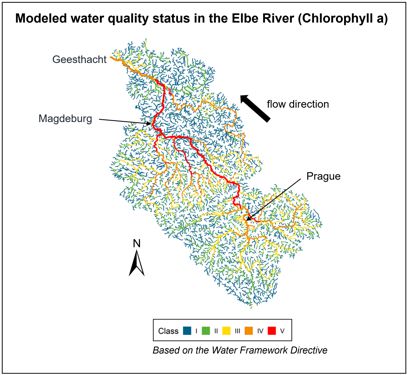
Eutrophication persists in many freshwater systems despite extensive efforts to control nutrient emissions from point and diffuse sources. While intensely studied at local or regional scales, the joint response of benthic and pelagic algae to nutrient loading across entire river networks remains poorly understood. Here, we assessed spatial patterns of pelagic and benthic algal biomass in response to point source and diffuse phosphorus loading in the Elbe River Basin, a temperate, transboundary river network, based on extensive monitoring data and with the parsimonious hydro-ecological model CnANDY (Coupled Complex Algal-Nutrient Dynamics). We referenced our simulations to median river discharge data and phosphorus inputs from point (1,900 wastewater treatment plants) and diffuse sources, determined with the MoRE model and CORINE land cover analysis. We found distinct spatial eutrophication patterns across the river network and complex responses to local and cumulative anthropogenic nutrient emissions. Lower stream orders, particularly those in urban and agricultural areas, showed the highest dissolved phosphorus concentration and benthic algae density. Conversely, pelagic algae dominated higher stream orders, influenced by nutrient transport from lower-order streams to downstream reaches. The validated CnANDY model effectively identified eutrophication hotspots, enabling prioritized nutrient and eutrophication management. Although extensive monitoring data were available, systematic gaps in established monitoring schemes limited the model calibration and validation. Therefore, we advocate for a revision and propose model-aided eutrophication monitoring at the river basin scale with representative coverage of all stream orders from up to downstream and the algal biomass in the benthic and pelagic compartments.
From Iron Curtain to green belt: shift from heterotrophic to autotrophic nitrogen retention in the Elbe River over 35 years of passive restoration
Wachholz, A., Jawitz, J.W., Borchardt, D. (2024) Biogeosciences 21 (15), 3537 - 3550 10.5194/bg-21-3537-2024
![Time series of nitrogen turnover for the periods before and after the breakdown of the Iron Curtain in 1990. The colors indicate the share of the heterotrophic and autotrophic nitrogen demand. F(AUT) is the fraction of turnover caused by autotrophic nitrogen demand [%]. The black lines separate three phases of heterotrophic dominance, transition and todays autotrophic regime.](/export/data/2/291832_wachholz.jpg "Time series of nitrogen turnover for the periods before and after the breakdown of the Iron Curtain in 1990. The colors indicate the share of the heterotrophic and autotrophic nitrogen demand. F(AUT) is the fraction of turnover caused by autotrophic nitrogen demand [%]. The black lines separate three phases of heterotrophic dominance, transition and todays autotrophic regime.")
We analyzed a multidecadal time series of nitrogen in the Elbe River between 1978 and 2020 and developed a metabolic demand model to explain trends in dissolved inorganic nitrogen (DIN) retention, gross primary production (GPP), and ecosystem respiration (ER) before and after the break down of the Iron Curtain. Our findings reveal a marked increase in summer DIN retention and a decrease in winter DIN retention, establishing a distinct seasonal pattern. We identified three distinct periods in the Elbe’s DIN retention dynamics: dominantly heterotrophic under high organic and inorganic pollution pressure (1980–1990), transition (1990–2003), and dominantly autotrophic with lower pollution (2003–2017). We link these changes to reduced industrial pollution, improved wastewater treatment, and a shift in the in-stream balance between heterotrophic and autotrophic metabolism. During the first period, high ER caused elevated nitrogen turnover, primarily driven by heterotrophic processes. As pollution from industrial and wastewater emissions decreased, GPP rates increased and ER gradually declined, prompting a shift towards an autotrophic dominated nitrogen retention regime. Our study indicates tight coupling of nutrient reduction from external sources and dominant processes of natural attenuation in large rivers.
Multi-decadal groundwater observations reveal surprisingly stable levels in southwestern Europe
Chávez García Silva, R., Reinecke, R., Copty, N.K., Barry, D.A., Heggy, E., Labat, D., Roggero, P.P., Borchardt, D., Rode, M., Gómez-Hernández, J.J., Jomaa, S., 2024. Commun. Earth Environ. 5 , art. 387
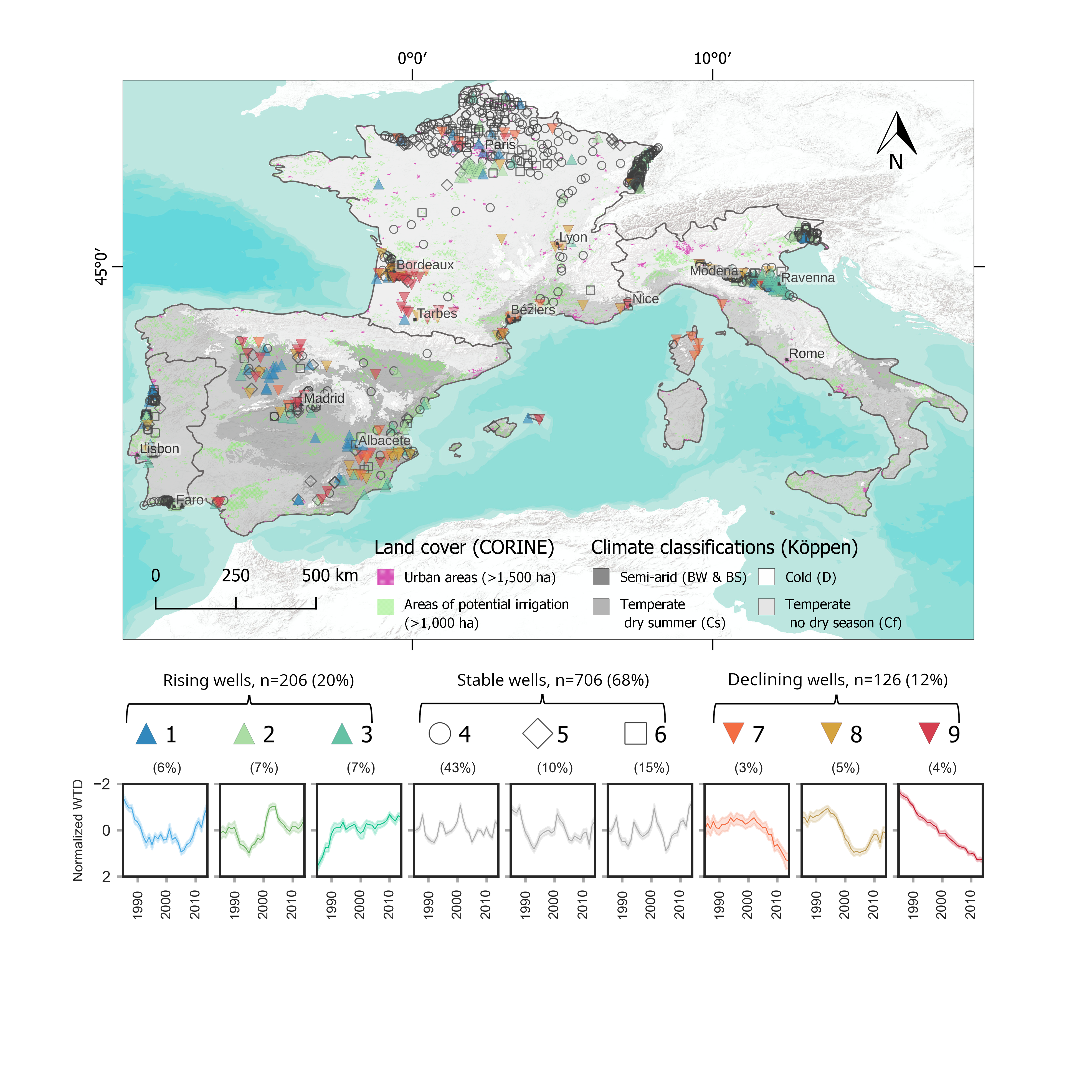
Groundwater is a vital freshwater resource for domestic use, agriculture production, and diverse ecosystems services in southwestern Europe. Despite increasing concerns about water scarcity in the region due to climate change and human activity, our study surprisingly shows that groundwater levels in Portugal, Spain, France, and Italy have remained stable overall in the past decades. Multi-decadal groundwater level data from over 12,000 wells revealed that 20% of wells showed rising levels, 68% were stable, and only 12% were declining. Rising levels are often due to improved groundwater management and higher precipitation in some areas, while declines are linked to agricultural use and urbanization. Our findings highlight the importance of long-term and systematic groundwater monitoring to understand these trends and to manage this vital resource sustainably.
Consistent stoichiometric long-term relationships between nutrients and chlorophyll-a across shallow lakes
Graeber, D., McCarthy, M.J., Shatwell, T., Borchardt, D., Jeppesen, E., Søndergaard, M., Lauridsen, T.L., Davidson, T.A., 2024. Nat Commun 15, art. 809.
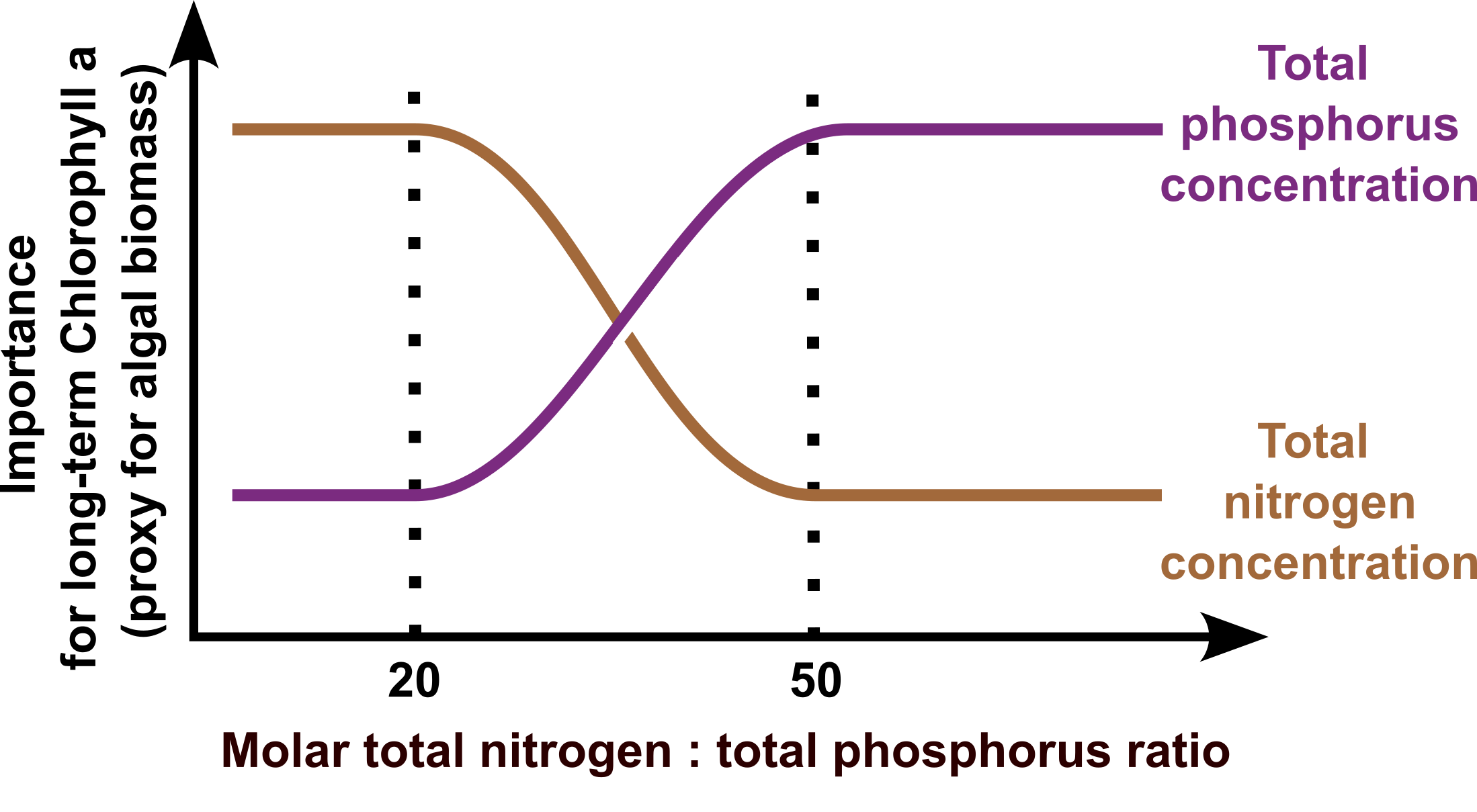
Too many nutrients are entering the water of many shallow lakes, leading to their over-fertilization, a phenomenon known as eutrophication. We now demonstrate a clear connection between the amount of nutrients in the water and the amount of Chlorophyll a – an indicator of algal biomass. However, this connection only becomes apparent when the ratio and concentration of both nitrogen and phosphorus are taken into account. Additionally, the relationship between the nutrients and Chlorophyll a significantly improves when data over a longer period of 5 years is analyzed. According to our analysis, the remaining differences in the fluctuation of Chlorophyll a between the lakes are due to other environmental variables, not nitrogen and phosphorus. Shallow lakes constitute around 89% of all lakes worldwide, and our findings clearly indicate that targeted, long-term control of the ratio and concentrations of nitrogen and phosphorus can be a sustainable strategy for the management of these lakes.
Complete publication list
Index:
You could use our publication index for further requests.
2026 (18)
- Agyekum, M.K., Brazao Protazio, J.M., Staquet, A., Augusseau, P.-E., Gardel, A., Mury, A., Anthony, E.J., Proisy, C. (2026):
Mangrove growth and biomass dynamics along the mud-dominated coast of French Guiana
Sci. Rep. 16 , art. 15869
10.1038/s41598-026-53756-1 - Agyekum, M.K., Protazio, J.M.B., Staquet, A., Augusseau, P.-E., Gardel, A., Mury, A., Anthony, E., Proisy, C. (2026):
Growth and biomass dynamics of French Guiana mangrove stands
Zenodo
10.5281/zenodo.18337681 - Agyekum, M.K., Riascos, J.M. (2026):
Evaluating the role of the understory mangrove fern Acrostichum aureum in mangrove sediment organic matter and carbon dynamics
Sci. Rep. 16 , art. 20982
10.1038/s41598-026-60454-5 - Agyekum, M.K., Riascos, J.M. (2026):
Raw data and analysis outputs for a fern‑litter manipulation experiment in a neotropical mangrove forest (Bahía Málaga, Colombia) [Dataset]
Zenodo
10.5281/zenodo.18807835 - Aydın, C.İ., Gündüz, İ.R., Çetinkaya, İ.D., Anyfanti, I.V., Belloulid, M.O., Godoy, V.A., Hamidan, N., Roggero, P.P., Rouhani, A., Soussi, I., Jomaa, S. (2026):
A multi-site assessment of nature's contributions to people in Mediterranean region
Environ. Res. Commun. 8 (10), art. 101001
10.1088/2515-7620/aeaad3 - Ben-Salem, N., Rouhani, A., Copty, N.K., Varouchakis, E.A., Gómez-Hernández, J.J., Karatzas, G.P., Rode, M., Jomaa, S. (2026):
The role of secondary data in estimating groundwater levels in the Iberian Peninsula
Groundwater Sustain. Dev. 33 , art. 101594
10.1016/j.gsd.2026.101594 - Farias, L., Martínez-López, N., García, M.R., Rode, M., Schäfer, R.B., Yen Le, T.T. (2026):
Mechanistic prediction of dissolved oxygen concentrations in surface water considering the influence of salinity and temperature
Hydrol. Res. 57 (4), 643 - 675
10.2166/nh.2026.074 - Fouad, S.S., Heggy, E., Amrouni, O., Hzami, A., Nijhuis, S., Mohamed, N., Saleh, I.H., Jomaa, S., Elsheshtawy, Y., Weilacher, U. (2026):
Reply to comment by Darwish on “Soaring building collapses in southern Mediterranean coasts: Hydroclimatic drivers and adaptive landscape mitigations”
Earth Future 14 (3), e2025EF007826
10.1029/2025EF007826 - Herzschuh, U., Weiß, J.F., Schild, L., Kühn, I., Kapsch, M.-L., Zimmermann, H.H., Stoof-Leichsenring, K.R., Sachse, D., Borchardt, D. (2026):
Riverine woodlands as a dynamic source of the marine sedimentary carbon sink
PNAS Nexus 5 (7), pgag229
10.1093/pnasnexus/pgag229 - Jiang, S., Rao, W., Li, T., Song, Z., Li, Z., Li, X., Rode, M. (2026):
Identification of transformation and sources of nitrate in a typical agricultural river of South-Central China using hydrochemistry, multiple isotopes and Bayesian model
J. Environ. Manage. 404 , art. 129426
10.1016/j.jenvman.2026.129426 - Jiang, S., Werner, A.D., Gao, L., Rode, M. (2026):
Climate change expected to amplify land-use change impacts on nitrogen export from a subtropical catchment in China
J. Hydrol. 667 , art. 134888
10.1016/j.jhydrol.2025.134888 - Mwanake, R.M., Wangari, E.G., Graeber, D., Kiese, R. (2026):
Diverging riverine dissolved C:N:P ratios under global environmental change
npj Clean Water 9 , art. 46
10.1038/s41545-026-00596-1 - Pasqualini, J., Anlanger, C., Mendoza-Lera, C., Fink, P., Lorke, A., Weitere, M., Nunes da Rocha, U., Knöller, K., Meador, T., Brauns, M. (2026):
Low-head dam removal restores biofilm structure but not function in a temperate stream
Int. Rev. Hydrobiol. 111 (1), e70027
10.1002/iroh.70027 - Renison, D., Rodriguez, J.M., Costas, S., Heinemann, N., Hensen, I. (2026):
Ant pruning and weak tussock facilitation jointly shape planted sapling performance along an elevation gradient
For. Ecol. Manage. 618 , art. 123965
10.1016/j.foreco.2026.123965 - Rojas-Gómez, K.L., Benisch, J., Helm, B., Borchardt, D., Krebs, P. (2026):
Monitoring data to explore particle size distribution and elemental composition in a stormwater outlet from a German urban catchment
Data Brief 65 , art. 112581
10.1016/j.dib.2026.112581 - Rojas-Gómez, K.L., Benisch, J., Helm, B., Borchardt, D., Krebs, P. (2026):
Identifying flush and transport patterns driving particle export and elemental composition of stormwater from a German urban catchment
J. Hydrol. Reg. Stud. 64 , art. 103196
10.1016/j.ejrh.2026.103196 - Secci, D., Todaro, V., D’Oria, M., Jomaa, S., Tanda, M.G. (2026):
Multi-site evaluation of historical climate records and CMIP6 projections across the Mediterranean
J. Hydrol. Reg. Stud. 66 , art. 103713
10.1016/j.ejrh.2026.103713 - Vozinaki, A.-E.K., Anyfanti, I.V., Karatzas, G.P., Varouchakis, E.A., Ceseracciu, C., Branca, G., Deriu, R., Roggero, P.P., Cetinkaya, I.D., Aydın, C.İ., Copty, N., Jomaa, S. (2026):
Sustainable water governance: insights from Living Lab experiences
Water Resour. Manag. 40 (1), art. 10
10.1007/s11269-025-04383-4
Index:
You could use our publication index for further requests.
Text Publication
Articles in ISI listed journals (35)
- Agyekum, M.K., Pathak, D., Kindinger, A., Kumar, R., Borchardt, D., Weitere, M., Frank, K., Schmitt-Jansen, M., Büttner, O., Brauns, M., Fink, P., Scharfenberger, U. (2025):
A hydrologically informed agricultural land use intensity index for assessing ecological impacts on streams and rivers
Commun. Earth Environ. 6 , art. 991
10.1038/s43247-025-02933-7 - Agyekum, M.K., Zimmer, M., MacKay, F., Weerts, S., Helfer, V. (2025):
Spatial and temporal patterns of mangrove forest canopy gaps at the southern distribution limit
Bull. Mar. Sci. 101 (3), 1161 - 1175
10.5343/bms.2023.0165 - Andersen, I.M., Taylor, J.M., Graeber, D., Kelly, P.T., Hoke, A.K., Robbins, C.J., Scott, J.T. (2025):
Redfield revisited: Insights into freshwater seston carbon : nitrogen : phosphorus stoichiometry
Limnol. Oceanogr. 70 (S2), S14 - S26
10.1002/lno.70133 - Boyen, J., Rodríguez, M.T., Vlaeminck, B., Fink, P., Hablützel, P.I., De Troch, M. (2025):
Temperature, pH, and diet interactively affect biosynthesis of polyunsaturated fatty acids in a benthic harpacticoid copepod
Limnol. Oceanogr. 70 (2), 334 - 348
10.1002/lno.12763 - Brown, L.E., Maavara, T., Zhang, J., Chen, X., Klaar, M., Moshe, F.O., Ben-Zur, E., Stein, S., Grayson, R., Carter, L., Levintal, E., Gal, G., Ziv, P., Tarkowski, F., Pathak, D., Khamis, K., Barquín, J., Philamore, H., Gradilla-Hernández, M.S., Arnon, S. (2025):
Integrating sensor data and machine learning to advance the science and management of river carbon emissions
Crit. Rev. Environ. Sci. Technol. 55 (9), 600 - 623
10.1080/10643389.2024.2429912 - Cao, Y., Scharfenberger, U., Shatwell, T., Adrian, R., Agasild, H., Angeler, D.G., Beklioğlu, M., Çakıroğlu, A.I., Hejzlar, J., Papastergiadou, E., Šorf, M., Stefanidis, K., Søndergaard, M., Zingel, P., Jeppesen, E. (2025):
Predicting daily net ecosystem production in shallow lakes from dissolved oxygen saturation levels: a pan-European mesocosm experiment and modelling approach
Hydrobiologia 852 (2), 471 - 487
10.1007/s10750-024-05714-z - Castelli, G., Howard, B.C., Adyel, T.M., AghaKouchak, A., Agramont, A., Aksoy, H., Alba, R., Alencar, P.H.L., Amanambu, A.C., Aslam, H., Bharati, L., Bos-Burgering, L., Bresci, E., Caramiello, C., Cavus, Y., Chaudhari, K., Chifflard, P., Choukrani, H., Chun, K.P., Cudennec, C., Cumiskey, L., Dakhlaoui, H., De Angeli, S., de Brito, M.M., Dembelé, M., Dewals, B., Elshenawy, A., Gwapedza, D., Hall, C., Hermans, L., Höllermann, B., Jaramillo, F., Jomaa, S., Koren, G., Krause, S., Lahsaini, M., Mahé, G., Manfreda, S., Maynard, C., Merheb, M., Nóbrega, R.L.B., Ocampo-Melgar, A., Olusola, A., Orduna Alegria, M.E., Owusu, A., Pacetti, T., Panchanathan, A., Panda, S., Piemontese, L., Pradhananga, D., Shobha Ajin, R., Rusca, M., Scolobig, A., Thaler, T., Tran, B.N., Triml-Chifflard, D., Vanelli, F.M., Villani, L., Walker, D.W., Zarif, F., Buytaert, W., Ceperley, N. (2025):
Co-creating water knowledge: a community perspective
Hydrol. Sci. J.-J. Sci. Hydrol. 70 (16), 2899 - 2919
10.1080/02626667.2025.2571065 - Ceseracciu, C., Nguyen, T.P.L., Deriu, R., Branca, G., Vozinaki, A.-E.K., Karatzas, G.P., Mellah, T., Akrout, H., Yıldırım, Ü., Kurt, M.A., Jomaa, S., Carletti, A., Roggero, P.P. (2025):
Innovative governance for sustainable management of Mediterranean coastal aquifers: Evidence from Sustain‐COAST living labs
Environ. Sci. Policy 167 , art. 104038
10.1016/j.envsci.2025.104038 - Coder, L., Musolff, A., Kronsbein, P.M., Knöller, K., Büttner, O., Rinke, K., Tittel, J. (2025):
How anthropogenic modification of riverscapes reduces the resilience of floodplain water bodies to drought
Ecol. Eng. 219 , art. 107686
10.1016/j.ecoleng.2025.107686 - Dordoni, M., Musolff, A., Knöller, K., Coder, L., Krauss, M., Rosenlöcher, Y., Büttner, O., Tittel, J. (2025):
Lake–groundwater biogeochemical interactions in a river-delimited system: the Groundwater and Lakes Urban Observatory (GLUO)
Int. Rev. Hydrobiol. 110 (2), 123 - 150
10.1002/iroh.70025 - Fouad, S.S., Heggy, E., Amrouni, O., Hzami, A., Nijhuis, S., Mohamed, N., Saleh, I.H., Jomaa, S., Elsheshtawy, Y., Weilacher, U. (2025):
Soaring building collapses in Southern Mediterranean coasts: hydroclimatic drivers & adaptive landscape mitigations
Earth Future 13 (2), e2024EF004883
10.1029/2024EF004883 - Große, A., Graeber, D., Fink, P., Reisinger, A.J., Kamjunke, N., Meyer, M., Ilić, M., Borchardt, D., Perujo, N. (2025):
Contrasting functional responses of benthic and hyporheic stream biofilms to light availability and macronutrient stoichiometry
Limnol. Oceanogr. 70 (S2), S126 - S139
10.1002/lno.70069 - Große, A., Perujo, N., Fink, P., Reisinger, A.J., Borchardt, D., McCarthy, M.J., Graeber, D. (2025):
Stream C to N to P ratios aligned with microbial needs enhance biofilm nitrate uptake and subsequent nitrogen loss
Biogeochemistry 168 (4), art. 62
10.1007/s10533-025-01252-5 - Heinemann, N., Yang, S., Büttner, O., Borchardt, D. (2025):
Nutrient loading and stream order shape benthic and pelagic spring algal biomass in a large, temperate river basin (Elbe River)
J. Environ. Manage. 383 , art. 125440
10.1016/j.jenvman.2025.125440 - Huang, J., Borchardt, D., Rode, M. (2025):
Changes in water quality and ecosystem processes at extreme summer low flow of 2018 with high-frequency sensors
Hydrol. Earth Syst. Sci. 29 (20), 5835 - 5849
10.5194/hess-29-5835-2025 - Khaliq, S., Schlenker, A., Kümmel, S., Höhn, D., Jochmann, M.A., Kerpen, K., Fink, P., Weitere, M., Schmidt, T.C. (2025):
Spatial and temporal patterns of Gammarus sp. in lowland streams analyzed through amino acid isotope analysis
Int. Rev. Hydrobiol. 110 (2), 151 - 165
10.1002/iroh.70024 - Leng, P., Rode, M., Koschorreck, M. (2025):
Summer drought enhances diurnal amplitude of CO2 in two German rivers of different size
Water Res. 271 , art. 122870
10.1016/j.watres.2024.122870 - Li, Y., Yang, X., Lischeid, G., Wollheim, W.M., Jomaa, S., Zhou, X., Rode, M. (2025):
Responses of wetted river network contraction and expansion dynamics to prolonged drought
Water Resour. Res. 61 (6), e2024WR038938
10.1029/2024WR038938 - Macaulay, S.J., Jeppesen, E., Riebesell, U., Nejstgaard, J.C., Berger, S.A., Lewandowska, A.M., Rico, A., Kefford, B.J., Vad, C.F., Costello, D.M., Wang, H., Pimentel, I.M., Barcelos e Ramos, J., González, J., Spilling, K., de Senerpont Domis, L., Boersma, M., Stockenreiter, M., Meerhoff, M., Vijver, M.G., Kelly-Quinn, M., Beklioğlu, M., Matias, M.G., Sswat, M., Juvigny-Khenafou, N.P.D., Fink, P., Zhang, P., Taniwaki, R.H., Ptacnik, R., Langenheder, S., Nederstigt, T.A.P., Horváth, Z., Piggott, J.J. (2025):
Addressing grand ecological challenges in aquatic ecosystems: how can mesocosms be used to advance solutions?
Oikos 2025 (5), e11020
10.1111/oik.11020 - Meyer, M., Koschorreck, M., Weitere, M., Kneis, D., Graeber, D., Perujo, N. (2025):
Local controls rather than short-term drought regulate microbial phosphorus and greenhouse gas dynamics in floodplain sediments
Biogeochemistry 168 (6), art. 98
10.1007/s10533-025-01295-8 - Miglino, D., Jomaa, S., Rode, M., Saddi, K.C., Isgrò, F., Manfreda, S. (2025):
Technical note: Image processing for continuous river turbidity monitoring – full-scale tests and potential applications
Hydrol. Earth Syst. Sci. 29 (17), 4133 - 4151
10.5194/hess-29-4133-2025 - Minaudo, C., Abonyi, A., Alcaraz, C., Diamond, J., Howden, N.J.K., Rode, M., Romero, E., Thieu, V., Worrall, F., Zhang, Q., Benito, X. (2025):
OLIGOTREND, a global database of multi-decadal chlorophyll a and water quality time series for rivers, lakes, and estuaries
Earth Syst. Sci. Data 17 (7), 3411 - 3430
10.5194/essd-17-3411-2025 - Ni, X., Dong, Z., Jia, W., Wang, W., Xie, W., Yao, H., Chen, M., Zhang, T., Li, Z. (2025):
A novel method for measuring interaction among multiple objectives in reservoir operation using niche theory
Water Sci. Eng. 18 (1), 78 - 89
10.1016/j.wse.2024.03.002 - Pasqualini, J., Majdi, N., Weitere, M., Brauns, M. (2025):
The contribution of the hyporheos to whole-stream invertebrate secondary production
Freshw. Sci. 44 (2), 170 - 186
10.1086/735823 - Perujo, N., Graeber, D., Fink, P., Neuert, L., Sunjidmaa, N., Weitere, M. (2025):
Bioavailable dissolved organic carbon serves as a key regulator of phosphorus dynamics in stream biofilms
Environ. Microbiol. Rep. 17 (3), e70115
10.1111/1758-2229.70115 - Rasmussen, J.J., Bundschuh, M., Jensen, T.M., Wiberg-Larsen, P., Baattrup-Pedersen, A., Friberg, N., Graeber, D. (2025):
Multiple stressor effects act primarily on microbial leaf decomposers in stream mesocosms
Sci. Total Environ. 958 , art. 178065
10.1016/j.scitotenv.2024.178065 - Rouhani, A., Ben-Salem, N., D'Oria, M., Chávez García Silva, R., Viglione, A., Copty, N.K., Rode, M., Barry, D.A., Gómez-Hernández, J.J., Jomaa, S. (2025):
Direct impact of climate change on groundwater levels in the Iberian Peninsula
Sci. Total Environ. 970 , art. 179009
10.1016/j.scitotenv.2025.179009 - Rozemeijer, J., Jordan, P., Hooijboer, A., Kronvang, B., Glendell, M., Hensley, R., Rinke, K., Stutter, M., Bieroza, M., Turner, R., Mellander, P.E., Thorburn, P., Cassidy, R., Appels, J., Ouwerkerk, K., Rode, M. (2025):
Best practice in high-frequency water quality monitoring for improved management and assessment; a novel decision workflow
Environ. Monit. Assess. 197 (4), art. 353
10.1007/s10661-025-13795-z - Sarwar, A.N., Caramiello, C., Pugliese, F., Jomaa, S., Guelmami, A., Ronse, M., Roggero, P.P., Marrone, N., De Paola, F., Cetinkaya, I.D., Copty, N.K., Rode, M., Manfreda, S. (2025):
A framework for selecting Nature-based Solutions: applications and challenges at the catchment scale
J. Environ. Manage. 394 , art. 127220
10.1016/j.jenvman.2025.127220 - Sauke, F., Fischer, R., Rode, M. (2025):
A review on modelling forest biogeochemistry and the coupled forest - soil interactions in a changing world
Environ. Modell. Softw. 187 , art. 106381
10.1016/j.envsoft.2025.106381 - Schäfer, R.B., Baikova, D., Bayat, H.S., Beermann, A.J., Berger, S.A., Boenigk, J., Brauns, M., Burfeid-Castellanos, A., Cardinale, B.J., David, G.M., Feckler, A., Feld, C.K., Fink, P., Gessner, M.O., Hadziomerovic, U., Hering, D., Yen Le, T.T., Macaulay, S.J., Medina Madariaga, G., Mayombo, N.A.S., Pimentel, I.M., Orr, J.A., Osakpolor, S., Schlenker, A., Sures, B., Vermiert, A.-M., Vos, M., Weitere, M., Schürings, C. (2025):
Effects of biodiversity loss on freshwater ecosystem functions increase with the number of stressors
Glob. Change Biol. 31 (11), e70617
10.1111/gcb.70617 - Stockenreiter, M., Hammerstein, S., Ilić, M., Titocci, J., Fink, P., Stibor, H. (2025):
Mesocosm studies linking phytoplankton diversity and zooplankton nutrition: The role of essential fatty acids in complex natural communities
Limnol. Oceanogr. 70 (S2), S84 - S98
10.1002/lno.70252 - Sunjidmaa, N., Mendoza-Lera, C., Pasqualini, J., Fink, P., Bartusch, A., Borchardt, D., Jähkel, A., Graeber, D. (2025):
Correction to: Irradiance and biofilm age control daytime and nighttime macronutrient cycling in stream mesocosms
Biogeochemistry 168 (2), art. 42
10.1007/s10533-025-01227-6 - Sunjidmaa, N., Mendoza-Lera, C., Pasqualini, J., Fink, P., Bartusch, A., Borchardt, D., Jähkel, A., Graeber, D. (2025):
Irradiance and biofilm age control daytime and nighttime macronutrient cycling in stream mesocosms
Biogeochemistry 168 (2), art. 25
10.1007/s10533-025-01215-w - Weichert, F.G., Inostroza, P.A., Ahlheim, J., Backhaus, T., Brack, W., Brauns, M., Fink, P., Krauss, M., Svedberg, P., Hollert, H. (2025):
AI-aided chronic mixture risk assessment along a small European river reveals multiple sites at risk and pharmaceuticals being the main risk drivers
Environ. Int. 197 , art. 109370
10.1016/j.envint.2025.109370
Articles in other journals (not listed in ISI) (1)
- Chávez García Silva, R., Reinecke, R., Copty, N.K., Barry, D.A., Heggy, E., Labat, D., Roggero, P.P., Borchardt, D., Rode, M., Gómez-Hernández, J.J., Jomaa, S. (2025):
Grundwasserbeobachtungen über mehrere Dekaden zeigen überraschend stabile Werte in Südwesteuropa
KW Korrespondenz Wasserwirtschaft 18 (2), 96 - 108
10.3243/kwe2025.02.003
Book chapters (1)
- Tittel, J., Coder, L., Büttner, O., Knöller, K., Kronsbein, P.M., Rinke, K., Musolff, A. (2025):
Anthropogenic modification of riverscapes reduces the resilience of floodplain water bodies to drought
Wasserbewirtschaftung im Einzugsgebiet der Elbe gestern, heute und morgen ~ Tagungsband. Magdeburger Gewässerschutzseminar 2025 = Magdeburský seminář o ochraně vod 2025, 8.-9.10.2025
Internationale Kommission zum Schutz der Elbe (IKSE), Magdeburg, p. 21
Reports (1)
- Büttner, O., Halle, M., Müller, A., Schmidt, C., Merz, R., Bärlund, I., Borchardt, D. (2025):
LAWA (Dezember 2025): Entwicklung von Schwellenwerten und Methoden zur Niedrigwasserbewertung
in Fließgewässern und zur Identifizierung von vulnerablen Fließgewässerabschnitten
LAWA LFP O2.24
Bund/Länder-Arbeitsgemeinschaft Wasser (LAWA), Berlin, XII, 84 S.
Data Publication (8)
- Agyekum, M.K., Pathak, D., Büttner, O., Scharfenberger, U. (2025):
Land use intensity index for stream ecosystems (LUIS)
Zenodo
10.5281/zenodo.15170942 - Agyekum, M.K., Pathak, D., Büttner, O., Scharfenberger, U. (2025):
Land Use Intensity Index for Stream Ecosystems (LUIS) datasets for Germany, 2017
Zenodo
10.5281/zenodo.17204506 - Andersen, I.M., Taylor, J.M., Kelly, P.T., Graeber, D., Hoke, A.K., Scott, J.T., Robbins, C.J. (2025):
Redfield revisited: insights into freshwater seston C:N:P stoichiometry [dataset]
figshare
10.6084/m9.figshare.28102916 - Große, A., Perujo, N., Fink, P., Reisinger, A.J., Borchardt, D., McCarthy, M.J., Graeber, D. (2025):
Stream C to N to P ratios aligned with microbial needs enhance biofilm nitrate uptake and subsequent nitrogen loss [dataset]
Zenodo
10.5281/zenodo.15882502 - Li, Y. (2025):
Field observation of river dryness and wetness [Data set]
Zenodo
10.5281/zenodo.14849719 - Macaulay, S.J., Jeppesen, E., Riebesell, U., Nejstgaard, J.C., Berger, S.A., Lewandowska, A.M., Rico, A., Kefford, B.J., Vad, C.F., Costello, D.M., Wang, H., Pimentel, I.M., Barcelos e Ramos, J., González, J., Spilling, K., de Senerpont Domis, L., Boersma, M., Stockenreiter, M., Meerhoff, M., Vijver, M.G., Kelly-Quinn, M., Beklioğlu, M., Matias, M.G., Sswat, M., Juvigny-Khenafou, N.P.D., Fink, P., Zhang, P., Taniwaki, R.H., Ptacnik, R., Langenheder, S., Nederstigt, T.A.P., Horváth, Z., Piggott, J.J. (2025):
Data from: Addressing grand ecological challenges in aquatic ecosystems: How can mesocosms be used to advance solutions? [Dataset]
Dryad
10.5061/dryad.jm63xsjn0 - Meyer, M., Koschorreck, M., Weitere, M., Kneis, D., Graeber, D., Perujo, N. (2025):
Local controls rather than short-term drought regulate microbial phosphorus and greenhouse gas dynamics in floodplain sediments [Data set]
Zenodo
10.5281/zenodo.16117586 - Rojas-Gómez, K.L., Benisch, J., Helm, B., Borchardt, D., Krebs, P. (2025):
Monitoring data to explore particle size distribution and elemental composition in a stormwater outlet from a German urban catchment [dataset]
OPARA
10.25532/OPARA-1052
Software Publication (2)
- Huang, J. (2025):
Diurnal metrics
Version: v1 Zenodo
10.5281/zenodo.17435921 - Li, Y. (2025):
Coupling interface of mHM and MODFLOW
Version: 1.0 Zenodo
10.5281/zenodo.14847216
Index:
You could use our publication index for further requests.
Text Publication
Articles in ISI listed journals (28)
- Abbas, G., Jomaa, S., Fink, P., Brosinsky, A., Nowak, K.M., Kümmel, S., Schkade, U.-K., Rode, M. (2024):
Investigating sediment sources using compound-specific stable isotopes and conventional fingerprinting methods in an agricultural loess catchment
Catena 246 , art. 108336
10.1016/j.catena.2024.108336 - Bouwman, A.F., Bärlund, I., Beusen, A.H.W., Flörke, M., Gramberger, M., Rivera Cardona, J., Podgorski, J., van den Roovaart, J., Grizzetti, B., Janssen, A.B.G., Kumar, R., Langan, S., Poikane, S., Spears, B.M., Strokal, M., Tang, T., Troost, T.A., Vigiak, O., van Vliet, M.T.H., Vystavna, Y., Wang, M., Hofstra, N. (2024):
Multimodel and multiconstituent scenario construction for future water quality
Environ. Sci. Technol. Lett. 11 (12), 1272 - 1280
10.1021/acs.estlett.4c00789 - Chávez García Silva, R., Reinecke, R., Copty, N.K., Barry, D.A., Heggy, E., Labat, D., Roggero, P.P., Borchardt, D., Rode, M., Gómez-Hernández, J.J., Jomaa, S. (2024):
Multi-decadal groundwater observations reveal surprisingly stable levels in southwestern Europe
Commun. Earth Environ. 5 , art. 387
10.1038/s43247-024-01554-w - Chen, M., Jomaa, S., Lausch, A., Beudert, B., Ghaffar, S., Jia, W., Rode, M. (2024):
Impact of forest dieback on hydrology and nitrogen export using a new dynamic water quality model
Water Resour. Res. 60 (11), e2024WR037341
10.1029/2024wr037341 - Collenteur, R.A., Haaf, E., Bakker, M., Liesch, T., Wunsch, A., Soonthornrangsan, J., White, J., Martin, N., Hugman, R., de Sousa, E., Vanden Berghe, D., Fan, X., Peterson, T.J., Bikše, J., Di Ciacca, A., Wang, X., Zheng, Y., Nölscher, M., Koch, J., Schneider, R., Benavides Höglund, N., Chidepudi, S.K.R., Henriot, A., Massei, N., Jardani, A., Rudolph, M.G., Rouhani, A., Gómez-Hernández, J.J., Jomaa, S., Pölz, A., Franken, T., Behbooei, M., Lin, J., Meysami, R. (2024):
Data-driven modelling of hydraulic-head time series: results and lessons learned from the 2022 Groundwater Time Series Modelling Challenge
Hydrol. Earth Syst. Sci. 28 (23), 5193 - 5208
10.5194/hess-28-5193-2024 - Demars, B.O.L., Schneider, S.C., Thiemer, K., Dörsch, P., Pulg, U., Stranzl, S., Velle, G., Pathak, D. (2024):
Light and temperature controls of aquatic plant photosynthesis downstream of a hydropower plant and the effect of plant removal
Sci. Total Environ. 912 , art. 169201
10.1016/j.scitotenv.2023.169201 - Escher, B.I., Ahlheim, J., Böhme, A., Borchardt, D., Brack, W., Braun, G., Colbourne, J.K., Dann, J.P., Gessner, J., Jahnke, A., König, M., Klüver, N., Krauss, M., Lee, J., Li, X., Lips, S., Orsini, L., Rinke, K., Schmitt-Jansen, M., Scholz, S., Schulze, T., Spahr, S., Ulrich, N., Weitere, M., Varga, E. (2024):
Mixtures of organic micropollutants exacerbated in vitro neurotoxicity of prymnesins and contributed to aquatic toxicity during a toxic algal bloom
Nat. Water 2 (9), 889 - 898
10.1038/s44221-024-00297-4 - Finckh, S., Carmona, E., Borchardt, D., Büttner, O., Krauss, M., Schulze, T., Yang, S., Brack, W. (2024):
Mapping chemical footprints of organic micropollutants in European streams
Environ. Int. 183 , art. 108371
10.1016/j.envint.2023.108371 - Ghaffar, S., Zhou, X., Jomaa, S., Yang, X., Meon, G., Rode, M. (2024):
Toward a data-effective calibration of a fully distributed catchment water quality model
Water Resour. Res. 60 (9), e2023WR036527
10.1029/2023wr036527 - Graeber, D., McCarthy, M.J., Shatwell, T., Borchardt, D., Jeppesen, E., Søndergaard, M., Lauridsen, T.L., Davidson, T.A. (2024):
Consistent stoichiometric long-term relationships between nutrients and chlorophyll-a across shallow lakes
Nat. Commun. 15 , art. 809
10.1038/s41467-024-45115-3 - Hildebrandt, S., Krueger, E.H., Ruhl, A.S., Borchardt, D. (2024):
Efficacy of point source legislation quantified for a 64-year river water quality trajectory of phosphorus loading
J. Environ. Manage. 352 , art. 119956
10.1016/j.jenvman.2023.119956 - Jia, W., Chen, M., Yao, H., Wang, Y., Wang, S., Ni, X. (2024):
Improving sub-daily runoff forecast based on the multi-objective optimized extreme learning machine for reservoir operation
Water Resour. Manag. 38 (15), 6173 - 6189
10.1007/s11269-024-03953-2 - Koschorreck, M., Kamjunke, N., Koedel, U., Rode, M., Schuetze, C., Bussmann, I. (2024):
Diurnal versus spatial variability of greenhouse gas emissions from an anthropogenically modified lowland river in Germany
Biogeosciences 21 (6), 1613 - 1628
10.5194/bg-21-1613-2024 - Manfreda, S., Miglino, D., Saddi, K.C., Jomaa, S., Eltner, A., Perks, M., Peña-Haro, S., Bogaard, T., van Emmerik, T.H.M., Mariani, S., Maddock, I., Tauro, F., Grimaldi, S., Zeng, Y., Gonçalves, G., Strelnikova, D., Bussettini, M., Marchetti, G., Lastoria, B., Su, Z., Rode, M. (2024):
Advancing river monitoring using image-based techniques: challenges and opportunities
Hydrol. Sci. J.-J. Sci. Hydrol. 69 (6), 657 - 677
10.1080/02626667.2024.2333846 - Nakulopa, F., Bärlund, I., Borchardt, D. (2024):
How a reservoir modulates downstream water quality under declining upstream loading and progressing climate change
Sci. Total Environ. 912 , art. 169460
10.1016/j.scitotenv.2023.169460 - Pasqualini, J., Graeber, D., Bartusch, A., Kümmel, S., Duran Hernandez, Z.L., Musat, N., Sunjidmaa, N., Weitere, M., Brauns, M. (2024):
Disentangling effects of multiple agricultural stressors on benthic and hyporheic nitrate uptake
Biogeochemistry 167 (3), 287 - 299
10.1007/s10533-024-01130-6 - Perujo, N., Neuert, L., Fink, P., Weitere, M. (2024):
Saturation of intracellular phosphorus uptake and prevalence of extracellular phosphorus entrapment in fluvial biofilms after long-term P pulses: Implications for river self-purification
Sci. Total Environ. 952 , art. 175976
10.1016/j.scitotenv.2024.175976 - Pilecky, M., Kämmer, S.K., Winter, K., Ptacnikova, R., Meador, T.B., Wassenaar, L.I., Fink, P., Kainz, M.J. (2024):
Compound-specific stable isotope analyses of fatty acids indicate feeding zones of zooplankton across the water column of a subalpine lake
Oecologia 205 , 325 - 337
10.1007/s00442-024-05574-3 - Rigby, K., Berdalet, E., Berglund, C., Roger, F., Steinke, M., Saha, M., Grebner, W., Brown, E., John, U., Gamfeldt, L., Fink, P., Berggren, F., Selander, E. (2024):
Direct and indirect effects of copepod grazers on community structure
J. Plankton Res. 46 (5), 515 - 524
10.1093/plankt/fbae047 - Schlenker, A., Brauns, M., Fink, P., Lorenz, A.W., Weitere, M. (2024):
Long-term recovery of benthic food webs after stream restoration
Sci. Total Environ. 923 , art. 171499
10.1016/j.scitotenv.2024.171499 - Schlenker, A., Brauns, M., Fink, P., Weitere, M. (2024):
Beyond biomass: Resource effects on primary production and consumer nutrient assimilation in streams
Freshw. Biol. 69 (10), 1353 - 1363
10.1111/fwb.14310 - Tarasova, L., Gnann, S., Yang, S., Hartmann, A., Wagener, T. (2024):
Catchment characterization: Current descriptors, knowledge gaps and future opportunities
Earth-Sci. Rev. 252 , art. 104739
10.1016/j.earscirev.2024.104739 - Titocci, J., Fink, P. (2024):
Disturbance alters phytoplankton functional traits and consequently drives changes in zooplankton life-history traits and lipid composition
Hydrobiologia 851 (1), 161 - 180
10.1007/s10750-023-05323-2 - Wachholz, A., Jawitz, J.W., Borchardt, D. (2024):
From Iron Curtain to green belt: shift from heterotrophic to autotrophic nitrogen retention in the Elbe River over 35 years of passive restoration
Biogeosciences 21 (15), 3537 - 3550
10.5194/bg-21-3537-2024 - Weichert, F.G., Brack, W., Brauns, M., Fink, P., Johann, S., Krauss, M., Hollert, H. (2024):
Dataset on target chemical and bioassay analysis - Exploring contaminants of emerging concern in a low mountain river of central Germany
Data Brief 54 , art. 110510
10.1016/j.dib.2024.110510 - Yang, X., Tetzlaff, D., Jin, J., Li, Q., Borchardt, D., Soulsby, C. (2024):
Linking terrestrial biogeochemical processes and water ages to catchment water quality: A new Damköhler analysis based on coupled modeling of isotope tracers and nitrate dynamics
Water Res. 262 , art. 122118
10.1016/j.watres.2024.122118 - Zacharias, S., Loescher, H.W., Bogena, H., Kiese, R., Schrön, M., Attinger, S., Blume, T., Borchardt, D., Borg, E., Bumberger, J., Chwala, C., Dietrich, P., Fersch, B., Frenzel, M., Gaillardet, J., Groh, J., Hajnsek, I., Itzerott, S., Kunkel, R., Kunstmann, H., Kunz, M., Liebner, S., Mirtl, M., Montzka, C., Musolff, A., Pütz, T., Rebmann, C., Rinke, K., Rode, M., Sachs, T., Samaniego, L., Schmid, H.P., Vogel, H.-J., Weber, U., Wollschläger, U., Vereecken, H. (2024):
Fifteen years of integrated Terrestrial Environmental Observatories (TERENO) in Germany: Functions, services and lessons learned
Earth Future 12 (6), e2024EF004510
10.1029/2024ef004510 - Zill, J., Perujo, N., Fink, P., Mallast, U., Siebert, C., Weitere, M. (2024):
Contribution of groundwater-borne nutrients to eutrophication potential and the share of benthic algae in a large lowland river
Sci. Total Environ. 951 , art. 175617
10.1016/j.scitotenv.2024.175617
Articles in other journals (not listed in ISI) (2)
- Fink, P. (2024):
Book review: Hildrew, A., and Giller, P. (2023). The Biology and Ecology of Streams and Rivers. Oxford University Press: Oxford. ISBN: 978-0198516101 (Hardcover) 466 p. € 124.50
Limnology and Oceanography Bulletin 33 (2), 90 - 91
10.1002/lob.10629 - Reyes-Aldana, H.E., Risse-Buhl, U., Graeber, D. (2024):
Furry engineers: How beavers can change an entire ecosystem
Front. Young Minds 12 , art. 1209980
10.3389/frym.2023.1209980
Book chapters (1)
- Borchardt, D. (2024):
Warum eine "Wasserwende" in Deutschland zwingend notwendig ist
In: Ammermüller, B., Münch, R., Schulz von Thun, F., Wagner, C., Witte, S. (Hrsg.)
Bitte Wenden. Pointierte Beiträge zu den Herausforderungen unserer Zeit
VKU, München; Berlin, S. 90 - 97
Conference papers (1)
- Musolff, A., Ledesma, J.L.J., Nguyen, V.T., Ebeling, P., Sarrazin, F., Borchardt, D., Attinger, S., Kumar, R. (2024):
Riverine nitrogen exports to the Wadden Sea – a travel time-based modelling approach
EGU General Assembly 2024, Vienna, Austria, 14–19 Apr 2024
EGUsphere
Copernicus Publications, EGU24-10273
10.5194/egusphere-egu24-10273
Data Publication (4)
- Chen, M. (2024):
The streamflow and water quality data for two catchments in the Bavarian Forest National Park, Germany [Data set]
Zenodo
10.5281/zenodo.14001652 - Dichgans, F., Schulze, T., Büttner, O., Busch, W., Schulz, C., Sachse, D., Schmidt, C. (2024):
Dataset of River Water Quality for Saxony, Germany, 1985-2023 [dataset]
PANGAEA
10.1594/PANGAEA.969111 - Jomaa, S. (2024):
Figures 1-3 and data needed to reproduce these Figures for the paper titled: Multi-decadal groundwater observations in southwestern Europe reveal largely stable levels, published by Chavez et al. (2024) in Communications Earth & Environment
figshare
10.6084/m9.figshare.26069383.v1 - Weichert, F.G., Werner, B.J., Brauns, M., Fink, P., Johann, S., Krauss, M., Hollert, H. (2024):
Chemical analysis dataset for contaminants of emerging concern and bioanalytical data for samples from a low mountain stream in Central Germany [Data set]
Zenodo
10.5281/zenodo.11114083
Index:
You could use our publication index for further requests.
Text Publication
Articles in ISI listed journals (36)
- Abbas, G., Jomaa, S., Bronstert, A., Rode, M. (2023):
Downstream changes in riverbank sediment sources and the effect of catchment size
J. Hydrol. 46 , art. 101340
10.1016/j.ejrh.2023.101340 - Adrian, R., Gsell, A.S., Shatwell, T., Scharfenberger, U. (2023):
Linking theory with empirical data: Improving prediction through mechanistic understanding of lake ecosystem complexity under global change
Fundam. Appl. Limnol. 196 (3-4), 179 - 194
10.1127/fal/2022/1457 - Ben-Salem, N., Reinecke, R., Copty, N.K., Gómez-Hernández, J.J., Varouchakis, E.A., Karatzas, G.P., Rode, M., Jomaa, S. (2023):
Mapping steady-state groundwater levels in the Mediterranean region: The Iberian Peninsula as a benchmark
J. Hydrol. 626, Part A , art. 130207
10.1016/j.jhydrol.2023.130207 - Bischoff, A.A., Kubitz, M., Ballesteros-Redondo, L., Stüeken, M., Rapp, T., Fink, P., Hagen, W., Palm, H.W. (2023):
Dynamics of fatty acids in pikeperch (Sander lucioperca) larvae and juveniles during early rearing and weaning in a commercial RAS—Implications for dietary refinement
Fishes 8 (9), art. 444
10.3390/fishes8090444 - Boenigk, J., Beisser, D., Franke, L., Klar, L., Ilić, M., Fink, P. (2023):
Differences in pigment composition and concentration between phototrophic, mixotrophic, and heterotrophic Chrysophyceae
Fottea 23 (2), 223 - 234
10.5507/fot.2023.001 - Boyen, J., Ribes-Navarro, A., Kabeya, N., Monroig, O., Rigaux, A., Fink, P., Hablützel, P., Navarro, J.C., De Troch, M. (2023):
Functional characterization reveals a diverse array of metazoan fatty acid biosynthesis genes
Mol. Ecol. 32 (4), 970 - 982
10.1111/mec.16808 - Davidson, T.A., Sayer, C.D., Jeppesen, E., Søndergaard, M., Lauridsen, T.L., Johansson, L.S., Baker, A., Graeber, D. (2023):
Bimodality and alternative equilibria do not help explain long-term patterns in shallow lake chlorophyll-a
Nat. Commun. 14 , art. 398
10.1038/s41467-023-36043-9 - Davidson, T.A., Sayer, C.D., Jeppesen, E., Søndergaard, M., Lauridsen, T.L., Johansson, L.S., Baker, A., Graeber, D. (2023):
Author Correction: Bimodality and alternative equilibria do not help explain long-term patterns in shallow lake chlorophyll-a
Nat. Commun. 14 , art. 546
10.1038/s41467-023-36343-0 - Dreischhoff, S., Das, I.S., Häffner, F., Wolf, A.M., Pollehne, F., Kasper, K.H. (2023):
Fast and easy bioassay for the necrotizing fungus Botrytis cinerea on poplar leaves
Plant Methods 19 , art. 32
10.1186/s13007-023-01011-3 - Fouad, S.S., Heggy, E., Ramah, M., Abotalib, Z.A., Palmer, E.M., Jomaa, S., Weilacher, U. (2023):
Egypt's waterways conservation campaigns under growing intrinsic demand and Nile upstream damming
J. Hydrol. Reg. Stud. 50 , art. 101537
10.1016/j.ejrh.2023.101537 - Iannino, A., Fink, P., Vosshage, A.T.L., Weitere, M. (2023):
Resource-dependent foraging behaviour of grazers enhances effects of nutrient enrichment on algal biomass
Oecologia 201 (2), 479 - 488
10.1007/s00442-022-05308-3 - Ilić, M., Walden, S., Hammerstein, S.K., Stockenreiter, M., Stibor, H., Fink, P. (2023):
Pigment and fluorescence proxies to estimate functional diversity of phytoplankton communities
Fundam. Appl. Limnol. 196 (3-4), 229 - 249
10.1127/fal/2023/1466 - Jia, W., Wu, Y., Wang, S., Chen, M., Liu, X. (2023):
Combined impacts of ENSO and IOD on streamflow: A case study of the Jinsha River Basin, China
Water 15 (1), art. 45
10.3390/w15010045 - Kamjunke, N., Brix, H., Flöser, G., Bussmann, I., Schütze, C., Achterberg, E.P., Ködel, U., Fischer, P., Rewrie, L., Sanders, T., Borchardt, D., Weitere, M. (2023):
Large-scale nutrient and carbon dynamics along the river-estuary-ocean continuum
Sci. Total Environ. 890 , art. 164421
10.1016/j.scitotenv.2023.164421 - Kamjunke, N., Brix, H., Flöser, G., Bussmann, I., Schütze, C., Achterberg, E.P., Ködel, U., Fischer, P., Rewrie, L., Sanders, T., Borchardt, D., Weitere, M. (2023):
Corrigendum to “Large-scale nutrient and carbon dynamics along the river-estuary-ocean continuum” [Sci. Total Environ. 890 (2023) 164421]
Sci. Total Environ. 896 , art. 165315
10.1016/j.scitotenv.2023.165315 - Lepenies, R., Büttner, L., Bärlund, I., Jax, K., Lyytimäki, J., Pedersen, A.B., Ørsted Nielsen, H., Mosoni, C., Mille, R., Payen, G., Richard, D. (2023):
The politics of national SDG indicator systems: A comparison of four European countries
Ambio 52 (4), 743 - 756
10.1007/s13280-022-01809-w - Liu, J., Wang, S., Jia, W., Chen, M., Wang, X., Yao, H., Ni, X. (2023):
Impact of climate change on reservoir operation during the dry season in the Pearl River Basin
Water 15 (21), art. 3749
10.3390/w15213749 - Pathak, D., Demars, B.O.L. (2023):
Metabolism modeling in rivers with unsteady flow conditions and transient storage zones
J. Geophys. Res.-Biogeosci. 128 (3), e2022JG007245
10.1029/2022JG007245 - Pilecky, M., Fink, P., Kämmer, S.K., Schott, M., Zehl, M., Kainz, M.J. (2023):
Mass spectrometry imaging reveals the spatial distribution of essential lipids in Daphnia magna – potential implications for trophic ecology
Inland Waters 13 (1), 111 - 120
10.1080/20442041.2022.2127609 - Rode, M., Tittel, J., Reinstorf, F., Schubert, M., Knöller, K., Gilfedder, B., Merensky-Pöhlein, F., Musolff, A. (2023):
Seasonal variation and release of soluble reactive phosphorus in an agricultural upland headwater in central Germany
Hydrol. Earth Syst. Sci. 27 (6), 1261 - 1277
10.5194/hess-27-1261-2023 - Rojas-Gómez, K.L., Binder, M., Walther, M., Engelmann, C. (2023):
A parsimonious approach to predict regions affected by sewer-borne contaminants in urban aquifers
Environ. Monit. Assess. 195 , art. 1517
10.1007/s10661-023-12027-6 - Schmidt, L., Schäfer, D., Geller, J., Lünenschloß, P., Palm, B., Rinke, K., Rebmann, C., Rode, M., Bumberger, J. (2023):
System for automated Quality Control (SaQC) to enable traceable and reproducible data streams in environmental science
Environ. Modell. Softw. 169 , art. 105809
10.1016/j.envsoft.2023.105809 - Varouchakis, E.A., Solomatine, D., Corzo Perez, G.A., Jomaa, S., Karatzas, G.P. (2023):
Combination of geostatistics and self-organizing maps for the spatial analysis of groundwater level variations in complex hydrogeological systems
Stoch. Environ. Res. Risk Assess. 37 (8), 3009 - 3020
10.1007/s00477-023-02436-x - Wachholz, A., Dehaspe, J., Ebeling, P., Kumar, R., Musolff, A., Saavedra, F., Winter, C., Yang, S., Graeber, D. (2023):
Stoichiometry on the edge - humans induce strong imbalances of reactive C:N:P ratios in streams
Environ. Res. Lett. 18 (4), art. 044016
10.1088/1748-9326/acc3b1 - Wang, H.-J., Merz, R., Yang, S., Basso, S. (2023):
Inferring heavy tails of flood distributions through hydrograph recession analysis
Hydrol. Earth Syst. Sci. 27 (24), 4369 - 4384
10.5194/hess-27-4369-2023 - Wang, H.-J., Merz, R., Yang, S., Tarasova, L., Basso, S. (2023):
Emergence of heavy tails in streamflow distributions: the role of spatial rainfall variability
Adv. Water Resour. 171 , art. 104359
10.1016/j.advwatres.2022.104359 - Wang, Y., Liu, G., Zhu, S., Hu, W., Zhang, H., Zhou, X., Peng, Z. (2023):
Assessment of impacts of water transfer on lake flow and water quality in Lake Chaohu using a three-dimensional hydrodynamic-ecological model
J. Hydrol. Reg. Stud. 46 , art. 101333
10.1016/j.ejrh.2023.101333 - Wang, Y., Peng, Z., Liu, G., Zhang, H., Zhou, X., Hu, W. (2023):
A mathematical model for phosphorus interactions and transport at the sediment-water interface in a large shallow lake
Ecol. Model. 476 , art. 110254
10.1016/j.ecolmodel.2022.110254 - Winter, C., Nguyen, V.T., Musolff, A., Lutz, S.R., Rode, M., Kumar, R., Fleckenstein, J.H. (2023):
Droughts can reduce the nitrogen retention capacity of catchments
Hydrol. Earth Syst. Sci. 27 (1), 303 - 318
10.5194/hess-27-303-2023 - Wu, S., Tetzlaff, D., Yang, X., Smith, A., Soulsby, C. (2023):
Integrating tracers and soft data into multi-criteria calibration: Implications from distributed modeling in a riparian wetland
Water Resour. Res. 59 (11), e2023WR035509
10.1029/2023WR035509 - Yang, X., Tetzlaff, D., Müller, C., Knöller, K., Borchardt, D., Soulsby, C. (2023):
Upscaling tracer-aided ecohydrological modeling to larger catchments: Implications for process representation and heterogeneity in landscape organization
Water Resour. Res. 59 (3), e2022WR033033
10.1029/2022WR033033 - Yang, X., Zhang, X., Graeber, D., Hensley, R., Jarvie, H., Lorke, A., Borchardt, D., Li, Q., Rode, M. (2023):
Large-stream nitrate retention patterns shift during droughts: seasonal to sub-daily insights from high-frequency data-model fusion
Water Res. 243 , art. 120347
10.1016/j.watres.2023.120347 - Zhang, X., Qu, S., Shen, J., Chen, Y., Yang, X., Jiang, P., Shi, P. (2023):
Effect of distinct evaluation objectives on different precipitation downscaling methods and the corresponding potential impacts on catchment runoff modelling
Water Resour. Manag. 37 (5), 1913 - 1930
10.1007/s11269-023-03462-8 - Zhang, X., Yang, X., Hensley, R., Lorke, A., Rode, M. (2023):
Disentangling in-stream nitrate uptake pathways based on two-station high-frequency monitoring in high-order streams
Water Resour. Res. 59 (3), e2022WR032329
10.1029/2022WR032329 - Zhou, X., Jomaa, S., Yang, X., Merz, R., Wang, Y., Rode, M. (2023):
Stream restoration can reduce nitrate levels in agricultural landscapes
Sci. Total Environ. 896 , art. 164911
10.1016/j.scitotenv.2023.164911 - Zingel, P., Jeppesen, E., Nõges, T., Hejzlar, J., Tavşanoğlu, Ü.N., Papastergiadou, E., Scharfenberger, U., Agasild, H. (2023):
Changes in nutrient concentration and water level affect the microbial loop: a 6-month mesocosm experiment
Aquat. Ecol. 57 (2), 369 - 381
10.1007/s10452-023-10015-z
Articles in other journals (not listed in ISI) (1)
- Kaus, A., Schäffer, M., Michalski, S., Pitsch, M., Karthe, D., Borchardt, D. (2023):
Morphological and genetic assessment of sympatric lenok species (genus Brachymystax) in the Onon River, Mongolia
Mongolian Journal of Biological Sciences 21 (1), 3 - 14
10.22353/mjbs.2023.21.01
Books (1)
- Schmidt, C., Jomaa, S., Bärlund, I., Büttner, O., Borchardt, D., Kumar, R., Batool, M., Schenk, K., Heege, T., Bauer, P., Bernert, H., Flörke, M., Rivera, J., Dürr, H., Kynast, E., Paulsen, H., Rothstein, U., Blitza, H. (2023):
Quality known. GlobeWQ final report
Helmholtz Centre for Environmental Research GmbH - UFZ [u.a.], Leipzig, 90 pp.
Edited books (1)
- Schmitt, T.G., Borchardt, D. (Hrsg., 2023):
Merkblatt DWA-M 102-5/BWK-M 3-5 - Grundsätze zur Bewirtschaftung und Behandlung von Regenwetterabflüssen zur Einleitung in Oberflächengewässer - Teil 5: Hydromorphologische und biologische Verfahren zur immissionsbezogenen Bewertung
Deutsche Vereinigung für Wasserwirtschaft, Abwasser und Abfall e. V. (DWA) & Bund der Ingenieure für Wasserwirtschaft, Abfallwirtschaft und Kulturbau e.V. (BWK), Hennef; Lüneburg, 32 S.
Book chapters (5)
- Borchardt, D. (2023):
Multiple Stressoren in Oberflächengewässern: Welche Rolle spielt der Klimawandel?
In: Geist, J., Deigele, C. (Hrsg.)
Gefährdung und Schutz von Oberflächengewässern. Rundgespräch am 25. Mai 2022 in München
Rundgespräche Forum Ökologie 49
Pfeil, München, S. 17 - 30 - Bortolini-Rosales, J.L., Reyes-Aldana, H.E. (2023):
Invasive alien species of invertebrates and fishes introduced into Mexican freshwater habitats
In: Jones, R.W., Ornelas-García, C.P., Pineda-López, R., Álvarez, F. (eds.)
Mexican fauna in the Anthropocene
Springer, Cham, p. 465 - 489
10.1007/978-3-031-17277-9_21 - James, N.A., Große, A. (2023):
Marine mammals and interactions with debris in the northeastern atlantic region: Synthesis and recommendations for monitoring and research
In: Grimstad, S.M.F., Ottosen, L.M., James, N.A. (eds.)
Marine plastics: Innovative solutions to tackling waste
Springer, Cham, p. 3 - 25
10.1007/978-3-031-31058-4_1 - Kretschmer, D., Wachholz, A., Reinecke, R. (2023):
Global groundwater in the Anthropocene
In: Malard, F., Griebler, C., Rétaux, S. (eds.)
Groundwater ecology and evolution (Second edition)
Academic Press, Amsterdam, p. 483 - 500
10.1016/B978-0-12-819119-4.00021-4 - Zupo, V., Mazzella, V., Fink, P., Saha, M., Carotenuto, Y., Mutalipassi, M. (2023):
Copepods vs. salmons environmental treats for crustaceans or possible eco-sustainable solutions?
In: Zupo, V. (ed.)
Crustaceans. Endocrinology, biology and aquaculture
CRC Press, Boca Raton, FL, p. 211 - 222
10.1201/9780367853426-17
Conference papers (4)
- Ebeling, P., Kumar, R., Chávez García Silva, R., Fleckenstein, J.H., Musolff, A. (2023):
Similarities and differences in groundwater responses to droughts across Germany
EGU General Assembly 2023, Vienna, Austria, 24–28 Apr 2023
EGUsphere
Copernicus Publications, EGU23-6892
10.5194/egusphere-egu23-6892 - Jomaa, S., Chavez, R., Ben-Salem, N., Varouchakis, E., Copty, N.K., Karatzas, G.P., Rode, M., Gómez-Hernández, J.J. (2023):
Power of groundwater data sharing in the Mediterranean region
EGU General Assembly 2023, Vienna, Austria, 24–28 Apr 2023
EGUsphere
Copernicus Publications, EGU23-13827
10.5194/egusphere-egu23-13827 - Miglino, D., Jomaa, S., Rode, M., Isgro, F., Saddi, K.C., Manfreda, S. (2023):
The use of optical camera for river turbidity monitoring
EGU General Assembly 2023, Vienna, Austria, 24–28 Apr 2023
EGUsphere
Copernicus Publications, EGU23-14960
10.5194/egusphere-egu23-14960 - Weber, U., Schuetze, C., Fischer, P., Boike, J., Hajnsek, I., Vereecken, H., Riese, M., Brueggemann, N., Koertzinger, A., Karstensen, J., Merz, B., Sachs, T., Brix, H., Sanders, T., Schloter, M., Schnitzler, J.-P., Knippertz, P., Schmid, H.P., Saathoff, H., Dietrich, P., Attinger, S., Borchardt, D., Kamjunke, N. (2023):
Event-oriented observation across scales and environmental systems: MOSES started operation
EGU General Assembly 2023, Vienna, Austria, 24–28 Apr 2023
EGUsphere
Copernicus Publications, EGU23-5223
10.5194/egusphere-egu23-5223
Software Publication (1)
- Dressler, G., Müller, B., Robinson, L. (2023):
LUCID: Land Use Competition In Drylands 1.0.0
CoMSES Model Library
10.25937/hnjk-fd20
Data Publication (2)
- Schmidt, L., Schäfer, D. (2023):
System for automated Quality Control (SaQC) to enable traceable and reproducible data streams in environmental science - Supplementary Material (1.0)
Zenodo
10.5281/zenodo.8092119 - Zhang, X., Yang, X., Hensley, R., Lorke, A., Rode, M. (2023):
Quantify instream metabolism and N uptake based on two-station mass balance method
Data Investigation Portal UFZ
10.48758/UFZ.12911
Index:
You could use our publication index for further requests.
Text Publication
Articles in ISI listed journals (37)
- Ahmadi, P., Elagami, H., Dichgans, F., Schmidt, C., Gilfedder, B.S., Frei, S., Peiffer, S., Fleckenstein, J.H. (2022):
Systematic evaluation of physical parameters affecting the terminal cettling velocity of microplastic particles in lakes using CFD
Front. Environ. Sci. 10 , art. 875220
10.3389/fenvs.2022.875220 - Ben Nsir, S., Jomaa, S., Yıldırım, Ü., Zhou, X., D’Oria, M., Rode, M., Khlifi, S. (2022):
Assessment of climate change impact on discharge of the Lakhmass catchment (Northwest Tunisia)
Water 14 (14), art. 2242
10.3390/w14142242 - Bischoff, A.A., Kubitz, M., Wranik, C.M., Ballesteros-Redondo, L., Fink, P., Palm, H.W. (2022):
The effect of Brachionus calyciflorus (Rotifera) on larviculture and fatty acid composition of pikeperch (Sander lucioperca (L.)) cultured under pseudo-green water conditions
Sustainability 14 (11), art. 6607
10.3390/su14116607 - Brauns, M., Allen, C.D., Boëchat, I.G., Cross, W.F., Ferreira, V., Graeber, D., Patrick, C.J., Peipoch, M., von Schiller, D., Gücker, B. (2022):
A global synthesis of human impacts on the multifunctionality of streams and rivers
Glob. Change Biol. 28 (16), 4783 - 4793
10.1111/gcb.16210 - Breidenbach, A., Schleuss, P.-M., Liu, S., Schneider, D., Dippold, M.A., de la Haye, T., Miehe, G., Heitkamp, F., Seeber, E., Mason-Jones, K., Xu, X., Huanming, Y., Xu, J., Dorji, T., Gube, M., Norf, H., Meier, J., Guggenberger, G., Kuzyakov, Y., Spielvogel, S. (2022):
Microbial functional changes mark irreversible course of Tibetan grassland degradation
Nat. Commun. 13 , art. 2681
10.1038/s41467-022-30047-7 - Büttner, O., Jawitz, J.W., Birk, S., Borchardt, D. (2022):
Why wastewater treatment fails to protect stream ecosystems in Europe
Water Res. 217 , art. 118382
10.1016/j.watres.2022.118382 - Cheraghi, M., Rinaldo, A., Sander, G.C., Perona, P., Cimatoribus, A., Jomaa, S., Barry, D.A. (2022):
Applicability of the landscape evolution model in the absence of rills
Front. Earth Sci. 10 , art. 872711
10.3389/feart.2022.872711 - Ebeling, P., Kumar, R., Lutz, S.R., Nguyen, V.T., Sarrazin, F., Weber, M., Büttner, O., Attinger, S., Musolff, A. (2022):
QUADICA: water QUAlity, DIscharge and Catchment Attributes for large-sample studies in Germany
Earth Syst. Sci. Data 14 (8), 3715 - 3741
10.5194/essd-14-3715-2022 - Fonseca, B.M., Levi, E.E., Westphalen Jensen, L., Graeber, D., Søndergaard, M., Lauridsen, T.L., Jeppesen, E., Davidson, T.A. (2022):
Effects of DOC addition from different sources on phytoplankton community in a temperate eutrophic lake: An experimental study exploring lake compartments
Sci. Total Environ. 803 , art. 150049
10.1016/j.scitotenv.2021.150049 - Huang, J., Borchardt, D., Rode, M. (2022):
How do inorganic nitrogen processing pathways change quantitatively at daily, seasonal and multi-annual scales in a large agricultural stream?
Hydrol. Earth Syst. Sci. 26 (22), 5817 - 5833
10.5194/hess-26-5817-2022 - Jähkel, A., Graeber, D., Fleckenstein, J.H., Schmidt, C. (2022):
Hydrologic turnover matters – gross gains and losses of six first‐order streams across contrasting landscapes and flow regimes
Water Resour. Res. 58 (7), e2022WR032129
10.1029/2022WR032129 - Jimenez-Fernandez, O., Schwientek, M., Osenbrück, K., Glaser, C., Schmidt, C., Fleckenstein, J.H. (2022):
Groundwater-surface water exchange as key control for instream and groundwater nitrate concentrations along a first-order agricultural stream
Hydrol. Process. 36 (2), e14507
10.1002/hyp.14507 - Kamjunke, N., Beckers, L.-M., Herzsprung, P., von Tümpling, W., Lechtenfeld, O., Tittel, J., Risse-Buhl, U., Rode, M., Wachholz, A., Kallies, R., Schulze, T., Krauss, M., Brack, W., Comero, S., Gawlik, B.M., Skejo, H., Tavazzi, S., Mariani, G., Borchardt, D., Weitere, M. (2022):
Lagrangian profiles of riverine autotrophy, organic matter transformation, and micropollutants at extreme drought
Sci. Total Environ. 828 , art. 154243
10.1016/j.scitotenv.2022.154243 - Kong, X., Ghaffar, S., Determann, M., Friese, K., Jomaa, S., Mi, C., Shatwell, T., Rinke, K., Rode, M. (2022):
Reservoir water quality deterioration due to deforestation emphasizes the indirect effects of global change
Water Res. 221 , art. 118721
10.1016/j.watres.2022.118721 - Kosow, H., Kirschke, S., Borchardt, D., Cullmann, J., Guillaume, J.H.A., Hannah, D.M., Schaub, S., Tosun, J. (2022):
Scenarios of water extremes: Framing ways forward for wicked problems
Hydrol. Process. 36 (2), e14492
10.1002/hyp.14492 - Laube, G., Schmidt, C., Fleckenstein, J.H. (2022):
A systematic model-based evaluation of the influence of hydraulic conductivity, heterogeneity and domain depth on hyporheic nutrient transformation
Adv. Water Resour. 159 , art. 104087
10.1016/j.advwatres.2021.104087 - Mutalipassi, M., Mazzella, V., Schott, M., Fink, P., Glaviano, F., Porzio, L., Lorenti, M., Buia, M.C., von Elert, E., Zupo, V. (2022):
Ocean acidification affects volatile infochemicals production and perception in fauna and flora associated with Posidonia oceanica (L.) Delile
Front. Mar. Sci. 9 , art. 809702
10.3389/fmars.2022.809702 - Nakulopa, F., Vanderkelen, I., Van de Walle, J., van Lipzig, N.P.M., Tabari, H., Jacobs, L., Tweheyo, C., Dewitte, O., Thiery, W. (2022):
Evaluation of high-resolution precipitation products over the Rwenzori Mountains (Uganda)
J. Hydrometeorol. 23 (5), 747 - 768
10.1175/JHM-D-21-0106.1 - Ni, X., Dong, Y., Xie, W., Wu, S., Chen, M., Yao, H., Jia, W. (2022):
A practical approach for environmental flow calculation to support ecosystem management in Wujiang River, China
Int. J. Environ. Res. Public Health 19 (18), art. 11615
10.3390/ijerph191811615 - Ni, X., Dong, Z., Jiang, Y., Xie, W., Yao, H., Chen, M. (2022):
A subjective-objective integrated multi-objective decision-making method for reservoir operation featuring trade-offs among non-inferior solutions themselves
J. Hydrol. 613, Part A , art. 128430
10.1016/j.jhydrol.2022.128430 - Nogueira, G.E.H., Schmidt, C., Partington, D., Brunner, P., Fleckenstein, J.H. (2022):
Spatiotemporal variations in water sources and mixing spots in a riparian zone
Hydrol. Earth Syst. Sci. 26 (7), 1883 - 1905
10.5194/hess-26-1883-2022 - Roggatz, C.C., Saha, M., Blanchard, S., Schirrmacher, P., Fink, P., Verheggen, F., Hardege, J.D. (2022):
Becoming nose-blind—Climate change impacts on chemical communication
Glob. Change Biol. 28 (15), 4495 - 4505
10.1111/gcb.16209 - Ryan, K.A., Palacios, L.C., Encina, F., Graeber, D., Osorio, S., Stubbins, A., Woelfl, S., Nimptsch, J. (2022):
Assessing inputs of aquaculture-derived nutrients to streams using dissolved organic matter fluorescence
Sci. Total Environ. 807, Part 2 , art. 150785
10.1016/j.scitotenv.2021.150785 - Saha, M., Fink, P. (2022):
Algal volatiles – the overlooked chemical language of aquatic primary producers
Biol. Rev. 97 (6), 2162 - 2173
10.1111/brv.12887 - Schmitz, M., Deutschmann, B., Markert, N., Backhaus, T., Brack, W., Brauns, M., Brinkmann, M., Seiler, T.-B., Fink, P., Tang, S., Beitel, S., Doering, J.A., Hecker, M., Shao, Y., Schulze, T., Weitere, M., Wild, R., Velki, M., Hollert, H. (2022):
Demonstration of an aggregated biomarker response approach to assess the impact of point and diffuse contaminant sources in feral fish in a small river case study
Sci. Total Environ. 804 , art. 150020
10.1016/j.scitotenv.2021.150020 - Sunjidmaa, N., Mendoza-Lera, C., Hille, S., Schmidt, C., Borchardt, D., Graeber, D. (2022):
Carbon limitation may override fine-sediment induced alterations of hyporheic nitrogen and phosphorus dynamics
Sci. Total Environ. 837 , art. 155689
10.1016/j.scitotenv.2022.155689 - Titocci, J., Bon, M., Fink, P. (2022):
Morpho-functional traits reveal differences in size fractionated phytoplankton communities but do not significantly affect zooplankton grazing
Microorganisms 10 (1), art. 182
10.3390/microorganisms10010182 - Titocci, J., Fink, P. (2022):
Food quality impacts on reproductive traits, development and fatty acid composition of the freshwater calanoid copepod Eudiaptomus sp.
J. Plankton Res. 44 (4), 528 - 541
10.1093/plankt/fbac030 - Tittel, J., Büttner, O., Friese, K., Lechtenfeld, O.J., Schuth, S., von Tümpling, W., Musolff, A. (2022):
Iron exports from catchments are constrained by redox status and topography
Glob. Biogeochem. Cycles 36 (1), e2021GB007056
10.1029/2021GB007056 - Tittel, J., Musolff, A., Rinke, K., Büttner, O. (2022):
Anthropogenic transformation disconnects a lowland river from contemporary carbon stores in its catchment
Ecosystems 25 (3), 618 - 632
10.1007/s10021-021-00675-z - Wachholz, A., Jawitz, J.W., Büttner, O., Jomaa, S., Merz, R., Yang, S., Borchardt, D. (2022):
Drivers of multi-decadal nitrate regime shifts in a large European catchment
Environ. Res. Lett. 17 (6), art. 064039
10.1088/1748-9326/ac6f6a - Weber, U., Attinger, S., Baschek, B., Boike, J., Borchardt, D., Brix, H., Brüggemann, N., Bussmann, I., Dietrich, P., Fischer, P., Greinert, J., Hajnsek, I., Kamjunke, N., Kerschke, D., Kiendler-Scharr, A., Körtzinger, A., Kottmeier, C., Merz, B., Merz, R., Riese, M., Schloter, M., Schmid, H.P., Schnitzler, J.-P., Sachs, T., Schütze, C., Tillmann, R., Vereecken, H., Wieser, A., Teutsch, G. (2022):
MOSES: A novel observation system to monitor dynamic events across Earth compartments
Bull. Amer. Meteorol. Soc. 103 (2), E339 - E348
10.1175/BAMS-D-20-0158.1 - Wu, S., Tetzlaff, D., Yang, X., Soulsby, C. (2022):
Disentangling the influence of landscape characteristics, hydroclimatic variability and land management on surface water NO3-N dynamics: spatially distributed modelling over 30 years in a lowland mixed land use catchment
Water Resour. Res. 58 (2), e2021WR030566
10.1029/2021WR030566 - Wu, S., Tetzlaff, D., Yang, X., Soulsby, C. (2022):
Identifying dominant processes in time and space: Time-varying spatial sensitivity analysis for a grid-based nitrate model
Water Resour. Res. 58 (8), e2021WR031149
10.1029/2021WR031149 - Yang, S., Büttner, O., Kumar, R., Basso, S., Borchardt, D. (2022):
An analytical framework for determining the ecological risks of wastewater discharges in river networks under climate change
Earth Future 10 (10), e2021EF002601
10.1029/2021EF002601 - Yang, X., Rode, M., Jomaa, S., Merbach, I., Tetzlaff, D., Soulsby, C., Borchardt, D. (2022):
Functional multi-scale integration of agricultural nitrogen-budgets into catchment water quality modeling
Geophys. Res. Lett. 49 (4), e2021GL096833
10.1029/2021GL096833 - Zhou, X., Jomaa, S., Yang, X., Merz, R., Wang, Y., Rode, M. (2022):
Exploring the relations between sequential droughts and stream nitrogen dynamics in central Germany through catchment-scale mechanistic modelling
J. Hydrol. 614, Part B , art. 128615
10.1016/j.jhydrol.2022.128615
Articles in other journals (not listed in ISI) (4)
- Borchardt, D. (2022):
Die neue Arbeit- und Merkblattreihe DWA-A 102/BWK-A 3 zur Bewirtschaftung von Regenwetterabflüssen. The new worksheet and leaflet series DWA-A 102/BWK-A 3 for the management of wet weather discharges
Wasser und Abfall 24 (3), 14 - 18
10.1007/s35152-022-0750-6 - Borchardt, D. (2022):
Bewirtschaftung der Regenwetterabflüsse für effizienteren Gewässerschutz. Management of stormwater runoff for more efficient water conservation
Wasser und Abfall 24 (3), 3
10.1007/s35152-022-0748-0 - Iannino, A., Weitere, M., Fink, P. (2022):
Wie Nährstoffe und Weidegänger gemeinsam die Eutrophierung in Fließgewässern steuern
KW Korrespondenz Wasserwirtschaft 15 (4), 218 - 224
10.3243/kwe2021.04.002 - Miglino, D., Jomaa, S., Rode, M., Isgro, F., Manfreda, S. (2022):
Monitoring water turbidity using remote sensing techniques
Environ. Sci. Proc. 21 (1), art. 63
10.3390/environsciproc2022021063
Edited books (1)
- Schmitt, T.G., Borchardt, D. (Hrsg., 2022):
Merkblatt DWA-M 102-4/BWK-M 3-4 - Grundsätze zur Bewirtschaftung und Behandlung von Regenwetterabflüssen zur Einleitung in Oberflächengewässer - Teil 4: Wasserhaushaltsbilanz für die Bewirtschaftung des Niederschlagswassers
Deutsche Vereinigung für Wasserwirtschaft, Abwasser und Abfall e. V. (DWA) & Bund der Ingenieure für Wasserwirtschaft, Abfallwirtschaft und Kulturbau e.V. (BWK), Hennef; Lüneburg, 50 S.
Reports (1)
- Liess, M., Liebmann, L., Lück, M., Vormeier, P., Weisner, O., Foit, K., Knillmann, S., Schäfer, R.B., Schulze, T., Krauss, M., Brack, W., Reemtsma, T., Halbach, K., Link, M., Schreiner, V.C., Schneeweiss, A., Möder, M., Weitere, M., Kaske, O., von Tümpling, W., Gunold, R., Ulrich, N., Paschke, A., Schüürmann, G., Schmitt-Jansen, M., Küster, E., Borchardt, D. (2022):
Umsetzung des Nationalen Aktionsplans zur nachhaltigen Anwendung von Pflanzenschutzmitteln (NAP) – Pilotstudie zur Ermittlung der Belastung von Kleingewässern in der Agrarlandschaft mit Pflanzenschutzmittel-Rückständen. Abschlussbericht, Forschungskennzahl 3717 63 403 0
Texte Umweltbundesamt 07/2022
Umweltbundesamt, Dessau-Roßlau, 319 S.
Conference papers (5)
- Chavez Garcia Silva, R., Ben-Salem, N., Reinecke, R., Rode, M., Jomaa, S. (2022):
Understanding groundwater drivers in the Mediterranean region using a combination of modeling and in-situ data at a regional scale
IAHS-AISH Scientific Assembly 2022, Montpellier, France, 29 May–3 Jun 2022
IAHS Publ.
International Association of Hydrological Sciences (IAHS), Wallingford, Oxfordshire, IAHS2022-344
10.5194/iahs2022-344 - Chavez Garcia Silva, R., Reinecke, R., Varouchakis, E., Gómez-Hernández, J., Rode, M., Jomaa, S. (2022):
Identification of large-scale aquifer behavior across three decades of groundwater storage change in the western Mediterranean region
EGU General Assembly 2022, Vienna, Austria, 23–27 May 2022
EGUsphere
Copernicus Publications, EGU22-7966
10.5194/egusphere-egu22-7966 - Hildebrandt, S., Krüger, E.H., Westphal, K., Ruhl, A.S., Borchardt, D. (2022):
Efficacy of source-control, use-related and end-of-pipe regulations on river water quality in a large German river catchment: a 50-year trajectory
EGU General Assembly 2022, Vienna, Austria, 23–27 May 2022
EGUsphere
Copernicus Publications, EGU22-10129
10.5194/egusphere-egu22-10129 - Jomaa, S., Ben-Salem, N., Chávez, R., Reinecke, R., Varouchakis, E., Silva, J.V., Ceseracciu, C., Nguyen, T.P.L., Cetinkaya, I.D., Saysel, A.K., Copty, N.K., Rouhani, A., Oueslati, M., Mino, E., Karatzas, G.P., Roggero, P.P., Rode, M., Gómez-Hernández, J.J. (2022):
Inclusive and resilient groundwater assessment towards sustainable development in the Mediterranean region
IAHS-AISH Scientific Assembly 2022, Montpellier, France, 29 May–3 Jun 2022
IAHS Publ.
International Association of Hydrological Sciences (IAHS), Wallingford, Oxfordshire, IAHS2022-419
10.5194/iahs2022-419 - Perujo, N., Neuert, L., Fink, P., Kamjunke, N., Sunjidmaa, N., Weitere, M., Graeber, D. (2022):
Labile DOC increases P removal efficiencies in the benthic zone and shifts P thresholds towards higher P concentrations
EGU General Assembly 2022, Vienna, Austria, 23–27 May 2022
EGUsphere
Copernicus Publications, EGU22-5521
10.5194/egusphere-egu22-5521
Data Publication (5)
- Brauns, M., Allen, C.D., Boëchat, I.G., Cross, W.F., Ferreira, V., Graeber, D., Patrick, C.J., Peipoch, M., von Schiller, D., Gücker, B. (2022):
Dataset: A global synthesis of human impacts on the multifunctionality of streams and rivers
Dryad
10.5061/dryad.8pk0p2nqh - Kong, X., Ghaffar, S., Determann, M., Friese, K., Jomaa, S., Mi, C., Shatwell, T., Rinke, K., Rode, M. (2022):
Reservoir water quality deterioration due to deforestation emphasizes the indirect effects of global change [Data set]. In Water Research (1.0, Vol. 221, Number 118721)
Zenodo
10.5281/zenodo.6617108 - Yang, X. (2022):
HiWaQ coupling tests with EcH2O-iso and mHM in the Silberhütte catchment
Data Investigation Portal UFZ
10.48758/ufz.12943 - Yang, X., Rode, M., Jomaa, S., Merbach, I., Tetzlaff, D., Soulsby, C., Borchardt, D. (2022):
Crop N-uptake responses to fertilization and its upscaling for catchment water quality modeling
Data Investigation Portal UFZ
10.48758/ufz.12211 - Yang, X., Tetzlaff, D., Soulsby, C., Borchardt, D. (2022):
Upscaling tracer-aided ecohydrological EcH2O-iso model in larger catchments: model setup and model simulations in the Selke catchment, central Germany [Data set]
Zenodo
10.5281/zenodo.6628889
Software Publication (2)
- Pathak, D. (2022):
MUFT model (v0.1.0)
Version: v0.1.0 Zenodo
10.5281/zenodo.7197544 - Yang, X., Tetzlaff, D., Soulsby, C., Borchardt, D. (2022):
EcH2O-iso v3.1: The tracer-aided ecohydrological model for larger scale catchments (v3.1)
Version: v3.1 Zenodo
10.5281/zenodo.7117112
Index:
You could use our publication index for further requests.
Text Publication
Articles in ISI listed journals (26)
- Ben Zaied, M., Jomaa, S., Ouessar, M. (2021):
Soil erosion estimates in arid region: a case study of the Koutine catchment, southeastern Tunisia
Appl. Sci. 11 (15), art. 6763
10.3390/app11156763 - Ghaffar, S., Jomaa, S., Meon, G., Rode, M. (2021):
Spatial validation of a semi-distributed hydrological nutrient transport model
J. Hydrol. 593 , art. 125818
10.1016/j.jhydrol.2020.125818 - Gottesman, B.L., Olson, J.C., Yang, S., Acevedo-Charry, O., Francomano, D., Martinez, F.A., Appeldoorn, R.S., Mason, D.M., Weil, E., Pijanowski, B.C. (2021):
What does resilience sound like? Coral reef and dry forest acoustic communities respond differently to Hurricane Maria
Ecol. Indic. 126 , art. 107635
10.1016/j.ecolind.2021.107635 - Graeber, D., Tenzin, Y., Stutter, M., Weigelhofer, G., Shatwell, T., von Tümpling, W., Tittel, J., Wachholz, A., Borchardt, D. (2021):
Bioavailable DOC: reactive nutrient ratios control heterotrophic nutrient assimilation—An experimental proof of the macronutrient-access hypothesis
Biogeochemistry 155 (1), 1 - 20
10.1007/s10533-021-00809-4 - Iannino, A., Fink, P., Weitere, M. (2021):
Feedback between bottom-up and top-down control of stream biofilm mediated through eutrophication effects on grazer growth
Sci. Rep. 11 , art. 21621
10.1038/s41598-021-00856-9 - Iannino, A., Vosshage, A.T.L., Weitere, M., Fink, P. (2021):
Effects of phosphorus enrichment on the spatial heterogeneity of stream periphyton under uneven light conditions
Hydrobiologia 848 (11), 2721 - 2729
10.1007/s10750-021-04591-0 - Ilić, M., Cordellier, M., Fink, P. (2021):
Intrapopulation variability in a functional trait: susceptibility of Daphnia to limitation by dietary fatty acids
Freshw. Biol. 66 (1), 130 - 141
10.1111/fwb.13623 - Kamjunke, N., Rode, M., Baborowski, M., Kunz, J.V., Zehner, J., Borchardt, D., Weitere, M. (2021):
High irradiation and low discharge promote the dominant role of phytoplankton in riverine nutrient dynamics
Limnol. Oceanogr. 66 (7), 2648 - 2660
10.1002/lno.11778 - Konschak, M., Zubrod, J.P., Baudy, P., Fink, P., Kenngott, K.G.J., Englert, D., Röder, N., Ogbeide, C., Schulz, R., Bundschuh, M. (2021):
Chronic effects of the strobilurin fungicide azoxystrobin in the leaf shredder Gammarus fossarum (Crustacea; Amphipoda) via two effect pathways
Ecotox. Environ. Safe. 209 , art. 111848
10.1016/j.ecoenv.2020.111848 - Konschak, M., Zubrod, J.P., Baudy, P., Fink, P., Pietz, S., Duque, T.S., Bakanov, N., Schulz, R., Bundschuh, M. (2021):
Mixture effects of a fungicide and an antibiotic: Assessment and prediction using a decomposer-detritivore system
Aquat. Toxicol. 232 , art. 105762
10.1016/j.aquatox.2021.105762 - Liess, M., Liebmann, L., Vormeier, P., Weisner, O., Altenburger, R., Borchardt, D., Brack, W., Chatzinotas, A., Escher, B., Foit, K., Gunold, R., Henz, S., Hitzfeld, K.L., Schmitt-Jansen, M., Kamjunke, N., Kaske, O., Knillmann, S., Krauss, M., Küster, E., Link, M., Lück, M., Möder, M., Müller, A., Paschke, A., Schäfer, R.B., Schneeweiss, A., Schreiner, V.C., Schulze, T., Schüürmann, G., von Tümpling, W., Weitere, M., Wogram, J., Reemtsma, T. (2021):
Pesticides are the dominant stressors for vulnerable insects in lowland streams
Water Res. 201 , art. 117262
10.1016/j.watres.2021.117262 - Meijer, L.J.J., van Emmerik, T., van der Ent, R., Schmidt, C., Lebreton, L. (2021):
More than 1000 rivers account for 80% of global riverine plastic emissions into the ocean
Sci. Adv. 7 (18), eaaz5803
10.1126/sciadv.aaz5803 - Musolff, A., Zhan, Q., Dupas, R., Minaudo, C., Fleckenstein, J.H., Rode, M., Dehaspe, J., Rinke, K. (2021):
Spatial and temporal variability in concentration-discharge relationships at the event scale
Water Resour. Res. 57 (10), e2020WR029442
10.1029/2020WR029442 - Nogueira, G.E.H., Schmidt, C., Brunner, P., Graeber, D., Fleckenstein, J.H. (2021):
Transit-time and temperature control the spatial patterns of aerobic respiration and denitrification in the riparian zone
Water Resour. Res. 57 (12), e2021WR030117
10.1029/2021WR030117 - Nogueira, G.E.H., Schmidt, C., Trauth, N., Fleckenstein, J.H. (2021):
Seasonal and short‐term controls of riparian oxygen dynamics and the implications for redox processes
Hydrol. Process. 35 (2), e14055
10.1002/hyp.14055 - Pfeiffer, M., Küstner, G., Erdenesukh, E., von Tümpling, W., Hofmann, J. (2021):
Investigation of environmental and land use impacts in forested permafrost headwaters of the Selenga-Baikal river system, Mongolia - Effects on discharge, water quality and macroinvertebrate diversity
Int. Soil Water Conserv. Res. 9 (4), 605 - 619
10.1016/j.iswcr.2021.06.002 - Pucher, M., Flödl, P., Graeber, D., Felsenstein, K., Hein, T., Weigelhofer, G. (2021):
Complex interactions of in-stream dissolved organic matter and nutrient spiralling unravelled by Bayesian regression analysis
Biogeosciences 18 (10), 3103 - 3122
10.5194/bg-18-3103-2021 - Sahm, R., Sünger, E., Burmann, L., Zubrod, J.P., Schulz, R., Fink, P. (2021):
Compound‐specific δ15N analyses of amino acids for trophic level estimation from indigenous and invasive freshwater amphipods
Int. Rev. Hydrobiol. 106 (1), 41 - 47
10.1002/iroh.202002058 - Wang, Y., Qian, P., Li, D., Chen, H., Zhou, X. (2021):
Assessing risk to human health for heavy metal contamination from public point utility through ground dust: a case study in Nantong, China
Environ. Sci. Pollut. Res. 28 (47), 67234 - 67247
10.1007/s11356-021-15243-0 - Weitere, M., Altenburger, R., Anlanger, C., Baborowski, M., Bärlund, I., Beckers, L.-M., Borchardt, D., Brack, W., Brase, L., Busch, W., Chatzinotas, A., Deutschmann, B., Eligehausen, J., Frank, K., Graeber, D., Griebler, C., Hagemann, J., Herzsprung, P., Hollert, H., Inostroza, P.A., Jäger, C.G., Kallies, R., Kamjunke, N., Karrasch, B., Kaschuba, S., Kaus, A., Klauer, B., Knöller, K., Koschorreck, M., Krauss, M., Kunz, J.V., Kurz, M.J., Liess, M., Mages, M., Müller, C., Muschket, M., Musolff, A., Norf, H., Pöhlein, F., Reiber, L., Risse-Buhl, U., Schramm, K.-W., Schmitt-Jansen, M., Schmitz, M., Strachauer, U., von Tümpling, W., Weber, N., Wild, R., Wolf, C., Brauns, M. (2021):
Disentangling multiple chemical and non-chemical stressors in a lotic ecosystem using a longitudinal approach
Sci. Total Environ. 769 , art. 144324
10.1016/j.scitotenv.2020.144324 - Yang, S., Bertuzzo, E., Borchardt, D., Suresh, P.S.C. (2021):
Hortonian scaling of coupled hydrological and biogeochemical responses across an intensively managed river basin
Front. Water 3 , art. 693056
10.3389/frwa.2021.693056 - Yang, S., Bertuzzo, E., Büttner, O., Borchardt, D., Rao, P.S.C. (2021):
Emergent spatial patterns of competing benthic and pelagic algae in a river network: A parsimonious basin-scale modeling analysis
Water Res. 193 , art. 116887
10.1016/j.watres.2021.116887 - Yang, X., Tetzlaff, D., Soulsby, C., Smith, A., Borchardt, D. (2021):
Catchment functioning under prolonged drought stress: tracer‐aided ecohydrological modelling in an intensively managed agricultural catchment
Water Resour. Res. 57 (3), e2020WR029094
10.1029/2020WR029094 - Yıldırım, Ü., Güler, C., Önol, B., Rode, M., Jomaa, S. (2021):
Modelling of the discharge response to climate change under RCP8.5 scenario in the Alata River Basin (Mersin, SE Turkey)
Water 13 (4), art. 483
10.3390/w13040483 - You, Y., Qu, S., Wang, Y., Yang, Q., Shi, P., Jiang, Y., Yang, X. (2021):
Applicability of difference in oxygen-18 and deuterium of water sources and isotopic hydrograph separation in a bamboo catchment during different rainfall types
Water 13 (24), art. 3531
10.3390/w13243531 - Zhang, Z.-Y., Schmidt, C., Nixdorf, E., Kuang, X., Fleckenstein, J.H. (2021):
Effects of heterogeneous stream-groundwater exchange on the source composition of stream discharge and solute load
Water Resour. Res. 57 (8), e2020WR029079
10.1029/2020WR029079
Articles in other journals (not listed in ISI) (4)
- Borchardt, D. (2021):
Trinkwassersicherung in Deutschland
Aus Politik und Zeitgeschichte 71 (12), 10 - 17 - Kuhlicke, C., Albert, C., Bachmann, D., Birkmann, J., Borchardt, D., Fekete, A., Greiving, S., Hansjürgens, B., Jüpner, R., Kabisch, S., Krellenberg, K., Merz, B., Müller, R., Rink, D., Rinke, K., Schwarze, R., Teutsch, G., Thieken, A., Ueberham, M., Voss, M. (2021):
Fünf Prinzipien für klimasichere Kommunen und Städte
KW Korrespondenz Wasserwirtschaft 14 (9), 537 - 539 - Rinke, K., Büttner, O., Borchardt, D. (2021):
Was bleibt zur Bewässerung?
DLG-Mitteilungen 135 (6), 18 - 21 - Wentzky, V., Tittel, J., Borchardt, D., Jäger, C., Donner, J., Rinke, K. (2021):
Funktionale Klassifikation von Phytoplankton-Gemeinschaften als innovative Erweiterung taxonomischer Bewertungsverfahren. Functional classification of phytoplankton communities as an innovative way to expand taxonomic analysis methods
KW Korrespondenz Wasserwirtschaft 14 (5), 295 - 300
10.3243/kwe2021.05.003
Books (2)
- Wendt-Potthoff, K., Avellán, T., van Emmerik, T., Hamester, M., Kirschke, S., Kitover, D., Schmidt, C. (2021):
Monitoring plastics in rivers and lakes: guidelines for the harmonization of methodologies
United Nations Environment Programme (UNEP), 97 pp. - Wendt-Potthoff, K., Avellán, T., van Emmerik, T., Hamester, M., Kirschke, S., Kitover, D., Schmidt, C. (2021):
Monitoring plastics in rivers and lakes: guidelines for the harmonization of methodologies - Technical summary for policy makers
United Nations Environment Programme (UNEP), 21 pp.
Edited books (1)
- Schmitt, T.G., Borchardt, D. (Hrsg., 2021):
Merkblatt DWA-M 102-3/BWK-M 3-3 - Grundsätze zur Bewirtschaftung und Behandlung von Regenwetterabflüssen zur Einleitung in Oberflächengewässer - Teil 3: Immissionsbezogene Bewertungen und Regelungen
Deutsche Vereinigung für Wasserwirtschaft, Abwasser und Abfall e. V. (DWA) & Bund der Ingenieure für Wasserwirtschaft, Abfallwirtschaft und Kulturbau e.V. (BWK), Hennef; Lüneburg, 103 S.
Book chapters (1)
- Karthe, D., Bogardi, J.J., Borchardt, D. (2021):
Water resources management: Integrated and adaptive decision making
In: Bogardi, J.J., Gupta, J., Wasantha Nandalal, K.D., Salamé, L., van Nooijen, R.R.P., Kumar, N., Tingsanchali, T., Bhaduri, A., Kolechkina, A.G. (eds.)
Handbook of water resources management: Discourses, concepts and examples
Springer Nature, Cham, p. 365 - 381
10.1007/978-3-030-60147-8_12
Reports (1)
- Böcher, M., Boetius, A., Borchardt, D., Grethe, H., Gutow, L., Haase, D., Hain, S., Ibisch, P., Jacob, K., Joosten, H., Niebert, K., Pörtner, H.-O., Settele, J., Zinngrebe, Y. (2021):
Naturschutzpolitischer Aufbruch jetzt: Für ein Jahrzehnt des naturschutzbasierten Klimaschutzes und der Biodiversitätspolitik. Orientierungspapier Biodiversität für die Koalitionsverhandlungen – Oktober 2021
Sustainable Development Solutions Network Germany (SDSN Germany), Bonn, 33 S.
Report articles (1)
- Borchardt, D. (2021):
Ökosysteme Flüsse und Seen
In: Böcher, M., Boetius, A., Borchardt, D., Grethe, H., Gutow, L., Haase, D., Hain, S., Ibisch, P., Jacob, K., Joosten, H., Niebert, K., Pörtner, H.-O., Settele, J., Zinngrebe, Y. (Hrsg.)
Naturschutzpolitischer Aufbruch jetzt: Für ein Jahrzehnt des naturschutzbasierten Klimaschutzes und der Biodiversitätspolitik. Orientierungspapier Biodiversität für die Koalitionsverhandlungen – Oktober 2021
Sustainable Development Solutions Network Germany (SDSN Germany), Bonn, S. 24 - 26
Conference papers (1)
- Chavez Garcia Silva, R., Reinecke, R., Varouchakis, E., Gómez-Hernández, J., Rode, M., Jomaa, S. (2021):
Long-term groundwater database and assessment for the Mediterranean region
EGU General Assembly 2021, online, 19–30 Apr 2021
EGUsphere
Copernicus Publications, EGU21-10989
10.5194/egusphere-egu21-10989
Index:
You could use our publication index for further requests.
Text Publication
Articles in ISI listed journals (30)
- Baattrup-Pedersen, A., Graeber, D., Kallestrup, H., Guo, K., Rasmussen, J.J., Larsen, S.E., Riis, T. (2020):
Effects of low flow and co-occurring stressors on structural and functional characteristics of the benthic biofilm in small streams
Sci. Total Environ. 733 , art. 139331
10.1016/j.scitotenv.2020.139331 - Bingemer, J., Pfeiffer, M., Hohberg, K. (2020):
First 12 years of tardigrade succession in the young soils of a quickly evolving ecosystem
Zool. J. Linn. Soc. 188 (3), 887 - 899
10.1093/zoolinnean/zlz165 - Birk, S., Chapman, D., Carvalho, L., Spears, B.M., Andersen, H.E., Argillier, C., Auer, S., Baattrup-Pedersen, A., Banin, L., Beklioğlu, M., Bondar-Kunze, E., Borja, A., Branco, P., Bucak, T., Buijse, A.D., Cardoso, A.C., Couture, R.-M., Cremona, F., de Zwart, D., Feld, C.K., Ferreira, M.T., Feuchtmayr, H., Gessner, M.O., Gieswein, A., Globevnik, L., Graeber, D., Graf, W., Gutiérrez-Cánovas, C., Hanganu, J., Işkın, U., Järvinen, M., Jeppesen, E., Kotamäki, N., Kuijper, M., Lemm, J.U., Lu, S., Lyche Solheim, A., Mischke, U., Moe, S.J., Nõges, P., Nõges, T., Ormerod, S.J., Panagopoulos, Y., Phillips, G., Posthuma, L., Pouso, S., Prudhomme, C., Rankinen, K., Rasmussen, J.J., Richardson, J., Sagouis, A., Santos, J.M., Schäfer, R.B., Schinegger, R., Schmutz, S., Schneider, S.C., Schülting, L., Segurado, P., Stefanidis, K., Sures, B., Thackeray, S.J., Turunen, J., Uyarra, M.C., Venohr, M., von der Ohe, P.C., Willby, N., Hering, D. (2020):
Impacts of multiple stressors on freshwater biota across spatial scales and ecosystems
Nat. Ecol. Evol. 4 (8), 1060 - 1068
10.1038/s41559-020-1216-4 - Boyen, J., Fink, P., Mensens, C., Hablützel, P.I., De Troch, M. (2020):
Fatty acid bioconversion in harpacticoid copepods in a changing environment: a transcriptomic approach
Philos. Trans. R. Soc. B-Biol. Sci. 375 , art. 20190645
10.1098/rstb.2019.0645 - Büttner, O., Jawitz, J.W., Borchardt, D. (2020):
Ecological status of river networks: stream order-dependent impacts of agricultural and urban pressures across ecoregions
Environ. Res. Lett. 15 (10), art. 1040b3
10.1088/1748-9326/abb62e - Carolus, J.F., Bartosova, A., Olsen, S.B., Jomaa, S., Veinbergs, A., Zīlāns, A., Pedersen, S.M., Schwarz, G., Rode, M., Tonderski, K. (2020):
Nutrient mitigation under the impact of climate and land-use changes: A hydro-economic approach to participatory catchment management
J. Environ. Manage. 271 , art. 110976
10.1016/j.jenvman.2020.110976 - Chukalla, A.D., Reidsma, P., van Vliet, M.T.H., Silva, J.V., van Ittersum, M.K., Jomaa, S., Rode, M., Merbach, I., van Oel, P.R. (2020):
Balancing indicators for sustainable intensification of crop production at field and river basin levels
Sci. Total Environ. 705 , art. 135925
10.1016/j.scitotenv.2019.135925 - Couturier, L.I.E., Michel, L.N., Amaro, T., Budge, S.M., da Costa, E., De Troch, M., Di Dato, V., Fink, P., Giraldo, C., Le Grand, F., Loaiza, I., Mathieu-Resuge, M., Nichols, P.D., Parrish, C.C., Sardenne, F., Vagner, M., Pernet, F., Soudant, P. (2020):
State of art and best practices for fatty acid analysis in aquatic sciences
ICES J. Mar. Sci. 77 (7-8), fsaa121
10.1093/icesjms/fsaa121 - Fink, P., Norf, H., Anlanger, C., Brauns, M., Kamjunke, N., Risse-Buhl, U., Schmitt-Jansen, M., Weitere, M., Borchardt, D. (2020):
Streamside mobile mesocosms (MOBICOS): A new modular research infrastructure for hydro-ecological process studies across catchment-scale gradients
Int. Rev. Hydrobiol. 105 (3-4), 63 - 73
10.1002/iroh.201902009 - Goyenola, G., Graeber, D., Meerhoff, M., Jeppesen, E., Teixeira-de Mello, F., Vidal, N., Fosalba, C., Ovesen, N.B., Gelbrecht, J., Mazzeo, N., Kronvang, B. (2020):
Influence of farming intensity and climate on lowland stream nitrogen
Water 12 , art. 1021
10.3390/w12041021 - Iannino, A., Vosshage, A.T.L., Weitere, M., Fink, P. (2020):
Taxonomic shift over a phosphorus gradient affects the stoichiometry and fatty acid composition of stream periphyton
J. Phycol. 56 (6), 1687 - 1695
10.1111/jpy.13060 - Jawitz, J.W., Desormeaux, A.M., Annable, M.D., Borchardt, D., Dobberfuhl, D. (2020):
Disaggregating landscape‐scale nitrogen attenuation along hydrological flow paths
J. Geophys. Res.-Biogeosci. 125 (2), e2019JG005229
10.1029/2019JG005229 - Jiang, S., Zhang, Q., Werner, A.D., Wellen, C., Hu, P., Sun, J., Deng, Y., Rode, M. (2020):
Modelling the impact of runoff generation on agricultural and urban phosphorus loading of the subtropical Poyang Lake (China)
J. Hydrol. 590 , art. 125490
10.1016/j.jhydrol.2020.125490 - Kirschke, S., Avellán, T., Bärlund, I., Bogardi, J.J., Carvalho, L., Chapman, D., Dickens, C.W.S., Irvine, K., Lee, S., Mehner, T., Warner, S. (2020):
Capacity challenges in water quality monitoring: understanding the role of human development
Environ. Monit. Assess. 192 (5), art. 298
10.1007/s10661-020-8224-3 - Konschak, M., Zubrod, J.P., Baudy, P., Fink, P., Kenngott, K., Lüderwald, S., Englert, K., Jusi, C., Schulz, R., Bundschuh, M. (2020):
The importance of diet-related effects of the antibiotic ciprofloxacin on the leaf-shredding invertebrate Gammarus fossarum (Crustacea; Amphipoda)
Aquat. Toxicol. 222 , art. 105461
10.1016/j.aquatox.2020.105461 - Krueger, E.H., Borchardt, D., Jawitz, J.W., Rao, P.S.C. (2020):
Balancing security, resilience, and sustainability of urban water supply systems in a desirable operating space
Environ. Res. Lett. 15 (3), art. 035007
10.1088/1748-9326/ab6c2d - Mutalipassi, M., Fink, P., Maibam, C., Porzio, L., Buia, M.C., Gambi, M.C., Patti, F.P., Scipione, M.B., Lorenti, M., Zupo, V. (2020):
Ocean acidification alters the responses of invertebrates to wound-activated infochemicals produced by epiphytes of the seagrass Posidonia oceanica
J. Exp. Mar. Biol. Ecol. 530–531 , art. 151435
10.1016/j.jembe.2020.151435 - Ochirbold, B-E., Tserendorj, A., Westphal, K., Karthe, D. (2020):
Hygienic condition of different water sources in the Kharaa River Basin, Mongolia in the light of a rapid warming trend
Atmosphere 11 (10), art. 1113
10.3390/atmos11101113 - Reinecke, R., Wachholz, A., Mehl, S., Foglia, L., Niemann, C., Döll, P. (2020):
Importance of spatial resolution in global groundwater modeling
Groundwater 58 (3), 363 - 376
10.1111/gwat.12996 - Reinhardt, T., Moelzner, J., Neu, T.R., Fink, P. (2020):
Biofilm pads—an easy method to manufacture artificial biofilms embedded in an alginate polymer matrix
Limnol. Oceanogr. Meth. 18 (1), 1 - 7
10.1002/lom3.10339 - Schäffer, M., Hellmann, C., Avlyush, S., Borchardt, D. (2020):
The key role of increased fine sediment loading in shaping macroinvertebrate communities along a multiple stressor gradient in a Eurasian steppe river (Kharaa River, Mongolia)
Int. Rev. Hydrobiol. 105 (1-2), 5 - 19
10.1002/iroh.201902007 - Schmidt, C., Kumar, R., Yang, S., Büttner, O. (2020):
Microplastic particle emission from wastewater treatment plant effluents into river networks in Germany: Loads, spatial patterns of concentrations and potential toxicity
Sci. Total Environ. 737 , art. 139544
10.1016/j.scitotenv.2020.139544 - Stutter, M., Graeber, D., Weigelhofer, G. (2020):
Available dissolved organic carbon alters uptake and recycling of phosphorus and nitrogen from river sediments
Water 12 (12), art. 3321
10.3390/w12123321 - Trench-Fiol, S., Fink, P. (2020):
Metatranscriptomics from a small aquatic system: microeukaryotic community functions through the diurnal cycle
Front. Microbiol. 11 , art. 1006
10.3389/fmicb.2020.01006 - Wang, Y., Kong, X., Peng, Z., Zhang, H., Liu, G., Hu, W., Zhou, X. (2020):
Retention of nitrogen and phosphorus in Lake Chaohu, China: implications for eutrophication management
Environ. Sci. Pollut. Res. 27 (33), 41488 - 41502
10.1007/s11356-020-10024-7 - Weise, H., Auge, H., Baessler, C., Bärlund, I., Bennett, E.M., Berger, U., Bohn, F., Bonn, A., Borchardt, D., Brand, F., Chatzinotas, A., Corstanje, R., De Laender, F., Dietrich, P., Dunker, S., Durka, W., Fazey, I., Groeneveld, J., Guilbaud, C.S.E., Harms, H., Harpole, S., Harris, J., Jax, K., Jeltsch, F., Johst, K., Joshi, J., Klotz, S., Kühn, I., Kuhlicke, C., Müller, B., Radchuk, V., Reuter, H., Rinke, K., Schmitt-Jansen, M., Seppelt, R., Singer, A., Standish, R.J., Thulke, H.-H., Tietjen, B., Weitere, M., Wirth, C., Wolf, C., Grimm, V. (2020):
Resilience trinity: safeguarding ecosystem functioning and services across three different time horizons and decision contexts
Oikos 129 (4), 445 - 456
10.1111/oik.07213 - Wentzky, V.C., Tittel, J., Jäger, C.G., Bruggeman, J., Rinke, K. (2020):
Seasonal succession of functional traits in phytoplankton communities and their interaction with trophic state
J. Ecol. 108 (4), 1649 - 1663
10.1111/1365-2745.13395 - Westphal, K., Musolff, A., Graeber, D., Borchardt, D. (2020):
Controls of point and diffuse sources lowered riverine nutrient concentrations asynchronously, thereby warping molar N:P ratios
Environ. Res. Lett. 15 (10), art. 104009
10.1088/1748-9326/ab98b6 - Yin, H., Wang, Y., Yang, Y., Huang, J., Xu, Z. (2020):
Tryptophan-like fluorescence as a fingerprint of dry-weather misconnections into storm drainage system
Environ. Sci. Eur. 32 , art. 61
10.1186/s12302-020-00336-3 - Zhang, X., Yang, X., Jomaa, S., Rode, M. (2020):
Analyzing impacts of seasonality and landscape gradient on event-scale nitrate-discharge dynamics based on nested high-frequency monitoring
J. Hydrol. 591 , art. 125585
10.1016/j.jhydrol.2020.125585
Book chapters (1)
- Weitere, M., Brauns, M., Rinke, K., Borchardt, D., Wentzky, V. (2020):
Wasserqualität und Biodiversität – eine enge wechselseitige Beziehung
In: Spreen, D., Kandarr, J., Jorzik, O. (Hrsg.)
Biodiversität im Meer und an Land: vom Wert biologischer Vielfalt, (ESKP-Themenspezial: Biodiversität)
ESKP Earth System Knowledge Platform Wissensplattform Erde und Umwelt, Potsdam, S. 54 - 57
10.2312/eskp.2020.1.2.4
Index:
You could use our publication index for further requests.
Text Publication
Articles in ISI listed journals (29)
- Batbayar, G., Pfeiffer, M., Kappas, M., Karthe, D. (2019):
Development and application of GIS-based assessment of land-use impacts on water quality: A case study of the Kharaa River Basin
Ambio 48 (10), 1154 - 1168
10.1007/s13280-018-1123-y - Flörke, M., Bärlund, I., van Vliet, M.T.H., Bouwman, A.F., Wada, Y. (2019):
Analysing trade-offs between SDGs related to water quality using salinity as a marker
Curr. Opin. Environ. Sustain. 36 , 96 - 104
10.1016/j.cosust.2018.10.005 - Graeber, D., Gücker, B., Wild, R., Wells, N.S., Anlanger, C., Kamjunke, N., Norf, H., Schmidt, C., Brauns, M. (2019):
Biofilm-specific uptake does not explain differences in whole-stream DOC tracer uptake between a forest and an agricultural stream
Biogeochemistry 144 (1), 85 - 101
10.1007/s10533-019-00573-6 - Hille, S., Graeber, D., Kronvang, B., Rubæk, G.H., Onnen, N., Molina-Navarro, E., Baattrup-Pedersen, A., Heckrath, G.J., Stutter, M.I. (2019):
Management options to reduce phosphorus leaching from vegetated buffer strips
J. Environ. Qual. 48 (2), 322 - 329
10.2134/jeq2018.01.0042 - Huang, J., Yin, H., Jomaa, S., Rode, M., Zhou, Q. (2019):
Limited nitrogen retention in an urban river receiving raw sewage and wastewater treatment plant effluent
Environ. Sci.-Process Impacts 21 (9), 1477 - 1488
10.1039/C9EM00201D - Hupfer, M., Nixdorf, B., Paul, L., Röske, I., Petzoldt, T., Borchardt, D. (2019):
Dietrich Uhlmann: A passionate scientist and an outstanding academic teacher
Int. Rev. Hydrobiol. 103 (5-6), 85 - 89
10.1002/iroh.201870033 - Iannino, A., Vosshage, A.T.L., Weitere, M., Fink, P. (2019):
High nutrient availability leads to weaker top-down control of stream periphyton: Compensatory feeding in Ancylus fluviatilis
Freshw. Biol. 64 (1), 37 - 45
10.1111/fwb.13192 - Ilić, M., Werner, C., Fink, P. (2019):
Equal relevance of omega-3 and omega-6 polyunsaturated fatty acids for the fitness of Daphnia spp.
Limnol. Oceanogr. 64 (16), 2512 - 2525
10.1002/lno.11201 - Jiang, S.Y., Zhang, Q., Werner, A.D., Wellen, C., Jomaa, S., Zhu, Q.D., Büttner, O., Meon, G., Rode, M. (2019):
Effects of stream nitrate data frequency on watershed model performance and prediction uncertainty
J. Hydrol. 569 , 22 - 36
10.1016/j.jhydrol.2018.11.049 - Kaus, A., Michalski, S., Hänfling, B., Karthe, D., Borchardt, D., Durka, W. (2019):
Fish conservation in the land of steppe and sky: Evolutionarily significant units of threatened salmonid species in Mongolia mirror major riverbasins
Ecol. Evol. 9 (6), 3416 - 3433
10.1002/ece3.4974 - Kirschke, S., Franke, C., Newig, J., Borchardt, D. (2019):
Clusters of water governance problems and their effects on policy delivery
Policy Soc. 38 (2), 255 - 277
10.1080/14494035.2019.1586081 - Krueger, E.H., Borchardt, D., Jawitz, J.W., Klammler, H., Yang, S., Zischg, J., Rao, P.S.C. (2019):
Resilience dynamics of urban water supply security and potential of tipping points
Earth Future 7 (10), 1167 - 1191
10.1029/2019EF001306 - Krueger, E., Rao, P.S.C., Borchardt, D. (2019):
Quantifying urban water supply security under global change
Glob. Environ. Change 56 , 66 - 74
10.1016/j.gloenvcha.2019.03.009 - McGrath, G., Kaeseberg, T., Reyes Silva, J.D., Jawitz, J.W., Blumensaat, F., Borchardt, D., Mellander, P.-E., Paik, K., Krebs, P., Rao, P.S.C. (2019):
Network topology and rainfall controls on the variability of combined sewer overflows and loads
Water Resour. Res. 55 (11), 9578 - 9591
10.1029/2019WR025336 - Op de Hipt, F., Diekkrüger, B., Steup, G., Yira, Y., Hoffmann, T., Rode, M., Näschen, K. (2019):
Modeling the effect of land use and climate change on water resources and soil erosion in a tropical West African catch-ment (Dano, Burkina Faso) using SHETRAN
Sci. Total Environ. 653 , 431 - 445
10.1016/j.scitotenv.2018.10.351 - Pucher, M., Wünsch, U., Weigelhofer, G., Murphy, K., Hein, T., Graeber, D. (2019):
staRdom: Versatile software for analyzing spectroscopic data of dissolved organic matter in R
Water 11 , art. 2366
10.3390/w11112366 - Reinhardt, T., van Schingen, M., Windisch, H.S., Nguyen, T.Q., Ziegler, T., Fink, P. (2019):
Monitoring a loss: Detection of the semi‐aquatic crocodile lizard (Shinisaurus crocodilurus) in inaccessible habitats via environmental DNA
Aquat. Conserv.-Mar. Freshw. Ecosyst. 29 (3), 353 - 360
10.1002/aqc.3038 - Saha, M., Berdalet, E., Carotenuto, Y., Fink, P., Harder, T., John, U., Not, F., Pohnert, G., Potin, P., Selander, E., Vyverman, W., Wichard, T., Zupo, V., Steinke, M. (2019):
Using chemical language to shape future marine health
Front. Ecol. Environ. 17 (9), 530 - 537
10.1002/fee.2113 - Sun, Y., Bao, W., Zhao, L., Yang, X., Ding, B., Wang, H., Hu, L., Jiang, P. (2019):
An improved friction calculation for water level and flow velocity simulation
Hydrol. Res. 50 (5), 1397 - 1409
10.2166/nh.2019.039 - Thieme, L., Graeber, D., Hofmann, D., Bischoff, S., Schwarz, M.T., Steffen, B., Meyer, U.-N., Kaupenjohann, M., Wilcke, W., Michalzik, B., Siemens, J. (2019):
Dissolved organic matter characteristics of deciduous and coniferous forests with variable management: different at the source, aligned in the soil
Biogeosciences 16 (7), 1411 - 1432
10.5194/bg-16-1411-2019 - Trommer, G., Lorenz, P., Lentz, A., Fink, P., Stibor, H. (2019):
Nitrogen enrichment leads to changing fatty acid composition of phytoplankton and negatively affects zooplankton in a natural lake community
Sci. Rep. 9 , art. 16805
10.1038/s41598-019-53250-x - Westphal, K., Graeber, D., Musolff, A., Fang, Y., Jawitz, J.W., Borchardt, D. (2019):
Multi-decadal trajectories of phosphorus loading, export, and instream retention along a catchment gradient
Sci. Total Environ. 667 , 769 - 779
10.1016/j.scitotenv.2019.02.428 - Weyhenmeyer, G.A., Hartmann, J., Hessen, D.O., Kopáček, J., Hejzlar, J., Jacquet, S., Hamilton, S.K., Verburg, P., Leach, T.H., Schmid, M., Flaim, G., Nõges, T., Nõges, P., Wentzky, V.C., Rogora, M., Rusak, J.A., Kosten, S., Paterson, A.M., Teubner, K., Higgins, S.N., Lawrence, G., Kangur, K., Kokorite, I., Cerasino, L., Funk, C., Harvey, R., Moatar, F., de Wit, H.A., Zechmeister, T. (2019):
Widespread diminishing anthropogenic effects on calcium in freshwaters
Sci. Rep. 9 , art. 10450
10.1038/s41598-019-46838-w - Windisch, H.S., Fink, P. (2019):
Transcriptome sequencing of a keystone aquatic herbivore yields insights on the temperature-dependent metabolism of essential lipids
BMC Genomics 20 , art. 894
10.1186/s12864-019-6268-y - Yang, S., Büttner, O., Jawitz, J.W., Kumar, R., Rao, P.S.C., Borchardt, D. (2019):
Spatial organization of human population and wastewater treatment plants in urbanized river basins
Water Resour. Res. 55 (7), 6138 - 6152
10.1029/2018WR024614 - Yang, S., Büttner, O., Kumar, R., Jäger, C.G., Jawitz, J.W., Rao, P.S.C., Borchardt, D. (2019):
Spatial patterns of water quality impairments from point source nutrient loads in Germany's largest national River Basin (Weser River)
Sci. Total Environ. 697 , art. 134145
10.1016/j.scitotenv.2019.134145 - Yang, X., Jomaa, S., Büttner, O., Rode, M. (2019):
Autotrophic nitrate uptake in river networks: A modeling approach using continuous high-frequency data
Water Res. 157 , 258 - 268
10.1016/j.watres.2019.02.059 - Yang, X., Jomaa, S., Rode, M. (2019):
Sensitivity analysis of fully distributed parameterization reveals insights into heterogeneous catchment responses for water quality modeling
Water Resour. Res. 55 (12), 10935 - 10953
10.1029/2019WR025575 - Zupo, V., Mutalipassi, M., Glaviano, F., Buono, A.C., Cannavacciuolo, A., Fink, P. (2019):
Inducers of settlement and metamorphosis of the shrimp Hippolyte inermis Leach in Posidonia oceanica
Sci. Rep. 9 , art. 12336
10.1038/s41598-019-48110-7
Articles in other journals (not listed in ISI) (2)
- Ben-Salem, N., Anane, M., Jomaa, S., Jellali, S. (2019):
Impact of anthropogenic activities on physiochemical properties of Wadi El Bey (Northeast of Tunisia)
Hydrolink (3), 70 - 73 - Salk, K.R., Fink, P., Filstrup, C.T., Rose, K.C., Grossart, H.-P. (2019):
ASLO activities focus on meeting the needs of early career members
Limnology and Oceanography Bulletin 28 (2), 76 - 78
10.1002/lob.10316
Book chapters (3)
- Priess, J.A., Hoyer, C., Jäckel, G., Lang, E.O., Pomm, S., Schweitzer, C. (2019):
Selected trade-offs and risks associated with land use transitions in Central Germany
In: Schröter, M., Bonn, A., Klotz, S., Seppelt, R., Baessler, C. (eds.)
Atlas of ecosystem services : drivers, risks, and societal responses
Springer International Publishing, Cham, p. 129 - 134
10.1007/978-3-319-96229-0_21 - Rinke, K., Keller, P.S., Kong, X., Borchardt, D., Weitere, M. (2019):
Ecosystem services from inland waters and their aquatic ecosystems
In: Schröter, M., Bonn, A., Klotz, S., Seppelt, R., Baessler, C. (eds.)
Atlas of ecosystem services : drivers, risks, and societal responses
Springer International Publishing, Cham, p. 191 - 192
10.1007/978-3-319-96229-0_30 - Völker, J., Borchardt, D. (2019):
Drinking water quality at risk: a European perspective
In: Schröter, M., Bonn, A., Klotz, S., Seppelt, R., Baessler, C. (eds.)
Atlas of ecosystem services : drivers, risks, and societal responses
Springer International Publishing, Cham, p. 205 - 210
10.1007/978-3-319-96229-0_32
Index:
You could use our publication index for further requests.
Text Publication
Articles in ISI listed journals (24)
- Adrian, R., Weitere, M., Borchardt, D. (2018):
An appreciation of Professor Dr. Norbert Walz for a quarter-century of service to the International Review of Hydrobiology
Int. Rev. Hydrobiol. 103 (1-2), 3 - 4
10.1002/iroh.201870012 - Bol, R., Gruau, G., Mellander, P.-E., Dupas, R., Bechmann, M., Skarbøvik, E., Bieroza, M., Djodjic, F., Glendell, M., Jordan, P., van der Grift, B., Rode, M., Smolders, E., Verbeeck, M., Gu, S., Klumpp, E., Pohle, I., Fresne, M., Gascuel-Odoux, C. (2018):
Challenges of reducing phosphorus based water eutrophication in the agricultural landscapes of Northwest Europe
Front. Mar. Sci. 5 , art. 276
10.3389/fmars.2018.00276 - Brauns, M., Boëchat, I.G., de Carvalho, A.P.C., Graeber, D., Gücker, B., Mehner, T., von Schiller, D. (2018):
Consumer-resource stoichiometry as a predictor of trophic discrimination (Δ13C, Δ15N) in aquatic invertebrates
Freshw. Biol. 63 (10), 1240 - 1249
10.1111/fwb.13129 - Deutsch, M., Reeh, T., Karthe, D. (2018):
Challenges for transboundary river management in Eastern Europe – three case studies
ERDE 149 (2-3), 64 - 75
10.12854/erde-2018-343 - Dupas, R., Tittel, J., Jordan, P., Musolff, A., Rode, M. (2018):
Non-domestic phosphorus release in rivers during low-flow: Mechanisms and implications for sources identification
J. Hydrol. 560 , 141 - 149
10.1016/j.jhydrol.2018.03.023 - Graeber, D., Lorenz, S., Rosenstand Poulsen, J., Heinz, M., von Schiller, D., Gücker, B., Gelbrecht, J., Kronvang, B. (2018):
Assessing net-uptake of nitrate and natural dissolved organic matter fractions in a revitalized lowland stream reach
Limnologica 68 , 82 - 91
10.1016/j.limno.2017.10.003 - Graeber, D., Rosenstand Poulsen, J., Heinz, M., Rasmussen, J.J., Zak, D., Gücker, B., Kronvang, B., Kamjunke, N. (2018):
Going with the flow: Planktonic processing of dissolved organic carbon in streams
Sci. Total Environ. 625 , 519 - 530
10.1016/j.scitotenv.2017.12.285 - Hügle, M., Dame, G., Behrmann, O., Rietzel, R., Karthe, D., Hufert, F.T., Urban, G.A. (2018):
Correction: A lab-on-a-chip for preconcentration of bacteria and nucleic acid extraction (vol 8, pg 20124, 2018)
RSC Advances 8 (47), 26817 - 26817
10.1039/c8ra90058b - Hügle, M., Dame, G., Behrmann, O., Rietzel, R., Karthe, D., Hufert, F.T., Urban, G.A. (2018):
An integrated lab-on-a-chip for preconcentration of bacteria and nucleic acid extraction
RSC Advances 8 (36), 20124 - 20130
10.1039/c8ra02177e - Jäger, C.G., Borchardt, D. (2018):
Longitudinal patterns and response lengths of algae in riverine ecosystems: A model analysis emphasising benthic-pelagic interactions
J. Theor. Biol. 442 , 66 - 78
10.1016/j.jtbi.2018.01.009 - Jomaa, S., Aboud, I., Dupas, R., Yang, X., Rozemeijer, J., Rode, M. (2018):
Improving nitrate load estimates in an agricultural catchment using Event Response Reconstruction
Environ. Monit. Assess. 190 (6), art. 330
10.1007/s10661-018-6700-9 - Karthe, D. (2018):
Environmental changes in Central and East Asian drylands and their effects on major river-lake systems
Quat. Int. 475 , 91 - 100
10.1016/j.quaint.2017.01.041 - Karthe, D., Chifflard, P., Büche, T. (2018):
Hydrogeography – linking water resources and their management to physical and anthropogenic catchment processes. Editorial
ERDE 149 (2-3), 57 - 63
10.12854/erde-2018-412 - Kaus, A., Büttner, O., Karthe, D., Schäffer, M., Borchardt, D. (2018):
Migration and movement profiles of a potadromous fish (Brachymystax lenok Pallas 1773) in a highly connected river system (Mongolia)
Ecol. Freshw. Fish 27 (3), 752 - 766
10.1111/eff.12390 - Krengel, F., Bernhofer, C., Chalov, S., Efimov, P., Efimova, L., Gorbachova, L., Habel, M., Helm, B., Kruhlov, I., Nabyvanets, Y., Osadcha, N., Osadchyi, V., Pluntke, T., Reeh, T., Terskii, P., Karthe, D. (2018):
Challenges for transboundary river management in Eastern Europe – three case studies
ERDE 149 (2-3), 157 - 172
10.12854/erde-2018-389 - Müller, C., Musolff, A., Strachauer, U., Brauns, M., Tarasova, L., Merz, R., Knöller, K. (2018):
Tomography of anthropogenic nitrate contribution along a mesoscale river
Sci. Total Environ. 615 , 773 - 783
10.1016/j.scitotenv.2017.09.297 - Musolff, A., Fleckenstein, J.H., Opitz, M., Büttner, O., Kumar, R., Tittel, J. (2018):
Spatio-temporal controls of dissolved organic carbon stream water concentrations
J. Hydrol. 566 , 205 - 215
10.1016/j.jhydrol.2018.09.011 - Op de Hipt, F., Diekkrüger, B., Steup, G., Yira, Y., Hoffmann, T., Rode, M. (2018):
Modeling the impact of climate change on water resources and soil erosion in a tropical catchment in Burkina Faso, West Africa
Catena 163 , 63 - 77
10.1016/j.catena.2017.11.023 - Reusch, T.B.H., Dierking, J., Andersson, H.C., Bonsdorff, E., Carstensen, J., Casini, M., Czajkowski, M., Hasler, B., Hinsby, K., Hyytiäinen, K., Johannesson, K., Jomaa, S., Jormalainen, V., Kuosa, H., Kurland, S., Laikre, L., MacKenzie, B.R., Margonski, P., Melzner, F., Oesterwind, D., Ojaveer, H., Refsgaard, J.C., Sandström, A., Schwarz, G., Tonderski, K., Winder, M., Zandersen, M. (2018):
The Baltic Sea as a time machine for the future coastal ocean
Sci. Adv. 4 (5), eaar8195
10.1126/sciadv.aar8195 - Rode, M., Op de Hipt, F., Collins, A.L., Zhang, Y., Theuring, P., Schkade, U.-K., Diekkrüger, B. (2018):
Subsurface sources contribute substantially to fine-grained suspended sediment transported in a tropical West African watershed, Burkina Faso
Land Degrad. Dev. 29 (11), 4092 - 4105
10.1002/ldr.3165 - Stutter, M.I., Graeber, D., Evans, C.D., Wade, A.J., Withers, P.J.A. (2018):
Balancing macronutrient stoichiometry to alleviate eutrophication
Sci. Total Environ. 634 , 439 - 447
10.1016/j.scitotenv.2018.03.298 - Vongvixay, A., Grimaldi, C., Dupas, R., Fovet, O., Birgand, F., Gilliet, N., Gascuel‐Odoux, C. (2018):
Contrasting suspended sediment export in two small agricultural catchments: Cross‐influence of hydrological behaviour and landscape degradation or stream bank management
Land Degrad. Dev. 29 (5), 1385 - 1396
10.1002/ldr.2940 - Wentzky, V.C., Tittel, J., Jäger, C.G., Rinke, K. (2018):
Mechanisms preventing a decrease in phytoplankton biomass after phosphorus reductions in a German drinking water reservoir—results from more than 50 years of observation
Freshw. Biol. 63 (9), 1063 - 1076
10.1111/fwb.13116 - Yang, X., Jomaa, S., Zink, M., Fleckenstein, J.H., Borchardt, D., Rode, M. (2018):
A new fully distributed model of nitrate transport and removal at catchment scale
Water Resour. Res. 54 (8), 5856 - 5877
10.1029/2017WR022380
Articles in other journals (not listed in ISI) (4)
- Borchardt, D. (2018):
Wassersicherheit bis 2030 - Utopie oder realistisches Ziel? Essay
Umwelt Perspektiven (Dezember 2018), 2 - 3 - Hofmann, J., Ibisch, R., Karthe, D., Scharaw, B., Schäffer, M., Hartwig, M., Theuring, P., Rode, M., Avlyush, S., Watson, V., Bremerich, V., Osor, G., Kaus, A., Westphal, K., Pfeiffer, M., Priess, J., Schweitzer, C., Krätz, D., Gröning, J., Hürdler, J., Batbayar, G., Heldt, S., Büttner, O., Borchardt, D. (2018):
Metadata describing the Kharaa Yeröö River Basin Water Quality Database
Freshwater Metadata Journal 36 , 1 - 10
10.15504/fmj.2018.36 - Rode, M., Völker, J., Grau, T., Borchardt, D., Trepel, M., Ollesch, G. (2018):
Empfehlungen für die Nährstoffbilanzmodellierung im Rahmen der Flussgebietsbewirtschaftung
Wasser und Abfall 20 (5), 50 - 55
10.1007/s35152-018-0053-0 - Rode, M., Völker, J., Grau, T., Borchardt, D., Trepel, M., Ollesch, G. (2018):
Evaluierung von Nährstoffbilanzmodellen für die zukünftige Flussgebietsbewirtschaftung
Wasser und Abfall 20 (3), 41 - 48
10.1007/s35152-018-0031-6
Book chapters (2)
- Jiang, S., Zhu, Q., Jomaa, S. (2018):
Field-controlled hydrological experiments in red soil-covered areas (South China): a review
In: Liu, J.-F., Gu, W.-Z. (eds.)
Hydrology of artificial and controlled experiments
InTechOpen, London, p. 185 - 196
10.5772/intechopen.70547 - Pfeiffer, M., Dulamsuren, C., Jäschke, Y., Wesche, K. (2018):
Grasslands of China and Mongolia: spatial extent, land use and conservation
In: Squires, V.R., Dengler, J., Feng, H., Huang, L. (eds.)
Grasslands of the world : diversity, management and conservation
CRC Press, Boca Raton, FL, p. 168 - 196
Reports (3)
- Avlyush, S., Pfeiffer, M., Karthe, D., Borchardt, D. (2018):
Integrated water resources management - model region Mongolia. Project profile: MoMo phase III
Helmholtz Centre for Environmental Research - UFZ, Leipzig, 31 pp. - Globevnik, L., Snoj, L., Šubelj, G., Kurnik, B. (2018):
Outlook on water and climate change vulnerability in the Western Balkans
In: Künitzer, A. (ed.)
ETC/ICM Technical Report 1/2018
European Topic Centre on Inland, Coastal and Marine Waters, Helmholtz Centre for Environmental Research GmbH – UFZ, Magdeburg, 86 pp. - White, O., Sadauskis, R., Sheate, W., Papadopoulou, L. (2018):
Water use in the Western Balkans: regional outlooks and global megatrends
In: Künitzer, A. (ed.)
ETC/ICM Technical Report 2/2018
European Topic Centre on Inland, Coastal and Marine Waters, Helmholtz Centre for Environmental Research GmbH – UFZ, Magdeburg, 131 pp.
Qualification assignments (1)
- Kaus, A. (2018):
Ecological assessment of salmonid populations in a country undergoing rapid environmental and socioeconomic transitions (Mongolia)
Dissertation, TU Dresden
210 pp.
Index:
You could use our publication index for further requests.
Text Publication
Articles in ISI listed journals (30)
- Batbayar, G., Pfeiffer, M., von Tümpling, W., Kappas, M., Karthe, D. (2017):
Chemical water quality gradients in the Mongolian sub-catchments of the Selenga River basin
Environ. Monit. Assess. 189 (8), art. 420
10.1007/s10661-017-6123-z - Dupas, R., Musolff, A., Jawitz, J.W., Rao, P.S.C., Jäger, C.G., Fleckenstein, J.H., Rode, M., Borchardt, D. (2017):
Carbon and nutrient export regimes from headwater catchments to downstream reaches
Biogeosciences 14 (18), 4391 - 4407
10.5194/bg-14-4391-2017 - Gu, S., Gruau, G., Dupas, R., Rumpel, C., Crème, A., Fovet, O., Gascuel-Odoux, C., Jeanneau, L., Humbert, G., Petitjean, P. (2017):
Release of dissolved phosphorus from riparian wetlands: Evidence for complex interactions among hydroclimate variability, topography and soil properties
Sci. Total Environ. 598 , 421 - 431
10.1016/j.scitotenv.2017.04.028 - Heldt, S., Rodríguez-de-Francisco, J.C., Dombrowsky, I., Feld, C.K., Karthe, D. (2017):
Is the EU WFD suitable to support IWRM planning in non-European countries? Lessons learnt from the introduction of IWRM and River Basin Management in Mongolia
Environ. Sci. Policy 75 , 28 - 37
10.1016/j.envsci.2017.05.009 - Jäger, C.G., Hagemann, J., Borchardt, D. (2017):
Can nutrient pathways and biotic interactions control eutrophication in riverine ecosystems? Evidence from a model driven mesocosm experiment
Water Res. 115 , 162 - 171
10.1016/j.watres.2017.02.062 - Jomaa, S., Barry, D.A., Rode, M., Sander, G.C., Parlange, J.-Y. (2017):
Linear scaling of precipitation-driven soil erosion in laboratory flumes
Catena 152 , 285 - 291
10.1016/j.catena.2017.01.025 - Karthe, D., Abdullaev, I., Boldgiv, B., Borchardt, D., Chalov, S., Jarsjö, J., Li, L., Nittrouer, J.A. (2017):
Water in Central Asia: an integrated assessment for science-based management
Environ. Earth Sci. 76 (20), art. 690
10.1007/s12665-017-6994-x - Karthe, D., Chalov, S., Moreido, V., Pashkina, M., Romanchenko, A., Batbayar, G., Kalugin, A., Westphal, K., Malsy, M., Flörke, M. (2017):
Assessment of runoff, water and sediment quality in the Selenga River basin aided by a web-based geoservice
Water Resour. 44 (3), 399 - 416
10.1134/S0097807817030113 - Karthe, D., Chifflard, P., Cyffka, B., Menzel, L., Nacken, H., Raeder, R., Sommerhäuser, M., Weiler, M. (2017):
Water research in Germany: from the reconstruction of the Roman Rhine to a risk assessment for aquatic neophytes
Environ. Earth Sci. 76 (16), art. 549
10.1007/s12665-017-6863-7 - Karthe, D., Lin, P.-Y., Westphal, K. (2017):
Instream coliform gradients in the Holtemme, a small headwater stream in the Elbe River Basin, Northern Germany
Front. Earth Sci. 11 (3), 544 - 553
10.1007/s11707-017-0648-x - Karthe, D., Rehkopp, N., Faust, H., Reeh, T. (2017):
Regional disparities of microbiological drinking water quality: assessment of spatial pattern and potential sociodemographic determinants
Urban Water J. 14 (6), 621 - 629
10.1080/1573062X.2016.1240809 - Kasimov, N., Karthe, D., Chalov, S. (2017):
Environmental change in the Selenga River—Lake Baikal Basin
Reg. Envir. Chang. 17 (7), 1945 - 1949
10.1007/s10113-017-1201-x - Kaus, A., Schäffer, M., Karthe, D., Büttner, O., von Tümpling, W., Borchardt, D. (2017):
Regional patterns of heavy metal exposure and contamination in the fish fauna of the Kharaa River basin (Mongolia)
Reg. Envir. Chang. 17 (7), 2023 - 2037
10.1007/s10113-016-0969-4 - Kirschke, S., Borchardt, D., Newig, J. (2017):
Mapping complexity in environmental governance: a comparative analysis of 37 priority issues in German water management
Environ. Policy Gov. 27 (6), 534 - 559
10.1002/eet.1778 - Kirschke, S., Newig, J., Völker, J., Borchardt, D. (2017):
Does problem complexity matter for environmental policy delivery? How public authorities address problems of water governance
J. Environ. Manage. 196 , 1 - 7
10.1016/j.jenvman.2017.02.068 - Krueger, E., Klinkhamer, C., Urich, C., Zhan, X., Rao, P.S.C. (2017):
Generic patterns in the evolution of urban water networks: Evidence from a large Asian city
Phys. Rev. E 95 (3), art. 032312
10.1103/PhysRevE.95.032312 - Kunz, J.V., Annable, M.D., Cho, J., von Tümpling, W., Hatfield, K., Rao, S., Borchardt, D., Rode, M. (2017):
Quantifying nutrient fluxes with a new hyporheic passive flux meter (HPFM)
Biogeosciences 14 (3), 631 - 649
10.5194/bg-14-631-2017 - Kunz, J.V., Annable, M.D., Rao, S., Rode, M., Borchardt, D. (2017):
Hyporheic passive flux meters reveal inverse vertical zonation and high seasonality of nitrogen processing in an anthropogenically modified stream (Holtemme, Germany)
Water Resour. Res. 53 (12), 10155 - 10172
10.1002/2017WR020709 - Kunz, J.V., Hensley, R., Brase, L., Borchardt, D., Rode, M. (2017):
High frequency measurements of reach scale nitrogen uptake in a fourth order river with contrasting hydromorphology and variable water chemistry (Weiße Elster, Germany)
Water Resour. Res. 53 (1), 328 - 343
10.1002/2016WR019355 - Lisle, I.G., Sander, G.C., Parlange, J.-Y., Rose, C.W., Hogarth, W.L., Braddock, R.D., Stagnitti, F., Lockington, D.A., Jomaa, S., Cheraghi, M., Barry, D.A. (2017):
Transport time scales in soil erosion modeling
Vadose Zone J. 16 (12)
10.2136/vzj2017.06.0121 - Minaudo, C., Dupas, R., Gascuel-Odoux, C., Fovet, O., Mellander, P.-E., Jordan, P., Shore, M., Moatar, F. (2017):
Nonlinear empirical modeling to estimate phosphorus exports using continuous records of turbidity and discharge
Water Resour. Res. 53 (9), 7590 - 7606
10.1002/2017WR020590 - Moeder, M., Carranza-Diaz, O., López-Angulo, G., Vega-Aviña, R., Chávez-Durán, F.A., Jomaa, S., Winkler, U., Schrader, S., Reemtsma, T., Delgado-Vargas, F. (2017):
Potential of vegetated ditches to manage organic pollutants derived from agricultural runoff and domestic sewage: A case study in Sinaloa (Mexico)
Sci. Total Environ. 598 , 1106 - 1115
10.1016/j.scitotenv.2017.04.149 - Musolff, A., Selle, B., Büttner, O., Opitz, M., Knorr, K.-H., Fleckenstein, J.H., Reemtsma, T., Tittel, J. (2017):
Does iron reduction control the release of dissolved organic carbon and phosphate at catchment scales? Need for a joint research effort
Glob. Change Biol. 23 (9), e5 - e6
10.1111/gcb.13758 - Musolff, A., Selle, B., Büttner, O., Opitz, M., Tittel, J. (2017):
Unexpected release of phosphate and organic carbon to streams linked to declining nitrogen depositions
Glob. Change Biol. 23 (5), 1891 - 1901
10.1111/gcb.13498 - Op de Hipt, F., Diekkrüger, B., Steup, G., Yira, Y., Hoffmann, T., Rode, M. (2017):
Applying SHETRAN in a tropical West African catchment (Dano, Burkina Faso)—calibration, validation, uncertainty assessment
Water 9 (2), art. 101
10.3390/w9020101 - Schwientek, M., Rügner, H., Scherer, U., Rode, M., Grathwohl, P. (2017):
A parsimonious approach to estimate PAH concentrations in river sediments of anthropogenically impacted watersheds
Sci. Total Environ. 601-602 , 636 - 645
10.1016/j.scitotenv.2017.05.208 - Si, W., Bao, W., Qu, S., Zhou, M., Shi, P., Yang, X. (2017):
Modelling the effect of land use change on hydrological model parameters via linearized calibration method in the upstream of Huaihe River Basin, China
Water SA 43 (2), 275 - 284
10.4314/wsa.v43i2.11 - Wollschläger, U., Attinger, S., Borchardt, D., Brauns, M., Cuntz, M., Dietrich, P., Fleckenstein, J.H., Friese, K., Friesen, J., Harpke, A., Hildebrandt, A., Jäckel, G., Kamjunke, N., Knöller, K., Kögler, S., Kolditz, O., Krieg, R., Kumar, R., Lausch, A., Liess, M., Marx, A., Merz, R., Mueller, C., Musolff, A., Norf, H., Oswald, S.E., Rebmann, C., Reinstorf, F., Rode, M., Rink, K., Rinke, K., Samaniego, L., Vieweg, M., Vogel, H.-J., Weitere, M., Werban, U., Zink, M., Zacharias, S. (2017):
The Bode hydrological observatory: a platform for integrated, interdisciplinary hydro-ecological research within the TERENO Harz/Central German Lowland Observatory
Environ. Earth Sci. 76 (1), art. 29
10.1007/s12665-016-6327-5 - Woodward, S.J.R., Wöhling, T., Rode, M., Stenger, R. (2017):
Predicting nitrate discharge dynamics in mesoscale catchments using the lumped StreamGEM model and Bayesian parameter inference
J. Hydrol. 552 , 684 - 703
10.1016/j.jhydrol.2017.07.021 - Yang, S., Paik, K., McGrath, G.S., Urich, C., Krueger, E., Kumar, P., Rao, P.S.C. (2017):
Functional topology of evolving urban drainage networks
Water Resour. Res. 53 (11), 8966 - 8979
10.1002/2017WR021555
Articles in other journals (not listed in ISI) (3)
- Alnor, T.H., Kristiansen, S.M., Graeber, D., Kronvang, B. (2017):
Dyrkning sender fortidens kulstof fra jord til fjord
Vand & Jord 24 (4), 132 - 136 - Hagemann, N., Kirschke, S. (2017):
Key issues of interdisciplinary NEXUS governance analyses: lessons learned from research on integrated water resources management
Resources 6 (1), art. 9
10.3390/resources6010009 - Karthe, D., Westphal, K. (2017):
Water and hygiene in the Kharaa River Basin Mongolia: current knowledge and research needs
Geography, Environment, Sustainability 11 (3), 44 - 53
10.24057/2071-9388-2017-11-3-44-53
Edited books (1)
- Hofmann, J., Battogtokh, D., Borchardt, D., Dombrowsky, I., Galbadrakh, L., Jadambaa, N., Karthe, D., Oczipka, M., Paulsen, H., Pfeiffer, M., Saulyegul, A., Scharaw, B., Ulambadrakh, K. (eds., 2017):
Kharaa - Yeröö River Basin Atlas. 2nd Edition
Kharaa-Yeröö River Basin Administration (KYRBA), Institute of Geography and Geoecology (IGG) [u.a.], Ulaanbaatar, Berlin, 106 pp.
Book chapters (5)
- Hofman, J., Westphal, K., Karthe, D., Saulyegul, A., Ibisch, R., Schäffer, M., Heldt, S. (2017):
Risk assessment of surface water bodies
In: Hofmann, J., Battogtokh, D., Borchardt, D., Dombrowsky, I., Galbadrakh, L., Jadambaa, N., Karthe, D., Oczipka, M., Paulsen, H., Pfeiffer, M., Saulyegul, A., Scharaw, B., Ulambadrakh, K. (eds.)
Kharaa - Yeröö River Basin Atlas. 2nd Edition
Kharaa-Yeröö River Basin Administration (KYRBA), Institute of Geography and Geoecology (IGG) [u.a.], Ulaanbaatar, Berlin, p. 7.6 - Karthe, D. (2017):
Von nationaler auf globaler Ebene – der Beitrag der Gesundheitsgeografie zur Global Change Forschung
In: Augustin, J., Koller, D. (Hrsg.)
Geografie der Gesundheit : die räumliche Dimension von Epidemiologie und Versorgung
Hogrefe, Bern, S. 243 - Karthe, D., Traoré, I. (2017):
Geografische Determinanten und Ausbreitungsmuster vektorübertragener Infektionskrankheiten in Westafrika
In: Augustin, J., Koller, D. (Hrsg.)
Geografie der Gesundheit : die räumliche Dimension von Epidemiologie und Versorgung
Hogrefe, Bern, S. 268 - 279 - Karthe, D., Westphal, K., Saulyegul, A., Renchinbud, B. (2017):
Hygienic monitoring
In: Hofmann, J., Battogtokh, D., Borchardt, D., Dombrowsky, I., Galbadrakh, L., Jadambaa, N., Karthe, D., Oczipka, M., Paulsen, H., Pfeiffer, M., Saulyegul, A., Scharaw, B., Ulambadrakh, K. (eds.)
Kharaa - Yeröö River Basin Atlas. 2nd Edition
Kharaa-Yeröö River Basin Administration (KYRBA), Institute of Geography and Geoecology (IGG) [u.a.], Ulaanbaatar, Berlin, p. 6.9 - Westphal, K., Javzan, C., Hofman, J., Saulyegul, A., Renchinbud, B., Nergui, S. (2017):
Surface water quality monitoring
In: Hofmann, J., Battogtokh, D., Borchardt, D., Dombrowsky, I., Galbadrakh, L., Jadambaa, N., Karthe, D., Oczipka, M., Paulsen, H., Pfeiffer, M., Saulyegul, A., Scharaw, B., Ulambadrakh, K. (eds.)
Kharaa - Yeröö River Basin Atlas. 2nd Edition
Kharaa-Yeröö River Basin Administration (KYRBA), Institute of Geography and Geoecology (IGG) [u.a.], Ulaanbaatar, Berlin, p. 6.5
Reports (4)
- Agnesi, S., Mo, G., Annunziatellis, A., Chaniotis, P., Korpinen, S., Snoj, L., Globevnik, L., Tunesi, L., Reker, J. (2017):
Spatial analysis of Marine Protected Area networks in Europe’s seas II, Volume A, 2017
In: Künitzer, A. (ed.)
ETC/ICM Technical Report 4/2017
European Topic Centre on Inland, Coastal and Marine Waters, Helmholtz Centre for Environmental Research GmbH – UFZ, Magdeburg, 41 pp. - Agnesi, S., Mo, G., Annunziatellis, A., Chaniotis, P., Korpinen, S., Snoj, L., Globevnik, L., Tunesi, L., Reker, J. (2017):
Assessing Europe’s Marine Protected Area networks – proposed methodologies and scenarios
In: Künitzer, A. (ed.)
ETC/ICM Technical Report 2/2017
European Topic Centre on Inland, Coastal and Marine Waters, Helmholtz Centre for Environmental Research GmbH – UFZ, Magdeburg, 72 pp. - van den Roovaart, J., van Duijnhoven, N., Fribourg-Blanc, B., Siauve, S., Prchalova, H. (2017):
Emissions of pollutants to Europe’s waters - sources, pathways and trends
In: Künitzer, A. (ed.)
ETC/ICM Technical Report 3/2017
European Topic Centre on Inland, Coastal and Marine Waters, Helmholtz Centre for Environmental Research GmbH – UFZ, Magdeburg, 94 pp. - Zal, N., Bariamis, G., Zachos, A., Baltas, E., Mimikou, M. (2017):
Use of freshwater resources in Europe – an assessment based on water quantity accounts
In: Künitzer, A. (ed.)
ETC/ICM Technical Report 1/2017
European Topic Centre on Inland, Coastal and Marine Waters, Helmholtz Centre for Environmental Research GmbH – UFZ, Magdeburg, 75 pp.
Report articles (2)
- Karthe, D., Behrmann, O., Blättel, V., Elsässer, D., Heese, C., Hügle, M., Hufert, F., Kunze, A., Niessner, R., Otto, J., Scharaw, B., Spoo, M., Tiehm, A., Urban, G., Vosseler, S., Westerhoff, T., Seidel, M., Dame, G. (2017):
Innovative Hygieneüberwachung von Roh- und Trinkwasser
In: Libbe, J., Nickel, D., Bock, S., Langer, M., Wilhelm, C., Beißwenger, K.-D. (Hrsg.)
Wasserinfrastrukturen für die zukunftsfähige Stadt – Beiträge aus der INIS-Forschung
Deutsches Institut für Urbanistik (DIFU), Berlin, S. 60 - 63 - Karthe, D., Rehkopp, N., Reeh, T., Faust, H. (2017):
Klimawandel und demografischer Wandel: potenzielle Gefährdungen für die Trinkwasserhygiene von morgen
In: Libbe, J., Nickel, D., Bock, S., Langer, M., Wilhelm, C., Beißwenger, K.-D. (Hrsg.)
Wasserinfrastrukturen für die zukunftsfähige Stadt – Beiträge aus der INIS-Forschung
Deutsches Institut für Urbanistik (DIFU), Berlin, S. 30 - 33
Edited reports (1)
- Kolditz, O., Braeckevelt, M., Chen, C., Dusi, E., Jäckel, G., Schmitz, U., Zhou, C. (eds., 2017):
ChinaConcept 2016 – Inventory of demands, activities and interests in environmental research
Center for Advanced Water Research - CAWR, Helmholtz Centre for Environmental Research - UFZ, Dresden, Leipzig, 119 pp.
Qualification assignments (1)
- Kunz, J.V. (2017):
Quantitative assessment of nitrogen dynamics in anthropogenically modified rivers and hyporheic zones
Dissertation, Technische Universität Dresden
154 pp.
Conference papers (1)
- Zischg, J., Klinkhamer, C., Zhan, X., Krueger, E., Ukkusuri, S., Rao, P.S.C., Rauch, W., Sitzenfrei, R. (2017):
Evolution of complex network topologies in urban water infrastructure
World Environmental and Water Resources Congress 2017
American Society of Civil Engineers (ASCE), 648 - 659
10.1061/9780784480625.061
Index:
You could use our publication index for further requests.
Text Publication
Articles in ISI listed journals (22)
- Alonso, S., Strachauer, U., Radszuweit, M., Bär, M., Hauser, M.J.B. (2016):
Oscillations and uniaxial mechanochemical waves in a model of an active poroelastic medium: Application to deformation patterns in protoplasmic droplets of Physarum polycephalum
Physica D 318–319 , 58 - 69
10.1016/j.physd.2015.09.017 - Chaibou Begou, J., Jomaa, S., Benabdallah, S., Bazie, P., Afouda, A., Rode, M. (2016):
Multi-site validation of the SWAT model on the Bani catchment: model performance and predictive uncertainty
Water 8 (5), art. 178
10.3390/w8050178 - Chalov, S., Thorslund, J., Kasimov, N., Aybullatov, D., Iliyecheva, E., Karthe, D., Kositsky, A., Lychagin, M., Nittrouer, J., Pavlov, M., Pietron, J., Shinkareva, G., Tarasov, M., Garmaev, E., Akhtman, Y., Jarsjö, J. (2016):
The Selenga River delta: a geochemical barrier protecting Lake Baikal waters
Reg. Envir. Chang. 17 (7), 2039 - 2053
10.1007/s10113-016-0996-1 - Cheraghi, M., Jomaa, S., Sander, G.C., Barry, D.A. (2016):
Hysteretic sediment fluxes in rainfall-driven soil erosion: Particle size effects
Water Resour. Res. 52 (11), 8613 - 8629
10.1002/2016WR019314 - Dupas, R., Jomaa, S., Musolff, A., Borchardt, D., Rode, M. (2016):
Disentangling the influence of hydroclimatic patterns and agricultural management on river nitrate dynamics from sub-hourly to decadal time scales
Sci. Total Environ. 571 , 791 - 800
10.1016/j.scitotenv.2016.07.053 - Ghazouani, M., Akrout, H., Jomaa, S., Jellali, S., Bousselmi, L. (2016):
Enhancing removal of nitrates from highly concentrated synthetic wastewaters using bipolar Si/BDD cell: Optimization and mechanism study
J. Electroanal. Chem. 783 , 28 - 40
10.1016/j.jelechem.2016.10.048 - Hartwig, M., Schäffer, M., Theuring, P., Avlyush, S., Rode, M., Borchardt, D. (2016):
Cause–effect–response chains linking source identification of eroded sediments, loss of aquatic ecosystem integrity and management options in a steppe river catchment (Kharaa, Mongolia)
Environ. Earth Sci. 75 (10), art. 855
10.1007/s12665-015-5092-1 - Inostroza, P.A., Vera-Escalona, I., Wicht, A.-J., Krauss, M., Brack, W., Norf, H. (2016):
Anthropogenic stressors shape genetic structure: insights from a model freshwater population along a land use gradient
Environ. Sci. Technol. 50 (20), 11346 - 11356
10.1021/acs.est.6b04629 - Jomaa, S., Jiang, S., Thraen, D., Rode, M. (2016):
Modelling the effect of different agricultural practices on stream nitrogen load in central Germany
Energy Sustain. Soc. 6 , art. 11
10.1186/s13705-016-0077-9 - Karnaukhov, D.Y., Bedulina, D.S., Kaus, A., Prokosov, S.O., Sartoris, L., Timofeyev, M.A., Takhteev, V.V. (2016):
Behaviour of Lake Baikal amphipods as a part of the night migratory complex in the Kluevka settlement region (south-eastern Baikal)
Crustaceana 89 (4), 419 - 430
10.1163/15685403-00003530 - Karthe, D., Behrmann, O., Blättel, V., Elsässer, D., Heese, C., Ho, J., Hügle, M., Hufert, F., Kunze, A., Niessner, R., Scharaw, B., Spoo, M., Tiehm, A., Urban, G., Vosseler, S., Westerhoff, T., Dame, G., Seidel, M. (2016):
Modular development of an inline monitoring system for waterborne pathogens in raw and drinking water
Environ. Earth Sci. 75 (23), art. 1481
10.1007/s12665-016-6287-9 - Karthe, D., Reeh, T., Walther, M., Niemann, S., Siegmund, A. (2016):
School-based environmental education in the context of a research and development project on integrated water resources management: experiences from Mongolia
Environ. Earth Sci. 75 (18), art. 1286
10.1007/s12665-016-6036-0 - Kaus, A., Büttner, O., Schäffer, M., Balbar, G., Surenkhorloo, P., Borchardt, D. (2016):
Seasonal home range shifts of the Siberian taimen (Hucho taimen Pallas 1773): Evidence from passive acoustic telemetry in the Onon River and Balj tributary (Amur River basin, Mongolia)
Int. Rev. Hydrobiol. 101 (5-6), 147 - 159
10.1002/iroh.201601852 - Kirschke, S., Völker, J., Richter, S. (2016):
Evaluating water management processes in Germany: conceptual approach and practical applications
Environ. Earth Sci. 75 (14), art. 1098
10.1007/s12665-016-5900-2 - Lange, M., Schaber, J., Marx, A., Jäckel, G., Badeck, F.W., Seppelt, R., Doktor, D. (2016):
Simulation of forest tree species’ bud burst dates for different climate scenarios: chilling requirements and photo-period may limit bud burst advancement
Int. J. Biometeorol. 60 (11), 1711 - 1726
10.1007/s00484-016-1161-8 - Malsy, M., Flörke, M., Borchardt, D. (2016):
What drives the water quality changes in the Selenga Basin: climate change or socioeconomic development?
Reg. Envir. Chang. 17 (7), 1977 - 1989
10.1007/s10113-016-1005-4 - Mueller, C., Zink, M., Samaniego, L., Krieg, R., Merz, R., Rode, M., Knöller, K. (2016):
Discharge driven nitrogen dynamics in a mesoscale river basin as constrained by stable isotope patterns
Environ. Sci. Technol. 50 (17), 9187 - 9196
10.1021/acs.est.6b01057 - Musolff, A., Schmidt, C., Rode, M., Lischeid, G., Weise, S.M., Fleckenstein, J.H. (2016):
Groundwater head controls nitrate export from an agricultural lowland catchment
Adv. Water Resour. 96 , 95 - 107
10.1016/j.advwatres.2016.07.003 - Rangel-Peraza, J.G., de Anda, J., González-Farías, F.A., Rode, M. (2016):
Sensitivity and uncertainty analysis on water quality modelling of Aguamilpa reservoir
J. Limnol. 75 (1s), 81 - 92
10.4081/jlimnol.2016.1391 - Rode, M., Halbedel, S., Anis, M.R., Borchardt, D., Weitere, M. (2016):
Continuous in-stream assimilatory nitrate uptake from high-frequency sensor measurements
Environ. Sci. Technol. 50 (11), 5685 - 5694
10.1021/acs.est.6b00943 - Rode, M., Wade, A.J., Cohen, M.J., Hensley, R.T., Bowes, M.J., Kirchner, J.W., Arhonditsis, G.B., Jordan, P., Kronvang, B., Halliday, S.J., Skeffington, R.A., Rozemeijer, J.C., Aubert, A.H., Rinke, K., Jomaa, S. (2016):
Sensors in the stream: the high-frequency wave of the present
Environ. Sci. Technol. 50 (19), 10297 - 10307
10.1021/acs.est.6b02155 - Traoré, I., Karthe, D., Sié, A., Coulibaly, B., Kappas, M. (2016):
Influence of air temperature on children water contacts with respect to schistosomiasis transmission risk in the Sourou Valley, Burkina Faso
Stoch. Environ. Res. Risk Assess. 30 (8), 2097 - 2107
10.1007/s00477-016-1214-x
Articles in other journals (not listed in ISI) (1)
- Sinha, S., Rode, M., Borchardt, D. (2016):
Examining runoff generation processes in the Selke catchment in central Germany: Insights from data and semi-distributed numerical model
J. Hydrol. Reg. Stud. 7 , 38 - 54
10.1016/j.ejrh.2016.06.002
Edited books (1)
- Borchardt, D., Bogardi, J.J., Ibisch, R.B. (eds., 2016):
Integrated water resources management: concept, research and implementation
Springer, Basel, 781 pp.
10.1007/978-3-319-25071-7
Book chapters (7)
- Bärlund, I., Flörke, M., Alcamo, J., Völker, J., Malsy, M., Reder, K., Büttner, O., Katterfeld, C., Dietrich, D., Borchardt, D. (2016):
Die Bewertung der globalen Wasserqualität - das Potenzial einer daten- und modellgetriebenen Analyse
In: Wernecke, G., Ebner von Eschenbach, A.-D., Strunck, Y., Kirschbauer, L., Müller, A. (Hrsg.)
Wasserressourcen: Wissen im Flussgebieten vernetzen. Beiträge zum Tag der Hydrologie am 17./18. März 2016 in Koblenz, ausgerichtet von der Hochschule Koblenz und der Bundesanstalt für Gewässerkunde
Forum für Hydrologie und Wasserbewirtschaftung 37
Deutsche Vereinigung für Wasserwirtschaft, Abwasser und Abfall (DWA), Hennef, S. 431 - Ibisch, R.B., Bogardi, J.J., Borchardt, D. (2016):
Integrated water resources management: concept, research and implementation
In: Borchardt, D., Bogardi, J.J., Ibisch, R.B. (eds.)
Integrated water resources management: concept, research and implementation
Springer, Basel, p. 3 - 32
10.1007/978-3-319-25071-7_1 - Ibisch, R.B., Leidel, M., Niemann, S., Hornidge, A.-K., Goedert, R. (2016):
Capacity development for integrated water resources management: lessons learned from applied research projects
In: Borchardt, D., Bogardi, J.J., Ibisch, R.B. (eds.)
Integrated water resources management: concept, research and implementation
Springer, Basel, p. 335 - 373
10.1007/978-3-319-25071-7_14 - Karthe, D., Heldt, S., Rost, G., Londong, J., Ilian, J., Heppeler, J., Stäudel, J., Khurelbaatar, G., Sullivan, C.M., van Afferden, M., Scharaw, B., Westerhoff, T., Dietze, S., Sigel, K., Hofmann, J., Watson, V., Borchardt, D. (2016):
Modular concept for municipal water management in the Kharaa River Basin, Mongolia
In: Borchardt, D., Bogardi, J.J., Ibisch, R.B. (eds.)
Integrated water resources management: concept, research and implementation
Springer, Basel, p. 649 - 681
10.1007/978-3-319-25071-7_25 - Kirschke, S., Horlemann, L., Brenda, M., Deffner, J., Jokisch, A., Mohajeri, S., Onigkeit, J. (2016):
Benefits and barriers of participation: experiences of applied research projects in integrated water resources management
In: Borchardt, D., Bogardi, J.J., Ibisch, R.B. (eds.)
Integrated water resources management: concept, research and implementation
Springer, Basel, p. 303 - 331
10.1007/978-3-319-25071-7_13 - Romaní, A.M., Boulêtreau, S., Villanueva, V.D., Garabetian, F., Marxsen, J., Norf, H., Pohlon, E., Weitere, M. (2016):
Microbes in aquatic biofilms under the effect of changing climate
In: Marxsen, J. (ed.)
Climate change and microbial ecology: current research and future trends
Horizon Scientific Press, Norfolk, p. 83 - 96 - Stärz, C., Kaden, S., Klauer, B., Leben, L. (2016):
Decision support in the context of IWRM: lessons learnt from research projects in developing and emerging countries
In: Borchardt, D., Bogardi, J.J., Ibisch, R.B. (eds.)
Integrated water resources management: concept, research and implementation
Springer, Basel, p. 435 - 455
10.1007/978-3-319-25071-7_17
Reports (5)
- Ibisch, R., Westphal, K., Borchardt, D., Rouillard, J., Lukat, E., Boteler, B., Lyche Solheim, A., Austnes, K., Leujak, W., Schmedtje, U. (2016):
European assessment of eutrophication abatement measures across land-based sources, inland, coastal and marine waters
ETC/ICM Technical Report 2/2016
European Topic Centre on Inland, Coastal and Marine Waters, Helmholtz Centre for Environmental Research GmbH – UFZ, Magdeburg, 95 pp. - Völker, J., Künitzer, A., Globevnik, L., Isoard, S., Kristensen, P., Kvapil, J., Prchalova, H., Ronan, P., Schmedtje, U., Snoj, L., Šubelj, G., Werner, B., Whalley, C. (2016):
European water policies and human health — combining reported environmental information
EEA Report 32/2016
Office for Official Publications of the European Communities, Luxembourg, 63 pp. - Völker, J., Mohaupt, V., Arle, J., Baumgarten, C., Blondzik, K., Borchardt, D., Hilliges, F., Mathan, C., Naumann, S., Osiek, D., Rechenberg, J., Schmetdje, U., Ullrich, A., Weiß, A., Wolter, R. (2016):
Water Framework Directive : the status of German waters 2015
Bundesministerium für Umwelt, Naturschutz, Bau und Reaktorsicherheit (BMUB) / Umweltbundesamt (UBA), Bonn, Dessau, 146 pp. - Völker, J., Mohaupt, V., Arle, J., Baumgarten, C., Blondzik, K., Borchardt, D., Hilliges, F., Mathan, C., Naumann, S., Osiek, D., Rechenberg, J., Schmetdje, U., Ullrich, A., Weiß, A., Wolter, R. (2016):
Die Wasserrahmenrichtlinie - Deutschlands Gewässer 2015
Umweltbundesamt, Dessau-Roßlau, 144 S. - (2016):
UNEP 2016. A snapshot of the world’s water quality: towards a global assessment
United Nations Environment Programme (UNEP), Nairobi, 162 pp.
Report articles (6)
- Bärlund, I., da Costa, M.P., Modak, P., Mensah, A.M., Gordon, C., Babel, M.S., Kamphaengthong, P.L., Dickens, C., Jomaa, S., Benabdallah, S., Riahi, K., Ollesch, G., Swaney, D., Limburg, K., Farrar, K., Alcamo, J. (2016):
Water pollution in river basins
UNEP 2016. A snapshot of the world’s water quality: towards a global assessment
United Nations Environment Programme (UNEP), Nairobi, p. 49 - 80 - Borchardt, D., Gordon, C., Mensah, A.M., Dannisøe, J.G., Müller, R.A., Alcamo, J. (2016):
Solutions to the water quality challenge: a preliminary review
UNEP 2016. A snapshot of the world’s water quality: towards a global assessment
United Nations Environment Programme (UNEP), Nairobi, p. 81 - 94 - Flörke, M., Alcamo, J., Malsy, M., Reder, K., Fink, G., Fink, J., Völker, J., Borchardt, D., Rinke, K. (2016):
Water pollution on the global scale
UNEP 2016. A snapshot of the world’s water quality: towards a global assessment
United Nations Environment Programme (UNEP), Nairobi, p. 15 - 49 - Tittel, J., Büttner, O., Frassl, M., Heider, S., Kamjunke, N., Morling, K., Musolff, A., Raeke, J., Selle, B. (2016):
Prognose - Faktoren der langfristingen Veränderung der DOC-Konzentrationen: Teilprojekt 2
In: Tittel, J., Kamjunke, N. (Hrsg.)
Belastung von Trinkwassertalsperren durch gelösten organischen Kohlenstoff: Prognose, Vorsorge, Handlungsoptionen (TALKO); Schlussbericht zum Verbundvorhaben
Helmholtz-Zentrum für Umweltforschung GmbH – UFZ; DVGW - Deutsche Vereinigung des Gas- und Wasserfaches e.V.; Technologiezentrum Wasser (TZW) - Außenstelle Dresden; IDUS Biologisch Analytisches Umweltlabor GmbH, Leipzig, Megdeburg, Dresden, Ottendorf-Okrilla, S. 53 - 100 - Völker, J., Dietrich, D., Borchardt, D., Saile, P., Lausch, A., Heege, T. (2016):
State of observational knowledge
UNEP 2016. A snapshot of the world’s water quality: towards a global assessment
United Nations Environment Programme (UNEP), Nairobi, p. 7 - 14 - Yu, D.J., Rao, S.C., Klinkhamer, C., Krueger, E., Sangwan, N. (2016):
Aligning different schools of thought on resilience of complex systems and networks
In: Linkov, I., Florin, M.-V., Trump, B., Bürkler, M. (eds.)
IRGC Resource Guide on Resilience
International Risk Governance Council - IRGC, Lausanne, p. 1 - 9
Index:
You could use our publication index for further requests.
Text Publication
Articles in ISI listed journals (17)
- Anis, M.R., Rode, M. (2015):
A new magnitude category disaggregation approach for temporal high-resolution rainfall intensities
Hydrol. Process. 29 (6), 1119 - 1128
10.1002/hyp.10227 - Anis, M.R., Rode, M. (2015):
Effect of climate change on overland flow generation: a case study in central Germany
Hydrol. Process. 29 (11), 2478– - 2490
10.1002/hyp.10381 - Chen, C., Börnick, H., Cai, Q., Dai, X., Jähnig, S.C., Kong, Y., Krebs, P., Kuenzer, C., Kunstmann, H., Liu, Y., Nixdorf, E., Pang, Z., Rode, M., Schueth, C., Song, Y., Yue, T., Zhou, K., Zhang, J., Kolditz, O. (2015):
Challenges and opportunities of German-Chinese cooperation in water science and technology
Environ. Earth Sci. 73 (8), 4861 - 4871
10.1007/s12665-015-4149-5 - Franko, U., Witing, F., Jäckel, G., Volk, M. (2015):
Large-scale identification of hot spots for soil carbon demand under climate change and bioenergy production
J. Plant Nutr. Soil Sci. 178 (2), 199 - 208
10.1002/jpln.201400241 - Hartwig, M., Borchardt, D. (2015):
Alteration of key hyporheic functions through biological and physical clogging along a nutrient and fine-sediment gradient
Ecohydrology 8 (5), 961 - 975
10.1002/eco.1571 - Hofmann, J., Karthe, D., Ibisch, R., Schäffer, M., Avlyush, S., Heldt, S., Kaus, A. (2015):
Initial characterization and water quality assessment of stream landscapes in northern Mongolia
Water 7 (7), 3166 - 3205
10.3390/w7073166 - Hülsmann, L., Geyer, T., Schweitzer, C., Priess, J., Karthe, D. (2015):
The effect of subarctic conditions on water resources: initial results and limitations of the SWAT model applied to the Kharaa River Basin in Northern Mongolia
Environ. Earth Sci. 73 (2), 581 - 592
10.1007/s12665-014-3173-1 - Jiang, S., Jomaa, S., Büttner, O., Meon, G., Rode, M. (2015):
Multi-site identification of a distributed hydrological nitrogen model using Bayesian uncertainty analysis
J. Hydrol. 529 , 940 - 950
10.1016/j.jhydrol.2015.09.009 - Kamjunke, N., Mages, M., Büttner, O., Marcus, H., Weitere, M. (2015):
Relationship between the elemental composition of stream biofilms and water chemistry—a catchment approach
Environ. Monit. Assess. 187 (7), art. 432
10.1007/s10661-015-4664-6 - Karthe, D. (2015):
Bedeutung hydrometeorologischer Extremereignisse im Kontext des Klimawandels für die Trinkwasserhygiene in Deutschland und Mitteleuropa
Hydrol. Wasserbewirtsch. 59 (5), 264 - 270
10.5675/HyWa_2015,5_7 - Karthe, D., Chalov, S.R., Borchardt, D. (2015):
Water resources and their management in central Asia in the early twenty first century: status, challenges and future prospects
Environ. Earth Sci. 73 (2), 487 - 499
10.1007/s12665-014-3789-1 - Karthe, D., Heldt, S., Houdret, A., Borchardt, D. (2015):
IWRM in a country under rapid transition: lessons learnt from the Kharaa River Basin, Mongolia
Environ. Earth Sci. 73 (2), 681 - 695
10.1007/s12665-014-3435-y - Karthe, D., Hofmann, J., Ibisch, R., Heldt, S., Westphal, K., Menzel, L., Avlyush, S., Malsy, M. (2015):
Science-based IWRM implementation in a data-scarce Central Asian region: experiences from a research and development project in the Kharaa River Basin, Mongolia
Water 7 (7), 3486 - 3514
10.3390/w7073486 - Kok, K., Bärlund, I., Flörke, M., Holman, I., Gramberger, M., Sendzimir, J., Stuch, B., Zellmer, K. (2015):
European participatory scenario development: strengthening the link between stories and models
Clim. Change 128 (3-4), 187 - 200
10.1007/s10584-014-1143-y - Pfeiffer, M., Batbayar, G., Hofmann, J., Siegfried, K., Karthe, D., Hahn-Tomer, S. (2015):
Investigating arsenic (As) occurrence and sources in ground, surface, waste and drinking water in northern Mongolia
Environ. Earth Sci. 73 (2), 649 - 662
10.1007/s12665-013-3029-0 - Rangel-Peraza, J.G., de Anda, J., González-Farías, F.A., Rode, M., Sanhouse-García, A., Bustos-Terrones, Y.A. (2015):
Assessment of heavy metals in sediment of Aguamilpa Dam, Mexico
Environ. Monit. Assess. 187 (3), art. 134
10.1007/s10661-015-4359-z - Theuring, P., Collins, A.L., Rode, M. (2015):
Source identification of fine-grained suspended sediment in the Kharaa River basin, northern Mongolia
Sci. Total Environ. 526 , 77 - 87
10.1016/j.scitotenv.2015.03.134
Edited books (2)
- Karthe, D., Chalov, S.R., Kasimov, N.S., Kappas, M. (eds., 2015):
Water and environment in the Selenga-Baikal Basin. International research cooperation for an ecoregion of global relevance
Earth View - Geography and Geoinformation 23
Ibidem-Verlag, Stuttgart, 366 pp. - Leibundgut, C., Blöschl, G., Borchardt, D., Bundi, U., Hansjürgens, B., Merz, B., Nobilis, F. (Hrsg., 2015):
Nachhaltige Wassernutzung in der Schweiz : NFP 61 weist Wege in die Zukunft ; Gesamtsynthese des Nationalen Forschungsprogramms NFP 61
vdf, Hochschulverl. an der ETH Zürich, Zürich, 120 S.
10.3218/3612-1
Book chapters (7)
- Batbayar, G., Karthe, D., Pfeiffer, M., von Tümpling, W., Kappas, M. (2015):
Influence of urban settlement and mining activities on surface water quality in northern Mongolia
In: Karthe, D., Chalov, S.R., Kasimov, N.S., Kappas, M. (eds.)
Water and environment in the Selenga-Baikal Basin. International research cooperation for an ecoregion of global relevance
Earth View - Geography and Geoinformation 23
Ibidem-Verlag, Stuttgart, p. 73 - 86 - Heldt, S., Karthe, D., Feld, C. (2015):
The EU-WFD as an implementation tool for IWRM in non-European countries – case study: Mongolia
In: Karthe, D., Chalov, S.R., Kasimov, N.S., Kappas, M. (eds.)
Water and environment in the Selenga-Baikal Basin. International research cooperation for an ecoregion of global relevance
Earth View - Geography and Geoinformation 23
Ibidem-Verlag, Stuttgart, p. 281 - 299 - Karthe, D. (2015):
Bedeutung des Klimawandels (insbesondere hydrometeorologischer Extremereignisse) für die Trinkwasserhygiene in Deutschland
In: Evers, M., Diekkrüger, B. (Hrsg.)
Aktuelle Herausforderungen im Flussgebiets- und Hochwassermanagement - Prozesse, Methoden, Konzepte. Beiträge zum Tag der Hydrologie am 19./20. März 2015 an der Universität Bonn
Forum für Hydrologie und Wasserbewirtschaftung 35
Deutsche Vereinigung für Wasserwirtschaft, Abwasser und Abfall (DWA), Hennef, S. 33 - 43
10.14617/for.hydrol.wasbew.35.15 - Karthe, D., Heldt, S. (2015):
Challenges for science-based IWRM implementation in Mongolia: experiences from the Kharaa River Basin
In: Karthe, D., Chalov, S.R., Kasimov, N.S., Kappas, M. (eds.)
Water and environment in the Selenga-Baikal Basin. International research cooperation for an ecoregion of global relevance
Earth View - Geography and Geoinformation 23
Ibidem-Verlag, Stuttgart, p. 265 - 280 - Kirschke, S., Richter, S., Völker, J. (2015):
Management-Indikatoren zur Bewertung des Umsetzungsprozesses der WRRL. Ein konzeptioneller und empirischer Beitrag
In: Evers, M., Diekkrüger, B. (Hrsg.)
Aktuelle Herausforderungen im Flussgebiets- und Hochwassermanagement : Prozesse, Methoden, Konzepte. Beiträge zum Tag der Hydrologie am 19./20. März 2015 an der Universität Bonn
Forum für Hydrologie und Wasserbewirtschaftung 35
Deutsche Vereinigung für Wasserwirtschaft, Abwasser und Abfall (DWA), Hennef, S. 255 - 264 - Rode, M., Hartwig, M., Wagenschein, D., Kebede, T., Borchardt, D. (2015):
The importance of hyporheic zone processes on ecological functioning and solute transport of streams and rivers
In: Chicharo, L., Müller, F., Fohrer, N. (eds.)
Ecosystem services and river basin ecohydrology
Springer, Dordrecht, p. 57 - 82
10.1007/978-94-017-9846-4_4 - Westphal, K., Sullivan, C., Gregersen, P., Karthe, D. (2015):
Potential and feasibility of willow vegetation filters in Mongolia
In: Karthe, D., Chalov, S.R., Kasimov, N.S., Kappas, M. (eds.)
Water and environment in the Selenga-Baikal Basin. International research cooperation for an ecoregion of global relevance
Earth View - Geography and Geoinformation 23
Ibidem-Verlag, Stuttgart, p. 301 - 320
Reports (4)
- Kodeš, V., Semerádová, S., Fribourg-Blanc, B., Bjerkeng, B., Green, N., Noerrevang Jensen, J., Fanta, M., Kovačič, M., Šubelj, G., Künitzer, A., Jacobsen, B. (2015):
Hazardous substances in European Waters - analysis of the data on hazardous substances in groundwater, rivers, transitional, coastal and marine waters reported to the European Environment Agency from 2002 - 2011. Volume 2
ETC/ICM Technical Report 3/2015
European Topic Centre on Inland, Coastal and Marine Waters, Helmholtz Centre for Environmental Research GmbH – UFZ, Magdeburg, 229-497 pp. - Kodeš, V., Semerádová, S., Fribourg-Blanc, B., Bjerkeng, B., Green, N., Noerrevang Jensen, J., Fanta, M., Kovačič, M., Šubelj, G., Künitzer, A., Jacobsen, B. (2015):
Hazardous substances in European Waters - analysis of the data on hazardous substances in groundwater, rivers, transitional, coastal and marine waters reported to the European Environment Agency from 2002 - 2011. Volume 1
ETC/ICM Technical Report 3/2015
European Topic Centre on Inland, Coastal and Marine Waters, Helmholtz Centre for Environmental Research GmbH – UFZ, Magdeburg, 1-228 pp. - Peterlin, M., Boteler, B., Globevnik, L., Green, N., Jesus, A., Künitzer, A., Lago, M., Palatinus, A., Piet, G.J., Prins, T., Spiteri, C., Stoker, B., Thomsen, F., Zenetos, A. (2015):
Initial assessment of European seas based on Marine Strategy Framework Directive Article 8 reporting - summary report
ETC/ICM Technical Report 1/2015
European Topic Centre on Inland, Coastal and Marine Waters, Helmholtz Centre for Environmental Research GmbH – UFZ, Magdeburg, 79 pp. - Völker, J., Dietrich, D., Richter, S., Borchardt, D. (2015):
Analyse und Bewertung der Instrumente zur Umsetzung der Wasserrahmenrichtlinie sowie Verknüpfung zu den institutionellen Rahmenbedingungen – Wasserfachliche Aspekte. Endbericht für ein Forschungsvorhaben im Auftrag des Sachverständigenrats für Umweltfragen
Materialien zur Umweltforschung 46
Sachverständigenrat für Umweltfragen (SRU), Berlin, 117 S.
Report articles (1)
- Karthe, D. (2015):
Hygienemonitoring von Roh- und Trinkwasser
In: Bock, S., Libbe, J., Nickel, D., Beißwenger, K.-D., Düsterdiek, B. (Hrsg.)
Starkregen und Hitzewellen: Die Stadt im Klimawandel fordert die kommunale Wasserwirtschaft heraus. Themen, Projekte und Lösungen aus der BMBF-Fördermaßnahme INIS
DStGB-Dokumentation 133
Winkler & Stenzel, Burgwedel, S. 10 - 11
Conference papers (1)
- Cheraghi, M., Jomaa, S., Sander, G.C., Barry, D.A. (2015):
Hysteresis effects in splash sediment transport
17th International Conference Transport & Sedimentation of Solid Particles, September 22-25, 2015, Delft, The Netherlands
1 - 9
Index:
You could use our publication index for further requests.
Text Publication
Articles in ISI listed journals (17)
- Bocaniov, S.A., Ullmann, C., Rinke, K., Lamb, K.G., Boehrer, B. (2014):
Internal waves and mixing in a stratified reservoir: insights from three-dimensional modeling
Limnologica 49 , 52 - 67
10.1016/j.limno.2014.08.004 - Boehrer, B., Kiwel, U., Rahn, K., Schultze, M. (2014):
Chemocline erosion and its conservation by freshwater introduction to meromictic salt lakes
Limnologica 44 , 81 - 89
10.1016/j.limno.2013.08.003 - Büttner, O., Schulz, M., Rode, M. (2014):
A new semi-quantitative tracer approach for the validation of a two-dimensional sediment transport model
J. Gt. Lakes Res. 40 (Suppl. 3), 8 - 18
10.1016/j.jglr.2014.10.001 - Chifflard, P., Karthe, D. (2014):
Water in research and practice
Erdkunde 68 (1), 1 - 2
10.3112/erdkunde.2014.01.01 - Friese, K., Schultze, M., Boehrer, B., Büttner, O., Herzsprung, P., Koschorreck, M., Kuehn, B., Rönicke, H., Tittel, J., Wendt-Potthoff, K., Wollschläger, U., Dietze, M., Rinke, K. (2014):
Ecological response of two hydro-morphological similar pre-dams to contrasting land-use in the Rappbode reservoir system (Germany)
Int. Rev. Hydrobiol. 99 (5), 335 - 349
10.1002/iroh.201301672 - Halbedel, S., Büttner, O. (2014):
MeCa, a toolbox for the calculation of metabolism in heterogeneous streams
Methods Ecol. Evol. 5 (9), 971 - 975
10.1111/2041-210X.12207 - Jäger, C.G., Diehl, S. (2014):
Resource competition across habitat boundaries: asymmetric interactions between benthic and pelagic producers
Ecol. Monogr. 84 (2), 287 - 302
10.1890/13-0613.1 - Jäger, C.G., Vrede, T., Persson, L., Jansson, M. (2014):
Interactions between metazoans, autotrophs, mixotrophs and bacterioplankton in nutrient-depleted high DOC environments: a long-term experiment
Freshw. Biol. 59 (8), 1596 - 1607
10.1111/fwb.12366 - Jiang, S., Jomaa, S., Rode, M. (2014):
Modelling inorganic nitrogen leaching in nested mesoscale catchments in central Germany
Ecohydrology 7 (5), 1345 - 1362
10.1002/eco.1462 - Kirschke, S., Hagemann, N. (2014):
Stärkung der Wasser-Governanceforschung. Impulse aus der Forschung zum Integrierten Wasserressourcen-Management. Strengthening water governance research. Impulses from research in the field of integrated water resources management
GAIA 23 (4), 313 - 317
10.14512/gaia.23.4.6 - Marcus, H., Wey, J.K., Norf, H., Weitere, M. (2014):
Disturbance alters the response of consumer communities towards warming: a mesocosm study with biofilm-dwelling ciliates
Ecosphere 5 (1), art. 10
10.1890/ES13-00170.1 - McIntyre, N., Ballard, C., Bruen, M., Bulygina, N., Buytaert, W., Cluckie, I., Dunn, S., Ehret, U., Ewen, J., Gelfan, A., Hess, T., Hughes, D., Jackson, B., Kjeldsen, T.R., Merz, R., Park, J.-S., O'Connell, E., O'Donnell, G., Oudin, L., Todini, E., Wagener, T., Wheater, H. (2014):
Modelling the hydrological impacts of rural land use change
Hydrol. Res. 45 (6), 737 - 754
10.2166/nh.2013.145 - Schmidt, C., Büttner, O., Musolff, A., Fleckenstein, J.H. (2014):
A method for automated, daily, temperature-based vertical streambed water-fluxes
Fundam. Appl. Limnol. 184 (3), 173 - 181
10.1127/1863-9135/2014/0548 - Seegert, J., Berendonk, T.U., Bernhofer, C., Blumensaat, F., Dombrowsky, I., Fuehner, C., Grundmann, J., Hagemann, N., Kalbacher, T., Kopinke, F.-D., Liedl, R., Leidel, M., Lorz, C., Makeschin, F., Markova, D., Niemann, S., Röstel, G., Schanze, J., Scheifhacken, N., Schuetze, N., Siebert, C., Stefan, C., Strehlitz, B., Teutsch, G., Weigelt, C., Weiß, H., Kolditz, O., Borchardt, D., Krebs, P. (2014):
Integrated water resources management under different hydrological, climatic and socio-economic conditions: results and lessons learned from a transdisciplinary IWRM project IWAS
Environ. Earth Sci. 72 (12), 4677 - 4688
10.1007/s12665-014-3877-2 - Seegert, J., Markova, D., Kolditz, O., Krebs, P., Borchardt, D. (2014):
IWAS II: integrated water resources management under different hydrological, climatic and socio-economic conditions. Editorial
Environ. Earth Sci. 72 (12), 4673 - 4675
10.1007/s12665-014-3879-0 - Sigel, K., Hagemann, N., Leidel, M., Niemann, S., Weigelt, C. (2014):
Insights regarding transdisciplinarity and knowledge transfer gained from two case studies on integrated water resources management in Ukraine and Mongolia
Interdiscip. Sci. Rev. 39 (4), 342 - 359
10.1179/0308018814Z.00000000096 - Tonkin, Z., Ramsey, D.S.L., Macdonald, J., Crook, D., King, A.J., Kaus, A. (2014):
Does localized control of invasive eastern gambusia (Poeciliidae: Gambusia holbrooki) increase population growth of generalist wetland fishes?
Austral Ecol. 39 (3), 355 - 366
10.1111/aec.12088
Articles in other journals (not listed in ISI) (3)
- Karthe, D., Kasimov, N.S., Chalov, S.R., Shinkareva, G.L., Malsy, M., Menzel, L., Theuring, P., Hartwig, M., Schweitzer, C., Hofmann, J., Priess, J., Lychagin, M. (2014):
Integrating multi-scale data for the assessment of water availability and quality in the Kharaa - Orkhon - Selenga River system
Geography, Environment, Sustainability 3 (7), 65 - 86 - Langer, M., Wolf, J., Sorge, H.-C., Karthe, D. (2014):
Forschung für die Wasserinfrastrukturen von morgen
Energie-, Wasser-Praxis 62 (10), 72 - 75 - Schmitt, T.G., Borchardt, D. (2014):
Einleitung von Regenwetterabflüssen in Gewässer: BWK-DWA-Diskussionsforum in Hennef
KA - Korrespondenz Abwasser, Abfall 61 (2), 107 - 108
Book chapters (1)
- von der Ohe, P.C., Apitz, S.E., Arbaciauskas, K., Beketov, M.A., Borchardt, D., de Zwart, D., Goedkoop, W., Hein, M., Hellsten, S., Hering, D., Kefford, B.J., Panov, V.E., Schäfer, R.B., Segner, H., van Gils, J., Vegter, J.J., Wetzel, M.A., Brack, W. (2014):
Status and causal pathway assessments supporting river basin management
In: Brils, J., Brack, W., Müller-Grabherr, D., Négrel, P., Vermaat, J.E. (eds.)
Risk-informed management of European river basins
Handbook of Environmental Chemistry Series 29
Springer, Berlin, Heidelberg, p. 53 - 149
Reports (3)
- Anthonj, C., Beskow, S., Dornelles, F., Fushita, A.T., Galharte, C.A., Galvão, P., Gatti Junior, P., Gücker, B., Hildebrandt, A., Karthe, D., Knillmann, S., Kotsila, P., Krauze, K., Kledson Leal Silva, A., Lehmann, P., Moura, P., Periotto, N.A., Rodrigues Filho, J.L., Lopes dos Santos, D.R., Selge, F., Silva, T., Soares, R.M., Strohbach, M., Suhogusoff, A., Wahnfried, I., Zandonà, E., Zasada, I. (2014):
Water in urban regions: building future knowledge to integrate land use, ecosystem services and human health
Deutsche Akademie der Naturforscher Leopoldina e.V., Halle (Saale), 29 pp. - Borchardt, D., Richter, S., Völker, J., Anschütz, M., Hentschel, A., Roßnagel, A. (2014):
Arbeitshilfe zur Prüfung von Ausnahmen von den Bewirtschaftungszielen der EG-Wasserrahmenrichtlinie bei physischen Veränderungen von Wasserkörpern nach § 31 Absatz 2 WHG aus wasserfachlicher und rechtlicher Sicht
Texte Umweltbundesamt 25/2014
Umweltbundesamt, Dessau-Roßlau, 111 S. - Prchalova, H., Semeradova, S., Fanta, M., Künitzer, A., Richter, S. (2014):
Emissions of pollutants to Europe’s waters – analysis of data reported under European data flows
ETC/ICM Technical Report 1/2014
European Topic Centre on Inland, Coastal and Marine Waters, Helmholtz Centre for Environmental Research GmbH – UFZ, Magdeburg, 62 pp.
Report articles (3)
- Karthe, D. (2014):
Trinkwasserversorgung und -hygiene in Deutschland: Herausforderungen im Kontext sich verändernder Rahmenbedingungen
In: Chifflard, P., Karthe, D., Grashey-Jansen, S., Wetzel, K.-F. (Hrsg.)
Beiträge zum 45. Jahrestreffen des Arbeitskreises Hydrologie vom 21.-23. November 2013 in Augsburg
Geographica Augustana : Manuskripte 16
Institut für Geographie, Augsburg, S. 18 - 23 - Karthe, D. (2014):
Bedeutung des Klimawandels und klimatischer Extremereignisse für die Siedlungswasserwirtschaft Deutschlands
In: Opp, C., Chifflard, P. (Hrsg.)
Wasserforschung - Grundlagen und Anwendungen. Überregionale Beiträge aus Wissenschaft und Praxis
Marburger Geographische Schriften 147
Marburger Geographische Gesellschaft, Marburg/Lahn , S. 1 - 20
10.13140/2.1.1195.0407 - Kunze, A., Elsäßer, D., Karthe, D., Dame, G., Sedehizade, F., Nießner, R., Seidel, M. (2014):
Entwicklung eines Hygiene Online-Monitoring Systems: Automatisierter Schnellnachweis von Bakterien und Viren (033W010E) für Roh- und Trinkwasser
In: Dellert-Ritter, M. (Hrsg.)
chrom+food FORUM
S. 60 - 61
Edited reports (3)
- Allard, B., Borchardt, D., Burri, P., Grigelis, A., Growitsch, C., Kalaydjian, F., Mair, R., Maisonnier, G., Pawłowski, L., Reichetseder, P., Swennen, R., Norton, M. (eds., 2014):
Shale gas extraction: issues of particular relevance to the European Union
EASAC, European Academies Science Advisory Council, Brussels, 16 pp. - Chifflard, P., Karthe, D., Grashey-Jansen, S., Wetzel, K.-F. (Hrsg., 2014):
Beiträge zum 45. Jahrestreffen des Arbeitskreises Hydrologie vom 21.-23. November 2013 in Augsburg
Geographica Augustana : Manuskripte 16
Institut für Geographie, Augsburg, 58 S. - Ibisch, R., Borchardt, D., Löwe, H., Bernhardt, I., Schade, J. (Hrsg., 2014):
Integriertes Wasserressourcen-Management (IWRM) : Umfrage zur wissenschaftlichen und anwendungsbezogenen Ergebnisverwertung der Fördermaßnahme „Integriertes Wasserressourcenmanagement (IWRM) – Von der Forschung zur Umsetzung“ des Bundesministeriums für Bildung und Forschung (BMBF)
Helmholtz-Zentrum für Umweltforschung - UFZ, Leipzig, Magdeburg, 76 S.
Qualification assignments (1)
- Büttner, O. (2014):
2D-Modellierung der Hydraulik und des Feinsedimenttransportes von Extremhochwässern in urbanen Gebieten
Dissertation, TU Braunschweig
Leichtweiß-Institut für Wasserbau, Braunschweig, 145 S.
Conference papers (4)
- Ibisch, R., Borchardt, D., Niemann, S., Goedert, R., Muñoz, M., Hornidge, A.-K., Ikhwan, M., Krug von Nidda, A., Felmeden, J., Schulz, O., Leidel, M. (2014):
Lessons learned with multi-level approaches for capacity development in applied research projects
In: Hülsmann, S., Ardakanian, R. (eds.)
Proceedings of the special session „Societal concerns and capacity development“ organized by UNU-FLORES at the 8th Symposium of European Freshwater Sciences (SEFS 8), Münster, Germany, 01-05 July 2013
United Nations University, Institute for Integrated Management of Material Fluxes and of Resources (UNU-FLORES), Dresden, 51 - 68 - Karthe, D. (2014):
Klimawandel und demographischer Wandel als Herausforderungen für die Sicherstellung der Trinkwasserhygiene in Deutschland
XI. Internationale wissenschaftliche Konferenz "Strukturveränderungen und gesellschaftlicher Fortschritt" am 4. April 2014, Almaty, Kasachstan
Deutsch-Kasachische Universität, Almaty, 205 - 211 - Richter, S., Borchardt, D., Ewen, C., Hammerbacher, R. (2014):
Dialogue and information dissemination process concerning the health and environmental aspects of hydrofracking: process and recommendations
Proceedings of the 13th IWA Specialist Conference Watershed and River Basin Management. September 9th-12th. San Francisco, USA - Völker, J., Richter, S., Borchardt, D., Mohaupt, V. (2014):
Water management plans in Germany: is there a straightforward way towards healthy aquatic ecosystems?
Proceedings of the 13th IWA Specialist Conference Watershed and River Basin Management. September 9th-12th. San Francisco, USA
Index:
You could use our publication index for further requests.
Text Publication
Articles in ISI listed journals (21)
- Avlyush, S., Schäffer, M., Borchardt, D. (2013):
Life cycles and habitat selection of two sympatric mayflies under extreme continental climate (River Kharaa, Mongolia)
Int. Rev. Hydrobiol. 98 (3), 141 - 154
10.1002/iroh.201301628 - Busskamp, R., Richter, S., Mohaupt, V. (2013):
Implementation of action programmes complying with the European Water Framework Directive in Germany - national determinations and sampled interim results from river basins and federal waterways
Hydrol. Wasserbewirtsch. 57 (6), 289 - 292 - Büttner, O., Tittel, J. (2013):
Uncertainties in dissolved organic carbon load estimation in a small stream
J. Hydrol. Hydromech. 61 (1), 81 - 83
10.2478/johh-2013-0010 - David, T., Borchardt, D., von Tümpling, W., Krebs, P. (2013):
Combined sewer overflows, sediment accumulation and element patterns of river bed sediments: a quantitative study based on mixing models of composite fingerprints
Environ. Earth Sci. 69 (2), 479 - 489
10.1007/s12665-013-2447-3 - Flörke, M., Kynast, E., Bärlund, I., Eisner, S., Wimmer, F., Alcamo, J. (2013):
Domestic and industrial water uses of the past 60 years as a mirror of socio-economic development: A global simulation study
Glob. Environ. Change 23 (1), 144 - 156
10.1016/j.gloenvcha.2012.10.018 - Halbedel, S., Büttner, O., Weitere, M. (2013):
Linkage between the temporal and spatial variability of dissolved organic matter and whole-stream metabolism
Biogeosciences 10 (8), 5555 - 5569
10.5194/bg-10-5555-2013 - Kamjunke, N., Büttner, O., Jäger, C.G., Marcus, H., von Tümpling, W., Halbedel, S., Norf, H., Brauns, M., Baborowski, M., Wild, R., Borchardt, D., Weitere, M. (2013):
Biogeochemical patterns in a river network along a land use gradient
Environ. Monit. Assess. 185 (11), 9221 - 9236
10.1007/s10661-013-3247-7 - Kistner, I., Ollesch, G., Meissner, R., Rode, M. (2013):
Spatial-temporal dynamics of water soluble phosphorus in the topsoil of a low mountain range catchment
Agric. Ecosyst. Environ. 176 , 24 - 38
10.1016/j.agee.2013.05.016 - Leidel, M., Niemann, S., Saliha, A.H., Cullmann, J., Seidel, N., Borchardt, D., Krebs, P., Bernhofer, C. (2013):
International viewpoint and news. IWRM education: e-learning module on Integrated Water Resources Management
Environ. Earth Sci. 68 (2), 609 - 613
10.1007/s12665-012-2059-3 - Nikolopoulou, M., Pasadakis, N., Norf, H., Kalogerakis, N. (2013):
Enhanced ex situ bioremediation of crude oil contaminated beach sand by supplementation with nutrients and rhamnolipids
Mar. Pollut. Bull. 77 (1-2), 37 - 44
10.1016/j.marpolbul.2013.10.038 - Piniewski, M., Voss, F., Bärlund, I., Okruszko, T., Kundzewicz, Z.W. (2013):
Effect of modelling scale on the assessment of climate change impact on river runoff
Hydrol. Sci. J.-J. Sci. Hydrol. 58 (4), 737 - 754
10.1080/02626667.2013.778411 - Reder, K., Bärlund, I., Voß, A., Kynast, E., Williams, R., Malve, O., Flörke, M. (2013):
European scenario studies on future in-stream nutrient concentrations
Trans. ASABE 56 (6), 1407 - 1417
10.13031/trans.56.9961 - Richter, S., Völker, J., Borchardt, D., Mohaupt, V. (2013):
The water framework directive as an approach for integrated water resources management: results from the experiences in Germany on implementation, and future perspectives
Environ. Earth Sci. 69 (2), 719 - 728
10.1007/s12665-013-2399-7 - Rinke, K., Kuehn, B., Bocaniov, S., Wendt-Potthoff, K., Büttner, O., Tittel, J., Schultze, M., Herzsprung, P., Rönicke, H., Rink, K., Rinke, K., Dietze, M., Matthes, M., Paul, L., Friese, K. (2013):
Reservoirs as sentinels of catchments: the Rappbode Reservoir Observatory (Harz Mountains, Germany)
Environ. Earth Sci. 69 (2), 523 - 536
10.1007/s12665-013-2464-2 - Schäffer, M., Winkelmann, C., Hellmann, C., Benndorf, J. (2013):
Reduced drift activity of two benthic invertebrate species is mediated by infochemicals of benthic fish
Aquat. Ecol. 47 (1), 99 - 107
10.1007/s10452-013-9428-1 - Shrestha, R.R., Osenbrück, K., Rode, M. (2013):
Assessment of catchment response and calibration of a hydrological model using high-frequency discharge–nitrate concentration data
Hydrol. Res. 44 (6), 995 - 1012
10.2166/nh.2013.087 - Sinha, S., Liu, X., Garcia, M.H. (2013):
A three-dimensional water quality model of Chicago Area Waterway System (CAWS)
Environ. Model. Assess. 18 (5), 567 - 592
10.1007/s10666-013-9367-1 - Slavik, I., Uhl, W., Skibinski, B., Rolinski, S., Petzoldt, T., Benndorf, J., Scheifhacken, N., Paul, L., Funke, M., Lohr, H., Völker, J., Borchardt, D. (2013):
A decision support procedure for integrative management of dammed raw water reservoirs
Water Sci. Technol.-Water Supply 13 (2), 349 - 357
10.2166/ws.2013.032 - Theuring, P., Rode, M., Behrens, S., Kirchner, G., Jha, A. (2013):
Identification of fluvial sediment sources in the Kharaa River catchment, Northern Mongolia
Hydrol. Process. 27 (6), 845 - 856
10.1002/hyp.9684 - Tittel, J., Büttner, O., Freier, K., Heiser, A., Sudbrack, R., Ollesch, G. (2013):
The age of terrestrial carbon export and rainfall intensity in a temperate river headwater system
Biogeochemistry 115 (1-3), 53 - 63
10.1007/s10533-013-9896-3 - Völker, J., Richter, S., Borchardt, D., Mohaupt, V. (2013):
Risk and monitoring based indicators of receiving water status: alternative or complementary elements in IWRM?
Water Sci. Technol. 67 (1), 33 - 39
10.2166/wst.2012.526
Articles in other journals (not listed in ISI) (2)
- Cyffka, B., Karthe, D. (2013):
Water resources and riverine ecosystems in Eastern Central Asia: management perspectives in the context of
multiple stressors. Editorial
Geo-öko 34 (1-2), 3 - 4 - Karthe, D., Malsy, M., Kopp, B., Minderlein, S., Hülsmann, L. (2013):
Assessing water availability and its drivers in the context of an integrated water resources management (IWRM): a case study from the Kharaa River Basin, Mongolia
Geo-öko 34 (1-2), 5 - 26
Edited books (1)
- Borchardt, D., Ibisch, R. (eds., 2013):
Integrated water resources management in a changing world : lessons learnt and innovative perspectives
IWA Publishing, London, 225 pp.
10.2166/9781780405278
Book chapters (6)
- Borchardt, D., Bjørnsen, P.K., Bogardi, J.J., Clausen, J., Dombrowsky, I., Garduño, H., Jardin, N., Jenkins, A., von Keitz, S., Kfir, R., Krebs, P., Kroiss, H., Leibundgut, C., Mauser, W., Moss, T., Panse, D., Reichert, P., Rekolainen, S., Rudolph, K.-U., Rudolph, D.L., Stålnacke, P., Taal, B.-M.M., Yang, M. (2013):
Message from the Dresden International Conference on Integrated Water Resources Management. 12th – 13th October 2011, Dresden, Germany
In: Borchardt, D., Ibisch, R. (eds.)
Integrated water resources management in a changing world : lessons learnt and innovative perspectives
IWA Publishing, London, p. XIII - XIV - Borchardt, D., Ibisch, R. (2013):
Preface
In: Borchardt, D., Ibisch, R. (eds.)
Integrated water resources management in a changing world : lessons learnt and innovative perspectives
IWA Publishing, London, p. XI - XII - Flörke, M., Bärlund, I., Schneider, C., Kynast, E. (2013):
Pan-European freshwater resources in a changing environment: how will the Blac See region develop?
In: Borchardt, D., Ibisch, R. (eds.)
Integrated water resources management in a changing world : lessons learnt and innovative perspectives
IWA Publishing, London, p. 3 - 12 - Kirschke, S., Ibisch, R., Stärz, C., Borchardt, D. (2013):
Report from the Dresden International Conference on Integrated Water Resources Management. 12th – 13th October 2011, Dresden, Germany
In: Borchardt, D., Ibisch, R. (eds.)
Integrated water resources management in a changing world : lessons learnt and innovative perspectives
IWA Publishing, London, p. XV - XXIV - Slavik, I., Uhl, W., Skibinski, B., Rolinski, S., Petzoldt, T., Benndorf, J., Scheifhacken, N., Paul, L., Funke, M., Lohr, H., Völker, J., Borchardt, D. (2013):
A decision support procedure for integrative management of dammed raw water reservoirs
In: Ibisch, R., Borchardt, D. (eds.)
Integrated water resources management in a changing world : lessons learnt and innovative perspectives
IWA Publishing, London, p. 161 - 169 - Völker, J., Richter, S., Borchardt, D., Mohaupt, V. (2013):
Risk and monitoring based indicators of receiving water status: alternative or complementary elements in IWRM?
In: Ibisch, R., Borchardt, D. (eds.)
Integrated water resources management in a changing world : lessons learnt and innovative perspectives
IWA Publishing, London, p. 133 - 139
Reports (1)
- Richter, S., Völker, J., Borchardt, D., Mohaupt, V., Jekel, H., Rohrmoser, W. (2013):
Die Wasserrahmenrichtlinie : eine Zwischenbilanz zur Umsetzung der Maßnahmenprogramme 2012
Bundesministerium für Umwelt, Naturschutz und Reaktorsicherheit (BMU), Berlin, 36 S.
Report articles (2)
- Illgen, C., Nitsche, C., Hüsers, N., Klotzsch, S., Albert, T., Vienken, T., Dietrich, P., Vogel, T. (2013):
Tracerversuche im Rahmen des Forschungsvorhabens MNA/ENA in Wülknitz
In: Kardel, K., Ihling, H., Illgen, C., Gruhne, S., Bräunig, A., Tannert, R., Hoffmann, R., Kästner, A., Wilscher, S., Enzner, V., Kühn, D., Knippert, D., Schuster, P., Fichtner, T., Schlönvoigt, H., Paffrath, I., Nitsche, C., Hüsers, N., Klotzsch, S., Albert, T., Vienken, T., Dietrich, P., Umoh, D., Knöller, K., Jeschke, C., Vogel, T. (Hrsg.)
Grundwasser – Altlasten – Boden aktuell
Schriftenreihe des LfULG 30
Sächsisches Landesamt für Umwelt, Landwirtschaft und Geologie (LfULG), Dresden, S. 23 - 30 - Völker, J. (2013):
Die Gewässerbewirtschaftung mit der Wasserrahmenrichtlinie : Grundlagen, Ziele und Umsetzungsstrategien
Gewässerbewirtschaftung und Schutz der Fischbestände
Fischerei und Naturschutz : VDSF-Schriftenreihe 15
VDSF, Verband Deutscher Sportfischer e.V., Offenbach, S. 9 - 10
Edited reports (2)
- Ibisch, R., Kirschke, S., Stärz, C., Borchardt, D. (Hrsg., 2013):
Integriertes Wasserressourcen-Management (IWRM): von der Forschung zur Umsetzung. 4. überarb. Aufl.
Helmholtz-Zentrum für Umweltforschung - UFZ, Leipzig, Magdeburg, 43 S. - Ibisch, R., Kirschke, S., Stärz, C., Borchardt, D. (eds., 2013):
Integrated water resources management (IWRM): from research to implementation. 4th rev. ed.
Helmholtz Centre for Environmental Research - UFZ, Leipzig, Magdeburg, 83 pp.
Conference papers (1)
- Dietrich, D., Völker, J., Büttner, O., Borchardt, D., Weitere, M., Eckartz-Vreden, G., Foerster, J. (2013):
Eutrophierungsbedingte Defizite in Tieflandfließgewässern - eine Herausforderung bei der Implementierung der EU-WRRL
Erweiterte Zusammenfassungen der Jahrestagung 2012 der Deutschen Gesellschaft für Limnologie (DGL) und der deutschen und österreichischen Sektion der Societas Internationalis Limnologiae (SIL). Koblenz, 24. - 28.09.2012
Deutsche Gesellschaft für Limnologie, Hardegsen, 210 - 215
Index:
You could use our publication index for further requests.
Text Publication
Articles in ISI listed journals (16)
- Baborowski, M., Büttner, O., Morgenstern, P., Jancke, T., Westrich, B. (2012):
Spatial variability of metal pollution in groyne fields of the Middle Elbe – implications for sediment monitoring
Environ. Pollut. 167 , 115 - 123
10.1016/j.envpol.2012.03.046 - Boyacioglu, H., Vetter, T., Krysanova, V., Rode, M. (2012):
Modeling the impacts of climate change on nitrogen retention in a 4th order stream
Clim. Change 113 (3-4), 981 - 999
10.1007/s10584-011-0369-1 - Flörke, M., Bärlund, I., Kynast, E. (2012):
Will climate change affect the electricity production sector? A European study
J. Water Clim. Change 3 (1), 44 - 54
10.2166/wcc.2012.066 - Flörke, M., Bärlund, I., Schneider, C., Kynast, E. (2012):
Pan-European freshwater resources in a changing environment: how will the Black Sea region develop?
Water Sci. Technol.-Water Supply 12 (5), 563 - 572
10.2166/ws.2012.027 - Hartwig, M., Theuring, P., Rode, M., Borchardt, D. (2012):
Suspended sediments in the Kharaa River catchment (Mongolia) and its impact on hyporheic zone functions
Environ. Earth Sci. 65 (5), 1601 - 1611
10.1007/s12665-011-1198-2 - Herzsprung, P., von Tümpling, W., Hertkorn, N., Harir, M., Büttner, O., Bravidor, J., Friese, K., Schmitt-Kopplin, P. (2012):
Variations of DOM quality in inflows of a drinking water reservoir: Linking of van Krevelen diagrams with EEMF spectra by rank correlation
Environ. Sci. Technol. 46 (10), 5511 - 5518
10.1021/es300345c - Jaakkola, E., Tattari, S., Ekholm, P., Pietola, L., Posch, M., Bärlund, I. (2012):
Simulated effects of gypsum amendment on phosphorus losses from agricultural soils
Agr. Food Sci. 21 (3), 292 - 306
10.23986/afsci.6773 - Kalbacher, T., Delfs, J.-O., Shao, H., Wang, W., Walther, M., Samaniego, L., Schneider, C., Kumar, R., Musolff, A., Centler, F., Sun, F., Hildebrandt, A., Liedl, R., Borchardt, D., Krebs, P., Kolditz, O. (2012):
The IWAS-ToolBox: software coupling for an integrated water resources management
Environ. Earth Sci. 65 (5), 1367 - 1380
10.1007/s12665-011-1270-y - Kalbus, E., Kalbacher, T., Kolditz, O., Krüger, E., Seegert, J., Röstel, G., Teutsch, G., Borchardt, D., Krebs, P. (2012):
Integrated Water Resources Management under different hydrological, climatic and socio-economic conditions
Environ. Earth Sci. 65 (5), 1363 - 1366
10.1007/s12665-011-1330-3 - Klauer, B., Rode, M., Schiller, J., Franko, U., Mewes, M. (2012):
Decision support for the selection of measures according to the requirements of the EU Water Framework
Water Resour. Manag. 26 (3), 775 - 798
10.1007/s11269-011-9944-5 - Leidel, M., Niemann, S., Hagemann, N. (2012):
Capacity development as a key factor for integrated water resources management (IWRM): improving water management in the Western Bug River Basin, Ukraine
Environ. Earth Sci. 65 (5), 1415 - 1426
10.1007/s12665-011-1223-5 - Malve, O., Tattari, S., Riihimäki, J., Jaakkola, E., Voß, A., Williams, R., Bärlund, I. (2012):
Estimation of diffuse pollution loads in Europe for continental scale modelling of loads and in-stream river water quality
Hydrol. Process. 26 (16), 2385 - 2394
10.1002/hyp.9344 - Punzet, M., Voß, F., Voß, A., Kynast, E., Bärlund, I. (2012):
A global approach to assess the potential impact of climate change on stream water temperatures and related in-stream first-order decay rates
J. Hydrometeorol. 13 (3), 1052 - 1065
10.1175/JHM-D-11-0138.1 - Tittel, J., Büttner, O., Kamjunke, N. (2012):
Non-cooperative behaviour of bacteria prevents efficient phosphorus utilization of planktonic communities
J. Plankton Res. 34 (2), 102 - 112
10.1093/plankt/fbr094 - Voß, A., Alcamo, J., Bärlund, I., Voß, F., Kynast, E., Williams, R., Malve, O. (2012):
Continental scale modelling of in-stream river water quality: a report on methodology, test runs, and scenario application
Hydrol. Process. 26 (16), 2370 - 2384
10.1002/hyp.9445 - Williams, R., Keller, V., Voß, A., Bärlund, I., Malve, O., Riihimäki, J., Tattari, S., Alcamo, J. (2012):
Assessment of current water pollution loads in Europe: estimation of gridded loads for use in global water quality models
Hydrol. Process. 26 (16), 2395 - 2410
10.1002/hyp.9427
Articles in other journals (not listed in ISI) (7)
- Borchardt, D., Richter, S., Völker, J., Mohaupt, V. (2012):
Implementation of the Water Framework Directive in Germany
Wasser und Abfall 14 (Special Edition, May 2012), 8 - 10 - Karthe, D., Sigel, K., Scharaw, B., Stäudel, J., Hufert, F., Borchardt, D. (2012):
Towards an integrated concept for monitoring and improvements in water supply, sanitation and hygiene (WASH) in urban Mongolia
WHOCC Newsletter Water & Risk (20), 1 - 5 - Karthe, D., Wildhage, J.J., Reeh, T. (2012):
Umweltbildung an außerschulischen Lernorten: Erfahrungen aus einem Oberstufenprojekt zur Untersuchung urbaner Gewässer
Geographie und ihre Didaktik 40 (2), 69 - 93 - Mohaupt, V., Richter, S., Völker, J., Borchardt, D. (2012):
Bewirtschaftungspläne zur Wasserrahmenrichtlinie in Deutschland: Resultate und Schlussfolgerungen
Nat. Landsch. 87 (4), 168 - 176
10.17433/4.2012.50153155.168-176 - Porubova, J., Klemm, M., Kiendl, I., Valters, K., Markova, D., Repele, M., Bazbauers, G. (2012):
Influence of temperature and pressure change on adiabatic and isothermal methanation processes
Scientific Journal of Riga Technical University. Environmental and Climate Technologies 9 , 22 - 27
10.2478/v10145-012-0013-y - Scharf, W., Völker, J. (2012):
Einflussfaktoren und Bedeutung der Eutrophierungsprozesse in rhithralen Fließgewässern
KW Korrespondenz Wasserwirtschaft 5 (10), 528 - 530 - Völker, J., Borchardt, D. (2012):
Einfluss der Hydromorphologie auf Gewässerlebensgemeinschaften
Natur in NRW 37 (1), 19 - 21
Books (1)
- Ewen, C., Borchardt, D., Richter, S., Hammerbacher, R. (2012):
Risikostudie Fracking: Übersichtsfassung der Studie "Sicherheit und Umweltverträglichkeit der Fracking-Technologie für die Erdgasgewinnung aus unkonventionellen Quellen"
team ewen, Darmstadt, 74 S.
Book chapters (5)
- de Anda, J., Rangel-Peraza, J.G., Obregon, O., Nelson, J., Williams, P.G., Jarquín-Javier, Y., Miller, J., Rode, M. (2012):
The use of digital elevation models (DEMs) for bathymetry development in large tropical reservoirs
In: Blondel, P. (ed.)
Bathymetry and Its Applications
InTech, Rijeka, p. 105 - 118
10.5772/32907 - Karthe, D., Reeh, T. (2012):
Medical geography and travel-related health risks in overseas tourism
In: Kappas, M., Groß, U., Kelleher, D. (eds.)
Global health : a challenge for interdisciplinary research
Universitätsverlag Göttingen, Göttingen, p. 351 - 369 - Karthe, D., Traoré, I., Sié, A., Kappas, M. (2012):
Malaria in Kossi Province, Burkina Faso: an investigation of spatio-temporal incidence pattern
In: Kappas, M., Groß, U., Kelleher, D. (eds.)
Global health : a challenge for interdisciplinary research
Universitätsverlag Göttingen, Göttingen, p. 305 - 320 - Rode, M., Kiwel, U. (2012):
How to use new online monitoring techniques to improve river water quality modeling at the river reach scale
In: Seppelt, R., Voinov, A.A., Lange, S., Bankamp, D. (eds.)
IEMSs 2012 - Managing resources of a limited planet: Pathways and visions under uncertainty. Proceedings of the 6th biannial meeting of the International Environmental Modelling and Software Society, Leipzig, Germany, July 1-5, 2012
p. 3038 - 3041 - Traoré, I., Sié, A., Coulibaly, B., Yé, M., Karthe, D., Kappas, M. (2012):
Rapid screening and mapping of urinary schistosomiasis prevalence among primary school children in Sourou Valley, Burkina Faso
In: Kappas, M., Groß, U., Kelleher, D. (eds.)
Global health : a challenge for interdisciplinary research
Universitätsverlag Göttingen, Göttingen, p. 255 - 281
Reports (2)
- Karthe, D., Borchardt, D. (2012):
Integrated water resources management - model region Mongolia. Project profile
Helmholtz Centre for Environmental Research - UFZ, Leipzig, 16 pp. - Krüger, E., Borchardt, D., Barthel, R. (2012):
Water research in Germany : research fields, centres, competences
Helmholtz Centre for Environmental Research - UFZ, Leipzig, 20 pp.
Report articles (4)
- Borchardt, D. (2012):
Risikostudie "Sicherheit und Umweltverträglichkeit der Fracking-Technologie für die Erdgasgewinnung in Deutschland"
1st UFZ Energy Days 2012: 4-5 April 2012. Book of abstracts
UFZ Report 6/2012
Helmholtz Centre for Environmental Research - UFZ, Leipzig, p. 50 - Karthe, D., Borchardt, D., Hufert, F. (2012):
Implementing Integrated Water Resources Management: experiences from a Central Asian Model Region
In: Pandya, A.B. (ed.)
India Water Week 2012. Water, energy and food security : call for solutions, Part A3
Government of India, Ministry of Water Resources, Delhi, p. 1 - 15 - Karthe, D., Chalov, S.R., Theuring, P., Belozarova, E. (2012):
Integration meso- und makroskaliger Ansätze zum Wasserressourcen-Monitoring und Management im Baikal-Selenga-Einzugsgebiet
In: Chifflard, P., Cyffka, B., Karthe, D., Wetzel, K.-F. (Hrsg.)
Beiträge zum 44. Jahrestreffen des Arbeitskreises Hydrologie, 15.-17. November 2012, WasserCluster Lunz am See, Niederösterreich. [Proceedings of the 44th annual conference of the working group on hydrology of the German Geographical Society]
AK Hydrologie im VGDH, S. 95 - 99 - Karthe, D., Theuring, P., Borchardt, D., Hufert, F. (2012):
An integrated water monitoring concept designed for a multi-stressor environment: experiences from the Kharaa River Basin, Mongolia
In: Tserashchuk, M. (ed.)
Proceedings of the IWA Young and Senior Water Professionals Conference St Petersburg 2012 Part I
p. 40 - 48
Conference papers (10)
- Büttner, O., Baborowski, M. (2012):
Depth Depending Pattern Recognition - a tool for visualization of spatial and temporal similarities of properties in sediment cores
Die Elbe und ihre Sedimente. Magdeburger Gewässerschutzseminar 2012. 10. und 11. Oktober 2012 in Hamburg
Internationale Kommission zum Schutz der Elbe (IKSE), Wernigerode, 120 - 121 - Büttner, O., Baborowski, M., Böhme, M., Gläßer, C., Matthies, M., Rode, M., Sauer, A., Schanze, J., Sonnabend, B., Schulz, M., von Tümpling, W., Walz, U. (2012):
Ergebnisse der Hochwasser- und Schadstoffausbreitungsmodellierung unter extremen Abflussbedingungen im Rahmen des SARISK Projektes
Partikuläre Stoffströme in Flusseinzugsgebieten. Kolloquium am 20./21. September 2011 in Koblenz
Veranstaltungen / BfG 1/2012
Bundesanstalt für Gewässerkunde, Koblenz, 49 - 60
10.5675/BfG_Veranst_2012.1 - Hülsmann, L., Geyer, T., Karthe, D., Priess, J., Schweitzer, C. (2012):
Process-based hydrological modeling using SWAT: The effect of permafrost on water resources in the large-scale river catchment Kharaa / Mongolia
EGU General Assembly 2012, Vienna, Austria, 22–27 April 2012
Geophysical Research Abstracts 14
European Geosciences Union (EGU), EGU2012-11694 - Ibisch, R., Schäffer, M., Borchardt, D. (2012):
Einflüsse von Landnutzung und Fischerei auf die ökologische Funktionalität von Fließgewässern im Nordosten der Mongolei
Erweiterte Zusammenfassungen der Jahrestagung 2011 der Deutschen Gesellschaft für Limnologie (DGL) und der deutschen und österreichischen Sektion der Societas Internationalis Limnologiae (SIL). Weihenstephan, 12. - 16.09.2011
Deutsche Gesellschaft für Limnologie, Hardegsen, 391 - 395 - Karthe, D., Borchardt, D. (2012):
Incorporating biodiversity into integrated water resources management: experiences from the Kharaa catchment, Mongolia
Erforschung biologischer Ressourcen der Mongolei: Abstracts of the International Symposium "Biodiversity Research in Mongolia", Halle (Saale), Germany, 25-29 March 2012
Wissenschaftliche Beiträge der Martin-Luther-Universität Halle-Wittenberg
Martin-Luther-Universität Halle-Wittenberg, Halle/S., 92 - 93 - Kaus, A., Schäffer, M., Borchardt, D. (2012):
Fish ecology and management - Current research in the Kharaa and Eroo river catchments, northern Mongolia
Erforschung biologischer Ressourcen der Mongolei: Abstracts of the International Symposium "Biodiversity Research in Mongolia", Halle (Saale), Germany, 25-29 March 2012
Wissenschaftliche Beiträge der Martin-Luther-Universität Halle-Wittenberg
Martin-Luther-Universität Halle-Wittenberg, Halle/S., 93 - 93 - Norf, H., Weitere, M., Borchardt, D. (2012):
MOBICOS: Eine modulare Laboreinheit für ökologische Experimente mit Freilandzug
Erweiterte Zusammenfassungen der Jahrestagung 2011 der Deutschen Gesellschaft für Limnologie (DGL) und der deutschen und österreichischen Sektion der Societas Internationalis Limnologiae (SIL). Weihenstephan, 12. - 16.09.2011
Deutsche Gesellschaft für Limnologie, Hardegsen, 416 - 417 - Purevdorj, S., Schäffer, M., Borchardt, D. (2012):
Food consumption in relation to composition and prey selectivity of a drift and benthic feeding fish species of comparative sites in the Kharaa river catchment, Northern Mongolia
Erforschung biologischer Ressourcen der Mongolei: Abstracts of the International Symposium "Biodiversity Research in Mongolia", Halle (Saale), Germany, 25-29 March 2012
Wissenschaftliche Beiträge der Martin-Luther-Universität Halle-Wittenberg
Martin-Luther-Universität Halle-Wittenberg, Halle/S., 96 - 97 - Saulyegul, A., Schäffer, M., Soninkhishig, N., Ibisch, R., Borchardt, D., Samjaa, R. (2012):
Life cycle strategy of the main aquatic insect groups in the Kharaa river basin, Mongolia
Erforschung biologischer Ressourcen der Mongolei: Abstracts of the International Symposium "Biodiversity Research in Mongolia", Halle (Saale), Germany, 25-29 March 2012
Wissenschaftliche Beiträge der Martin-Luther-Universität Halle-Wittenberg
Martin-Luther-Universität Halle-Wittenberg, Halle/S., 98 - 98 - Schäffer, M., Saulyegul, A., Borchardt, D. (2012):
Aquatic macroinvertebrate and fish communities in the Kharaa river basin, North Mongolia: pressures and assessment
Erforschung biologischer Ressourcen der Mongolei: Abstracts of the International Symposium "Biodiversity Research in Mongolia", Halle (Saale), Germany, 25-29 March 2012
Wissenschaftliche Beiträge der Martin-Luther-Universität Halle-Wittenberg
Martin-Luther-Universität Halle-Wittenberg, Halle/S., 98 - 99
Index:
You could use our publication index for further requests.
Text Publication
Articles in ISI listed journals (8)
- Baborowski, M., Büttner, O., Einax, J.W. (2011):
Assessment of water quality in the Elbe River at low water conditions based on factor analysis
CLEAN-Soil Air Water 39 (5), 437 - 443
10.1002/clen.201000373 - David, T., von Tümpling, W., Krebs, P., Borchardt, D. (2011):
Element patterns for particulate matter in stormwater effluent
Water Sci. Technol. 63 (12), 3013 - 3019
10.2166/wst.2011.606 - Früh, D., Norf, H., Weitere, M. (2011):
Response of biofilm-dwelling ciliate communities to enrichment with algae
Aquat. Microb. Ecol. 63 (3), 299 - 309
10.3354/ame01502 - Hofmann, J., Hürdler, J., Ibisch, R., Schaeffer, M., Borchardt, D. (2011):
Analysis of recent nutrient emission pathways, resulting surface water quality and ecological impacts under extreme continental climate: the Kharaa river basin (Mongolia)
Int. Rev. Hydrobiol. 96 (5), 484 - 519
10.1002/iroh.201111294 - Kok, K., Van Vliet, M., Bärlund, I., Dubel, A., Sendzimir, J. (2011):
Combining participative backcasting and exploratory scenario development: experiences from the SCENES project
Technol. Forecast. Soc. Chang. 78 (5), 835 - 851
10.1016/j.techfore.2011.01.004 - Menzel, L., Hofmann, J., Ibisch, R. (2011):
Untersuchung von Wasser- und Stoffflüssen als Grundlage für ein IWRM im Kharaa-Einzugsgebiet, Mongolei.
Studies of water and mass fluxes to provide a basis for an Integrated Water Resources Management (IWRM) in the catchment of the River Kharaa in Mongolia
Hydrol. Wasserbewirtsch. 55 (2), 88 - 103 - Rao, W., Chen, J., Tan, H., Jiang, S., Su, J. (2011):
Sr-Nd isotopic and REE geochemical constraints on the provenance of fine-grained sands in the Ordos deserts, north-central China
Geomorphology 132 (3-4), 123 - 138
10.1016/j.geomorph.2011.05.003 - Rao, W., Tan, H., Jiang, S., Chen, J. (2011):
Trace element and REE geochemistry of fine- and coarse-grained sands in the Ordos deserts and links with sediments in surrounding areas
Chem. Erde-Geochem. 71 (2), 155 - 170
10.1016/j.chemer.2011.02.003
Articles in other journals (not listed in ISI) (1)
- Traoré, I., Ouédraogo, F.C., Yé, M., Sié, A., Karthe, D. (2011):
Distribution spatiale de la mortalité palustre dans le district sanitaire de Nouna au nord-ouest du Burkina Faso
Journal Africain des Sciences de l'Environnement 1 (1), 27 - 49
Book chapters (4)
- Büttner, O., Krüger, F., Otte-Witte, K., Baborowski, M., Meon, G., Rode, M. (2011):
Bestimmung von potentiellen Sedimentations- und Erosionsflächen in einem Auengebiet der mittleren Elbe
Kontaminierte Gewässersedimente - Strategie, Fallbeispiele, Empfehlungen
DWA-Themen T 3
Deutsche Vereinigung für Wasserwirtschaft, Abwasser und Abfall (DWA), Hennef, S. 90 - 98 - Rode, M., Boyacioglu, H., Vetter, T., Krysanova, V. (2011):
Impacts of climate change on regulating nitrogen retention in the River Weiße Elster in Germany
In: Peters, N.E., Krysanova, V., Lepistö, A., Prasad, R., Thoms, M., Wilby, R., Zandaryaa, S. (eds.)
Water Quality: Current Trends and Expected Climate Change Impacts (Proceedings of the Symposium HS04 held during the IUGG GA in Melbourne, Australia, 28 June-7 July 2011)
IAHS Publ. 348
International Association of Hydrological Sciences (IAHS), Wallingford, Oxfordshire, p. 151 - 158 - Schaeffer, M. (2011):
Illustrated description of a simple methodology for quantifying fine sediment input into river bed substrate
In: Dashzeveg, T. (ed.)
Geoecological Issues in Mongolia Special edition
Mongolian Academy of Sciences, Institute of Geoecology, Ulaanbaatar, p. 36 - 40 - Schulz, M., Büttner, O., Baborowski, M., Böhme, M., Matthies, M., von Tümpling, W. (2011):
Modellierung der Schadstoffausbreitung bei Extremhochwasser im Raum Bitterfeld
Kontaminierte Gewässersedimente - Strategie, Fallbeispiele, Empfehlungen
DWA-Themen T 3
Deutsche Vereinigung für Wasserwirtschaft, Abwasser und Abfall (DWA), Hennef, S. 105 - 117
Reports (1)
- Thrän, D., Edel, M., Pfeifer, J., Ponitka, J., Rode, M., Knispel, S. (2011):
Identifizierung strategischer Hemmnisse und Entwicklung von Lösungsansätzen zur Reduzierung der Nutzungskonkurrenzen beim weiteren Ausbau der Biomassenutzung
DBFZ Report 4
DBFZ Deutsches Biomasseforschungszentrum gemeinnützige GmbH, Leipzig, 193 S.
Report articles (5)
- Borchardt, D. (2011):
Wasser und globaler Wandel
UFZ-Experten in Sachen Wasser
November 2011
Helmholtz-Zentrum für Umweltforschung - UFZ, Leipzig, S. 4 - 7 - Karthe, D., Borchardt, D., Kaus, A. (2011):
Towards an integrated water resources management for the Kharaa catchment, Mongolia
Climate Change and Water Management. International Conference, Darkhan
Darkhan Agricultural University, p. 85 - 98 - Karthe, D., Borchardt, D., Kaus, A. (2011):
Towards an integrated water resources management for the Kharaa catchment, Mongolia
In: Gurinovič, A.D. (ed.)
Proceedings of the IWA 1st Central Asian Regional Young and Senior Water Professionals Conference, Almaty/Kazakhstan
p. 79 - 93 - Kaus, A., Karthe, D., Borchardt, D. (2011):
Incorporating fish ecology into water resources management: current research in Northern Mongolia
In: Gurinovič, A.D. (ed.)
Proceedings of the IWA 1st Central Asian Regional Young and Senior Water Professionals Conference, Almaty/Kazakhstan
p. 94 - 102 - Samaniego, L., Rode, M. (2011):
Wasser und Modellierung
UFZ-Experten in Sachen Wasser
November 2011
Helmholtz-Zentrum für Umweltforschung - UFZ, Leipzig, S. 8 - 12
Edited reports (1)
- Ibisch, R., Kirschke, S., Stärz, C., Borchardt, D., Harbach, M., Klauer, B., Rudolph, K.-U. (eds., 2011):
Integrated water resources management (IWRM): from research to implementation. 2nd rev. ed.
Helmholtz Centre for Environmental Research - UFZ, Leipzig, Magdeburg, 54 pp.
Conference papers (2)
- Eligehausen, J., Völker, J., Borchardt, D. (2011):
Eine Äschenregion ohne Äschen: Untersuchungen zum Bestandsrückgang am Beispiel der Lenne
Erweiterte Zusammenfassungen der Jahrestagung 2010 der Deutschen Gesellschaft für Limnologie (DGL) und der deutschen und österreichischen Sektion der Societas Internationalis Limnologiae (SIL). Bayreuth, 27.09. - 01.10.2010
Deutsche Gesellschaft für Limnologie, Hardegsen, 293 - 299 - Karthe, D., Traoré, I., Reeh, T., Ouédraogo, F.C., Pörtge, K.-H. (2011):
Das Bewässerungsprojekt im Sourou-Tal/Burkina Faso : eine nachhaltige Maßnahme zur Ernährungssicherung? The Sourou Valley irrigation project in Burkina Faso - a sustainable contribution to food security?
In: Runge, J., Becker, E. (Hrsg.)
Afrika 2010 - natürliche Ressourcen und nachhaltige (?) Entwicklung : Jahrestagung der Afrikagruppe Deutscher Geowissenschaftler (AdG) 2010 in Frankfurt ; [25. und 26. Juni 2010]
Zentralblatt für Geologie und Paläontologie - Teil 1 2009, Heft 1-2
Schweizerbart, Stuttgart, 15 - 38
Index:
You could use our publication index for further requests.
Text Publication
Articles in ISI listed journals (53)
- Balin, D., Lee, H., Rode, M. (2010):
Is point uncertain rainfall likely to have a great impact on distributed complex hydrological modeling?
Water Resour. Res. 46 , W11520
10.1029/2009WR007848 - Hesser, F.B., Franko, U., Rode, M. (2010):
Spatially distributed lateral nitrate transport at the catchment scale
J. Environ. Qual. 39 (1), 193 - 203
10.2134/jeq2009.0031 - Lee, H., Balin, D., Shrestha, R.R., Rode, M. (2010):
Streamflow prediction with uncertainty analysis, Weida catchment, Germany
KSCE J. Civ. Eng. 14 (3), 413 - 420
10.1007/s12205-010-0413-0 - Norf, H., Weitere, M. (2010):
Resource quantity and seasonal background alter warming effects on communities of biofilm ciliates
FEMS Microbiol. Ecol. 74 (2), 361 - 370
10.1111/j.1574-6941.2010.00948.x - Rode, M., Arhonditsis, G., Balin, D., Kebede, T., Krysanova, V., van Griensven, A., van der Zee, S.E.A.T.M. (2010):
New challenges in integrated water quality modelling
Hydrol. Process. 24 (24), 3447 - 3461
10.1002/hyp.7766 - Scharf, B.W., Boehrer, B., Büttner, O., Kopsch, C., Niessen, F. (2010):
Local variability of sedimentation rate in Lake Arendsee, Germany
Limnologica 40 (2), 97 - 101
10.1016/j.limno.2009.10.004 - Tockner, K., Pusch, M., Borchardt, D., Lorang, M.S. (2010):
Multiple stressors in coupled river-floodplain ecosystems
Freshw. Biol. 51 (Suppl. 1), 135 - 151
10.1111/j.1365-2427.2009.02371.x - Boehrer, B., Dietz, S., von Rohden, C., Kiwel, U., Jöhnk, K.D., Naujoks, S., Ilmberger, J., Lessmann, D. (2009):
Double-diffusive deep water circulation in an iron-meromictic lake
Geochem. Geophys. Geosyst. 10 (6), Q06006
10.1029/2009GC002389 - Brack, W., Apitz, S.E., Borchardt, D., Brils, J., Cardoso, A.C., Foekema, E.M., van Gils, J., Jansen, S., Harris, B., Hein, M., Heise, S., Hellsten, S., de Maagd, P.G.-J., Müller, D., Panov, V.E., Posthuma, L., Quevauviller, P., Verdonschot, P.F.M., von der Ohe, P.C. (2009):
Towards a holistic and risk-based management of European river basins
Integr. Environ. Assess. Manag. 5 (1), 5 - 10
10.1897/ieam_2008-024.1 - Geller, W., Koschorreck, M., Wendt-Potthoff, K., Bozau, E., Herzsprung, P., Büttner, O., Schultze, M. (2009):
A pilot-scale field experiment for the microbial neutralization of a holomictic acidic pit lake
J. Geochem. Explor. 100 (2-3), 153 - 159
10.1016/j.gexplo.2008.04.003 - Gurmessa, T.K., Bárdossy, A. (2009):
A principal component regression approach to simulate the bed-evolution of reservoirs
J. Hydrol. 368 (1-4), 30 - 41
10.1016/j.jhydrol.2009.01.033 - Ingendahl, D., Borchardt, D., Saenger, N., Reichert, P. (2009):
Vertical hydraulic exchange and the contribution of hyporheic community respiration to whole ecosystem respiration in the River Lahn (Germany)
Aquat. Sci. 71 (4), 399 - 410
10.1007/s00027-009-0116-0 - Rode, M., Thiel, E., Franko, U., Wenk, G., Hesser, F. (2009):
Impact of selected agricultural management options on the reduction of nitrogen loads in three representative meso scale catchments in Central Germany
Sci. Total Environ. 407 (11), 3459 - 3472
10.1016/j.scitotenv.2009.01.053 - Schulz, M., Büttner, O., Baborowski, M., Böhme, M., Matthies, M., von Tümpling, W. (2009):
A dynamic model to simulate arsenic, lead, and mercury contamination in the terrestrial environment during extreme floods of rivers
CLEAN-Soil Air Water 37 (3), 209 - 217
10.1002/clen.200900013 - Schulz, M., Büttner, O., Böhme, M., Matthies, M., von Tümpling, W. (2009):
A dynamic model to simulate spills of fuel and diesel oil in the terrestrial environment during extreme fluvial floods
CLEAN-Soil Air Water 37 (9), 735 - 741
10.1002/clen.200900078 - Kluge, T., Liehr, S., Lux, A., Moser, P., Niemann, S., Umlauf, N., Urban, W. (2008):
IWRM concept for the Cuvelai Basin in northern Namibia
Phys. Chem. Earth 33 (1-2), 48 - 55
10.1016/j.pce.2007.04.005 - Koeniger, P., Schwientek, M., Uhlenbrook, S., Leibundgut, C., Krause, W.J. (2008):
Tritium balance in macro-scale river basins analysed through distributed hydrological modelling
Hydrol. Process. 22 (5), 567 - 576
10.1002/hyp.6634 - Rode, M., Klauer, B., Petry, D., Volk, M., Wenk, G., Wagenschein, D. (2008):
Integrated nutrient transport modelling with respect to the implementation of the European WFD: The Weisse Elster Case Study
Water SA 34 (4), 490 - 496 - Rönicke, H., Doerffer, R., Siewers, H., Büttner, O., Lindenschmidt, K.E., Herzsprung, P., Beyer, M., Rupp, H. (2008):
Phosphorus input by nordic geese to the eutrophic Lake Arendsee, Germany
Fundam. Appl. Limnol. 172 (2), 111 - 119
10.1127/1863-9135/2008/0172-0111 - Shrestha, R.R., Rode, M. (2008):
Multi-objective calibration and fuzzy preference selection of a distributed hydrological model
Environ. Modell. Softw. 23 (12), 1384 - 1395
10.1016/j.envsoft.2008.04.001 - Wagenschein, D., Rode, M. (2008):
Modelling the impact of river morphology on nitrogen retention - A case study of the Weisse Elster River (Germany)
Ecol. Model. 211 (1-2), 224 - 232
10.1016/j.ecolmodel.2007.09.009 - Wenninger, J., Uhlenbrook, S., Lorentz, S., Leibundgut, C. (2008):
Correction "Identification of runoff generation processes using combined hydrometric, tracer and geophysical methods in a headwater catchment in South Africa (vol 53, pg 65, 2008)"
Hydrol. Sci. J.-J. Sci. Hydrol. 53 (2), 500 - 500
10.1623/hysj.53.2.500 - Wenninger, J., Uhlenbrook, S., Lorentz, S., Leibundgut, C. (2008):
Identification of runoff generation processes using combined hydrometric, tracer and geophysical methods in a headwater catchment in South Africa
Hydrol. Sci. J.-J. Sci. Hydrol. 53 (1), 65 - 80
10.1623/hysj.53.1.65 - Ayub, M., Anis, M.R., Hayat, T. (2007):
Slip effects on the flow of a third order fluid with variable suction
Meccanica 42 (6), 527 - 535
10.1007/s11012-007-9073-7 - Brandes, E., Wenninger, J., Koeniger, P., Schindler, D., Rennenberg, H., Leibundgut, C., Mayer, H., Gessler, A. (2007):
Assessing environmental and physiological controls over water relations in a Scots pine (Pinus sylvestris L.) stand through analyses of stable isotope composition of water and organic matter
Plant Cell Environ. 30 (1), 113 - 127
10.1111/j.1365-3040.2006.01609.x - Rode, M., Suhr, U. (2007):
Uncertainties in selected river water quality data
Hydrol. Earth Syst. Sci. 11 (2), 863 - 874
10.5194/hess-11-863-2007 - Rode, M., Suhr, U., Wriedt, G. (2007):
Multi-objective calibration of a river water quality model - information content of calibration data
Ecol. Model. 204 (1-2), 129 - 142
10.1016/j.ecolmodel.2006.12.037 - Shrestha, R.R., Bárdossy, A., Rode, M. (2007):
A hybrid deterministic-fuzzy rule based model for catchment scale nitrate dynamics
J. Hydrol. 342 (1-2), 143 - 156
10.1016/j.jhydrol.2007.05.020 - Wriedt, G., Spindler, J., Neef, T., Meißner, R., Rode, M. (2007):
Groundwater dynamics and channel activity as major controls of in-stream nitrate concentrations in a lowland catchment system?
J. Hydrol. 343 (3-4), 154 - 168
10.1016/j.jhydrol.2007.06.010 - Büttner, O., Otte-Witte, K., Krüger, F., Meon, G., Rode, M. (2006):
Numerical modelling of floodplain hydraulics and suspended sediment transport and deposition at the event scale in the middle river Elbe, Germany
Acta Hydrochim. Hydrobiol. 34 (3), 265 - 278
10.1002/aheh.200500626 - Kraetz, D., Ibisch, R.B., Borchardt, D. (2006):
Reproductive ecology and population structure of Lenok (Brachymystax lenok) in tributaries of the Eroo river (Mongolia): implications for conservation and management
J. Fish Biol. 69 (Supplement C), 256 - 257
10.1111/j.1095-8649.2006.1284_2.x - Lee, H., McIntyre, N.R., Wheater, H.S., Young, A.R. (2006):
Predicting runoff in ungauged UK catchments
Proc. Inst. Civil. Eng.-Water Manag. 159 (2), 129 - 138
10.1680/wama.2006.159.2.129 - Mutz, M., Piegay, H., Gregory, K.J., Borchardt, D., Reich, M., Schmieder, K. (2006):
Perception and evaluation of dead wood in streams and rivers by German students
Limnologica 36 (2), 110 - 118
10.1016/j.limno.2006.01.001 - Wriedt, G., Rode, M. (2006):
Modelling nitrate transport and turnover in a lowland catchment system
J. Hydrol. 328 (1-2), 157 - 176
10.1016/j.jhydrol.2005.12.017 - Joerin, C., Beven, K.J., Musy, A., Talamba, D. (2005):
Study of hydrological processes by the combination of environmental tracing and hill slope measurements: application on the Haute-Mentue catchment
Hydrol. Process. 19 (16), 3127 - 3145
10.1002/hyp.5836 - Koeniger, P., Wittmann, S., Leibundgut, C., Krause, W.J. (2005):
Tritium balance modelling in a macroscale catchment
Hydrol. Process. 19 (17), 3313 - 3320
10.1002/hyp.5972 - Lindenschmidt, K.E., Poser, K., Rode, M. (2005):
Impact of morphological parameters on water quality variables of a regulated lowland river
Water Sci. Technol. 52 (6), 187 - 193 - Lindenschmidt, K.E., Rauberg, J., Hesser, F.B. (2005):
Extending uncertainty analysis of a hydrodynamic-water quality modelling system using high level architecture (HLA)
Water Qual. Res. J. Canada 40 (1), 59 - 70 - Ollesch, G., Sukhanovski, Y., Kistner, I., Rode, M., Meißner, R. (2005):
Characterization and modelling of the spatial heterogeneity of snowmelt erosion
Earth Surf. Process. Landf. 30 (2), 197 - 211
10.1002/esp.1175 - Shrestha, R.R., Theobald, S., Nestmann, F. (2005):
Simulation of flood flow in a river system using artificial neural networks
Hydrol. Earth Syst. Sci. 9 (4), 313 - 321
10.5194/hess-9-313-2005 - Tetzlaff, D., Grottker, M., Leibundgut, C. (2005):
Hydrological criteria to assess changes of flow dynamic in urban impacted catchments
Phys. Chem. Earth 30 (6-7), 426 - 431
10.1016/j.pce.2005.06.008 - Boehrer, B., Tibke, M., Suhr, U. (2004):
Frontal progression of a juxtaposed ice cover on the Elbe river
J. Hydrol. 288 (3-4), 258 - 263
10.1016/j.jhydrol.2003.10.009 - Lindenschmidt, K.E., Ollesch, G., Rode, M. (2004):
Physically-based hydrological modelling for non-point phosphorus transport in small and medium-sized river basins
Hydrol. Sci. J.-J. Sci. Hydrol. 49 (3), 495 - 510
10.1623/hysj.49.3.495.54348 - Borchardt, D., Richter, S. (2003):
Identification of significant pressures and impacts upon receiving waters
Water Sci. Technol. 48 (10), 33 - 38 - Lindenschmidt, K.E., Ollesch, G., Kerzhentsev, A., Hecky, R.E. (2003):
A comparative study of substances transport behavior in two Ugandan and one Russian catchment areas
J. Gt. Lakes Res. 29 (Supplement 2), 159 - 168
10.1016/S0380-1330(03)70545-0 - Sukhanovski, Y.P., Ollesch, G., Khan, K.Y., Meißner, R., Rode, M., Volokitin, M.P., Son, B.K. (2003):
Applicability of the Universal Soil Loss Equation for European Russia
Eurasian Soil Sci. 36 (6), 658 - 663 - Uhlig, C., Wriedt, G., Baumgartl, T., Horn, R. (2002):
Measurement of redox potential inside a suction probe
J. Plant Nutr. Soil Sci. 165 (1), 35 - 38
10.1002/1522-2624(200202)165:1<35::AID-JPLN35>3.0.CO;2-K - Lehmann, A., Rode, M. (2001):
Long-term behaviour and cross-correlation water quality analysis of the river Elbe at Magdeburg, Germany
Water Res. 35 (9), 2153 - 2160
10.1016/S0043-1354(00)00488-7 - Rode, M., Lindenschmidt, K.-E. (2001):
Distributed sediment and phosphorus transport modeling on a medium sized catchment in central Germany
Phys. Chem. Earth Pt B-Hydrol. Oceans Atmos. 26 (7-8), 635 - 640
10.1016/S1464-1909(01)00061-2 - Rode, M., Lindenschmidt, K.E. (2001):
Erratum to "Distributed sediment and phosphorus transport modeling on a medium sized catchment in central Germany (vol 26, pg 635, 2001)"
Phys. Chem. Earth Pt B-Hydrol. Oceans Atmos. 26 (11-12), 887
10.1016/S1464-1909(01)00111-3 - Beyer, L., Pingpank, K., Wriedt, G., Bolter, M. (2000):
Soil formation in coastal continental Antarctica (Wilkes Land)
Geoderma 95 (3-4), 283 - 304
10.1016/S0016-7061(99)00095-6 - Rode, M., Frede, H.-G. (1999):
Testing AGNPS for soil erosion and water quality modelling in agricultural catchments in Hessen (Germany)
Phys. Chem. Earth Pt B-Hydrol. Oceans Atmos. 24 (4), 297 - 301
10.1016/S1464-1909(99)00003-9 - Rode, M., Frede, H.G. (1997):
Modification of AGNPS for agricultural land and climate conditions in central Germany
J. Environ. Qual. 26 (1), 165 - 172
10.2134/jeq1997.00472425002600010024x
Articles in other journals (not listed in ISI) (19)
- Slavik, I., Uhl, W., Völker, J., Lohr, H., Funke, M., Rolinski, S., Paul, L. (2010):
IntegTa: a procedure for integrative management of dammed raw water reservoirs for drinking water production and their lower reaches
Water Sci. Technol.-Water Supply 10 (5), 783 - 792
10.2166/ws.2010.186 - Richter, S., Funke, M., Borchardt, D., Klauer, B., Mewes, M. (2009):
Phosphorbelastung von Fließgewässern - Einfluss unterschiedlicher Zielwerte auf die Priorisierung und Kosten von Maßnahmen
Wasser und Abfall 11 (1-2), 45 - 50 - Guse, B., Bronstert, A., Rode, M., Tetzlaff, B., Wendland, F. (2007):
Application of two phosphorus models with different complexities in a mesoscale river catchment
Advances in Geosciences 11 , 77 - 84
10.5194/adgeo-11-77-2007 - Demidov, V.V., Kerzhentsev, A.S., Volokitin, M.P., Meißner, R., Ollesch, G., Sukhanovski, Y.P., Kolomitzev, N.V., Kiseleva, O.E. (2006):
Vlijanie erozionnogo stoka na zagrjaznennost' vod malych rek (Influence of erosion flow on water contamination of small rivers)
Melioracija i vodnoe chozjajstvo 47 (5), 33 - 35 - Kerzhenstev, N.N., Demidov, V.V., Sukhanovski, Y.P., Meißner, R., Rode, M., Ollesch, G. (2006):
Erozija pocv pri snegotajanii v lesostepnojzone central'noj rossii (Erosion of soil on exposure to snow melting in forest-steppe zone of Central Russia)
Melioracija i vodnoe chozjajstvo 47 (5), 31 - 33 - Lindenschmidt, K.E., Herrmann, U., Pech, I., Suhr, U., Apel, H., Thieken, A. (2006):
Risk assessment and mapping of extreme floods in non-dyked communities along the Elbe and Mulde Rivers
Advances in Geosciences 9 , 15 - 23
10.5194/adgeo-9-15-2006 - von Tümpling, W., Rode, M., Büttner, O., Baborowski, M., Böhme, M., Gläßer, C., Sonnabend, B., Matthies, M., Schulz, M., Schanze, J., Walz, U., Sauer, A. (2006):
Entwicklung eines Schadstoffausbreitungsmodells zur stoffbezogenen Risikoanalyse und -bewertung extremer Hochwasserereignisse am Beispiel des Landkreises und der Stadt Bitterfeld
UWSF - Z. Umweltchem. Ökotox. 18 (2), 129 - 131
10.1007/BF03038961 - Weiß, A., Völker, J., Günther, C., Borchardt, D., Tönsmann, F. (2006):
Lösung von Konfliktpotenzialen bei Mehrfachnutzung von Talsperren am Beispiel der Edertalsperre
WasserWirtschaft 96 (7-8), 33 - 37 - Wriedt, G., Rode, M. (2006):
Investigation of parameter uncertainty and identifiability of the hydrological model WaSiM-ETH
Advances in Geosciences 9 , 145 - 150
10.5194/adgeo-9-145-2006 - Lindenschmidt, K.E., Eckardt, S., Suhr, U., Baborowski, M., Guhr, H. (2005):
Modellierung der Gewässergüte und Transport anorganischer Schadstoffe der mittleren Saale
Geo-öko 26 , 217 - 230 - Lindenschmidt, K.E., Hesser, F.B., Rode, M. (2005):
Integrating water quality models in the High Level Architecture (HLA) environment
Advances in Geosciences 4 , 51 - 56
10.5194/adgeo-4-51-2005 - Ollesch, G., Kistner, I., Wenk, G., Meißner, R. (2005):
Bedeutung unterschiedlicher Quellen und Eintragssituationen für den Gesamtstoffaustrag aus einem Kleineinzugsgebiet im Harz
Geo-öko 26 , 35 - 52 - Lindenschmidt, K.E., Eckhardt, S., Wodrich, R., Eckert, U., Baborowski, M., Guhr, H. (2004):
Gewässergütemodellierung einer Stauhaltung an der unteren Saale
GWF Wasser, Abwasser 145 (9), 612 - 621 - von Saleski, M., Warwick, J.J., Hohmann, R., Lindenschmidt, K.E. (2004):
Parameterunsicherheit eines hydrodynamischen Flussmodells mit Wehren
GWF Wasser, Abwasser 145 (5), 310 - 317 - Ollesch, G., Sukhanovski, Y.P., Demidov, V., Kistner, I., Meißner, R. (2003):
Bedeutung ausgewählter Parameter für die Abschätzung der Erosion am Beispiel eines russischen Einzugsgebiets
Geo-öko 24 (1-2), 189 - 201 - Rode, M., Klauer, B., Krause, P., Lindenschmidt, K.E. (2002):
Integrated river basin management: a new ecologically-based modelling approach
International Journal of Ecohydrology and Hydrobiology 2 (1-4), 171 - 179 - Rode, M., Ollesch, G., Meißner, R. (2002):
Ermittlung von landwirtschaftlichen Phosphoreinträgen in Fließgewässer durch Oberflächenabfluss
KA - Wasserwirtschaft, Abwasser, Abfall 49 (6), 837 - 843 - Rode, M. (2001):
Neue Ansätze für das integrierte Flusseinzugsgebietsmanagement - das UFZ Verbundprojekt am Beispiel des Saaleeinzugsgebietes
Forum der Geoökologie 12 (3), 24 - 27 - Rode, M., Frede, H.-G. (1996):
Überprüfung des N-A-Modells AGNPS für erosionsbedingte Nährstoffeinträge in hessischen Mittelgebirgseinzugsgebieten
Deutsche gewässerkundliche Mitteilungen : DGM 40 (6), 244 - 250
Books (1)
- Kerzencev, A.C., Meißner, R., Lemidov, V.V., Ollesch, G., Suchanovskij, J.P., Volokitin, M.P., Kistner, I., Kolomitzev, N.V., Rode, M., Son, B.K., Bychovec, S.S., Demin, D.V., Piskunov, A.N., Ilina, T.A., Kiseleva, O.E. (2006):
Modelirovanie erozionnych processov na territorii malogo vodosbornogo bassejna
Nauka Publ., Moscow, 223 pp.
Edited books (6)
- Borchardt, D., Pusch, M. (eds., 2009):
The ecology of the hyporheic zone of running waters. Patterns, processes and bottleneck functions
Advanc. Limnol. 61
Schweizerbart, Stuttgart, 224 pp. - Klauer, B., Rode, M., Petry, D. (Hrsg., 2008):
Flussgebietsmanagement nach EG-Wasserrahmenrichtlinie
Ökologie und Wirtschaftsforschung 75
Metropolis, Marburg, 400 S. - Hennrich, K., Rode, M., Bronstert, A. (Hrsg., 2003):
Flussgebietsmanagement: 6. Workshop zur Großskaligen Modellierung in der Hydrologie, 28./29. November 2002
Kassel University Press, Kassel, 224 S. - Lang, A., Hennrich, K., Dikau, R. (eds., 2003):
Long term hillslope and fluvial system modelling
Lecture Notes in Earth Sciences (LNES) 101
Springer, Berlin, Heidelberg, New York, 246 pp. - Rode, M., Henle, K., Schellenberger, A. (Hrsg., 2001):
Erhalt und Regenerierung der Flusslandschaft der Saale. Workshop vom 24. bis 25. Januar 2000 in Halle (Saale)
Nova Acta Leopoldina Band 84, Nr. 319
Wissenschaftliche Verlagsgesellschaft, Stuttgart, 208 S. - Friese, K., Witter, B., Miehlich, G., Rode, M. (Hrsg., 2000):
Stoffhaushalt von Auenökosystemen. Böden und Hydrologie, Schadstoffe, Bewertungen
Springer, Berlin, Heidelberg, New York, 434 S.
Book chapters (54)
- Leidel, M., Niemann, S., Hagemann, N. (2010):
Capacity development for Integrated Water Resources Management (IWRM) in a transition country. Improving river basin management in the Western Bug basin, Ukraine
In: Steusloff, H. (ed.)
Integrated Water Resources Management Karlsruhe 2010: IWRM, International Conference, 24 - 25 November 2010, conference proceedings
KIT Scientific Publishing, Karlsruhe, p. 382 - 388 - Altmoos, U., Schmidt, J., Bohle, H.-W., Ibisch, R.B., Borchardt, D. (2009):
Abundance and spatial variability of invertebrate communities in the River Lahn (Germany) and their relation to hyporheic properties
In: Borchardt, D., Pusch, M. (eds.)
The ecology of the hyporheic zone of running waters. Patterns, processes and bottleneck functions
Advanc. Limnol. 61
Schweizerbart, Stuttgart, p. 161 - 184 - Borchardt, D., Pusch, M. (2009):
An integrative, interdisciplinary research approach for the identification of patterns, processes and bottleneck functions of the hyporheic zone of running waters
In: Borchardt, D., Pusch, M. (eds.)
The ecology of the hyporheic zone of running waters. Patterns, processes and bottleneck functions
Advanc. Limnol. 61
Schweizerbart, Stuttgart, p. 1 - 7 - Fischer, J., Borchardt, D., Ingendahl, D., Ibisch, R.B., Sänger, N., Wawra, B., Lenk, M. (2009):
Vertical gradients of nutrients in the hyporheic zone of the River Lahn (Germany): relevance of surface versus hyporheic conversion processes
In: Borchardt, D., Pusch, M. (eds.)
The ecology of the hyporheic zone of running waters. Patterns, processes and bottleneck functions
Advanc. Limnol. 61
Schweizerbart, Stuttgart, p. 105 - 118 - Hübner, D., Borchardt, D., Fischer, J. (2009):
Cascading effects of eutrophication on intragravel life stages of European Grayling (Thymallus thymallus L.)
In: Borchardt, D., Pusch, M. (eds.)
The ecology of the hyporheic zone of running waters. Patterns, processes and bottleneck functions
Advanc. Limnol. 61
Schweizerbart, Stuttgart, p. 205 - 224 - Ibisch, R.B., Seydell, I., Borchardt, D. (2009):
Influence of periphyton biomass dynamics on biological colmation processes in the hyporheic zone of a gravel bed river (River Lahn, Germany)
In: Borchardt, D., Pusch, M. (eds.)
The ecology of the hyporheic zone of running waters. Patterns, processes and bottleneck functions
Advanc. Limnol. 61
Schweizerbart, Stuttgart, p. 87 - 104 - Schmidt, J., Borchardt, D., Ibisch, R.B., Bohle, H.-W. (2009):
Direct measurement of respiration and decolmation activity of hyporheic meiofauna: first results from a new approach using anesthetizing substances
In: Borchardt, D., Pusch, M. (eds.)
The ecology of the hyporheic zone of running waters. Patterns, processes and bottleneck functions
Advanc. Limnol. 61
Schweizerbart, Stuttgart, p. 185 - 203 - Völker, J., Funke, M., Borchardt, D. (2009):
Einflüsse von Talsperren auf die ökologische Qualität und das hyporheische Interstitial von Fließgewässern am Beispiel der Weißeritz (Sachsen) und der Eder (Hessen)
Erweiterte Zusammenfassungen der Jahrestagung 2008 der Deutschen Gesellschaft für Limnologie (DGL) und der Deutschen und Österreichischen Sektion der Societas Internationalis Limnologiae (SIL), Konstanz, 22.-26.09.2008
Deutsche Gesellschaft für Limnologie, Hardegsen, S. 86 - 91 - Haase, D., Hirt, U., Klauer, B., Petry, D., Rosenberg, M., Rode, M., Schiller, J., Volk, M., Wagenschein, D. (2008):
Die Weiße Elster als Fallbeispiel
In: Klauer, B., Rode, M., Petry, D. (Hrsg.)
Flussgebietsmanagement nach EG-Wasserrahmenrichtlinie
Ökologie und Wirtschaftsforschung 75
Metropolis, Marburg, S. 63 - 74 - Hesser, F., Franko, U., Kralisch, S., Rode, M. (2008):
Integrierte Stickstofftransportmodellierung
In: Klauer, B., Rode, M., Petry, D. (Hrsg.)
Flussgebietsmanagement nach EG-Wasserrahmenrichtlinie
Ökologie und Wirtschaftsforschung 75
Metropolis, Marburg, S. 121 - 146 - Klauer, B., Bräuer, I., Franko, U., Hesser, F., Morgenstern, S., Rode, M., Wagenschein, D., Wenk, G. (2008):
Darstellung der Ergebnisse der Wirkungsanalyse
In: Klauer, B., Rode, M., Petry, D. (Hrsg.)
Flussgebietsmanagement nach EG-Wasserrahmenrichtlinie
Ökologie und Wirtschaftsforschung 75
Metropolis, Marburg, S. 257 - 273 - Klauer, B., Petry, D., Rode, M., Unnerstall, H. (2008):
Einleitung
In: Klauer, B., Rode, M., Petry, D. (Hrsg.)
Flussgebietsmanagement nach EG-Wasserrahmenrichtlinie
Ökologie und Wirtschaftsforschung 75
Metropolis, Marburg, S. 17 - 42 - Rode, M., Franko, U., Shbaita, H., Wenk, G., Wagenschein, D. (2008):
Analyse von Wirkungen von Umweltmaßnahmen
In: Klauer, B., Rode, M., Petry, D. (Hrsg.)
Flussgebietsmanagement nach EG-Wasserrahmenrichtlinie
Ökologie und Wirtschaftsforschung 75
Metropolis, Marburg, S. 203 - 226 - Rode, M. (2008):
Konzept der Modellierung des Wasser- und Stoffhaushaltes komplexer Landschaften
In: Klauer, B., Rode, M., Petry, D. (Hrsg.)
Flussgebietsmanagement nach EG-Wasserrahmenrichtlinie
Ökologie und Wirtschaftsforschung 75
Metropolis, Marburg, S. 117 - 120 - Rosenberg, M., Hirt, U., Volk, M., Wagenschein, D., Rode, M. (2008):
Modellierung des Entwicklungsrahmens
In: Klauer, B., Rode, M., Petry, D. (Hrsg.)
Flussgebietsmanagement nach EG-Wasserrahmenrichtlinie
Ökologie und Wirtschaftsforschung 75
Metropolis, Marburg, S. 99 - 113 - Schiller, J., Klauer, B., Bräuer, I., Petry, D., Rode, M., Wagenschein, D. (2008):
Defizitanalyse, Zielbestimmung und Vorauswahl von Maßnahmen: Methodische Vorgehensweise
In: Klauer, B., Rode, M., Petry, D. (Hrsg.)
Flussgebietsmanagement nach EG-Wasserrahmenrichtlinie
Ökologie und Wirtschaftsforschung 75
Metropolis, Marburg, S. 77 - 98 - Shbaita, H., Rode, M. (2008):
Regionalisierung am Beispiel der Phosphoraustragungsmodellierung
In: Klauer, B., Rode, M., Petry, D. (Hrsg.)
Flussgebietsmanagement nach EG-Wasserrahmenrichtlinie
Ökologie und Wirtschaftsforschung 75
Metropolis, Marburg, S. 159 - 166 - Wagenschein, D., Rode, M. (2008):
Fließgewässergütemodellierung und gewässerinterne Nährstoffretention
In: Klauer, B., Rode, M., Petry, D. (Hrsg.)
Flussgebietsmanagement nach EG-Wasserrahmenrichtlinie
Ökologie und Wirtschaftsforschung 75
Metropolis, Marburg, S. 167 - 174 - Wenk, G., Rode, M., Volk, M., Schmidt, G., Liersch, S. (2008):
Modellierung von Wasserhaushalt und Stickstofftransport mit dem integrierten Modell SWAT (Soil Water Assessment Tool)
In: Klauer, B., Rode, M., Petry, D. (Hrsg.)
Flussgebietsmanagement nach EG-Wasserrahmenrichtlinie
Ökologie und Wirtschaftsforschung 75
Metropolis, Marburg, S. 147 - 158 - Shrestha, R.R., Rode, M. (2007):
Modelling catchment-scale nitrate transport using a combined process based and data-driven approach
Water quality and sediment behaviour of the future: predictions for the 21st century (Proceedings of the IAHS symposia at the IUGG General Assembly in Perugia, Italy)
IAHS Publ. 314
International Association of Hydrological Sciences (IAHS), Wallingford, Oxfordshire, p. 125 - 134 - Büttner, O., Böhme, M., Sonnabend, B., Gläßer, C., Rode, M. (2006):
Hydrodynamic flood simulation in urban areas in the region of Bitterfeld, Germany
In: Jüpner, R. (ed.)
Beiträge zur Konferenz "Strategien und Instrumente zur Verbesserung des vorbeugenden Hochwasserschutzes"; 23.-25. November 2006 in Tangermünde
Magdeburger Wasserwirtschaftliche Hefte 6
Shaker, Aachen, p. 213 - 216 - Funke, M., Borchardt, D., Adrian, I., Benemann, A., Grunau, T., Halle, M., Podraza, P., Seuter, S., Dietrich, J., Engels, R., Suslova, A., Patzke, S., Pahlow, M., Schumann, A., Dehnhardt, A., Hirschfeld, J., Petschow, U., Drünkler, D., Nischwi, G., Jordan, A., Ebell, A. (2006):
Maßnahmen zur Erreichung der Umweltziele gemäß WRRL
In: Dietrich, J., Schumann, A. (Hrsg.)
Werkzeuge für das integrierte Flussgebietsmanagement: Ergebnisse der Fallstudie Werra
Konzepte für die nachhaltige Entwicklung einer Flusslandschaft 7
Weißensee Verlag, Berlin, S. 348 - 393 - Funke, M., Borchardt, D., Adrian, I., Benemann, A., Grunau, T., Halle, M., Podraza, P., Seuter, S., Dietrich, J., Engels, R., Suslova, A., Patzke, S., Pahlow, M., Schumann, A. (2006):
Belastungen der Umwelt aus menschlichen Tätigkeiten
In: Dietrich, J., Schumann, A. (Hrsg.)
Werkzeuge für das integrierte Flussgebietsmanagement: Ergebnisse der Fallstudie Werra
Konzepte für die nachhaltige Entwicklung einer Flusslandschaft 7
Weißensee Verlag, Berlin, S. 292 - 318 - Funke, M., Borchardt, D. (2006):
Modellierung der Gewässergüte
In: Dietrich, J., Schumann, A. (Hrsg.)
Werkzeuge für das integrierte Flussgebietsmanagement: Ergebnisse der Fallstudie Werra
Konzepte für die nachhaltige Entwicklung einer Flusslandschaft 7
Weißensee Verlag, Berlin, S. 135 - 146 - Mohaupt, V., Borchardt, D., Richter, S. (2006):
Bestandsaufnahme der Belastungen und Wirkungen menschlicher Tätigkeiten auf Oberflächengewässer
In: Rumm, P., von Keitz, S., Schmalholz, M. (Hrsg.)
Handbuch der EU-Wasserrahmenrichtlinie. Inhalte, Neuerungen und Anregungen für die nationale Umsetzung
Erich Schmidt, Berlin, S. 133 - 155 - von Keitz, S., Borchardt, D. (2006):
Optimierung der kommunalen und industriellen Abwasserrreinigung
In: Rumm, P., von Keitz, S., Schmalholz, M. (Hrsg.)
Handbuch der EU-Wasserrahmenrichtlinie. Inhalte, Neuerungen und Anregungen für die nationale Umsetzung
Erich Schmidt, Berlin, S. 291 - 300 - von Tümpling, W., Rode, M., Böhme, M. (2006):
Schadstoffausbreitungsmodellierung und Risikobewertung im Raum Bitterfeld bei Extremhochwasser - ein Überblick über das Verbundprojekt
In: Jüpner, R. (Hrsg.)
Beiträge zur Konferenz "Strategien und Instrumente zur Verbesserung des vorbeugenden Hochwasserschutzes"; 23.-25. November 2006 in Tangermünde
Magdeburger Wasserwirtschaftliche Hefte 6
Shaker, Aachen, S. 57 - 63 - Hesser, F., Kralisch, S., Rode, M. (2004):
Kopplung heterogener Prozessmodelle - das Object Modeling System
In: Möltgen, J., Petry, D. (Hrsg.)
Interdisziplinäre Methoden des Flussgebietsmanagements. Workshopbeiträge 15./16. März 2004
IfGI Prints 21
Westfälische Wilhelms-Universität Münster, Institut für Geoinformatik, Münster, S. 325 - 332 - Lindenschmidt, K.E., Wagenschein, D. (2004):
Gewässergütemodellierung mit WASP und QSIM am Beispiel der Saale, der Stadtspree und des Teltowkanals
In: Gnauck, A. (Hrsg.)
Modellierung und Simulation von Ökosystemen
Berichte aus der Umweltinformatik
Shaker, Aachen, S. 91 - 106 - Petry, D., Rode, M., Hennrich, K., Klauer, B., Hansjürgens, B. (2004):
Entscheidungshilfen für ein integriertes Flussgebietsmanagement - Konfliktbewertung und Lösungsansätze am Beispiel der Weißen Elster
In: Möltgen, J., Petry, D. (Hrsg.)
Interdisziplinäre Methoden des Flussgebietsmanagements. Workshopbeiträge 15./16. März 2004
IfGI Prints 21
Westfälische Wilhelms-Universität Münster, Institut für Geoinformatik, Münster, S. 21 - 30 - Guhr, H., Baborowski, M., Lindenschmidt, K.E., Hoffmeister, C. (2003):
Dynamik von partikulär gebundenen Stoffen im Freiwasser der unteren Saale
Wasserchemische Gesellschaft - Fachgruppe in der GDCh, Kurzreferate Jahrestagung 2003, Stade, 26.-28.5.2003
Gesellschaft Deutscher Chemiker (GDCh), S. 222 - 226 - Spindler, J., Dreher, N. (2003):
Zooplankton auf dem Weg von sauer nach neutral - Entwicklung der Zooplanktongemeinschaft während der Flutung des Tagebaus Goitsche
Tagungsbericht 2002 der Deutschen Gesellschaft für Limnologie (DGL) und der deutschen und österreichischen Sektion der Societas Internationalis Limnologiae (SIL). Band II, Braunschweig, 30.9.-4.10.2002
Deutsche Gesellschaft für Limnologie, Werder, p. 524 - 528 - Wagenschein, D., Lindenschmidt, K.E. (2003):
Modelling river water quality as a dependence of river morphology and structure - concept for simulations of the Weisse Elster River
In: Gnauck, A., Heinrich, R. (eds.)
The information society and enlargement of the European Union : 17th International Conference Informatics for Environmental Protection, Cottbus, 24-26 September 2003. Part 2: Applications, workshops, posters
Umweltinformatik aktuell 31
Metropolis, Marburg, p. 959 - 962 - Büttner, O., Tibke, M., Gast, H., Spindler, J., Schneidewind, A. (2002):
Datenbanken in der Gewässerforschung am Beispiel des Informationssystems GEFO
In: Geller, W., Punčochář, P., Guhr, H., von Tümpling, W., Medek, J., Smrtˇák, J., Feldmann, H., Uhlmann, O. (eds.)
Die Elbe - neue Horizonte des Flussgebietsmanagements. 10. Magdeburger Gewässerschutzseminar
Teubner, Stuttgart, Leipzig, Wiesbaden, p. 143 - 144 - Guhr, H., Lindenschmidt, K.E., Baborowski, M., von Tümpling, W. (2002):
Ascertaining substance turnover processes in the lower Saale River, Germany
In: Schmitz, G.H. (ed.)
ICWRER 2002. Proceedings of 3rd International Conference on Water Resources and Environment Research, Dresden, Germany, 22-25 July 2002. Vol. 3. Poster presentations
Beiträge zu Abfallwirtschaft, Altlasten 28
Forum für Abfallwirtschaft und Altlasten e.V., Pirna, p. 84 - 88 - Lindenschmidt, K.E., Rode, M. (2002):
Quantifying non-point dissolved phosphorus transport in a mesoscale catchment
In: Schmitz, G.H. (ed.)
ICWRER 2002. Proceedings of 3rd International Conference on Water Resources and Environment Research, Dresden, Germany, 22-25 July 2002. Vol. 2. Matter and particle transport in surface and subsurface flow; Ecosystem research
Beiträge zu Abfallwirtschaft, Altlasten 28
Forum für Abfallwirtschaft und Altlasten e.V., Pirna, p. 373 - 377 - Ollesch, G., Meißner, R., Rode, M. (2002):
Characterisation and modelling of winter (snow melt) soil erosion processes
Proceedings 12th International Soil Conservation Organization Conference -Soil and Water Conservation: Regional Policies and Action, Beijing 2002
Volume I
Tsinghua University Press, Beijing, p. 9 - 14 - Rode, M., Klauer, B., Krause, P., Lindenschmidt, K.E. (2002):
Integrated River Basin Management, the Saale Project
In: Schmitz, G.H. (ed.)
ICWRER 2002. Proceedings of 3rd International Conference on Water Resources and Environment Research, Dresden, Germany, 22-25 July 2002. Vol. 1. Modeling water resources phenomena; Water resources management
Beiträge zu Abfallwirtschaft, Altlasten 28
Forum für Abfallwirtschaft und Altlasten e.V., Pirna, p. 408 - 412 - Rode, M., Lindenschmidt, K.E. (2002):
Integriertes Flusseinzugsgebietsmanagement am Beispiel der Saale
In: Geller, W., Punčochář, P., Guhr, H., von Tümpling, W., Medek, J., Smrtˇák, J., Feldmann, H., Uhlmann, O. (Hrsg.)
Die Elbe - neue Horizonte des Flussgebietsmanagements. 10. Magdeburger Gewässerschutzseminar
Teubner, Stuttgart, Leipzig, Wiesbaden, S. 169 - 170 - Rode, M., Lindenschmidt, K.E., Klauer, B., Krause, P. (2002):
Integriertes Flussgebietsmanagement am Beispiel der Saale
In: Stephan, K., Bormann, H., Diekkrüger, B. (Hrsg.)
Möglichkeiten und Grenzen für den Einsatz hydrologischer Modelle in Politik, Wirtschaft und Klimafolgenforschung. Tagungsbericht: 5. Workshop zur hydrologischen Modellierung
Kassel University Press, Kassel, S. 71 - 82 - Sonnenschmidt, H., Suhr, U., Lindenschmidt, K.E. (2002):
Simulation der Auswirkungen künstlicher Eingriffe in die Gewässermorphologie der Saale mit OSim
In: Geller, W., Punčochář, P., Guhr, H., von Tümpling, W., Medek, J., Smrtˇák, J., Feldmann, H., Uhlmann, O. (Hrsg.)
Die Elbe - neue Horizonte des Flussgebietsmanagements. 10. Magdeburger Gewässerschutzseminar
Teubner, Stuttgart, Leipzig, Wiesbaden, S. 309 - 310 - Kabisch, S. (2001):
Konfliktvermeidung durch Kommunikation? Konfliktbehaftetes Gebietsmanagement im Rahmen der Gestaltung der Bergbaufolgelandschaft im Südraum Leipzig und Folgerungen für das Saale-Gebiet
In: Rode, M., Henle, K., Schellenberger, A. (Hrsg.)
Erhalt und Regenerierung der Flußlandschaft Saale. Workshop vom 24. bis 25. Januar 2000 in Halle (Saale), veranstaltet von der Deutschen Akademie der Naturforscher Leopoldina und dem UFZ - Umweltforschungszentrum Leipzig-Halle GmbH
Nova Acta Leopoldina Band 84, Nr. 319
Wissenschaftliche Verlagsgesellschaft, Stuttgart, S. 179 - 186 - Lindenschmidt, K.E., Chorus, I., Bunke-Vogt, C., Jaime, E. (2001):
Cyanobacterial neurotoxins
In: Chorus, I. (ed.)
Cyanotoxins - occurrence, causes, consequences
Springer, Berlin, Heidelberg, New York, p. 37 - 45
10.1007/978-3-642-59514-1_2 - Lindenschmidt, K.E., Chorus, I., Niesel, V., Fastner, J., Wiedner, C., Nixdorf, B. (2001):
Environmental factors on Microcystin levels in waterbodies
In: Chorus, I. (ed.)
Cyanotoxins - occurrence, causes, consequences
Springer, Berlin, Heidelberg, New York, p. 159 - 177
10.1007/978-3-642-59514-1_4 - Lindenschmidt, K.E., Rode, M. (2001):
Linking hydrology to erosion modeling in a river catchment decision support and management system
In: Mariño, M., Simonovic, S. (eds.)
Integrated water resources management. Selection of papers presented at the International Symposium held in April 2000 at the University of California, Davis, California, USA
IAHS Publ. 272
International Association of Hydrological Sciences (IAHS), Wallingford, Oxfordshire, p. 243 - 248 - Büttner, O., Otte-Witte, K., Meon, G., Quoika, S., Rode, M. (2000):
Zweidimensionale Strömungsmodellierung für einen überfluteten Auenbereich
In: Friese, K., Witter, B., Miehlich, G., Rode, M. (Hrsg.)
Stoffhaushalt von Auenökosystemen. Böden und Hydrologie, Schadstoffe, Bewertungen
Springer, Berlin, Heidelberg, New York, S. 159 - 168
10.1007/978-3-642-59744-2_16 - Moen, G., Otte-Witte, K., Büttner, O. (2000):
2D-Modelle für Strömung und Stoffeintrag in Auenlandschaften am Beispiel der mittleren Elbe = Two-dimensional modelling of overland flow and sedimentation of natural flood plains of the river Elbe basin
In: Gerken, B., Lohr, M., Schumacher, E. (Hrsg.)
Renaturierung von Bächen, Flüssen und Strömen. Tagungsband zur gleichnamigen internationalen Fachtagung
vom 24.-26. November 1999 in Neuhaus im Solling
Angewandte Landschaftsökologie 37
Bundesamt für Naturschutz (BfN), Bonn, S. 91 - 100 - Rinklebe, J., Marahrens, S., Böhnke, R., Amarell, U., Neue, H.-U. (2000):
Großmaßstäbige bodenkundliche Kartierung im Biosphärenreservat Mittlere Elbe
In: Friese, K., Witter, B., Miehlich, G., Rode, M. (Hrsg.)
Stoffhaushalt von Auenökosystemen. Böden und Hydrologie, Schadstoffe, Bewertungen
Springer, Berlin, Heidelberg, New York, S. 27 - 35
10.1007/978-3-642-59744-2_3 - Meyenburg, G., Rode, M., Krüger, F., Rupp, H., Schwartz, R. (1999):
Möglichkeiten und Ziele einer projekt- und institutsübergreifenden Harmonisierung von bodenkundlichen Untersuchungen an Auenböden der Mittelelbe
In: Gröngröft, A., Schwartz, R. (Hrsg.)
Eigenschaften und Funktionen von Auenböden an der Elbe. Festschrift für Günter Miehlich
Hamburger Bodenkundliche Arbeiten 44
Verein zur Förderung der Bodenkunde in Hamburg, Hamburg, S. 93 - 98 - Quoika, S., Büttner, O., Krüger, F., Rode, M., Baborowski, M. (1998):
Zweidimensionale Modellierung der Strömungsverhältnisse und des Sedimenttransportes in einem Auengebiet der mittleren Elbe
In: Geller, W., Punčochář, P., Bornhöft, D., Bouček, J., Feldmann, H., Guhr, H., Mohaupt, V., Simon, M., Smrtˇák, J., Spoustová, J., Uhlmann, O. (Hrsg.)
Gewässerschutz im Einzugsgebiet der Elbe. 8. Magdeburger Gewässerschutzseminar, Oktober 1998, Karlsbad (Tschechien)
B.G. Teubner, Stuttgart, Leipzig, S. 369 - 370
10.1007/978-3-322-80011-4_118 - Rode, M., Lehmann, A., Wendt, A., Weber, E. (1998):
Zeitreihenanalyse von Elbemeßdaten mit Hilfe univariater Modelle
In: Geller, W., Punčochář, P., Bornhöft, D., Bouček, J., Feldmann, H., Guhr, H., Mohaupt, V., Simon, M., Smrtˇák, J., Spoustová, J., Uhlmann, O. (Hrsg.)
Gewässerschutz im Einzugsgebiet der Elbe. 8. Magdeburger Gewässerschutzseminar, Oktober 1998, Karlsbad (Tschechien)
B.G. Teubner, Stuttgart, Leipzig, S. 207 - 208
10.1007/978-3-322-80011-4_64 - Rode, M., Suhr, U. (1998):
Modellgestützte Analyse der Gewässergüte in der oberen und mittleren Elbe
In: Geller, W., Punčochář, P., Bornhöft, D., Bouček, J., Feldmann, H., Guhr, H., Mohaupt, V., Simon, M., Smrtˇák, J., Spoustová, J., Uhlmann, O. (Hrsg.)
Gewässerschutz im Einzugsgebiet der Elbe. 8. Magdeburger Gewässerschutzseminar, Oktober 1998, Karlsbad (Tschechien)
B.G. Teubner, Stuttgart, Leipzig, S. 209 - 210
10.1007/978-3-322-80011-4_65 - Baborowski, M., Friese, K. (1996):
Charakterisierung des Transportverhaltens von Schwermetallen während einer Hochwasserwelle anhand der PartikelgröBenverteilung in Schwebstoffen
In: Prange, A., Wilken, R.D., von Tümpling, U., Punčochář, P., Spoustová, J., Lencová, E. (Hrsg.)
Ökosystem Elbe - Zustand, Entwicklung und Nutzung. 7. Magdeburger Gewässerschutzseminar; Internationale Fachtagung in Budweis, Tschechische Republik, vom 22. - 25. Okttober 1996
GKSS-Forschungszentrum, Geesthacht, S. 303 - 305 - Karrasch, B., Baborowski, M. (1996):
Abundanz, Biomasse und Produktion des Bakterio- und Phytoplanktons in der Elbe
In: Prange, A., Wilken, R.D., von Tümpling, U., Punčochář, P., Spoustová, J., Lencová, E. (Hrsg.)
Ökosystem Elbe - Zustand, Entwicklung und Nutzung. 7. Magdeburger Gewässerschutzseminar; Internationale Fachtagung in Budweis, Tschechische Republik, vom 22. - 25. Okttober 1996
GKSS-Forschungszentrum, Geesthacht, S. 20 - 24
Reports (9)
- Klauer, B., Rode, M., Franko, U., Mewes, M., Schiller, J. (2010):
Decision support for the selection of measures according to the requirements of the EU Water Framework Directive
UFZ-Diskussionspapiere 2/2010
UFZ Leipzig-Halle GmbH, Leipzig, 21 pp. - Richter, S., Völker, J., Dworak, T., Freiedl, C., Borchardt, D., Dörr, R.-D., Irmer, U., Jekel, H., Kirschbaum, B., Mathan, C., Mehlhorn, B., Mohaupt, V., Naumann, S., Rechenberg, J., Stratenwerth, T., Rohrmoser, W., Wolter, R., Busskamp, R., Büttner, O., Kirchmeyer, J. (2010):
Die Wasserrahmenrichtlinie. Auf dem Weg zu guten Gewässern - Ergebnissee der Bewirtschaftungsplanung 2009 in Deutschland
Bundesministerium für Umwelt, Naturschutz und Reaktorsicherheit (BMU), Berlin, 75 S. - Richter, S., Funke, M., Borchardt, D., Mewes, M., Klauer, B. (2009):
Beispielhafte Anwendung des Verfahrens BASINFORM am Wasserkörper (Hessen) zur Aufstellung von Maßnahmenprogrammen nach Wasserrahmenrichtlinie
UFZ-Diskussionspapiere 4/2009
UFZ Leipzig-Halle GmbH, Leipzig, 55 S. - Alcamo, J., Andreae, M., Akhtar-Schuster, M., Borchardt, D., Callies, U., Cramer, W., Görg, C., Hansjürgens, B., Heimann, M., Helbig, G., Jacob, D., Jürgens, N., Karte, J., Kalko, E., Kaltschmitt, M., Klepper, G., Klotz, S., Kraas, F., Kremer, H., Kroll, S., Lelieveld, J., Lemke, P., Marotzke, J., Mauser, W., Schulz, M., Seppelt, R., Stoll, P.-T., Teutsch, G., Vlek, P., Wefer, G., Weisser, W., von Storch, H., Zacharias, S. (2008):
Global change research in Germany 2008
In: Höll, B., Mauser, W. (eds.)
German National Committee on Global Change Research (NKGCF), München, 45 pp. - Borchardt, D. (2008):
Detaillierte Nachweisführung immissionsorientierter Anforderungen an Misch- und Niederschlagswassereinleitungen gemäß BWK-Merkblatt 3
BWK-Merkblatt 7
Fraunhofer IRB Verlag, Stuttgart, 50 S. - Borchardt, D., Bürgel, B., Durchschlag, A., Grimm, O., Grottker, M., Halle, M., Podraza, P., Schitthelm, D., Uhl, M. (2007):
Ableitung von immissionsorientierten Anforderungen an Misch- und Niederschlagswassereinleitungen unter Berücksichtigung örtlicher Verhältnisse. 4., veränd. Aufl.
BWK-Merkblatt 3
Fraunhofer IRB Verlag, Stuttgart, 40 S. - Rode, M., Wenk, G. (2006):
HarmoniRiB river basin data documentation. Chapter 3 - Weisse-Elster river basin. November 2006. HarmoniRiB Project Report Contract EVK1-CT-2002-00109
UFZ Leipzig-Halle GmbH, Leipzig, 52 pp. - Rode, M., Wenk, G., Wagenschein, D. (2006):
Weisse Elster case study November 2006. HarmoniRiB Final Report Contract EVK1-CT-2002-00109
UFZ Leipzig-Halle GmbH, Leipzig, 49 pp. - Schmitt, T.G., Borchardt, D., Bürgel, B., Fuchs, S., Haller, B., Joswig, K., Krebs, P., Meißner, E., Mertsch, V., Podraza, P., Remmler, F., Uhl, M., Welker, A., WIllems, G. (2006):
Leitlinien der integralen Entwässerungsplanung. DWA Arbeitsblatt A 100
Deutsche Vereinigung für Wasserwirtschaft, Abwasser und Abfall (DWA), Hennef, 42 S.
Report articles (6)
- Borchardt, D. (2010):
Biodiversität und Wasser
UFZ-Experten in Sachen Biodiversität
Dezember 2010
Helmholtz-Zentrum für Umweltforschung - UFZ, Leipzig, S. 26 - 28 - Borchardt, D. (2007):
Brauchen Gewässer noch weitere Behandlungsstufen auf Kläranlagen?
Wie sieht die Abwasserbehandlung der Zukunft aus? Vierte, fünfte, sechste Reinigungsstufe? 82. Darmstädter Seminar -Abwassertechnik- am 15. November 2007 in Darmstadt
Schriftenreihe WAR 190
Institut WAR, Darmstadt, S. 31 - 40 - Rode, M., Suhr, U. (2005):
Surface water quality data
In: van Loon, E., Refsgaard, J.C. (eds.)
Guidelines for assessing data uncertainty in river basin management studies. HarmoniRiB Report Contract EVK1-CT-2002-00109
GEUS Geological Survey of Denmark and Greenland, Copenhagen, p. 8-1 - 8-17 - Rode, M. (2000):
Die ökologische Entwicklung der Elbe
Flusslandschaften - Forschung an der Elbe
UFZ-Magazin Lebensräume 5
UFZ Leipzig-Halle GmbH, Leipzig, S. 10 - 11 - Rode, M., Scholz, M. (2000):
Auen als Teil der Flusslandschaft
UFZ-Jahresbericht '98-'99
UFZ Leipzig-Halle GmbH, Leipzig, S. 110 - 119 - Wendt-Potthoff, K., Langner, C. (2000):
Sediment microbiology and biogeochemistry of the iron cycle in a young acidic mining lake
In: Friese, K., Kirschner, K., Schultze, M., Wendt-Potthoff, K. (eds.)
Geochemische und mikrobiologische Vorgänge in Sedimenten und an der Sediment-Wasser-Grenzschicht in Restseen von Bergbaufolgelandschaften - UFZ-Workshop, Leipzig, 23.-25.2.2000
UFZ-Bericht 6/2000
UFZ Leipzig-Halle GmbH, Leipzig, p. 11 - 12
Edited reports (2)
- Ewen, C., Richter, S. (Hrsg., 2010):
Empfehlung : Gewässerschutz Werra/Weser und Kaliproduktion. Abschlussbericht
Leitung Runder Tisch, Kassel, 90 S. - Henle, K., Scholz, M., Weber, W., Brinschwitz, D., Geyer, S., Messner, F., Rode, M., Foeckler, F., Schanowski, A., Dziock, F., Stab, S. (Hrsg., 2000):
Kiesabbau in Auen am Beispiel der Elbe: Grundlagen zur Einschätzung ihrer großräumigen ökologischen Auswirkungen
BfG-Mitteilungen 7/2000
Bundesanstalt für Gewässerkunde, Koblenz, 120 S.
Qualification assignments (5)
- Völker, J. (2008):
Abhängigkeit der Besiedlung benthischer Invertebraten von Hydromorphologie und Saprobie in silikatischen Mittelgebirgsbächen
Dissertation, TU Dresden
154 S. - Wagenschein, D. (2006):
Einfluss der Gewässermorphologie auf die Nährstoffretention - Modellstudie am Beispiel der mittleren Weißen Elster
Dissertation, Brandenburgische Technische Universität (BTU)
PhD Dissertation 12/2006
Helmholtz-Zentrum für Umweltforschung - UFZ, Leipzig, 110 S. - Shrestha, R.R. (2005):
River flood prediction systems: towards complementary hydrodynamic, hydrological and data driven models with uncertainty analysis
Dissertation, Universität Fridericiana zu Karlsruhe (TH)
Mitteilungen des Instituts für Wasser und Gewässerentwicklung 229
Universität Fridericiana zu Karlsruhe (TH), Karlsruhe, 157 pp. - Wriedt, G. (2004):
Modelling of nitrogen transport and turnover during soil and groundwater passage in a small lowland catchment of Northern Germany
Dissertation, Universität Potsdam
123 pp. - Bharati, L. (2003):
The impact of runoff generation processes on sediment and phosphorus transport - field studies and model application in the Schäfertal catchment (Harz Mountains, Germany)
Dissertation, Martin-Luther-Universität Halle-Wittenberg
144 pp.
Edited conference proceedings (1)
- Borchardt, D., Ehlert, T., Follner, K., Hoffmann, A., Griebler, C., Ilg, C., Koenzen, U., Meiners, G., Mohaupt, V., Neukirchen, B., Richter, S., Scholz, M., van de Weyer, K. (eds., 2009):
Biodiversity of surface waters, floodplains and groundwater - Results of the Symposium, October 29./30.2008, Bonn, Germany
Umweltbundesamt (UBA) / Bund für Naturschutz (BfN), 88 pp.
Conference papers (42)
- Schulz, M., Büttner, O., Matthies, M. (2010):
Reaktive Transportmodellierung im Raum Bitterfeld bei Extremhochwasser
Erweiterte Zusammenfassungen der Jahrestagung 2009 der Deutschen Gesellschaft für Limnologie (DGL) und der deutschen und österreichischen Sektion der Societas Internationalis Limnologiae (SIL). Oldenburg, 28.09. - 02.10.2009
Deutsche Gesellschaft für Limnologie, Hardegsen, 506 - 510 - Büttner, O., Schulz, M., Matthies, M., Rode, M. (2009):
Flood and pollutant dispersal simulation in urban areas
8th International Conference on Hydroinformatics: Science and Information Technologies for Sustainable Management of Aquatic Ecosystems, Concepción/Chile, 12.-16.01.2009
10 - Ibisch, R.B., Borchardt, D., Schäffer, M. (2009):
Invertebrate Lebensgemeinschaften als Indikatoren für Landnutzungseffekte im Norden der Mongolei
Erweiterte Zusammenfassungen der Jahrestagung 2008 der Deutschen Gesellschaft für Limnologie (DGL) und der deutschen und österreichischen Sektion der Societas Internationalis Limnologiae (SIL). Konstanz, 22. - 26.09.2008
Deutsche Gesellschaft für Limnologie, Hardegsen, 308 - 312 - Kraetz, D.A., Ibisch, R.B., Nergui, S., Avylush, S., Enkhbayar, G., Borchardt, D. (2009):
Gold-Tagebau und der Einfluss multibler Stressoren auf aquatische Lebensgemeinschaften in Fließgewässern der Mongolei
Erweiterte Zusammenfassungen der Jahrestagung 2008 der Deutschen Gesellschaft für Limnologie (DGL) und der deutschen und österreichischen Sektion der Societas Internationalis Limnologiae (SIL). Konstanz, 22. - 26.09.2008
Deutsche Gesellschaft für Limnologie, Hardegsen, 293 - 297 - Baborowski, M., Büttner, O., Kasimir, P. (2008):
Saisonale Variabilität der Wasserbeschaffenheit der Elbe und Monitoring nach EG Waserrahmenrichtlinie
Magdeburger Gewässerschutzseminar 2008, Magdeburg, 7.-10.10.2008
44 - 46 - Zacharias, S., Dietrich, P., Vogel, H.-J., Seppelt, R., Borchardt, D., Klotz, S., Messner, F., Teutsch, G. (2008):
TERENO - Methodical approach for the implementation of a terrestrial observatory for environmental research in Central Germany. Theme B: Functions & values of soil-water systems; understanding of proccesses
ConSoil 2008. Proceedings of the 10th International UFZ-Deltares/TNO Conference on Soil-Water Systems in cooperation with Provincia di Milano, Italy, 3-6 June 2008
Helmholtz Centre for Environmental Research - UFZ, Leipzig, 85 - 89 - Borchardt, D. (2007):
Eutrophication risks of rivers and streams under the conditions of climate change
Risk assessment in European river basins, Leipzig, 12.-14.11.2007
46 - 48 - Schulz, M., Büttner, O., Matthies, M., von Tümpling, W., Böhme, M. (2007):
Modellierung der Schadstoffausbreitung bei Extremhochwasser im Raum Bitterfeld
Erweiterte Zusammenfassungen der Jahrestagung 2006 der Deutschen Gesellschaft für Limnologie (DGL) und der deutschen und österreichischen Sektion der Societas Internationalis Limnologiae (SIL). Dresden, 25. - 29.09.2006
Deutsche Gesellschaft für Limnologie, Werder, 177 - 181 - Spindler, J., Borges, N., Neef, T., Seeger, J., Rode, M. (2007):
N-Limitation in einem landwirtschaftlichen Entwässerungsgraben
Erweiterte Zusammenfassungen der Jahrestagung 2006 der Deutschen Gesellschaft für Limnologie (DGL) und der deutschen und österreichischen Sektion der Societas Internationalis Limnologiae (SIL). Dresden, 25. - 29.09.2006
Deutsche Gesellschaft für Limnologie, Werder, 235 - 239 - von Tümpling, W., Baborowski, M., Böhme, M., Büttner, O., Gläßer, C., Matthies, M., Rode, M., Sauer, A., Schanze, J., Schulz, M., Sonnabend, B., Walz, U. (2007):
Modelling of the distribution and risk assessment of pollutants in the Bitterfeld floodplain - an overview of the joint project
In: Schanze, J. (ed.)
Flood Risk Management Research. From extreme events to citizens involvement. European Symposium on Flood Risk Management Research (EFRM 2007), Dresden, 6-7.2.2007
IÖR, Dresden, 251 - 252 - Boehrer, B., Tibke, M., Suhr, U., Guhr, H. (2005):
Rückstau von Treibeis auf der Elbe
Tagungsbericht 2004 der Deutschen Gesellschaft für Limnologie e.V. (DGL) und der Deutschsprachigen Sektion der Societas Internationalis Limnologiae (SIL). Potsdam, 20. - 24.09.2004
Deutsche Gesellschaft für Limnologie, Berlin, 330 - 334 - Borges, N., Wriedt, G., Rode, M. (2004):
Nitrogen degradation in a shallow groundwater-stream system of a lowland catchment (Saxony-Anhalt)
In: Geller, W., Blachuta, J., Blažková, Š., Claus, E., Dubicki, A., Feldmann, H., Guhr, H., Helios-Rybicka, E., Holzmann, H., Szalinska, W., von Tümpling, W., Zaray, G. (eds.)
11th Magdeburg Seminar on Waters in Central and Eastern Europe: Assessment, Protection, Management. Proceedings of the International Conference at the UFZ, Leipzig, 18-22 October 2004
UFZ-Bericht 18/2004
UFZ Leipzig-Halle GmbH, Leipzig, 33 - 34 - Büttner, O., Böhme, M., Grafe, P., Tibke, M., Voigt, M. (2004):
Data management in the Ad-hoc Flood project (Data of the Elbe flood in summer of 2002)
In: Geller, W., Blachuta, J., Blažková, Š., Claus, E., Dubicki, A., Feldmann, H., Guhr, H., Helios-Rybicka, E., Holzmann, H., Szalinska, W., von Tümpling, W., Zaray, G. (eds.)
11th Magdeburg Seminar on Waters in Central and Eastern Europe: Assessment, Protection, Management. Proceedings of the International Conference at the UFZ, Leipzig, 18-22 October 2004
UFZ-Bericht 18/2004
UFZ Leipzig-Halle GmbH, Leipzig, 211 - 212 - Ollesch, G., Meißner, R., Rode, M., Zevaco, M., Frimmel, F., Kerzhentsev, A. (2004):
Influence of landuse on the water quality of the Volga River - results of the Volga-Rhine research project
In: Geller, W., Blachuta, J., Blažková, Š., Claus, E., Dubicki, A., Feldmann, H., Guhr, H., Helios-Rybicka, E., Holzmann, H., Szalinska, W., von Tümpling, W., Zaray, G. (eds.)
11th Magdeburg Seminar on Waters in Central and Eastern Europe: Assessment, Protection, Management. Proceedings of the International Conference at the UFZ, Leipzig, 18-22 October 2004
UFZ-Bericht 18/2004
UFZ Leipzig-Halle GmbH, Leipzig, 134 - 135 - Rode, M., Borges, N., Lindenschmidt, K.E. (2004):
Der Einsatz von Gewässergütemodellen unter besonderer Berücksichtigung von Modellunsicherheiten
In: Bronstert, A., Thieken, A., Merz, B., Rode, M., Menzel, L. (Hrsg.)
Wasser- und Stofftransport in heterogenen Einzugsgebieten. Tag der Hydrologie 2004, Potsdam, 22.-23.3.2004. Band 1 Vorträge
Forum für Hydrologie und Wasserbewirtschaftung 05.04
Deutsche Vereinigung für Wasserwirtschaft, Abwasser und Abfall (DWA), Hennef, 113 - 120 - Wriedt, G., Blank, B., Geistlinger, H., Rode, M. (2004):
Simulation der Wechselwirkungen zwischen Nitrattransport und Gebietseigenschaften am Beispiel des Schaugraben-Einzugsgebietes bei Osterburg/Altmark
In: Bronstert, A., Thieken, A., Merz, B., Rode, M., Menzel, L. (Hrsg.)
Wasser- und Stofftransport in heterogenen Einzugsgebieten. Tag der Hydrologie 2004, Potsdam, 22.-23.3.2004. Band 1 Vorträge
Forum für Hydrologie und Wasserbewirtschaftung 05.04
Deutsche Vereinigung für Wasserwirtschaft, Abwasser und Abfall (DWA), Hennef, 61 - 68 - Wriedt, G., Rode, M. (2004):
Development of an adaptive flood forecasting model for the White Elster catchment - concepts and methods
In: Geller, W., Blachuta, J., Blažková, Š., Claus, E., Dubicki, A., Feldmann, H., Guhr, H., Helios-Rybicka, E., Holzmann, H., Szalinska, W., von Tümpling, W., Zaray, G. (eds.)
11th Magdeburg Seminar on Waters in Central and Eastern Europe: Assessment, Protection, Management. Proceedings of the International Conference at the UFZ, Leipzig, 18-22 October 2004
UFZ-Bericht 18/2004
UFZ Leipzig-Halle GmbH, Leipzig, 295 - 296 - Böhme, F., Russow, R., Neue, H.-U. (2003):
Atmospheric nitrogen deposition - reasons for its underestimation showed on the example Bad Lauchstädt (Saxony-Anhalt, Germany)
Diffuser Eintrag von Chemikalien in Boden & Grundwasser - Bewertung & Management, Dresden, 26.-28.2.2003
Mitteilungen des Instituts für Grundwasserwirtschaft 3/2003
TU Dresden, Institut für Grundwasserwirtschaft, Dresden, 271 - Bongartz, K., Krause, P., Rode, M., Taddei, U. (2003):
Das Flussgebietsinformationssystem Saale RIS
In: Hennrich, K., Rode, M., Bronstert, A. (Hrsg.)
Flussgebietsmanagement : 6. Workshop zur Großskaligen Modellierung in der Hydrologie; [28./29. November 2002]
Kassel University Press, Kassel, 201 - 211 - Hennrich, K., Rode, M., Petry, D., Klauer, B. (2003):
Entscheidungshilfen für ein integriertes Flusseinzugsgebietsmanagement - Konfliktbewertung und Lösungsansätze am Beispiel der Weißen Elster
In: Kleeberg, R. (Hrsg.)
Klima - Wasser - Flussgebietsmanagement - im Lichte der Flut, Freiburg i.Br., 20.-21.3.2003
Forum für Hydrologie und Wasserbewirtschaftung 4
Deutsche Vereinigung für Wasserwirtschaft, Abwasser und Abfall (DWA), Hennef, 139 - 142 - Hesser, F.B., Kralisch, S. (2003):
Das "Object Modeling System" zur Kopplung von Modellen mit unterschiedlicher Zeit- und Raumdiskretisierung
In: Hohmann, R. (Hrsg.)
17. Symposium in Magdeburg: Simulationstechnik, Magdeburg, 16.-19.9.2003
Frontiers in Simulation 13
SCS-Europe, Delft, 439 - 444 - Hesser, F.B., Kralisch, S., Lindenschmidt, K.E. (2003):
Das Object Modeling System als Modellierungsrahmen für die integrierte Einzugsgebietsmodellierung
In: Hennrich, K., Rode, M., Bronstert, A. (Hrsg.)
Flussgebietsmanagement : 6. Workshop zur Großskaligen Modellierung in der Hydrologie; [28./29. November 2002]
Kassel University Press, Kassel, 69 - 79 - Krause, P., Bongartz, K., Rode, M. (2003):
Ein Modellierungskonzept für die integrierte Wasser- und Stoffhaushaltsmodellierung im Kontext der Saale- und Weiße Elster Projekte
In: Hennrich, K., Rode, M., Bronstert, A. (Hrsg.)
Flussgebietsmanagement : 6. Workshop zur Großskaligen Modellierung in der Hydrologie; [28./29. November 2002]
Kassel University Press, Kassel, 45 - 56 - Leinweber, P., Schlichting, A., Meissner, R., Shenker, M., Litaor, I., Sapek, A., Sapek, B., Otabbong, E., Robinson, S., Hacin, J. (2003):
PROWATER: development of decision support tools for the re-wetting of fenlands
Diffuser Eintrag von Chemikalien in Boden & Grundwasser - Bewertung & Management, Dresden, 26.-28.2.2003
Mitteilungen des Instituts für Grundwasserwirtschaft 3/2003
TU Dresden, Institut für Grundwasserwirtschaft, Dresden, 259 - Lindenschmidt, K.E., Schlehf, D., Hesse, C., Baborowski, M., Guhr, H. (2003):
Gewässergütemodellierung der Saale
In: Hohmann, R. (Hrsg.)
Simulationstechnik. 17. Symposium; Tagungsband ASIM 200317. Symposium in Magdeburg: Simulationstechnik, Magdeburg, 16.-19.9.2003
Frontiers in Simulation 13
SCS-Europe, Delft, 297 - 302 - Rode, M., Suhr, U. (2003):
Multi-objektive Kalibrierung eines Gewässergütemodells am Beispiel der Elbe
In: Hennrich, K., Rode, M., Bronstert, A. (Hrsg.)
Flussgebietsmanagement : 6. Workshop zur Großskaligen Modellierung in der Hydrologie; [28./29. November 2002]
Kassel University Press, Kassel, 189 - 199 - Wriedt, G. (2003):
Integrated modelling of nitrogen transport and turnover in lowland catchements of Northern Germany
Diffuser Eintrag von Chemikalien in Boden & Grundwasser - Bewertung & Management, Dresden, 26.-28.2.2003
Mitteilungen des Instituts für Grundwasserwirtschaft 3/2003
TU Dresden, Institut für Grundwasserwirtschaft, Dresden, 89 - Wriedt, G., Blank, B., Geistlinger, H., Meißner, R., Rode, M. (2003):
Modellierung des Nitrattransportes und -umsatzes in Tieflandeinzugsgebieten - Ansatz, Umsetzung und Anwendung
In: Hohmann, R. (Hrsg.)
17. Symposium in Magdeburg: Simulationstechnik, Magdeburg, 16.-19.9.2003
Frontiers in Simulation 13
SCS-Europe, Delft, 279 - 284 - Klauer, B., Petry, D., Rode, M. (2002):
Entscheidungshilfen für ein integriertes Flussgebietsmanagement der Weißen Elster
Einsatz ökologischer Modellsysteme zur Unterstützung von Entscheidungen bei Eingriffen in Fließgewässern. Kolloquium am 5./6. Juni 2002 in Koblenz
Veranstaltungen / BfG 4/2002
Bundesanstalt für Gewässerkunde, Koblenz, 93 - 98 - Blank, B., Möller, D., Wriedt, G., Meißner, R., Rode, M. (2001):
Isotopentechnik als Tool zur Stickstoffbilanzierung
In: Beierkuhnlein, C., Biedermann, R., Breuste, J., Dollinger, F., Kleyer, M., Peppler-Lisbach, C., Potschin, M., Schröder, B., Steinhardt, U., Syrbe, R.-U. (eds.)
2. Jahrestagung der IALE-Region Deutschland "Landschaften als Lebensraum: Analyse-Bewertung-Planung-Management", Oldenburg, 13.-15.9.2001
62 - 63 - Meißner, R., Ollesch, G., Rode, M., Kerzhentsev, A. (2001):
Bodenerosion im Wolgaeinzugsgebiet - Risikoabschätzung und vorherrschende Prozesse -
Bodenkundlicher Kongress der Deutschen und der Österreichischen Bodenkundlichen Gesellschaft, Wien, 1.-9.9.2001
DBG-Mitteilungen 96/2
Deutsche Bodenkundliche Gesellschaft, Oldenburg, 635 - 636 - Ollesch, G., Meißner, R., Rode, M. (2001):
German-Russian cooperation in the field of watershed management
Great Rivers, Nishni Novgorod, 15.-18.5.2001 - Ollesch, G., Meißner, R., Rode, M. (2001):
Soil erosion in the Volga catchment - risk assessment and processes
Great Rivers, Nishni Novgorod, 15.-18.5.2001 - Rode, M., Geller, W. (2001):
Flussgebietsmanagement als interdisziplinäre Aufgabe
Tagungsbericht 2000 der Deutschen Gesellschaft für Limnologie (DGL) und der deutschen und österreichischen Sektion der Societas Internationalis Limnologiae (SIL), Magdeburg, 18. - 22.09.2000
Deutsche Gesellschaft für Limnologie, Tutzing, 54 - 57 - Rode, M., Suhr, U., Bormki, G., Guhr, H. (2001):
Modellierung der Sekundärbelastung der Elbe bei unterschiedlichen jahreszeitlichen Bedingungen
Tagungsbericht 2000 der Deutschen Gesellschaft für Limnologie (DGL) und der deutschen und österreichischen Sektion der Societas Internationalis Limnologiae (SIL), Magdeburg, 18. - 22.09.2000
Deutsche Gesellschaft für Limnologie, Tutzing, 118 - 120 - Wriedt, G., Blank, B., Meißner, R., Rode, M. (2001):
Untersuchungen zum Stickstoffumsatz während der Boden- und Grundwasserpassage im pleistozänen Tiefland - Methoden und erste Ergebnisse
Bodenkundlicher Kongress der Deutschen und der Österreichischen Bodenkundlichen Gesellschaft, Wien, 1.-9.9.2001
DBG-Mitteilungen 96/1
Deutsche Bodenkundliche Gesellschaft, Oldenburg, 141 - 142 - Büttner, O., Otte-Witte, K., Krüger, F., Meon, G., Friese, K., Baborowski, M., Rode, M. (2000):
Two-dimensional sediment transport model of Elbe River wetlands
25th EGS General Assembly, Nice, France, 24–29 April 2000
Geophysical Research Abstracts 2
European Geosciences Union (EGU), 92 - 93 - Büttner, O., Otte-Witte, K., Krüger, F., Meon, G., Rode, M. (2000):
Numerische Feststofftransportmodellierung in Auenflächen
In: Geller, W., Punčochář, P., Barion, D., Feldmann, H., Guhr, H., Jirasek, V., Simon, M., Smrtˇák, J. (eds.)
Gewässer Landschaften - Aquatic Landscapes: 9. Magdeburger Gewässerschutzseminar Einzugsgebietsmanagement (River Basin Management) ; Die IKSE : 10 Jahre integriertes Management im Einzugsgebiet der Elbe, [Berlin, 25.-27.10.2000]
ATV-DVWK-Schriftenreihe 22
Gesellschaft zur Förderung der Abwassertechnik (GFA), Hennef, 207 - 208 - Lindenschmidt, K.E., Molnar, T., Rode, M. (2000):
Integration eines Nährstofftransportmodells in ein Entscheidungshilfe- und Bewirtschaftungssystem für Flusseinzugsgebiete
In: Geller, W., Punčochář, P., Barion, D., Feldmann, H., Guhr, H., Jirasek, V., Simon, M., Smrtˇák, J. (eds.)
Gewässer Landschaften - Aquatic Landscapes: 9. Magdeburger Gewässerschutzseminar Einzugsgebietsmanagement (River Basin Management) ; Die IKSE : 10 Jahre integriertes Management im Einzugsgebiet der Elbe, [Berlin, 25.-27.10.2000]
ATV-DVWK-Schriftenreihe 22
Gesellschaft zur Förderung der Abwassertechnik (GFA), Hennef, 45 - 48 - Rode, M., Suhr, U., Bormki, G., Guhr, H. (2000):
Modellierung der Sekundärbelastung der Elbe bei unterschiedlichen jahreszeitlichen Bedingungen
In: Geller, W., Punčochář, P., Barion, D., Feldmann, H., Guhr, H., Jirasek, V., Simon, M., Smrtˇák, J. (eds.)
Gewässer Landschaften - Aquatic Landscapes: 9. Magdeburger Gewässerschutzseminar Einzugsgebietsmanagement (River Basin Management) ; Die IKSE : 10 Jahre integriertes Management im Einzugsgebiet der Elbe, [Berlin, 25.-27.10.2000]
ATV-DVWK-Schriftenreihe 22
Gesellschaft zur Förderung der Abwassertechnik (GFA), Hennef, 124 - 125 - Garcia, G.S., Volk, M., Krönert, R., Herzog, F., Rode, M. (1999):
Impact of land use on the water balance, soil erosion and water quality
Workshop "Sustainable management of water resources in Brazil", Hannover, 28.-29.9.99
28 - 30 - Rode, M. (1998):
The impact of channel erosion on P loss in small central German catchments
In: Foy, R.H., Dils, R. (eds.)
Proceedings OECD sponsored Workshop "Practical and innovative measures for the control of agricultural phosphorus losses to water", Greenmount College of Agriculture and Horticulture Northern Irland, 16-19 June 1998
172 - 173
- Schmitt, T.G., Borchardt, D. (Hrsg., 2023): Merkblatt DWA-M 102-5/BWK-M 3-5 - Grundsätze zur Bewirtschaftung und Behandlung von Regenwetterabflüssen zur Einleitung in Oberflächengewässer - Teil 5: Hydromorphologische und biologische Verfahren zur immissionsbezogenen Bewertung Deutsche Vereinigung für Wasserwirtschaft, Abwasser und Abfall e. V. (DWA) & Bund der Ingenieure für Wasserwirtschaft, Abfallwirtschaft und Kulturbau e.V. (BWK), Hennef; Lüneburg, 32 S.
- Schmitt, T.G., Borchardt, D. (Hrsg., 2022): Merkblatt DWA-M 102-4/BWK-M 3-4 - Grundsätze zur Bewirtschaftung und Behandlung von Regenwetterabflüssen zur Einleitung in Oberflächengewässer - Teil 4: Wasserhaushaltsbilanz für die Bewirtschaftung des Niederschlagswassers Deutsche Vereinigung für Wasserwirtschaft, Abwasser und Abfall e. V. (DWA) & Bund der Ingenieure für Wasserwirtschaft, Abfallwirtschaft und Kulturbau e.V. (BWK), Hennef; Lüneburg, 50 S.
- Schmitt, T.G., Borchardt, D. (Hrsg., 2021): Merkblatt DWA-M 102-3/BWK-M 3-3 - Grundsätze zur Bewirtschaftung und Behandlung von Regenwetterabflüssen zur Einleitung in Oberflächengewässer - Teil 3: Immissionsbezogene Bewertungen und Regelungen Deutsche Vereinigung für Wasserwirtschaft, Abwasser und Abfall e. V. (DWA) & Bund der Ingenieure für Wasserwirtschaft, Abfallwirtschaft und Kulturbau e.V. (BWK), Hennef; Lüneburg, 103 S.
- Schmitt, T. G., Beck, R., Becker, M., Borchardt, D., Bürgel, B., Dittmer, U., Fuchs, S., Haller, B., Joswig, K., Mertsch, V., Podraza, P., Uhl, M., Weß, G., Welker, A. (2021). Grundsätze zur Bewirtschaftung und Behandlung von Regenwetterabflüssen zur Einleitung in Oberflächengewässer - Teil 1: Allgemeines. Hrsg. Deutsche Vereinigung für Wasserwirtschaft, Abwasser und Abfalls (DWA). ISBN 978-3-96862-2.
- Schmitt, T. G., Beck, R., Becker, M., Borchardt, D., Bürgel, B., Dittmer, U., Fuchs, S., Haller, B., Joswig, K., Mertsch, V., Podraza, P., Uhl, M., Weß, G., Welker, A. (2021). Grundsätze zur Bewirtschaftung und Behandlung von Regenwetterabflüssen zur Einleitung in Oberflächengewässer - Teil 2: Emissionsbezogenen Bewertungen und Regelungen. Hrsg. Deutsche Vereinigung für Wasserwirtschaft, Abwasser und Abfalls (DWA). ISBN 978-3-96862-6.
- Borchardt, D., Bürgel, B., Durchschlag, A., Grimm, O., Grottker, M., Halle, M., Podraza, P., Schitthelm, D. und M. Uhl (2007). Ableitung von immissionsorientierten Anforderungen an Misch- und Niederschlagswassereinleitungen unter Berücksichtigung örtlicher Verhältnisse. Merkblatt 3 des Bund der Ingenieure für Wasserwirtschaft, Abfallwirtschaft und Kulturbau (BWK). Düsseldorf. 4. überarb. Aufl. 40 S..
- Schmitt, T. G., Borchardt, D., Bürgel, B., Fuchs, St., Haller, B., Joswig, K., Krebs, P., Meißner, E., Mertsch, V., Podraza, P., Remmler, F., Uhl, M., Welker, A., Willems, G. (2006). Leitlinien der integralen Entwässerungsplanung. DWA Arbeitsblatt A 100 der Deutschen Vereinigung für Wasserwirtschaft, Abwasser und Abfall (DWA). Hennef. 42 S..
- Borchardt, D., Günther, C. und I. Brehmer (2005). Leitfaden für das Erkennen kritischer Gewässerbelastungen durch Abwassereinleitungen – Handlungsanleitung. Hessisches Ministerium für Umwelt, ländlichen Raum und Verbraucherschutz Wiesbaden, 114 S..
- Borchardt, D., Günther, C. und I. Brehmer (2005). Leitfaden für das Erkennen kritischer Gewässerbelastungen durch Abwassereinleitungen – Begleitband. Hessisches Ministerium für Umwelt, ländlichen Raum und Verbraucherschutz Wiesbaden, 216 S..
- Borchardt, D., Bürgel, B., Durchschlag, A., Grimm, O., Grottker, M., Halle, M., Podraza, P., Schitthelm, D. und M. Uhl (2004). Ableitung von immissionsorientierten Anforderungen an Misch- und Niederschlagswassereinleitungen unter Berücksichtigung örtlicher Verhältnisse. Merkblatt 3 des Bund der Ingenieure für Wasserwirtschaft, Abfallwirtschaft und Kulturbau (BWK). Düsseldorf. 2. überarb. Aufl. 40 S..
- Borchardt, D., Bürgel, B., Durchschlag, A., Grimm, O., Grottker, M., Halle, M., Podraza, P., Schitthelm, D. und M. Uhl (2003). Ableitung von immissionsorientierten Anforderungen an Misch- und Niederschlagswassereinleitungen unter Berücksichtigung örtlicher Verhältnisse. Materialien. Düsseldorf. 124 S..
- Krejci, V., Borchardt, D., Brombach, H., Krier, H., Mehlhart, G. und F. (2003). Hinweise zur Wirksamkeit und Kosten gewässerbezogener Maßnahmen zur Regenwasserbehandlung in der Stadtentwässerung: Planungsmethoden und Beispiele. ATV-DVWK-Arbeitsbericht 03/2003. Gfa Verlag Hennef. 56 S..