
EMVIC
One Health | An interdisciplinary and transdisciplinary networking project investigating the impact of environmental exposure on the microbiome, viral immune responses and children’s health (BMFTR)
The EMVIC network adopts the One Health approach and addresses a key research gap at the intersection of environmental health, infectious diseases, microbiome research, immunology and public health. The main research question is how environmental influences during pregnancy and early childhood affect the microbiome, the development of the immune system, the risk of infection, the success of vaccinations and the long-term health of children and adolescents, based on samples and data from the prospective mother-child cohort LiNA (Lifestyle and environmental factors and their Influence on Newborns’ Allergy risk). EMVIC focuses on three viral pathogens that are highly relevant to public health and immunomodulation throughout the lifespan: measles virus, Epstein-Barr virus (EBV) and SARS-CoV-2. In addition, gut bacterial communities and their metabolites, which are increasingly recognised as important modulators of both susceptibility to infection and vaccine efficacy, are being investigated.
The overall project comprises four sub-projects (Fig. 1) and brings together expertise from the following fields:
• Immunology/Environment: Dr. Gunda Herberth, Project Coordinator, Helmholtz-Centre for Environmental Research - UFZ• Virology: PD Dr. Corinna Pietsch, University of Leipzig
• Microbiome: PD Dr. Marius Vital, Hannover Medical School (MHH)
• Epidemiology/Serology: Dr. Carolina Klett-Tammen, Dr. Vanessa Melhorn, Helmholtz Centre for Infection Research (HZI)
The findings of the EMVIC network will provide a scientific basis for better understanding how environmental factors influence immune responses to viral infections and vaccinations, particularly in vulnerable groups such as pregnant women, children and adolescents.
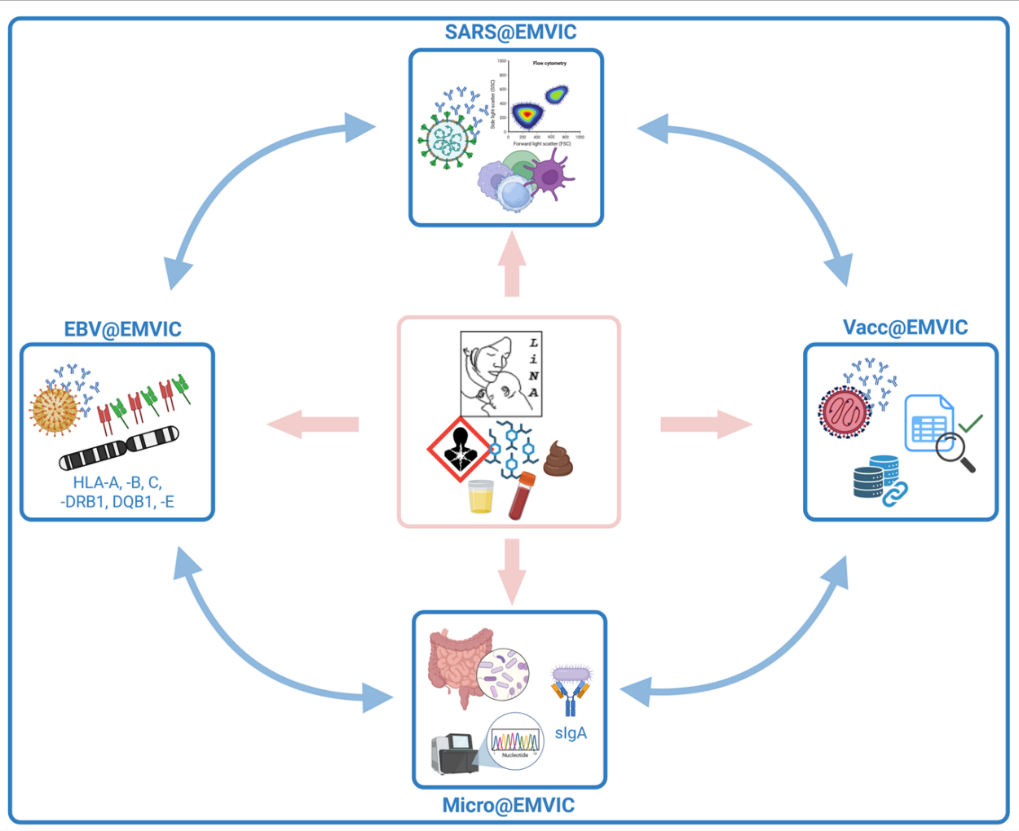
The SARS@EMVIC sub-project at the Helmholtz Centre for Environmental Research – UFZ (Dr Gunda Herberth) is investigating how environmental factors, particularly exposure to chemicals, affect the immune response to SARS-CoV-2. In particular, it focuses on studying the cellular immune response in children from the birth cohort before and after the COVID-19 pandemic. The aim is to identify existing environmental factors, such as early chemical exposure, that modulate the SARS-CoV-2 immune response. In the next step, in vitro tests will be used to investigate how immunomodulatory chemicals affect the SARS-CoV-2 immune response in human immune cells. This will allow the epidemiological data to be functionally validated and causal inferences to be drawn. This ensures a close integration of research and clinical relevance, as well as a high level of translational applicability of the generated data within a One Health context.
The EBV@EMVIC sub-project at the University of Leipzig (PD Dr Corinna Pietsch) is investigating how environmental and lifestyle factors, as well as psychosocial and socio-economic stressors, influence the immune response to the Epstein-Barr virus (EBV) in adolescence. EBV is a widespread virus that remains in the body for life after the initial infection and is associated with later diseases in some of those affected. Using the LiNA cohort, we are integrating environmental and health data with virological and immunological measurements: we determine EBV status and the timing of infection, record detailed patterns of the EBV-specific antibody response, and additionally examine viral and host factors (e.g. genetic characteristics of the virus and host HLA variants) in selected samples. The aim is to identify typical immune response patterns and to understand which combinations of environmental conditions and individual factors are associated with differences in the EBV immune response. The results are incorporated as quality-assured, reusable data modules into the One Health analyses of the EMVIC consortium and provide starting points for further studies.
The Micro@EMVIC sub-project at Hannover Medical School (PD Dr Marius Vital) is characterising the gut microbiome in adolescents using metagenomic analyses to investigate how its composition and functions correlate with environmental and behavioural determinants, as well as psychosocial and socio-economic factors, among the participating adolescents. Furthermore, investigations are being carried out into secretory immunoglobulin A (sIgA), which recognises gut bacteria and thus plays a key role in the interaction between the immune system and the microbiome. A specific focus is on the relationship between microbiome characteristics and the participants’ vaccination status and infections. To this end, data on the taxonomic composition and functions of the gut microbiota, as well as the concentration and distribution patterns of sIgA, will be correlated with vaccination status and infections. In addition, analyses will be carried out using further metadata, in particular environmental exposure variables, e.g. chemical exposure during pregnancy, psychosocial stress factors, antibiotic use and dietary habits.
The Vacc@EMVIC sub-project at the Helmholtz Centre for Infection Research is investigating how early environmental and lifestyle factors influence the immune response following vaccination. The focus is on the measles vaccination as an exemplary use case for the development and stability of vaccine-induced immunity from early childhood through to adolescence. Longitudinal serological data from umbilical cord blood and from samples taken at ages 2, 10 and 14 are being analysed; samples from the mothers taken during pregnancy are also included. Using Luminex-based multiplex serology, antibody responses against measles and other pathogens such as mumps, rubella and varicella are characterised to determine vaccination status, the strength of the humoral immune response and possible waning patterns. These immunological data are linked to detailed information on early exposures, in particular chemical exposures during pregnancy, but also other relevant factors for One Health such as contact with animals, infections, breastfeeding, childcare, psychosocial stress and lifestyle factors. The aim is to identify risk constellations associated with a weakened or rapidly waning vaccine response. The results will be integrated into the harmonised EMVIC data structure and analysed alongside data from the sub-projects mentioned above in order to identify overarching links between the environment, infections, the microbiome and immune development within a One Health framework.
Scientists involved:
Project Coordinator:
Dr. Gunda Herberth (UFZ)
Project Partners:
PD Dr. Corinna Pietsch (University of Leipzig)PD Dr. Marius Vital (MHH)
Dr. Carolina Klett-Tammen / Dr. Vanessa Melhorn (HZI)