Research Group Navigate
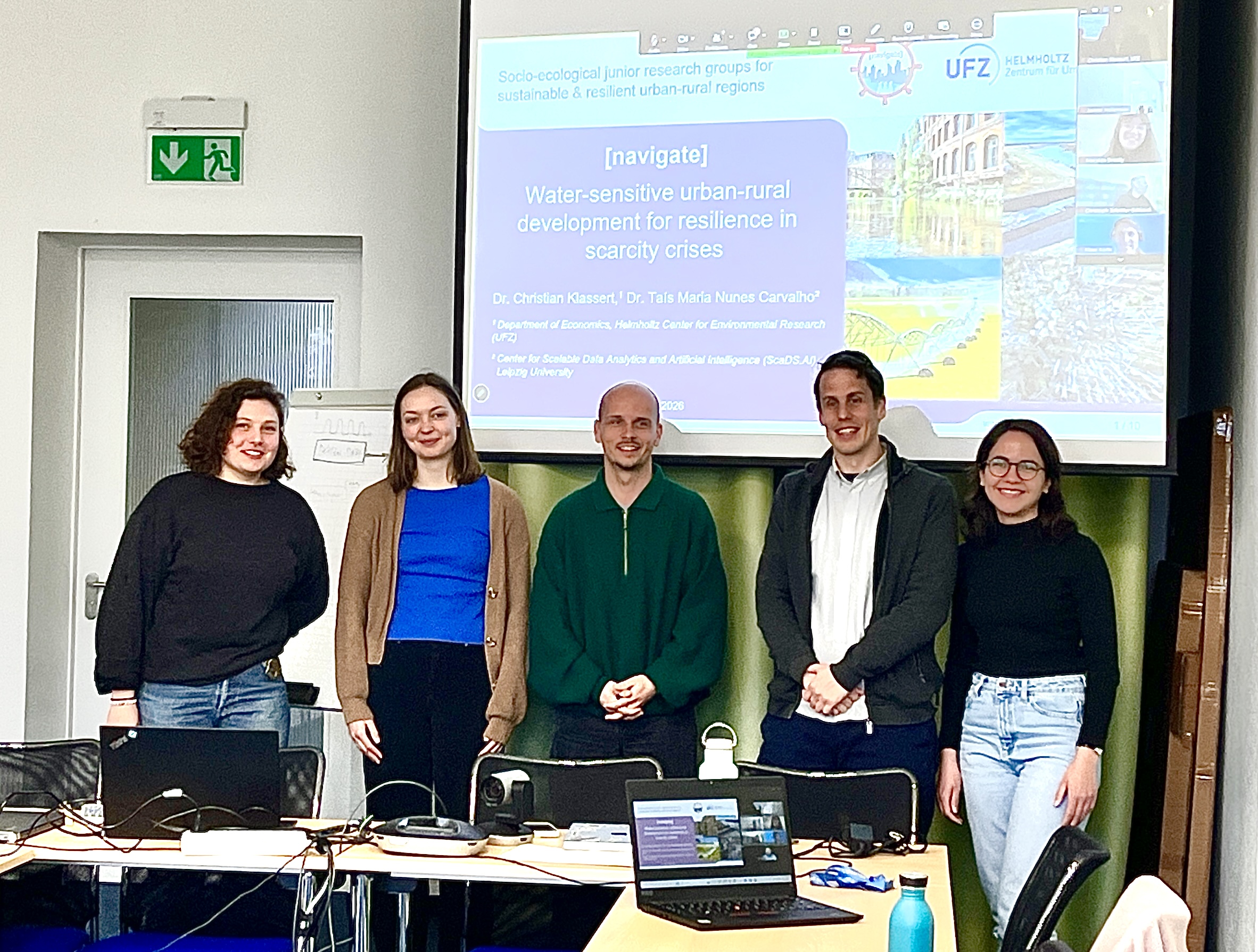
Team
Taís Maria Nunes Carvalho (Group Team Lead)
Christian Klassert (Group Team Lead)
PhD candidates
Susanne Flinner
Michelle Grunwald
Maximilian Föhl
Background
The change in hydro-climatic conditions in the historically water-abundant country of Germany raises the risk of unexpected water scarcity crises due to changes in quantitative and qualitative water availability, water demands, or a combination of multiple scarcity drivers. Without precautionary measures, such crises can create conflicts between securing the urban drinking water supply and agriculture, industry and ecosystems in the surrounding rural area. Yet, integrated adaptation strategies, which consistently account for rural and urban water demands, the management and planning of water supply infrastructure, and uncertainty about the future development of scarcity drivers, are missing.
The research group navigate combines scientific expertise and in-depth local stakeholder knowledge with novel and emerging data sources to formulate and analyze water scarcity crisis scenarios and develop transformation strategies for water-sensitive urban-rural regions. The group focuses on a case study of the rapidly growing Leipzig-Halle region and its long-distance water supply from Saxony and Saxony-Anhalt, which have already faced water scarcity and the need to curtail water abstractions in the recent droughts.
Water sensitive rural-urban development is investigated from three perspectives: (1) Understanding urban water consumption peaks in scarcity crises and strengthening awareness for crisis-related water conservation efforts by combining approaches from psychology, economics, and natural language processing (navigate awareness); (2) managing and planning rural-urban water supply infrastructure under deep uncertainty about droughts, heat, and compound events with machine learning and multi-level multi-objective optimization methods (navigate infrastructure); and (3) quantifying conflicts with rural water uses by agriculture, industry, and ecosystems and identifying regional development imperatives to achieve crisis-resilient freshwater systems through the use of a coupled hydro-economic multi-agent model and remote sensing data analyses (navigate conflicts).
Water crisis scenarios, model assumptions, and evaluation metrics are developed jointly with experts and stakeholders, and in exchange with international partner case studies in Santa Cruz (Stanford University), Bogotá (Universidad de los Andes), and Paris (INRAE). The group will synthesize the results into concrete recommendations for action, policy briefs for relevant groups of decision makers, as well as interactive online tools to further raise awareness for water scarcity.
- water availability and uncertainty, including hydrological variability, climate change impacts, and robustness of water resources under extreme and compound events,
- urban water demand dynamics, such as peak demand during heatwaves, behavioral drivers of water use, and the effectiveness of demand-side management policies,
- rural water use and allocation conflicts, particularly agricultural and industrial water demands, irrigation dynamics, and decision-making under scarcity conditions,
- rural–urban linkages and infrastructure, including water transfers, infrastructure planning under deep uncertainty, and trade-offs between short- and long-term management strategies,
- interactions and feedbacks in coupled human–water systems, capturing cross-sectoral dependencies, policy feedbacks, and cascading risks across spatial and temporal scales,
- governance and stakeholder integration, focusing on participatory approaches, co-production of knowledge, and decision-making processes across sectors.
We apply a mix of qualitative and quantitative research methods, including:
- transdisciplinary development of uncertainty and evaluation frameworks through participatory scenario planning and the co-production of robustness metrics with local stakeholders and experts,
- behavioral and demand-side analysis using machine learning, econometric techniques, and identity models from social psychology to understand urban water use and willingness to save water,
- human-natural systems and agent-based modeling to simulate urban growth, agricultural drought impacts, and irrigation decisions,
- decision-making under deep uncertainty (DMDU) and multiobjective policy search to identify cost-effective and robust infrastructure management strategies,
- integrated model assessments and socio-hydrological coupling to evaluate the feedbacks between social, economic, and biophysical drivers of water scarcity,
- advanced data analytics including natural language processing to assess public awareness.
Navigate actively contributes to academic teaching and knowledge dissemination. We:
- · Supervise Bachelor’s, Master’s, and PhD theses
- Engage with stakeholders through workshops, expert dialogues, and policy briefings
- Support sustainable water planning and management in Germany and beyond
In cooperation with the research group, theses and internships that are specifically related to the current topics can be carried out. Please send inquiries and unsolicited applications to Dr. Taís Carvalho or Dr. Christian Klassert .
Open positions, if available, are advertised on the
UFZ career and jobs website
.