
Human exposure monitoring and assessment analysing human blood and urine as well as wastewater
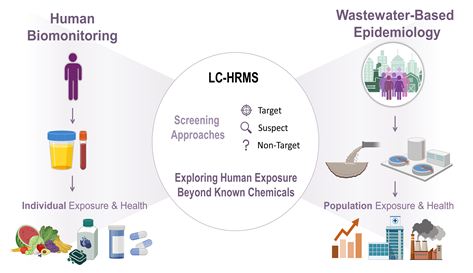
Human biomonitoring (HBM) and wastewater-based epidemiology (WBE) are complementary approaches to assess human exposure to chemicals (Kasprzyk-Hordern et al., 2023). While HBM and WBE are traditionally very much focused on a small number of target compounds we develop methods to analyse and assess complex mixtures of parent compounds and metabolites using analytical screening tools. Our specific focus has been on the development of innovative methods to screen human urine for pesticide metabolites combining high-throughput in vitro incubation and automated LC-HRMS data processing (Huber et al., 2021) together with in silico deconjugation of conjugates (Huber et al., 2022a). We use these approaches for large scale screening of pesticide metabolites in HBM (Huber et al., 2022b; Ottenbros et al., 2023) and for linking pesticide residues in urine with dietary biomarkers (Huber et al., 2024) and human health risks (Gomez-Olarte et al., 2025). To further improve annotation accuracy in LC-HRMS we apply ion mobility techniques to separate analytes from coeluting matrix interferences (Huber et al., 2025).
Complementing HBM we use LC-HRMS screening of wastewater to unravel human exposure to chemicals. In addition to the focus on human metabolites we explore alternative methods on the discrimination of components of domestic discharge from industrial emissions and other sources using temporal clustering (Haalck et al., 2025).