Our department shows how groundwater flows – Long Night of Science 2026 at the UFZ in Halle
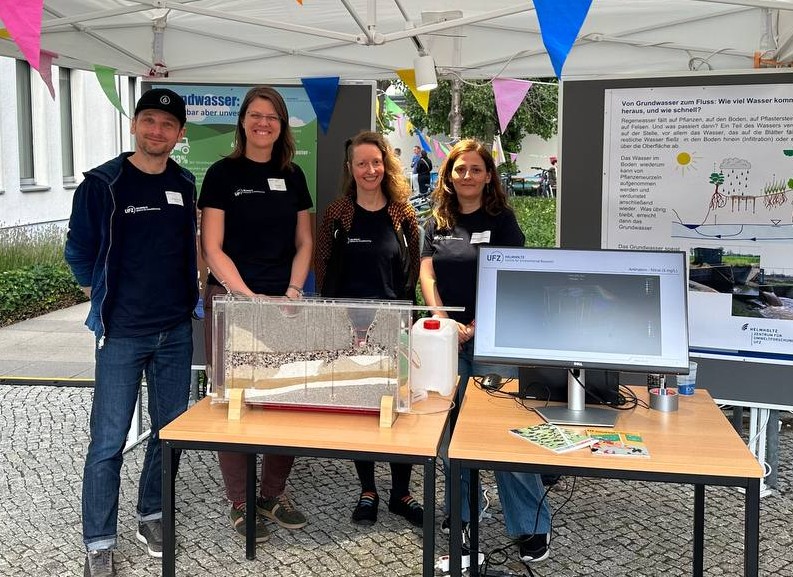 Christian, Pia, Jette and Nafiseh with their groundwater models.
On July 3, 2026, universities and research institutions in Halle (Saale) opened their doors to the public as part of the Long Night of Science. The UFZ was also represented with a diverse program and offered insights into current research on the environment and sustainability.
The Department of Hydrogeology invited visitors to participate in hands-on activities on the topic of groundwater in the underground below our feet. Using a physical and a digital groundwater model, Christian Schmidt, Jette Wüst, Nafiseh Salehi Siavashani, and Pia Ebeling demonstrated how water and dissolved substances move through the subsurface and what challenges this poses for the protection of our water resources.
Visitors were able to conduct their own experiments on the physical model and observe how groundwater flows and how pollutants spread within it using dyed water. The digital model demonstrated how computer simulations can help calculate, for example, nitrate contamination during drinking water extraction. In addition, insights into regional water quality were presented using maps of nitrogen and phosphorus concentrations in rivers. This highlighted an important research focus of our department: the analysis of water quality using large-scale datasets.
The event offered numerous opportunities for engaging discussions on the topics of groundwater, water quality, and water security with a diverse audience—from young to grown-ups. We would like to thank all visitors for their interest and the stimulating conversations, and we look forward to providing further insights into the fascinating world of groundwater and water quality at future events.Planetary Solutions Workshop "Towards solutions to reduce nutrient fluxes to inland waters and the ocean – Understanding the processes and time scales of nutrient retention, cycling and export"
On 1–2 December 2025, researchers and experts in hydrology, hydrogeology, ecology, environmental management, biogeochemistry, microbiology, and water quality gathered at UFZ Leipzig for the Nutrient Fluxes Workshop. The workshop was organized by the UFZ Departments of River Ecology, Hydrogeology, and Lake Research and led by UFZ researchers Nuria Perujo, Laura Soares, and Jan Fleckenstein. A total of 16 participants from international institutions attended the workshop, including CEAB-CSIC (Spanish National Research Council, Spain), University of Girona (Spain), Aarhus University (Denmark), Geological Survey of Denmark and Greenland (GEUS, Denmark), University of California (US), US Geological Survey (US), and Deltares (the Netherlands).
The workshop focused on the latest research, methodologies, and discussions surrounding nutrient cycles and fluxes, with special emphasis on identifying ongoing challenges in reducing nutrient fluxes from land to the ocean. Participants engaged in presentations, group discussions, and hands-on sessions, sharing insights and fostering collaboration across disciplines. Key topics included the complexity of landscapes, global change, trans-boundary scales, and data management. The participants aim to continue this dialogue through the preparation and publication of a perspective paper.
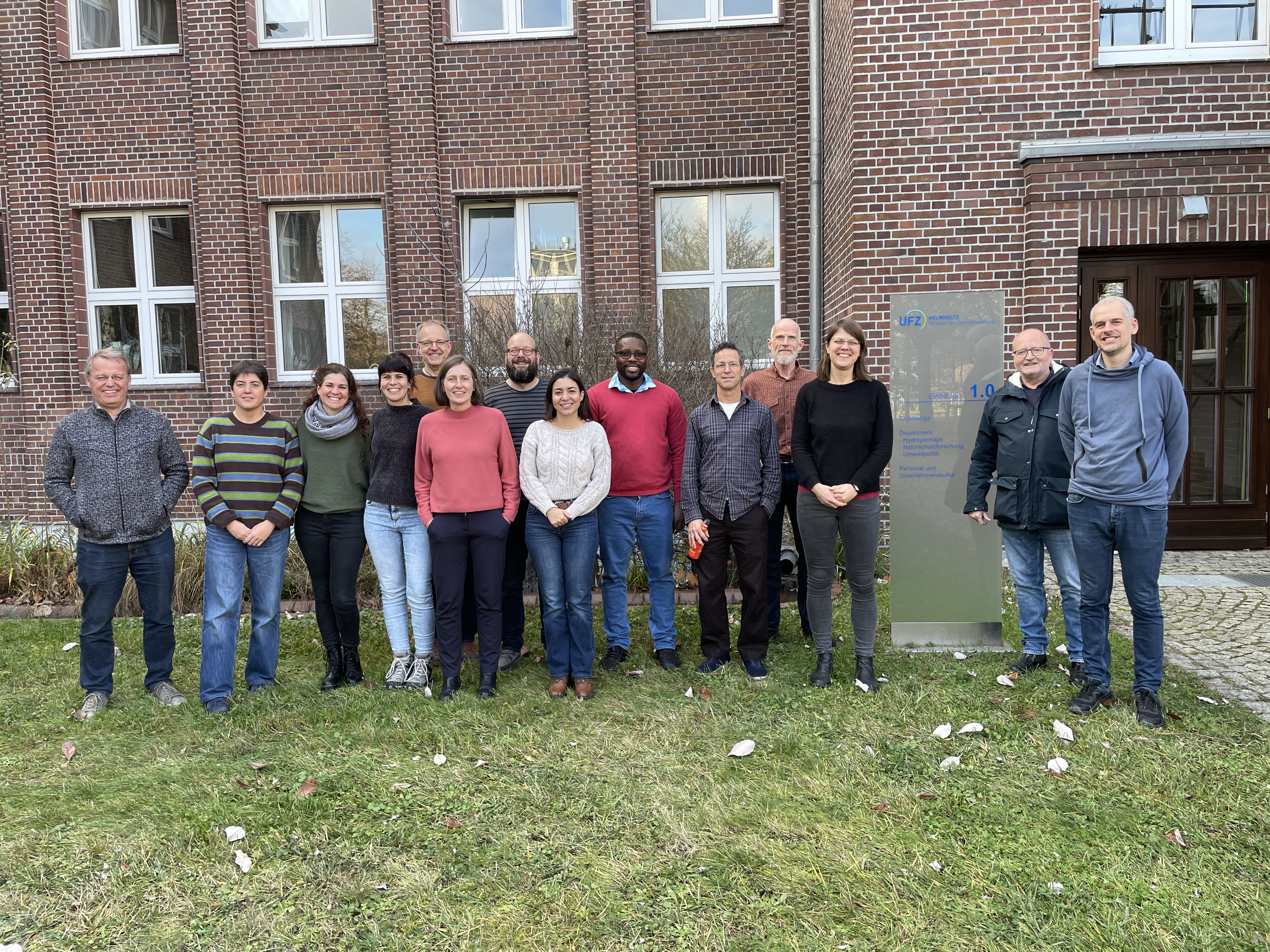 The workshop participants in front of UFZ building 1.0
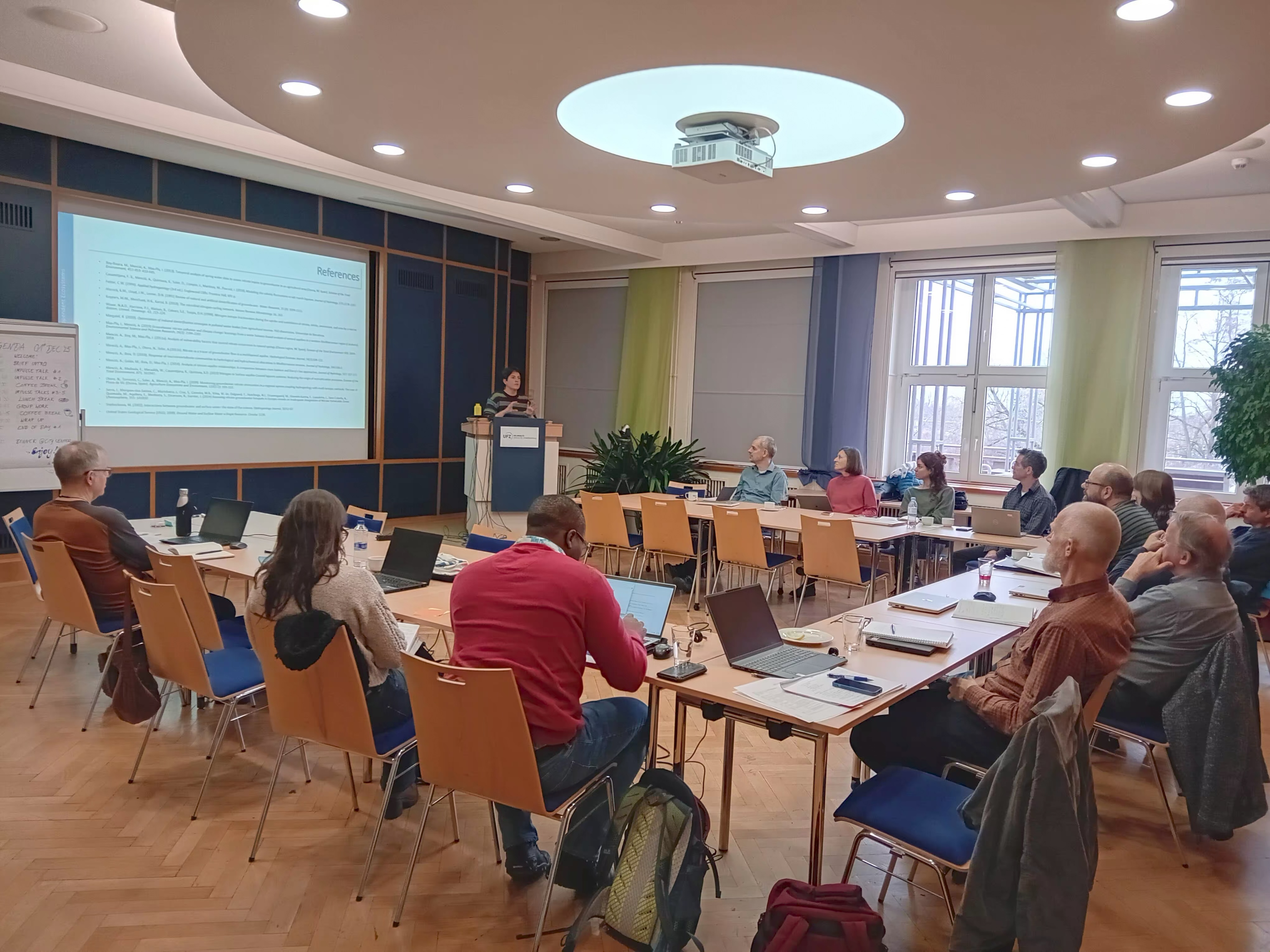 The workshop in progress
Talk by Jim Jawitz (Soil, Water, and Ecosystem Sciences Dep/ University of Florida,USA)
On 13th November 2025, 2pm in the Seminar "Water & Environment" in Seminar Room 7.013 A + B (new building), UFZ/ Leipzig and online:
Sustainability of water-dependent societies: Connections, complexity, and cooperation
Sustainable provision of sufficient and equitable water supply for all people while also supporting ecosystem functions requires science-based water policies that consider water quantity, water quality, ecosystem health, and economic productivity.
How should you allocate your research energies between these themes? What are the research philosophies that underpin your research topic choices? Jim Jawitz provided suggestions along with examples from our long-standing collaboration between the UFZ and the University of Florida.