
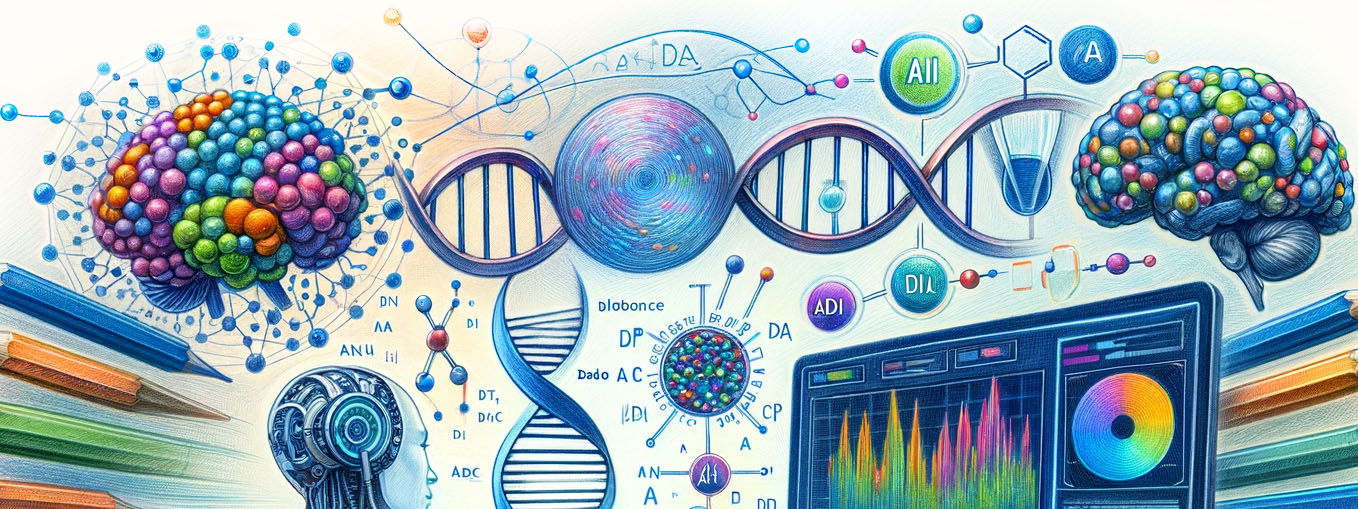
Image created with OpenAI's DALL·E and modified by Jana Schor, 2024.
Bio-Data Science
At Bio-Data Science, we develop and apply data science and AI methods to improve the understanding and use of complex data in human and environmental health. Our work combines machine learning, graph-based AI, knowledge graphs, large language models, and advanced data integration to generate new hypotheses, enable large-scale predictions, and support transparent, scientifically grounded decision-making.
A major focus of our research is on chemicals in the environment and their effects on ecosystems and human health. We integrate heterogeneous data into structured and queryable knowledge that can be used for analysis, prediction, and accessible scientific interpretation. In computational toxicology, for example, our work supports more efficient chemical risk assessment by helping to prioritize substances for testing, guide monitoring strategies, and contribute to the design of safer and more sustainable chemicals.
We place strong emphasis on trustworthy AI through explainability, uncertainty quantification, and reproducible research workflows. More recently, our work also includes grounded LLMs and agentic AI systems that provide traceable access to complex domain knowledge.
In this way, Bio-Data Science contributes to innovative, responsible, and impactful research at the interface of environmental science, health, and artificial intelligence.
My recommendation for a UFZ website would be the second version, because it is leaner, more modern, and more precise. The first version is better if you want to preserve more of the original spirit and breadth.
A major focus of our research is on chemicals in the environment and their effects on ecosystems and human health. We integrate heterogeneous data into structured and queryable knowledge that can be used for analysis, prediction, and accessible scientific interpretation. In computational toxicology, for example, our work supports more efficient chemical risk assessment by helping to prioritize substances for testing, guide monitoring strategies, and contribute to the design of safer and more sustainable chemicals.
We place strong emphasis on trustworthy AI through explainability, uncertainty quantification, and reproducible research workflows. More recently, our work also includes grounded LLMs and agentic AI systems that provide traceable access to complex domain knowledge.
In this way, Bio-Data Science contributes to innovative, responsible, and impactful research at the interface of environmental science, health, and artificial intelligence.
My recommendation for a UFZ website would be the second version, because it is leaner, more modern, and more precise. The first version is better if you want to preserve more of the original spirit and breadth.