UFZ Innovation Forum 2025
Intelligent Water Cycles for Resilient Cities – from Planning to Practice
05 November 2025, KUBUS at the Helmholtz Centre for Environmental Research – UFZ
Learn more about
- securing water quality in sponge cities
- technical solutions and innovations
- legal frameworks and questions
- interactions with urban planning and transformation
- societal perspectives
Look forward to
- specialist lectures by external experts on pollutants in urban spaces
- insights into the "Water-Sensitive Urban Development Leipzig" steering network
- presentations by the Helmholtz Solution Lab UrbanLE with a focus on blue-green-red infrastructures
- breakout sessions, a marketplace of opportunities and space for exchange and networking
Register here ► Registration
The event is free of charge and will be held in German. Registration deadline is 28 October 2025.
Recognised for Continuing Professional Development by the Saxon Chamber of Engineers (8 teaching units of 45 minutes each).
Contact for questions and suggestions
Dr. Joachim Nöller
Knowledge and Technology Transfer (WTT)
Email:
wtt@ufz.de
Sponge cities are being established in many places to make urban spaces more resilient to climate change-related extreme weather events such as heavy rainfall, heat periods and long dry spells.
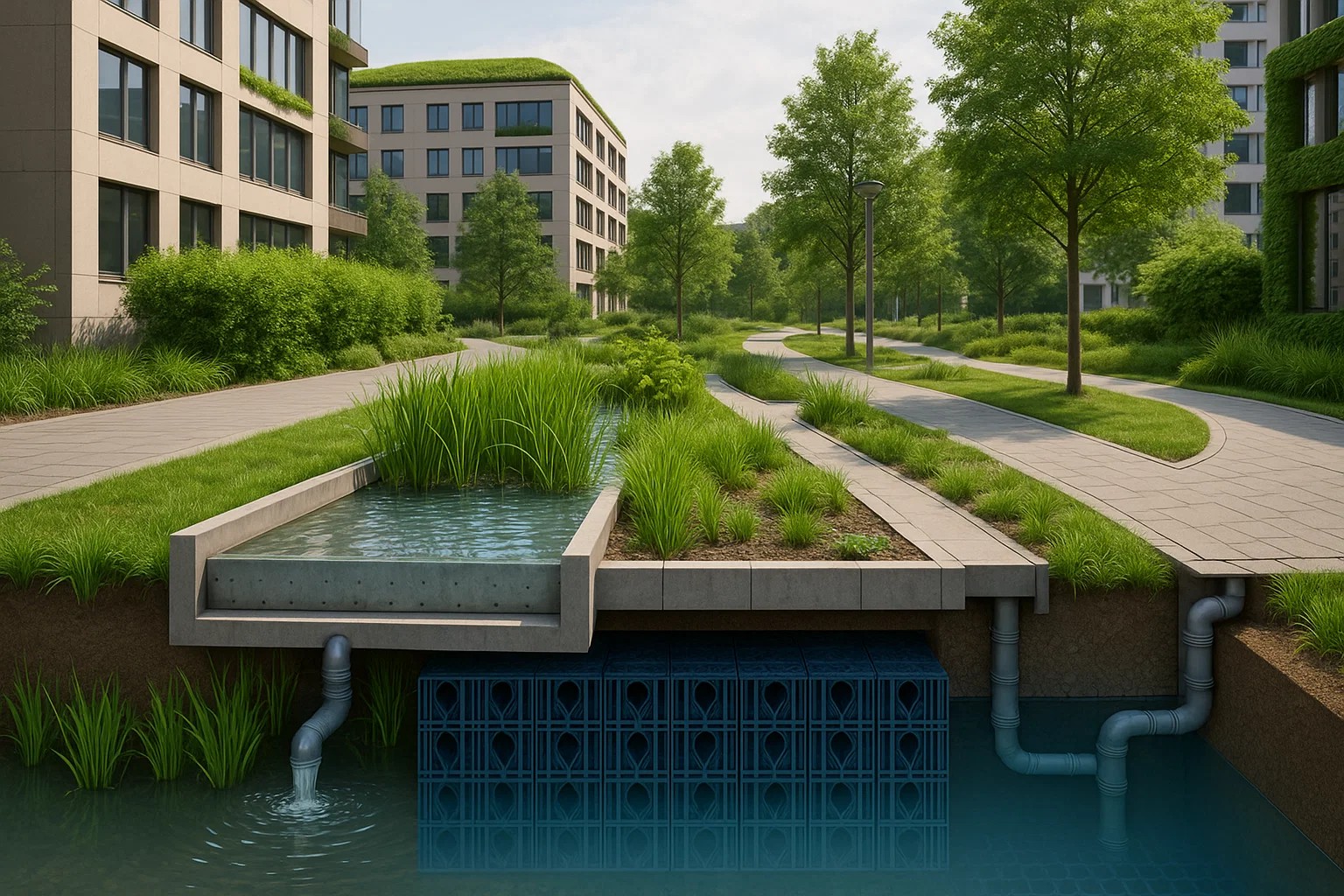
The core elements are usually innovative blue-green infrastructures – such as green roofs and facilities for retention and/or infiltration of surface water. They serve to collect rainwater, establish natural water cycles in neighbourhoods and thus counteract the consequences of extreme weather events.
Furthermore, these structures also harbour previously untapped potential for purifying urban water from pollutants. Water flowing off buildings, roads and other urban surfaces contains particulate and freely dissolved pollutants that can accumulate in sewers. The release of these pollutants into the water cycle and groundwater must be prevented, and blue-green structures can provide suitable solutions for this.
Domestic greywater – which accounts for approximately 70% of total domestic wastewater – can also be used as a resource for irrigating urban green spaces and improving microclimate management in urban areas. Since greywater is only lightly contaminated and also occurs independently of weather conditions, it represents a valuable water source. Treated directly at the point of origin, it can contribute to strengthening local water cycles at neighbourhood level.
For further guidance on climate-adapted water and vegetation management on research campuses, see the HKB Guideline by the Helmholtz Competence Network for Climate-Responsive Construction.
- How can water quality be secured in the sponge cities of the future?
- What risks exist from known or new chemicals?
- What technological advances are there in the field of water treatment and utilisation?
- How can these structures be integrated into existing planning processes and approval procedures?
- How are these structures received by the population?
- And how can potential conflicts in establishing such structures be dealt with constructively?
We will address these and other central questions around the future topic of climate adaptation for cities at the Innovation Forum 2025 in November at UFZ. Come to Leipzig, learn more about it and actively contribute to the discussion.
The Innovation Forum at UFZ is an established platform for exchange and networking – for everyone involved in the sustainable transformation of economy and society.Register here ► Registration
The Knowledge and Technology Transfer (WTT) team at UFZ looks forward to welcoming you on 5 November 2025 at the Leipzig KUBUS at Permoserstraße 15 in 04318 Leipzig!
Programme
9:00 |
Welcome |
9:15 |
Keynote "Unseen yet Impactful: Contaminants in Blue-Green Infrastructure Systems"Dr. Christiane Meier – Federal Environment Agency, Unit IV 1.2 |
9:45 |
Keynote "Water-Sensitive Urban Development Steering Network"Dr. Brigitta Ziegenbein – Urban Planning Department of the City of Leipzig |
10:15 |
Keynote "SolutionLab Leipzig Gets Started"Prof. Dr. Roland Müller – UFZ |
10:45 |
Coffee Break & Networking |
11:00 |
Session 1 "Technologies for Securing Water Quality"Helene Freihube, HTWK-IWS Leipzig |
12:30 |
Marketplace of Opportunities & LunchCompany & partner presentationsGreenInnoSax - HTWKResilients GmbH ZinCo GmbH Leipziger Gründach Think Tank RegioWasser UFZ Projekte Cleaner |
13:30 |
Session 2 "Law and Planning"Prof. Dr. Moritz Reese & Felix Klickermann – UFZ This session examines urban contaminants within drainage systems. The discussion shall focus on pathways of contamination alongside innovative and sustainable solutions for future Blue-Green Infrastructure to manage these contaminants. This encompasses the full range of nature-based through to technologically advanced treatment options for local water storage, reuse and groundwater protection. |
15:00 |
Coffee Break & Networking |
15:30 |
Fishbowl Discussion "Between Crises, Conflicts and Participation: Pathways to the Resilient City"Dr. Annegret Haase, Prof. Dr. Sina Leipold & Dr. Josef Kaiser – UFZThe discussion focuses on two key questions:
|
16:30 |
Wrap-up – What's Next? |
17:00 |
Closing Reception with Pretzels & Drinks |