Press Release, 19. November 2026
Pesticide policy insufficient to protect soils
UFZ team analyses pesticide policy in Germany
Healthy soils are important for food production, carbon storage, water and pollutant filtration, and nutrient cycling. They also provide a habitat for bacteria, fungi and many other soil organisms. However, erosion, acidification, and compaction can impair the natural functions of soils – as can the introduction of chemicals such as pesticides. Researchers at the Helmholtz Centre for Environmental Research (UFZ) investigated how effectively policies in Germany protect soils from the risks associated with pesticide use. According to the analysis published in Environmental Management, governance issues limit the effectiveness of these measures.
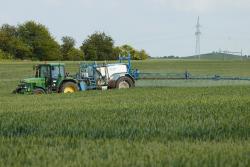
A study by the UFZ shows that Germany's pesticide policy does not adequately protect our soils.
Photo: André Künzelmann / UFZ
Many soils in Germany are in poor condition. According to the 2024 EU Soil Health Dashboard, around 76% of soils were degraded as a result of various material and non-material pressures. Pesticides are a contributing factor. According to the Federal Office of Consumer Protection and Food Safety, more than 99,000 t of pesticides were sold in Germany in 2025, which is considerably more than in 2024 (over 87,000 t) and 2023 (almost 76,000 t). Pesticide sales are rising despite various policies intended to restrict their use and reduce their harmful effects on soils. At the global level, the Kunming–Montreal Global Biodiversity Framework, which was adopted in 2022, calls for the overall risk from pesticides and highly hazardous chemicals to be reduced by at least half by 2030. However, this objective is not legally binding. At the EU level, the Soil Monitoring Law is intended to help ensure that European soils are in a good chemical, physical, and biological condition by 2050. In Germany, in addition to numerous state laws and regulations, there are federal laws and regulations such as the Federal Soil Protection Act, the Plant Protection Act, and the Federal Nature Conservation Act, some of which have been in force for many years. But how effective are these policies? How could their effectiveness be improved? And what alternative measures could be taken to minimise pesticides risks?
To answer these questions, UFZ researchers analysed federal and state legislation as well as selected district and municipal measures in Jülich and Niederzier in the Düren district of North Rhine-Westphalia. The results, according to UFZ researcher and lead author Dr Katharine Heyl, are that the "pesticide application requirements examined have limited regulatory effect because they are too vague and difficult to enforce.” This is evident, for example, in the ‘good professional practice’ defined in the Plant Protection Law. At the federal level, this law sets out basic protective measures and is intended to take account of new scientific findings on pesticide use. “However, the guidelines on good professional practice have not been updated since 2010. This means that current research findings are no longer taken into account”, Heyl states. To make matters worse, neither good professional practice nor the principles governing its application impose obligations that can be directly enforced through sanctions. As a result, good professional practice has a limited steering effect. Furthermore, there are too few controls. In 2025, only 1.7% of farms in Germany were inspected. “This shows that, given the large number of farms and other pesticide users, the authorities are hardly in a position to monitor compliance with the measures closely”, says Heyl.
The UFZ research team also analysed spatial measures, including the ban on the use of pesticides in nature reserves or on land in the immediate vicinity of water bodies as laid down in the Plant Protection Application Ordinance. These measures, too, have a limited steering effect on pesticide risks. “Exceptions reduce the effectiveness of these rules”, says co-author Felix Klickermann. In the two municipalities in North Rhine-Westphalia, the authorities could authorise the use of pesticides in nature reserves if this prevents damage to agriculture and forestry on neighbouring land. Exceptions may also be granted to ensure railway safety. In this case too, the spatial requirements are not adequately controlled. For example, the Federal Office of Consumer Protection and Food Safety regularly reports on breaches of the requirement to maintain minimum distances from bodies of water and of the rule that pesticides may be applied only to designated areas. For example, in 2025, the authorities found that one third of the farms inspected (230 of 687) had breached the ban on pesticide use near water bodies and product-specific application requirements. “These governance problems considerably reduce the effectiveness of area-based measures governing the use of pesticides”, says Klickermann.
However, the study also shows that certain policy measures reduce the risks associated with pesticides. Effective measures include water protection zones and training and advisory services for users of pesticides. But these alone are not enough. “It would make sense to revise the measures on pesticide use by bringing good professional practice into line with the latest scientific findings and making it legally binding”, says co-author Dr Jessica Stubenrauch. Spatial requirements could also be tightened by designating buffer zones between nature reserves and surrounding areas.
However, a revision of the existing measures alone is unlikely to solve the problems. The UFZ researchers therefore believe that new, complementary economic instruments are necessary. One example would be a pesticide tax based on the risks and quantity of the pesticide used. A 2021 UFZ study indicates that such a tax could reduce both pesticide risks and the quantities applied. “Economic instruments could reduce pesticide risks more comprehensively than simply tightening existing measures”, Heyl states. However, many other changes will be needed to make agriculture sustainable in the medium and long term and protect soils, including a reform of the EU Common Agricultural Policy (CAP).
Publication:
Katharine Heyl, Jessica Stubenrauch, Felix Klickermann: From Pesticide Pollution to Healthy Soils: Policy Assessment and Reform Options in Germany, Environmental Management, https://doi.org/10.1007/s00267-026-02605-y
Further information
Dr Katharine Heyl
UFZ Department of Environmental and Planning Law
katharine.heyl@ufz.de
UFZ press office
Susanne Hufe
Phone: +49 341 6025-1630
presse@ufz.de
In the Helmholtz Centre for Environmental Research (UFZ), scientists conduct research into the causes and consequences of far-reaching environmental changes. Their areas of study cover water resources, ecosystems of the future, environmental technologies and biotechnologies, the effects of chemicals in the environment, modelling and social-scientific issues. The UFZ employs more than 1,100 staff at its sites in Leipzig, Halle and Magdeburg. It is funded by the Federal Government, Saxony and Saxony-Anhalt.
www.ufz.deThe Helmholtz Association contributes to solving major challenges facing society, science and the economy with top scientific achievements in six research fields: Energy; Earth and Environment; Health; Key Technologies; Matter; and Aeronautics, Space and Transport. With some 39,000 employees in 19 research centres, the Helmholtz Association is Germany’s largest scientific organisation.
www.helmholtz.de