
Press Release, 28. October 2026
Climate change amplifies flooding more than extreme precipitation
UFZ study combines climate and hydrological models to analyse flood peaks
The extent to which anthropogenic climate change alters the intensity of individual extreme precipitation events can already be estimated reliably. However, the same cannot yet be said of the resulting flood hazards. A new study led by the Helmholtz Centre for Environmental Research (UFZ) found that climate change amplified flood peaks considerably more than precipitation itself during Storm Boris in 2024. Assessments based solely on precipitation may therefore lead to an underestimation of changes in flood hazards. The study was published in Science Advances.
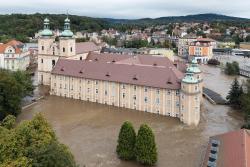
Flooding in K?odzko, Poland, in September 2024: the Nysa K?odzka river floods the grounds of the Franciscan monastery. The region was hit particularly hard by the flooding after Storm Boris.
Photo: Jacek Halicki, CC BY-SA 4.0
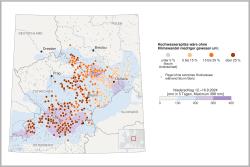
For gauges with extreme flooding (at least a 25-year flood), the map shows how much lower the simulated flood peak would have been without human-caused climate change. The shaded areas show observed rainfall from 12 to 16 September 2024. The map shows one of several model calculations in the study.
Photo: Daten: Miersch et al., Science Advances (2026); Grafik: Peter Miersch
In September 2024, Storm Boris brought extreme precipitation and severe flooding to large parts of Central and Eastern Europe. Poland, Czechia, and Austria were particularly affected. In some areas, several hundred millimetres of rain fell within a few days, and numerous rivers burst their banks.
Earlier attribution studies had shown that global warming intensified precipitation during Storm Boris. These studies compare the observed event with a counterfactual scenario that largely excludes human influence on the climate. However, such analyses generally stop at the meteorological event itself and focus on questions such as how much extreme precipitation has intensified. The effects of these changes on flood hazards therefore often remain unclear.
“In our study, we have taken this a step further. Using hydrological models, we investigated how changes in precipitation amounts caused by climate change affect the magnitude of flooding”, says lead author Peter Miersch from the UFZ. Although it is known that an increase in precipitation does not necessarily lead to a proportional increase in flood magnitude, the size of this effect for individual events and the extent to which it can be attributed to anthropogenic climate change have so far remained unclear.
To investigate this, the researchers combined climate simulations with two different hydrological models in order to trace how rainfall in a catchment generates runoff and ultimately leads to flooding. The differences were substantial. Without anthropogenic climate change, precipitation during Storm Boris would have been around 6–9% lower depending on the climate model, but flood peaks would have been 14–22% lower on average.
The reason for this disproportionate increase lies in how catchments respond to additional rainfall. “The soil can initially absorb some of the rain during a heavy rainfall event. But eventually the soil becomes saturated, and every additional millimetre of rain flows directly into the river”, explains Miersch. Once the soil is saturated, additional rainfall leads to a particularly sharp increase in runoff.
To assess the robustness of the results, the researchers combined two different climate models with two hydrological models, one of which uses machine learning. Despite the different methodological approaches, the same basic pattern emerged in all combinations: flood peaks increased considerably more than precipitation.
This effect is particularly relevant where flood protection measures are designed for specific flood thresholds. “If climate change increases extreme precipitation by 10%, it does not mean flooding will increase by only 10%. It could also be 20%. If flood levels exceed the thresholds for which flood protection measures are designed, extensive damage can occur very quickly”, says co-author Prof. Dr Jakob Zscheischler, a climate researcher at the UFZ and Professor of Data Analytics in Hydro Sciences at TUD Dresden University of Technology. Assessments of flood risk and flood protection that consider only changes in extreme precipitation may therefore lead to an underestimation of the increase in flood hazard.
However, the researchers deliberately limited the scope of the study to isolate how much anthropogenic climate change altered a specific event under otherwise identical conditions. The study does not establish whether climate change makes weather patterns similar to those during Storm Boris more or less likely. Changes in land use or water management were also not taken into account. Put simply, the researchers compared the same present-day landscape under different climatic conditions.
The results therefore show that changes in flood hazards associated with climate change cannot be assessed solely based on changes in precipitation. When assessing future risks and developing adaptation strategies, it is therefore important to consider the entire process from the weather event to river discharge.
Publication:
Peter Miersch, István Dunkl, Antonio Sánchez-Benítez, Marylou Athanase, Oldrich Rakovec, Daniel Klotz, Sebastian Sippel, Helge Goessling, Jakob Zscheischler: Evidence from 2024 Storm Boris indicates anthropogenic climate change amplifies floods more than extreme precipitation; Science Advances, https://doi.org/10.1126/sciadv.aef7703
Further information
Prof Dr Jakob Zscheischler
Head of the UFZ Department of Compound Environmental Risks
jakob.zscheischler@ufz.de
Peter Miersch
UFZ Department of Compound Environmental Risks
peter.miersch@ufz.de
UFZ press office
Susanne Hufe
Phone: +49 341 6025-1630
presse@ufz.de
In the Helmholtz Centre for Environmental Research (UFZ), scientists conduct research into the causes and consequences of far-reaching environmental changes. Their areas of study cover water resources, ecosystems of the future, environmental technologies and biotechnologies, the effects of chemicals in the environment, modelling and social-scientific issues. The UFZ employs more than 1,100 staff at its sites in Leipzig, Halle and Magdeburg. It is funded by the Federal Government, Saxony and Saxony-Anhalt.
www.ufz.deThe Helmholtz Association contributes to solving major challenges facing society, science and the economy with top scientific achievements in six research fields: Energy; Earth and Environment; Health; Key Technologies; Matter; and Aeronautics, Space and Transport. With some 39,000 employees in 19 research centres, the Helmholtz Association is Germany’s largest scientific organisation.
www.helmholtz.de