
Press Release, 28. October 2026
Yeast and electricity convert CO? into valuable chemicals
Researchers develop a new process that captures CO? and produces a valuable bio-based chemical
To limit further climate change, researchers are exploring technologies that can convert atmospheric carbon dioxide (CO?) into useful products. In collaboration with BOKU University in Vienna (Austria), researchers at the Helmholtz Centre for Environmental Research (UFZ) have demonstrated that electrochemical and microbial processes can be combined to capture CO? and produce itaconic acid, a bio-based chemical used in industry. According to the researchers, this new process demonstrates how CO? emissions can be converted into sustainable bio-based products, with the potential to produce a wider range of valuable chemicals by using different microorganisms. The study was published in Angewandte Chemie International Edition.
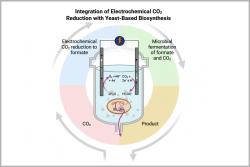
This study demonstrates a novel hybrid system that integrates electrochemical CO2 reduction with microbial biosynthesis of a valuable chemical in a single reactor.
Photo: Izadi et al. Angew. Chemie / Graphic: Simone Bachleitner, Paniz Izadi
Itaconic acid is a bio-based organic acid used to manufacture biodegradable plastics, textiles, adhesives, and resins. It is considered a promising sustainable alternative to petroleum-based chemicals. Worldwide, around 70,000 t of itaconic acid are produced annually, and production is increasing. “On an industrial scale, itaconic acid is produced biotechnologically from sugar using a fungus. We have now developed a process that uses CO? instead of sugar as a starting material so that we can put emissions to productive use”, explains Prof. Falk Harnisch, an electrobiotechnologist at the UFZ and last author of the study.
In collaboration with researchers from BOKU University in Vienna, the UFZ team has developed a method that combines electrochemical and microbial processes in a single bioreactor. But how exactly does this electrobioreactor work? And how did the researchers come up with the idea of combining the use of CO? with the production of itaconic acid in the first place?
A previous study by BOKU University showed that itaconic acid can be produced biotechnologically from methanol, a type of alcohol. Because microorganisms can metabolise a wide range of substances, the team led by Harnisch tested a chemically similar substance that can be produced relatively easily from CO?. “Electricity, ideally from renewable sources, can be used to convert CO? into formate, which is chemically related to methanol because both contain just one carbon atom. We therefore wanted to investigate whether the yeast could also use formate as an energy source for itaconic acid production”, says Dr Paniz Izadi, a researcher in Harnisch’s UFZ team and first author of the study.
The design of the electrobioreactor in which electrochemical and microbial processes take place simultaneously presented a number of challenges. The electrochemical conversion of CO? into formate works best at elevated temperatures and an alkaline pH in the presence of as few other chemical substances as possible. The genetically engineered yeast strain Komagataella phaffii, which is used in the bioreactor, requires entirely different conditions: temperatures of around 30°C, a neutral pH, and a nutrient-rich medium. “In order to ensure that both the electrochemical and microbial processes took place and operated as efficiently as possible, we had to find a compromise between their different requirements in the electrobioreactor”, explains Dr Simone Bachleitner, Senior Scientist at the Institute of Microbiology and Microbial Biotechnology at BOKU University.
The experiment was successful, and the yeast produced itaconic acid from CO? using electrochemically produced formate as an energy source. “We successfully combined electrochemical and microbial processes in our bioreactor. A self-contained process chain offers major practical advantages because it eliminates the need to transport intermediate products between separate facilities. Although the yield of itaconic acid was lower than when sugar or methanol was used, our study clearly demonstrates that CO? can be converted into complex and valuable biochemicals”, says Harnisch.
The researchers hope that their new process will provide a model for practical applications and contribute to the development of industrial-scale facilities. The researchers now plan to optimise the processes in the electrobioreactor and investigate their suitability for other microorganisms and bio-based products.
Publication:
Paniz Izadi, Manja M. Severinsen Zijlstra, Aykut Kas,Philip Haus,Verena Enzinger,Gregor Lutz,Özge Ata,Simone Bachleitner,Diethard Mattanovich and Falk Harnisch: Integrated electromicrobial production of itaconic acid from CO2 at liter-scale using Komagataella phaffii; Angew. Chem.-Int. Edit., https://doi.org/10.1002/anie.8633090
Further information
Prof Dr Falk Harnisch
Co-Head of the UFZ Department of Microbial Biotechnology
falk.harnisch@ufz.de
UFZ press office
Susanne Hufe
Phone: +49 341 6025-1630
presse@ufz.de
In the Helmholtz Centre for Environmental Research (UFZ), scientists conduct research into the causes and consequences of far-reaching environmental changes. Their areas of study cover water resources, ecosystems of the future, environmental technologies and biotechnologies, the effects of chemicals in the environment, modelling and social-scientific issues. The UFZ employs more than 1,100 staff at its sites in Leipzig, Halle and Magdeburg. It is funded by the Federal Government, Saxony and Saxony-Anhalt.
www.ufz.deThe Helmholtz Association contributes to solving major challenges facing society, science and the economy with top scientific achievements in six research fields: Energy; Earth and Environment; Health; Key Technologies; Matter; and Aeronautics, Space and Transport. With some 39,000 employees in 19 research centres, the Helmholtz Association is Germany’s largest scientific organisation.
www.helmholtz.de