
Press Release, 22. October 2026
Stream restoration improves biodiversity but not necessarily ecosystem functioning
A UFZ study highlights the limitations of conventional measures in restoring ecosystem functions
The EU Nature Restoration Regulation adopted in 2024 establishes the restoration of ecosystem functions as an objective of stream restoration. But can conventional measures that focus primarily on restoring the physical structure of rivers and streams fulfil this task? A meta-analysis by an international research team coordinated by the Helmholtz Centre for Environmental Research (UFZ) shows that this is not necessarily the case. Although restoration measures can improve stream structure and biodiversity, important ecological processes such as nutrient uptake and organic matter decomposition do not necessarily recover. In their study published in Global Change Biology, the researchers therefore recommend incorporating functional indicators more systematically into monitoring and assessments of restoration success and targeting restoration measures more specifically at the functions they are intended to restore.
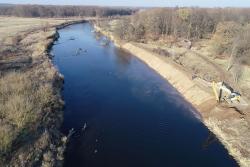
Stream restoration measures along the Mulde River in Germany: Bank reinforcement structures are being removed to restore more natural riverbank conditions.
Photo: M. Vieweg
Many rivers and streams in Europe have been extensively modified through the construction of barriers, the reinforcement of banks and streambeds, and the straightening and channelling of streams. According to the Federal Environment Agency, fewer than 10% of rivers and streams in Germany have at least good ecological status. Structural modifications and pollutant inputs reduce biodiversity and weaken the natural self-purification capacity and resilience of rivers and streams. Restoration measures are intended to mitigate these impacts and improve the ecological status of water bodies. Typical measures include channel reconfiguration, the removal of barriers, the reconnection of floodplains, the restoration of riparian vegetation, and the addition of large wood to streams. Such measures can improve the diversity and composition of aquatic communities.
An international team of river ecologists from 13 research institutions coordinated by the UFZ analysed 66 scientific studies to assess how ecosystem functions respond to restoration and whether they recover alongside biodiversity. They analysed data from 281 stream or stream sites in Europe, North America, Asia and Oceania and identified 27 functional parameters, nine of which had sufficient comparable data for the meta-analysis. These included gross primary production, nutrient uptake, denitrification, and decomposition of organic matter. These parameters reflect key processes in freshwater ecosystems and indicate how environmental pressures or restoration affect ecosystem functioning. Gross primary production involves the formation of organic biomass by algae and aquatic plants using sunlight and nutrients. Denitrification involves the conversion of nitrate into gaseous nitrogen compounds by microorganisms, including nitrous oxide, a potent greenhouse gas.
“Hydromorphological restoration can improve biological structure, but ecosystem functions do not automatically recover as a result. Our findings show that improvements in stream structure or biological recovery do not necessarily indicate that ecosystem functions have recovered”, says Ulrike Haase, lead author and doctoral researcher at TU Dresden.
The researchers also found considerable variation in the effects of restoration measures on ecosystem functions. Of the nine functions studied, denitrification was the only one for which rates were significantly lower in restored than in degraded streams. “However, this does not automatically mean that the function has deteriorated. Lower denitrification rates may also indicate lower nutrient enrichment”, says Dr Mario Brauns, a UFZ river ecologist who coordinated the study and is a co-author. For the remaining functions, no clear differences were found between restored and degraded streams. “This shows that the restoration measures commonly used to date are usually not sufficient on their own to ensure a measurable recovery of the ecosystem functions we studied”, says Brauns. By contrast, biological characteristics such as species diversity, abundance, and biomass generally improved following restoration. “However, we can assess whether an ecosystem function is actually recovering only if we know its status under appropriate reference conditions”, concludes Brauns.
Ecosystem functions have received little attention in assessments of restoration measures despite the explicit call to restore natural river functions in the EU Biodiversity Strategy for 2030. The Kunming–Montreal Global Biodiversity Framework also identifies the restoration of ecosystem functions as a goal. “Quantifying ecosystem functions such as gross primary production or nutrient uptake often requires considerable effort”, says Brauns. Compared with biodiversity, ecosystem functions still lack widely standardised assessment procedures and suitable reference values.
Such standards are becoming necessary because the EU Nature Restoration Regulation identifies ecosystem functions as an objective of stream and river restoration. Ecosystem functions must therefore be measured directly and assessed against suitable reference conditions to develop functional indicators for evaluating the success of restoration measures. “The main priority is to further develop and standardise functional indicators for practical use. We must incorporate these indicators into future monitoring and assessments of restoration success”, says Brauns. The necessary scientific metrics are already established but must now be linked to suitable reference conditions and translated into approaches that can be integrated into existing monitoring and reporting systems.
Publication:
Ulrike Haase, Daniel C. Allen, Christine Anlanger, Iola G. Boëchat, Clara Mendoza-Lera, Wyatt F. Cross, Pia Ebeling, Davi G. Fernandes Cunha, Patrick Fink, Nicolas Finkler, Björn Gücker, Andreas Lorke, Julia Pasqualini, Christopher J. Patrick, Marc Peipoch, Oskar Schröder, Ryan Sponseller, Daniel von Schiller, Markus Weitere, Mario Brauns: Hydromorphological restoration of streams does not ensure the recovery of ecosystem functioning, Global Change Biology, DOI: 10.1111/gcb.71126
Further information
Dr. Mario Brauns
Co-Head UFZ Department of River Ecology
mario.brauns@ufz.de
UFZ press office
Susanne Hufe
Phone: +49 341 6025-1630
presse@ufz.de
In the Helmholtz Centre for Environmental Research (UFZ), scientists conduct research into the causes and consequences of far-reaching environmental changes. Their areas of study cover water resources, ecosystems of the future, environmental technologies and biotechnologies, the effects of chemicals in the environment, modelling and social-scientific issues. The UFZ employs more than 1,100 staff at its sites in Leipzig, Halle and Magdeburg. It is funded by the Federal Government, Saxony and Saxony-Anhalt.
www.ufz.deThe Helmholtz Association contributes to solving major challenges facing society, science and the economy with top scientific achievements in six research fields: Energy; Earth and Environment; Health; Key Technologies; Matter; and Aeronautics, Space and Transport. With some 39,000 employees in 19 research centres, the Helmholtz Association is Germany’s largest scientific organisation.
www.helmholtz.de