
Press Release, 05. October 2026
The "EE-Standortfinder" helps identify suitable sites for wind and solar energy
Interactive tool available online from 5 October
Where in Germany are conditions favourable for wind turbines? Which sites are suitable for open-space photovoltaic systems? What are the arguments for and against potential sites? Answers to such questions are provided by the EE-Standortfinder (Renewable Energy Site Finder), which the Helmholtz Centre for Environmental Research (UFZ) launched online on 5 October. The interactive and freely available web application developed by the UFZ in collaboration with the Research Institute for Sustainability at the GFZ (RIFS) identifies and assesses potential sites for new onshore wind farms and open-space photovoltaic systems. It is aimed primarily at local authorities, energy agencies, and consultancy firms but also those involved in spatial, regional, and renewable energy planning as well as the general public.
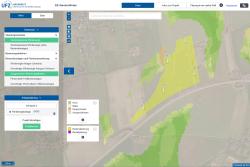
The EE-Standortfinder helps identify suitable sites for wind and solar energy and can support local planning, consultation, and public engagement.
Photo: UFZ
Suitable sites are urgently needed across Germany to support the energy transition. However, finding suitable sites is difficult, and local discussions are often emotionally charged because differing interests, spatial requirements, and sector-specific considerations come into conflict. “Much of the information needed for site selection is already available as spatial data. However, it comes from different sources and is often very time-consuming to analyse without in-depth GIS expertise”, says Nora Mittelstädt, who heads the EE-Standortfinder project at the UFZ. The UFZ web application presents the relevant information so that site potential and possible conflicts of interest can be identified at an early stage.
On an interactive map of Germany, the Renewable Energy Site Finder uses a colour scale from green (high) through yellow (medium) to red (limited) to show how suitable potential sites are for wind turbines and open-space photovoltaic (PV) systems based on legal, technical, and ecological criteria. Areas where wind or solar energy development is excluded for legal, technical, or ecological reasons are marked in grey. Fifty-four criteria, including vegetation, protected area categories, built-up areas, water bodies, and transport infrastructure, are used to assess potential wind turbine sites. The assessment also considers the risk of collisions between wind turbines and breeding birds such as the red kite (Milvus milvus), Eurasian eagle-owl (Bubo bubo), and white-tailed eagle (Haliaeetus albicilla) as well as the biodiversity area indicator developed by the Leibniz Institute of Ecological Urban and Regional Development. This indicator assesses the quality and diversity of biotope types as habitats for different species. The potential for open-space PV systems is assessed using 42 criteria, including vegetation, protected area categories, built-up areas, water bodies, transport infrastructure, and the agricultural yield potential of soils. The criteria are classified as ‘suitable’, ‘conditionally suitable’, or ‘unsuitable’ for the construction of a wind or solar energy installation.
Users can place proposed wind turbines and open-space PV systems at selected locations on the map and assess site suitability based on the criteria. The more criteria that are ‘suitable’, the more favourable the conditions for a potential site. The Renewable Energy Site Finder also estimates the expected annual energy yield of wind and PV installations and the financial benefits for municipalities within a 2,500-metre radius or for the municipality in which the installation would be located. These amounts can therefore be included in the overall assessment and used by local stakeholders and civil society for participation and budget planning. “The EE-Standortfinder does not automatically determine the best site but rather provides a transparent and comprehensible information base that can support local planning, consultation, and public engagement processes”, says Nora Mittelstädt.
The application is aimed at not only at local authorities, energy agencies, and consultancy firms but also those involved in spatial, regional, and renewable energy planning as well as the general public. “The energy transition is also being shaped at the local level. The Renewable Energy Site Finder shows at an early stage where conditions are favourable for wind and solar energy and where potential conflicts may arise”, says researcher David Manske, who helped develop the application.
The EE-Standortfinder is not only a planning tool but also the subject of social science research. RIFS researchers are investigating how the web application influences consultation and participation processes and subsequent site selection decisions. For example, they are examining whether the digital decision-making tool helps identify conflicts earlier and whether this increases the acceptance and legitimacy of decisions.
The project was funded by the Federal Ministry for Economic Affairs and Energy and carried out by the Helmholtz Centre for Environmental Research (UFZ) and the Research Institute for Sustainability at the GFZ (RIFS).
EE-Standortfinder: https://web.app.ufz.de/gdi/ee-standortfinder
Questions and suggestions regarding the EE-Standortfinder: ee-monitor@ufz.de
Further information on the environmental sustainability of the energy transition in Germany can be found at https://ee-monitor.de
Further information
Nora Mittelstädt
UFZ Department of System Analysis and Sustainability Assessment
nora.mittelstaedt@ufz.de
UFZ press office
Susanne Hufe
Phone: +49 341 6025-1630
presse@ufz.de
In the Helmholtz Centre for Environmental Research (UFZ), scientists conduct research into the causes and consequences of far-reaching environmental changes. Their areas of study cover water resources, ecosystems of the future, environmental technologies and biotechnologies, the effects of chemicals in the environment, modelling and social-scientific issues. The UFZ employs more than 1,100 staff at its sites in Leipzig, Halle and Magdeburg. It is funded by the Federal Government, Saxony and Saxony-Anhalt.
www.ufz.deThe Helmholtz Association contributes to solving major challenges facing society, science and the economy with top scientific achievements in six research fields: Energy; Earth and Environment; Health; Key Technologies; Matter; and Aeronautics, Space and Transport. With some 39,000 employees in 19 research centres, the Helmholtz Association is Germany’s largest scientific organisation.
www.helmholtz.de