
Press Release, 28. September 2026
Attractive butterflies in the spotlight
A study examines which butterflies are considered particularly attractive and how this affects research and conservation.
Large, decorative butterflies attract considerably more interest than less spectacular species. According to an international study involving researchers from the Helmholtz Centre for Environmental Research (UFZ), this preference is reflected not only in public attention but also in scientific research and nature conservation efforts. By contrast, less attractive butterflies are more common on the Red Lists of threatened species. In a recent article in Current Biology, the research team emphasises that this imbalance and its consequences must be given greater consideration in nature conservation.
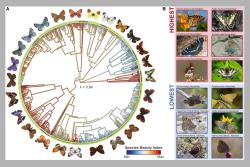
The Species Beauty Index (SBI) for European butterflies. A (left) shows typical representatives alongside the phylogenetic tree of European butterflies. Red colours indicate higher SBI values while blue colours indicate lower values. B (right) shows species from different families that are among those with the highest and lowest SBI values.
Photo: Leonardo Dapporto / Current Biology
With its large, pale-yellow wings, striking pattern and decorative hindwing tails, the yellow swallowtail (Papilio machaon) has long been considered particularly attractive and has accordingly received a high rating in a recent online survey led by Prof. Dr Leonardo Dapporto and Mariagrazia Portera from the University of Florence. As part of the study, more than 21,000 people from over one hundred countries viewed photographs of European butterflies and were asked to rate their beauty on a scale of 1 to 10 based on their first impression.
“This enabled us to identify a whole range of characteristics that people appreciate in butterflies”, explains Dr Elisabeth Kühn from the UFZ, who coordinated this survey for Germany. The most attractive butterflies tend to have bright colours, particularly yellow and blue, contrasting patterns, and large, serrated wings or, as in the case of the yellow swallowtail, distinctive hindwing tails. By contrast, small, inconspicuous, brownish species tend to attract less attention and are more likely to be overlooked. “The vast majority of respondents shared this view. It didn’t matter whether they were familiar with butterflies”, says Kühn. Based on the ratings, a ‘beauty index’ was calculated for each of the nearly 500 European species studied. The higher the value, the more attractive the species was considered.
But what are the consequences of this difference in appeal? To find this out, the team first analysed how much public attention each species attracted. How often had people uploaded photos of each species to the online platforms Flickr and iNaturalist? How many Wikipedia articles were there about each species, and how often were they read? The trend clearly shows that more attractive species receive greater attention in all these areas than less conspicuous species. “We had expected this to be the case in terms of public perception. However, we were surprised to find the same pattern in scientific research”, says Kühn. The number of published gene sequences and the number of published studies are both considerably higher for these attractive butterflies.
Statistical analyses by the research team show that less attractive butterflies are also disadvantaged under European nature conservation legislation. In 1979, the Council of Europe adopted an international treaty governing the protection of wild plants and animals as well as habitats. The Bern Convention contains extensive lists of animals and plants subject to varying degrees of protection. However, even there, butterflies with a high beauty index are over-represented.
This bias extends even to the 1992 Fauna-Flora-Habitat (FFH) Directive, one of the key legal foundations for nature conservation in the EU. Because the FFH Directive is based on the Bern Convention, it reflects the same preference for attractive species. This has far-reaching consequences because the Directive determines where European nature conservation funding and management measures are concentrated. For example, through its LIFE programme, the EU funds projects to support endangered animals and plants, particularly species covered by the FFH Directive. Here, too, more attractive butterflies are over-represented.
By contrast, attractive butterflies do not appear any more frequently than other species on the national and European Red Lists for 2010 and 2025. This is probably because these lists of endangered species are compiled according to fixed criteria. “The key factor is how common a species is, or, where applicable, how rapidly its numbers are declining”, says Kühn. Visual appeal plays no role in this assessment.
According to the 2025 lists, less attractive butterflies actually tend to fare worse than more attractive species. “For example, many inconspicuous brown species in the Alps are under serious threat from climate change”, says Kühn. As temperatures rise, butterflies such as the cold-loving Alpine graying (Oeneis glacialis) are shifting to ever higher altitudes until no suitable habitat remains. “Such species need to be given greater consideration in European nature conservation; after all, they fulfil equally important functions within ecosystems”, says Kühn. Climate change is a much more important threat today than it was when the FFH list was drawn up in 1992. More than half of the butterfly species classified as endangered are now threatened by rising temperatures. And it is not primarily the most attractive species.
Nevertheless, Kühn believes that using attractive species as flagships for nature conservation projects can be useful. “This simply attracts much more attention and increases the chances of preserving habitats”, she says. This benefits all species in these habitats regardless of their attractiveness. “However, it is important that we gather as much information as possible even about less attractive species”, says Kühn. Only by obtaining data on as many species as possible can researchers determine which ones need protection.
That is why, more than 20 years ago, the UFZ, in collaboration with the Gesellschaft für Schmetterlingsschutz (GfS; Society for Butterfly Conservation), launched the Tagfalter-Monitoring Deutschland (TMD; Butterfly Monitoring Programme for Germany). As part of this initiative, hundreds of dedicated citizen scientists across Germany set out every year from April to the end of September to observe butterflies, identify the species, and count the individuals. Week after week, they walk a fixed route of up to one kilometre and use a standardised procedure to record the butterflies they encounter along the way. “Of course, we’ve also noticed that people find some species more attractive than others”, says Kühn, who coordinates the TMD at the UFZ. The TMD participants also upload more photos of particularly attractive butterflies. However, all species, including the less attractive brown ones, are recorded.
Video: https://www.youtube.com/watch?v=6XVaDaf_lOM
Publication:
Leonardo Dapporto et al.: Beauty bias in butterfly research and conservation; Current Biology, https://doi.org/10.1016/j.cub.2026.07.049
Further information
Dr Elisabeth Kühn
UFZ Department of Conservation Biology & Social-Ecological Systems
elisabeth.kuehn@ufz.de
UFZ press office
Susanne Hufe
Phone: +49 341 6025-1630
presse@ufz.de
In the Helmholtz Centre for Environmental Research (UFZ), scientists conduct research into the causes and consequences of far-reaching environmental changes. Their areas of study cover water resources, ecosystems of the future, environmental technologies and biotechnologies, the effects of chemicals in the environment, modelling and social-scientific issues. The UFZ employs more than 1,100 staff at its sites in Leipzig, Halle and Magdeburg. It is funded by the Federal Government, Saxony and Saxony-Anhalt.
www.ufz.deThe Helmholtz Association contributes to solving major challenges facing society, science and the economy with top scientific achievements in six research fields: Energy; Earth and Environment; Health; Key Technologies; Matter; and Aeronautics, Space and Transport. With some 39,000 employees in 19 research centres, the Helmholtz Association is Germany’s largest scientific organisation.
www.helmholtz.de