
Press Release, 17. September 2026
Connecting biodiversity, climate change, and human behaviour as a whole
CBC2026 Conference from 21 to 24 September at the UFZ in Leipzig
Biodiversity loss and climate change are urgent challenges that humanity must address in order to safeguard the basis for human life. This can be successful only if we consider both issues together and take into account how human behaviour can both drive and tackle these problems. Because biodiversity, climate, and human behaviour have long been considered in isolation even within the scientific community, many interactions between them have so far been explored only to a limited extent. At the joint invitation of the Helmholtz Centre for Environmental Research (UFZ) and Leipzig University, researchers from a range of disciplines and over 30 countries will gather in Leipzig from 21 to 24 September for the Connecting Biodiversity, Climate and Human Behaviour (CBC2026) conference. They will discuss the current state of knowledge in this new field of research, identify new research topics, and expand networks at an international level.
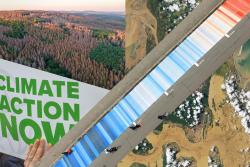
Connecting Biodiversity, Climate, and Human Behavior
Photo: Collage UFZ / Photos: Silvio Bürger and Pixabay
Growing public awareness and scientific evidence are making it increasingly clear that climate change and biodiversity loss are closely interlinked. Human activity is driving both crises, and effective solutions must take these interrelationships into account. However, scientific research into the interplay between these factors is still at an early stage. “We are missing understanding of the link between these crises. We know that how we manage our resources influences the interplay between biodiversity and climate change”, says Prof Dr Karin Frank, an ecological modeller at the UFZ and Chair of the CBC2026 Organising Committee.
The four-day conference will therefore bring together more than 270 international experts from the fields of biodiversity, climate, and behavioural research. These experts will exchange views on the current state of knowledge, identify research gaps, strengthen international networks, and discuss potential ways to solutions.
The organisers are particularly pleased that many participants are PhD students and postdocs at the start of their academic careers because this shows how timely the topic is. Ninety early-career researchers are applying for one of the ‘Awards for Early Career Researchers’.
“Meteorologists like me want to understand how biodiversity can help mitigate the effects of climate change. This requires collaboration with biodiversity researchers and other disciplines, including economics”, says Prof Dr Johannes Quaas, who is also spokesperson for the related Area of Excellence at Leipzig University.
Scientists attending the conference can look forward to a multifarious programme featuring around 180 scientific presentations, 80 poster presentations, and a panel discussion. The topics cover biodiversity and climate research, remote sensing, modelling, AI, environmental psychology, and behavioural research, all in the context of interactions between biodiversity loss and climate change.
Highlights: seven keynote speeches by international experts
One of the keynote speakers is the German climate researcher Prof Dr Hans-Otto Pörtner, who will open the conference with a talk entitled ‘Climate Change and Biodiversity Loss: Existential Challenges for Nature and Humankind’. Pörtner is a researcher at the Alfred Wegener Institute (AWI) and is one of the world’s leading experts on the physiological and ecological impacts of climate change on marine life and ecosystems. From 2015 to 2023, he served as co-chair of Working Group II of the Intergovernmental Panel on Climate Change (IPCC) and thus played a key role in assessing the effects of climate change on human and natural systems. He has been a member of the German Advisory Council on Global Change (WBGU) since 2020. He also chaired the first joint IPBES–IPCC workshop, which resulted in a joint workshop report on the interplay between climate change and biodiversity in 2021.
In her keynote ‘Hidden Foundations: Soil Biodiversity as the Basis of Ecosystem Stability in a Changing World’, Prof Dr Liesje Mommer from Wageningen University & Research will present her research on biodiversity. Mommer, a renowned expert on plant–soil interactions and biodiversity, studies how underground processes, particularly root interactions, soil microbes, and pathogens, influence the functioning, productivity, and resilience of ecosystems. She heads the ‘Wageningen Biodiversity Initiative’, which connects fundamental ecological research with political and societal measures to address biodiversity loss.
In his keynote ‘Climate Change Misinformation: Supply, Demand, and the Challenges to Science in a “Post-Truth” World’, Prof Dr Stephan Lewandowski from the Department of Cognitive Psychology at the University of Bristol discusses the intersection of cognition, misinformation, and societal responses to scientific evidence. He shows how the human mind processes, stores, and updates information and focuses on why people sometimes retain beliefs that contradict scientific evidence.
Additional keynotes will be given by: Prof Dr. Hans Verbeeck (Ghent University): „Lianas in a Changing World: Ten Years of Research on Tropical Forest Functioning”; Prof Dr Moritz Drupp (ETH Zurich): “Navigating sustainability challenges: Insights from economics”; Prof Dr Isabel Martínez Cano (Spanish National Research Council): “Vegetation dynamics in Earth System Models: ecological processes, disturbance and climate change projections” sowie Prof Dr Kelly Fielding (University of Queensland): “How do we promote greater public support for action on climate change and biodiversity loss?”.
Panel discussion ‘CBC Research for Planetary Solutions in Times of Polycrises and Fake News’
In the subsequent panel discussion, ‘CBC Research for Planetary Solutions in Times of Polycrises and Fake News’, experts from science and business will discuss the potential of research at the intersection of climate, biodiversity, and human behaviour, the design of communication strategies and business models, and the challenges of evidence-based policy advice. The panellists include:
- Prof Dr Stephan Lewandowski, an expert in cognitive psychology at the University of Bristol
- Prof Dr Jörg Junhold, Director of Leipzig Zoo, former President of the Association of Zoological Gardens and the World Association of Zoos and Aquariums
- Yvonne Zwick, Chair of BAUM e.V. and European Climate Pact Ambassador, a networker at the interface between business, politics, and society
- Prof Dr Josef Settele, agricultural biologist at the UFZ, member of the German Advisory Council on the Environment (SRU), and contributor in various roles to reports by the Intergovernmental Science-Policy Platform on Biodiversity and Ecosystem Services (IPBES)
“We are delighted that these four experts have agreed to join the panel. They are already working on solutions and will share their specialist knowledge, particularly where research meets practice”, says Frank.
The CBC2026 conference will take place from 21 to 24 September at the KUBUS in Leipzig, at the Helmholtz Centre for Environmental Research (UFZ). The conference is being organised by the UFZ and the University of Leipzig. The idea for this stems from the “Breathing Nature” initiative, a network of research institutions in central Germany.
You can find the full conference programme here: https://cbc-conference.org/program/
Members of the press are particularly welcome to attend the keynote speeches and the panel discussion on 23 September 2026 from 2:45 pm to 3:30 pm. Please register at presse@ufz.de.
If you are interested in speaking to individual speakers during the conference, please contact us at the email address above. We can help arrange this.
Further information
Prof Dr Karin Frank
Head of UFZ Department Ecological Modelling
karin.frank@ufz.de
Prof Dr Johannes Quaas
Faculty of Physics and Earth System Sciences, University of Leipzig
johannes.quaas@uni-leipzig.de
UFZ press office
Susanne Hufe
Phone: +49 341 6025-1630
presse@ufz.de
In the Helmholtz Centre for Environmental Research (UFZ), scientists conduct research into the causes and consequences of far-reaching environmental changes. Their areas of study cover water resources, ecosystems of the future, environmental technologies and biotechnologies, the effects of chemicals in the environment, modelling and social-scientific issues. The UFZ employs more than 1,100 staff at its sites in Leipzig, Halle and Magdeburg. It is funded by the Federal Government, Saxony and Saxony-Anhalt.
www.ufz.deThe Helmholtz Association contributes to solving major challenges facing society, science and the economy with top scientific achievements in six research fields: Energy; Earth and Environment; Health; Key Technologies; Matter; and Aeronautics, Space and Transport. With some 39,000 employees in 19 research centres, the Helmholtz Association is Germany’s largest scientific organisation.
www.helmholtz.de