Press Release, 27. August 2026
Making biodiversity count – UFZ launches the 'TripleBird' research project
Bird data enable scenarios and applications for nature conservation and businesses
In many areas – whether at the global, national, or regional scale – the condition of ecosystems is deteriorating and the populations of many animal and plant species are declining. One problem from a scientific perspective: local declines in biodiversity can rarely be demonstrated. However, changes in bird populations in Germany over the years have been well documented. The Helmholtz Centre for Environmental Research (UFZ) has therefore launched the ‘TripleBird’ project in partnership with the German Federation of Avifaunists (DDA) and in collaboration with the German Centre for Integrative Biodiversity Research (iDiv) and the University of Potsdam. Together with the states of Saxony and Saxony-Anhalt, the Federal Ministry for Research, Technology and Space (BMFTR) will fund the project with around €5 million over the coming years. The UFZ will establish the technical infrastructure for data access and analysis, develop model-based scenarios, and explore potential applications for nature conservation as well as the business and financial sectors. As a first step, a nationwide bird monitor is to be released by the end of the year.
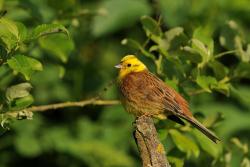
The yellowhammer (Emberiza citrinella) is one of the bird species found in the agricultural landscape whose numbers have declined in recent years: since 2006, more than one in four yellowhammers in Germany has disappeared.
Photo: Christian Gelpke
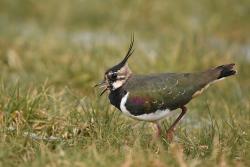
According to the Red List, the lapwing (Vanellus vanellus) is classified as 'critically endangered' in Germany. The lapwing population has declined by 80 per cent since 1990.
Photo: Christian Gelpke
A key challenge in biodiversity research is making changes in biodiversity measurable at local, regional, national, and global levels. This is the only way to investigate their causes and describe their effects on ecosystems. “However, when it comes to protecting biodiversity, we often lack the concrete data we need, and there are still no generally accepted indicators that reflect spatial and temporal changes in biodiversity”, says biodiversity researcher Prof. Dr. Katrin Böhning-Gaese, Principal Investigator and Scientific Director of the UFZ.
Birds currently have the best data coverage: all species (approx. 11,000) worldwide are known. For many bird species, high-quality data exist on ecological and morphological characteristics, ranges, and abundance – often even down to regional and local levels. There are also comprehensive monitoring programmes in place across Europe and North America. In Germany, thanks to the efforts of many volunteers, the Federation of German Avifaunists (DDA) has been coordinating a monitoring programme for rare breeding birds since 1977 and for common breeding birds since 1989. Birds are particularly well suited as indicators of biodiversity loss because they reflect a wide range of conditions and trends in landscapes. For example, the decline of many bird species such as the skylark (Alauda arvensis), the grey partridge (Perdix perdix), and the lapwing (Vanellus vanellus) in agricultural landscapes shows that habitat quality has deteriorated dramatically over recent decades. Since species diversity is an indicator of ecosystem resilience, this suggests that fields, meadows, and pastures are losing stability, with potential negative consequences for food security. “In ‘TripleBird’, we therefore want to combine bird data with climate, environmental, and land-use data to publish a bird monitor, develop model-based scenarios of changes in bird populations, and devise applications for nature conservation, business, and public authorities”, says Böhning-Gaese.
'BirdTwin': data infrastructure
As a digital twin, BirdTwin forms the foundation of the overall project. The dataset is based on more than 3.8 million precise observations from the DDA monitoring programme for common breeding birds (MhB). In addition to the MhB data, around one million complete observation lists were provided by the DDA via the bird sighting reporting portal. In ‘BirdTwin’, these monitoring data will be made available to both public and professional users and integrated into a digital twin for operational use. The bird data are supplemented by additional climate, environmental, and land-use data for Germany. “Using the digital twin, we ensure that these data are processed appropriately for specific requirements and made available for model-based scenario development and applications in nature conservation”, says Petra Jacobs, who leads 'BirdTwin'.
As a first step, a bird monitor for Germany is to be released before the end of this year and then updated annually. In the beginning, it will focus on nine bird species found in agricultural landscapes, whose populations have, in some cases, declined significantly in recent decades. The species in the set include the skylark (Alauda arvensis), the yellowhammer (Emberiza citrinella), the corn bunting (Emberiza calandra), the whinchat (Saxicola rubetra), and the lapwing (Vanellus vanellus). According to Jacobs, further species are to be added gradually so that the monitor will soon include all common breeding bird species in Germany. Because historical bird data up to 2005 are also included, population trends can be identified – for example, in which regions bird populations have increased or decreased, where hotspots for individual species are located, and how the land is being used and what climatic conditions prevail in the areas populated by the birds.
'BirdFutures': models and scenarios
In order to investigate possible causes of changes in bird populations and assess future trends, model-based scenarios are being developed as part of ‘BirdFutures’. “We can explore various scenarios relating to land use and climate”, says UFZ project leader Dr. Tatiane Micheletti. These include the shift towards extensive farming on agricultural land, the increase in the proportion of fallow land, and the expansion of hedgerow networks. “This enables us to predict what impact certain measures will have on the bird species found in these areas and consequently, on biodiversity”, says Micheletti. These models will enable different policy measures and management strategies to be compared and evaluated. This enables decision-makers in nature conservation and politics as well as public authorities to assess the potential impact of their decisions on biodiversity in the context of the EU Common Agricultural Policy or the EU Nature Restoration Regulation.
'BirdBusiness': link to the business world and finance sector
Building on the output from 'BirdTwin' and 'BirdFutures', applications for the business and financial sectors will be developed, tested and and piloted in collaboration with NGOs, banks and companies within 'BirdBusiness'. “The requirements for stress tests on banks and for corporate sustainability reporting are increasingly calling for a focus on the role of biodiversity in ensuring economic stability. For example, the aim is to determine whether companies are investing in a region particularly important for biodiversity and whether these investments could have an impact on biodiversity”, says Dr. Johannes Förster, responsible for the finance sector. The EU Corporate Sustainability Reporting Directive (CSRD) requires, in particular, large companies with a major impact on biodiversity to publish data on their ecological footprint.
Because the models in 'TripleBird' provide spatially specific information on the state of biodiversity and how it is changing, they can also be used to support investment and site selection decisions for example, to assess how habitats might be affected by new production facilities, industrial plants, or data centres and how such impacts could be minimised through compensation measures. However, the tool could also be important for public authorities and nature conservation organisations. “The aim is to develop applications that make it possible to identify priority areas at the local level, where specific measures relating to nature conservation and agriculture could be particularly beneficial. This could benefit state authorities that must decide on the locations for new business developments or restoration projects”, says Förster.
'BirdFutures' is receiving funding of approximately €2.7 million over six years from the Federal Ministry of Research, Technology and Space (BMFTR) under grant reference number 033L313A. The BMFTR is funding ‘BirdFutures’ as part of the ‘Research for Sustainability’ (FONA) strategy.
'BirdTwin' is being funded for three years with tax revenue totalling approx. €1.5 million under funding reference number I 299 based on the budget approved by the State Parliament of Saxony-Anhalt.
'BirdBusiness' is co-funded with €1 million in tax revenue under the budget approved by the Saxon State Parliament.
Information on the 'TripleBird' project can be found at https://www.ufz.de/triplebird/index.php?en=52656
Further information
Prof. Dr. Katrin Böhning-Gaese
Scientific Director of the UFZ / Principal Investigator TripleBird
presse@ufz.de
Petra Jacobs
UFZ Department of Conservation Biology & Social-Ecological Systems / BirdTwin sub-project
petra.jacobs@ufz.de
Dr Tatiane Micheletti
UFZ Department of Ecological Modelling / BirdFutures sub-project
tatiane.micheletti@ufz.de
Milina Alber
UFZ-Knowledge and Technology Transfer / BirdBusiness sub-project
milina.alber@ufz.de
Dr. Johannes Förster
UFZ Department of Environmental Politics / BirdBusiness sub-project
johannes.foerster@ufz.de
UFZ press office
Susanne Hufe
Phone: +49 341 6025-1630
presse@ufz.de
In the Helmholtz Centre for Environmental Research (UFZ), scientists conduct research into the causes and consequences of far-reaching environmental changes. Their areas of study cover water resources, ecosystems of the future, environmental technologies and biotechnologies, the effects of chemicals in the environment, modelling and social-scientific issues. The UFZ employs more than 1,100 staff at its sites in Leipzig, Halle and Magdeburg. It is funded by the Federal Government, Saxony and Saxony-Anhalt.
www.ufz.deThe Helmholtz Association contributes to solving major challenges facing society, science and the economy with top scientific achievements in six research fields: Energy; Earth and Environment; Health; Key Technologies; Matter; and Aeronautics, Space and Transport. With some 39,000 employees in 19 research centres, the Helmholtz Association is Germany’s largest scientific organisation.
www.helmholtz.de