
Brief Information, 14. August 2025
Two student teams win ‘Jugend forscht’ competition with UFZ support
Microorganisms for clean groundwater and the use of viruses for pest control convince the jury
On June 1st, the winners of this year's ‘Jugend forscht’ competition were awarded. In the national finale, 167 young people competed in the fields of mathematics, computer science, natural sciences and technology. Among the winners were two teams supervised by UFZ researchers. They received awards in the fields of biology and physics.
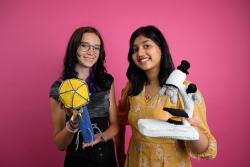
Misha Hegde and Mira Maurer
Photo: Stiftung Jugend forscht e. V.
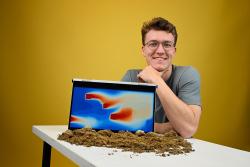
Tobias Pötzsch
Photo: Stiftung Jugend forscht e. V.
The science competition ‘Jugend forscht’ aims to promote enthusiasm for mathematics, computer science, natural sciences and technology among talented young people. This year, 112 projects were submitted, some of which were developed in cooperation with research institutions and companies. The UFZ also supported participants in their work – with great success: two projects supervised by the UFZ were honoured with awards. Students Misha Hegde and Mira Maurer won the first prize in the field of biology and two special prizes with their project ‘Bacteria on the Menu 2.0’. Furthermore, Tobias Pötzsch's contribution ‘Simulations and Tools for Bioreactive Transport’ was awarded a special prize by the German Federal Environmental Foundation in the field of environmental technology.
With their award-winning project ‘Bacteria on the Menu 2.0’, 15-year-old students Misha Hegde and Mira Maurer (both from Seeheim-Jugenheim in Hessen) have qualified for the European Union Contest for Young Scientists. The aim of their work was to prove that bacteriophages – viruses that exclusively infect bacteria – can combat bacterial pathogens in plants. To do this, they isolated viruses from the soil in their garden and discovered a new phage from the podovirus group.
Dr Nawras Ghanem from the UFZ Department of Applied Microbial Ecology supported the two students in their work and provided them with insights into the research with phages. ‘We are a kind of mentor or quality control,’ he says, explaining his role as a supervisor. ‘We shared our expertise on how to work with phages, how to propagate them and how to use them experimentally.’ At the start of the research project, they had planned on using Escherichia coli and T4 phages as a model system. But since working with pathogenic bacteria wasn't a feasible option due to safety precautions, the two students decided to go with the plant pathogen Rhizobium radiobacter instead. They successfully used this host to isolate a new phage. ‘We are talking about bacterial plant diseases that are usually treated with pesticides or chemicals. We have developed an environmentally friendly solution for this,’ says Nawras Ghanem, emphasising the significance of the discovery of the new phage. For him, working with the students is an important part of his job and a contribution to society. He feels it is important to pass on information and give motivated students the opportunity to explore things for themselves that cannot be done in the classroom. How the research on bacteriophages will continue, is not yet decided. A possible next step would be to characterise the phages. Nawras Ghanem would be happy to continue working on this project.
18-year-old Tobias Pötzsch from Taucha near Leipzig dedicated his project in the ‘Physics’ category to a mathematical model that can simulate the degradation of pollutants dissolved in groundwater by microorganisms. For this purpose, he developed a special computer programme designed to solve partial differential equations and expanded the OpenGeoSys simulation software, which UFZ researchers use in their work, too. His project was supported by Dr. Christoph Lehmann from the UFZ Department of Environmental Informatics. He introduced Tobias Pötzsch to the software and assisted him with the individual steps of modelling, as well as through feedback rounds and discussions of his findings.
Tobias Pötzsch's work started as an internship, developed into a school project and finally became a contribution for ‘Jugend forscht’. Like Nawras Ghanem, Christoph Lehmann also considers working with young researchers to be an integral part of his job: ‘The UFZ is a state-funded research centre. That's why I see it as our responsibility to promote education, and Tobias is someone with enormous potential,’ he says. The student has already improved existing models and used parameter studies to investigate various conditions for pollutant degradation by microorganisms. Moreover, he has developed a user-friendly visualisation and exploration tool. This allows the results of his work to become more accessible to people without programming knowledge. Christoph Lehmann even sees potential in this for further developing the OpenGeoSys simulation software: ‘I would like to see us integrate the results into the main version of OpenGeoSys.’
(Annika Zegowitz, student)
Further information
UFZ press office
Susanne Hufe
Phone: +49 341 6025-1630
presse@ufz.de
In the Helmholtz Centre for Environmental Research (UFZ), scientists conduct research into the causes and consequences of far-reaching environmental changes. Their areas of study cover water resources, ecosystems of the future, environmental technologies and biotechnologies, the effects of chemicals in the environment, modelling and social-scientific issues. The UFZ employs more than 1,100 staff at its sites in Leipzig, Halle and Magdeburg. It is funded by the Federal Government, Saxony and Saxony-Anhalt.
www.ufz.deThe Helmholtz Association contributes to solving major challenges facing society, science and the economy with top scientific achievements in six research fields: Energy; Earth and Environment; Health; Key Technologies; Matter; and Aeronautics, Space and Transport. With some 39,000 employees in 19 research centres, the Helmholtz Association is Germany’s largest scientific organisation.
www.helmholtz.de