
Press Release, 11. June 2026
Landscape Water Velocities Control Nitrogen Pollution
The nitrogen pollution risk is therefore also climate-related
Nitrate pollution is a growing global environmental challenge due to the extensive use of fertilizer. A study published in Science, led by the Leibniz Institute of Freshwater Ecology and Inland Fisheries (IGB) with the Helmholtz Centre for Environmental Research (UFZ), shows that both the amount of water moving through landscapes and how fast it moves, play a key role in nitrogen pollution risk. The findings reveal that increasing pollution is often climate-driven by extreme acceleration or deceleration of water cycling. To explain this, the researchers introduce the concept of “wetness boundaries”, where crossing these wetness thresholds – whether below or above them – amplifies nitrogen leaching. Their projections suggest reduced pollution risks across much of of Europe by 2100 under low emission scenario, but highlight increasing risks in large parts of Eastern and Southern Europe under high emission scenario.
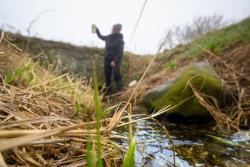
In the Demnitzer Mühlenfließ study area, data on the landscape water balance is continuously collected across an area of 66 km².
Photo: David Ausserhofer, IGB
Anthropogenic inputs of nitrogen to the terrestrial biosphere have doubled since the pre-industrial era, mainly due to the application of synthetic and organic fertilizers. Excess nitrogen leaches into the water bodies, posing risks to freshwater eutrophication, drinking water supply, food production, and ecosystem sustainability. To better understand the nitrogen transport, the research team developed a process-based model to track water and nitrogen fluxes using stable water isotopes. The model was applied to over 3,800 European river basins and researchers mapped the velocities of water cycling; assessing how acceleration and deceleration in wetter and drier climatic conditions have reshaped nitrogen pollution since the 1980s. The study also projects how this is likely to evolve towards the end of the 21st century.
Why water velocities play a role in nitrogen pollution
Water velocity plays a key role in nitrogen pollution because it determines the balance between transport and retention. Faster water velocities, commonly found in along Europe’s north west coast and mountainous regions, shorten the time available for nitrogen removal and increases the risk of leaching from soils to groundwater and streams. In contrast, slower velocities, which dominate lowland regions, allow more time for plants and microorganisms to remove nitrogen. “Previously nitrogen pollution was mainly attributed to anthropogenic inputs like fertilizer, here we demonstrated that water velocity is also a critical control on nitrogen leaching”, said lead author Dr. Songjun Wu.
Experience since 1980s – climatic extremes increase pollution risk
Summarizing the changes since the 1980s, the study found that the magnitude of climate-driven hydrological shifts determines the evolution of nitrogen cycling. Moderate variation generally reduces nitrogen leaching, whereas extreme shifts tend to increase leaching. For instance, strong acceleration in wetter periods can rapidly flush nitrogen into water bodies with little time for retention, while strong deceleration is often associated with drought, suppressing plant/microbial uptake and resulting in soil nitrogen accumulation as well as pulse leaching during large rainfall events. To capture these dynamics, the researchers introduce the concept of “wetness boundaries” – remaining within these limits mitigate leaching risks, while crossing them leads to increased pollution. As project supervisor Professor Doerthe Tetzlaff from IGB and Humboldt University zu Berlin explained, “the wetness boundaries can help define a safe operating space resilient to hydrological change and can be used to identify potential increased risk in nitrogen leaching.”
Climate change creates multiple risks
The study further projects the co-evolution of water and nitrogen cycling across Europe until 2100 and found contrasting trajectories. Under the low emission scenario hydrological changes are expected to remain within wetness boundaries with reduced nitrogen leaching in over 70% of Europe. “This scenario can be explained by higher temperatures and longer growing seasons, which promote uptake and metabolism in plants and organisms”, said Dörthe Tetzlaff. Under high emission scenarios, however, continued drying may suppress vegetation and microbial uptake over extensive areas in Eastern and Southern Europe, increasing the risk of nitrogen accumulation and subsequent leaching during extreme events. “This drying trend creates dual risks for both water quantity and quality, and may also affect other regions like Central and East Asia”, said co-author Professor Chris Soulsby from the University of Aberdeen in Scotland.
"In addition to land use, the water balance plays a crucial role in the risk of nitrate pollution in soils and water bodies. Under the influence of climate change, this risk could therefore shift. The study demonstrates that we must understand nitrate pollution within the complex interplay of transport and retention in the landscape. The projections shown here expand our knowledge of potential scenarios and pinpoint regions in Europe where climate change will negatively impact nitrate levels," summarizes UFZ hydrogeologist Dr. Andreas Musolff.
How to prevent such negative developments?
To mitigate such risks, the study highlights the importance of keeping hydrological changes within wetness boundaries. This can be achieved either by addressing climate extremes or by expanding these boundaries through reducing anthropogenic nitrogen inputs, for example via crop rotation, optimized fertilization, and improved wastewater treatment.
Publication:
Songjun Wu, Chris Soulsby, Yi Zheng, Andreas Musolff, Doerthe Tetzlaff: Divergent Evolution of Nitrogen Cycling Along Gradients of Landscape Water Velocities; Science, DOI: 10.1126/science.aed0399
Further information
Dr Andreas Musolff
UFZ Department Hydrogeology
andreas.musolff@ufz.de
UFZ press office
Susanne Hufe
Phone: +49 341 6025-1630
presse@ufz.de
In the Helmholtz Centre for Environmental Research (UFZ), scientists conduct research into the causes and consequences of far-reaching environmental changes. Their areas of study cover water resources, ecosystems of the future, environmental technologies and biotechnologies, the effects of chemicals in the environment, modelling and social-scientific issues. The UFZ employs more than 1,100 staff at its sites in Leipzig, Halle and Magdeburg. It is funded by the Federal Government, Saxony and Saxony-Anhalt.
www.ufz.deThe Helmholtz Association contributes to solving major challenges facing society, science and the economy with top scientific achievements in six research fields: Energy; Earth and Environment; Health; Key Technologies; Matter; and Aeronautics, Space and Transport. With some 39,000 employees in 19 research centres, the Helmholtz Association is Germany’s largest scientific organisation.
www.helmholtz.de