
Press Release, 04. May 2026
Physics-based Weather Models more Reliable than AI for Extreme Events
Study reveals limitations of AI-based weather forecasts for record-breaking storms, heat waves, and cold waves
Artificial Intelligence (AI) has rapidly transformed weather forecasting in recent years. Modern AI models deliver fast and energy-efficient predictions and, under average weather conditions, often achieve accuracy comparable to—or even exceeding—that of classical physics-based numerical models. However, for particularly severe, record-breaking extreme events, AI-based forecasts reach their limits. This is shown by a new international study led by Karlsruhe Institute of Technology (KIT) and University of Geneva, in which the Helmholtz Centre for Environmental Research (UFZ) also participated. The results were published in Science Advances.
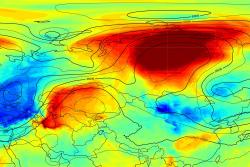
The figure shows temperature anomalies during the 2020 Siberian heatwave, an event that shattered historical records and triggered widespread impacts, including severe wildfires. The study finds that for this event, and many other record-breaking extremes, AI-based weather forecasts still substantially underperform compared to physics-based models.
Photo: Zhongwei Zhang, KIT
How well modern AI weather models predict extreme heat, cold, and wind events that exceed historical records was investigated by researchers led by Dr. Zhongwei Zhang at the Institute of Statistics at KIT. The result: under these exceptional weather conditions, the physics-based high-resolution model HRES of the European Centre for Medium-Range Weather Forecasts consistently outperforms the currently leading AI models.
AI Systematically Underestimates Records
The scientists compared several established AI models–including GraphCast, Pangu-Weather, and Fuxi–with the physics-based reference model HRES. While AI models perform well in overall evaluations across all weather situations, they show consistently larger forecast errors for record-breaking events. In particular, they underestimate both the intensity and the frequency of extreme events. “Our analyses show that AI models generally underestimate the intensity of heat, cold, and wind records,” explains Zhongwei Zhang. “The greater the exceedance of the record of their training data, the larger the underestimation.”
Limitations of Neural Networks underlying AI-Models
The researchers attribute this to a fundamental limitation of pure data-driven models: AI systems learn from historical data and are particularly effective at predicting weather patterns that resemble those observed in the past. By definition, however, record-breaking events lie outside previous experience. “Neural networks struggle to reliably extrapolate beyond their training domain – that is, to make predictions beyond previously observed values,” says Professor Sebastian Engelke, Full Professor at the University of Geneva. “Physics-based models such as HRES, by contrast, are based on fundamental laws of physics. This ensures that their forecasts are still reliable when the atmosphere moves into states that have not yet been observed.” Such record-breaking weather situations are occurring more frequently in a rapidly warming climate, with sometimes severe consequences for health, infrastructure, and the economy.
Implications for Early Warning Systems
The findings are particularly relevant for early warning systems and disaster management. A systematic underestimation of extreme events can result in warnings being issued too late – or not at all.
The authors of the study therefore emphasize that AI weather models cannot currently replace classical numerical forecasts. “For high-risk applications, one should not rely solely on AI,” states Zhongwei Zhang. “Climate change also leads to more concurrent extreme events, an additional challenge for AI-based weather forecasting models”, adds Professor Jakob Zscheischler, Head of the Department of Compound Environmental Risks at the Helmholtz Centre for Environmental Research (UFZ). Instead, the researchers recommend a parallel use of both approaches, as well as further research into hybrid models and physics-informed neural networks that combine physical knowledge with AI methods.
Perspectives for Improved AI Models
At the same time, the study identifies pathways for making AI-based weather forecasts more robust in the future. These include, among other measures, targeted enrichment of training data with simulated extreme events, new training methods from extreme value statistics, and hybrid modeling approaches. Until then, the central message remains clear: “AI is a powerful tool for weather forecasting—but for the most extreme and potentially high-impact events, physics-based models remain indispensable,” Sebastian Engelke concludes.
Publication:
Zhongwei Zhang, Erich Fischer, Jakob Zscheischler and Sebastian Engelke: Physics-basedl models outperform AI weather forecasts of record-breaking extremes. Science Advances, 2026. DOI: 10.1126/sciadv.aec1433.
Further information
Prof Dr Jakob Zscheischler
Head of UFZ Department of Compound Environmental Risks
jakob.zscheischler@ufz.de
UFZ press office
Susanne Hufe
Phone: +49 341 6025-1630
presse@ufz.de
In the Helmholtz Centre for Environmental Research (UFZ), scientists conduct research into the causes and consequences of far-reaching environmental changes. Their areas of study cover water resources, ecosystems of the future, environmental technologies and biotechnologies, the effects of chemicals in the environment, modelling and social-scientific issues. The UFZ employs more than 1,100 staff at its sites in Leipzig, Halle and Magdeburg. It is funded by the Federal Government, Saxony and Saxony-Anhalt.
www.ufz.deThe Helmholtz Association contributes to solving major challenges facing society, science and the economy with top scientific achievements in six research fields: Energy; Earth and Environment; Health; Key Technologies; Matter; and Aeronautics, Space and Transport. With some 39,000 employees in 19 research centres, the Helmholtz Association is Germany’s largest scientific organisation.
www.helmholtz.de