Press Release, 04. March 2026
Microbe-based technologies make it possible: wastewater as a source of energy and raw materials
Technologies that use electrochemically active microorganisms make it possible to extract not only clean water but also electricity and nutrients from wastewater. In a review article published in Frontiers in Science, researchers from the University of Greifswald and the Helmholtz Centre for Environmental Research (UFZ), together with international colleagues, highlight the considerable potential of microbial electrochemical technologies (MET) to protect the environment and conserve valuable resources.
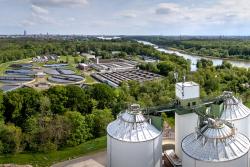
The Rosental Wastewater Treatment Plant, which currently has a population of around 630,000, is the main treatment plant for the city of Leipzig.
Photo: Leipziger Gruppe
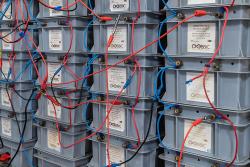
A system installed in Durban (South Africa) collects urine and greywater from a communal washroom.
Photo: Uwe Schröder
Around 359 billion cubic metres of wastewater – four times the volume of Lake Geneva – are produced worldwide every year. “This represents over 800,000 GWh of chemical energy and is comparable to the annual output of 100 nuclear power plants”, says Prof Dr Uwe Schröder of the University of Greifswald, who led the study. “Wastewater also contains plenty of nutrients that we have so far been letting go to waste.”
It’s all down to the right microbes: Electricity from wastewater
This is precisely where microbial electrochemical technologies (MET) come into play: Special microorganisms that naturally occur in wastewater convert the chemical energy it contains into electrical energy while also cleaning the water. In laboratory tests, up to 35% of the energy contained in wastewater has been converted into electricity. Pilot plants such as “Pee Power®” demonstrate that the technology works in practice: For example, in 2015, electricity generated from urine was used to power the lighting in the sanitation facilities at the Glastonbury Festival, a major open-air music festival in southern England. Long-term studies in Uganda, Kenya, and South Africa also show that such systems can reliably treat even large volumes of urine and, by providing well-lit sanitary facilities, help to improve safety.
Worldwide, around 3.5 billion people have no access to adequate sanitation facilities. Researchers see METs as a key step towards achieving the sixth Sustainable Development Goal of the UN: ensuring access to water and sanitation for all. “The widespread adoption of these technologies offers many benefits, particularly in regions with heavily contaminated wastewater, where existing treatment methods are either too costly or do not reach all those who need them”, says Prof Dr Falk Harnisch of the Helmholtz Centre for Environmental Research (UFZ) in Leipzig.
Extracting nutrients from water
Even valuable nutrients such as nitrogen and phosphorus can be recovered from wastewater using METs. Although these nutrients are abundant in wastewater, they are currently sourced elsewhere through energy-intensive, unsustainable, and increasingly costly processes – a situation that METs could transform as part of a sustainable circular economy. “Up to 7% of the demand for phosphate and 11% of the global demand for ammonium nitrogen could be met through recovery from wastewater”, says Schröder.
From the laboratory to the market
In order for METs to be put to rollout, the systems must become more robust, cost-effective, and energy-efficient. Schröder’s team in Greifswald is researching the biochemical and electrochemical principles involved. Some of this work builds on research by Harnisch’s group, which is developing innovative reactors while also exploring applications beyond wastewater treatment, including the use of other waste streams such as those from food processing and paper manufacturing. In any case, substantial efforts to build support for the technology – through funding programmes, pilot plants, and economic incentives – will be needed to gain acceptance among the established wastewater sector and other relevant industries in Central Europe.
Publication:
Schröder, U., Harnisch F., Heidrich E., Ieropoulos I. A., Logan, B.E., Nath, D., Pant D., Patil, S.A., Puig S., Ren J., Rossi R., Rotaru A.-E., ter Heijne, A (2026). Waste to value: microbial electrochemical technologies for sustainable water, material and energy cycles. Frontiers in Science. https://doi.org/10.3389/fsci.2026.1688727.
Further information:
Webinar recording: https://www.youtube.com/watch?v=nQsg2WuDOPk
Further information
Prof Dr Falk Harnisch
Co-Head of the UFZ Department of Microbial Biotechnology
falk.harnisch@ufz.de
Prof Dr Uwe Schröder
University of Greifswald
uwe.schroeder@uni-greifswald.de
UFZ press office
Susanne Hufe
Phone: +49 341 6025-1630
presse@ufz.de
In the Helmholtz Centre for Environmental Research (UFZ), scientists conduct research into the causes and consequences of far-reaching environmental changes. Their areas of study cover water resources, ecosystems of the future, environmental technologies and biotechnologies, the effects of chemicals in the environment, modelling and social-scientific issues. The UFZ employs more than 1,100 staff at its sites in Leipzig, Halle and Magdeburg. It is funded by the Federal Government, Saxony and Saxony-Anhalt.
www.ufz.deThe Helmholtz Association contributes to solving major challenges facing society, science and the economy with top scientific achievements in six research fields: Energy; Earth and Environment; Health; Key Technologies; Matter; and Aeronautics, Space and Transport. With some 39,000 employees in 19 research centres, the Helmholtz Association is Germany’s largest scientific organisation.
www.helmholtz.de