
Statement, 20. February 2026
An intact environment also creates security
We need a cross-hazard approach
The world is currently experiencing the highest number of conflicts since the Second World War. In addition, the global order is increasingly eroding. These threats are serious and must be taken seriously. However, it would be fatal to overlook the risks posed by climate change, biodiversity loss, and environmental pollution, writes UFZ Scientific Director Prof Katrin Böhning-Gaese. In the long term, this would only exacerbate the overall challenges and confront us with enormous new problems.
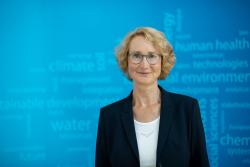
Prof Dr Katrin Böhning-Gaese
Photo: Sebastian Wiedling / UFZ
Times are uncertain. The world is experiencing the highest number of conflicts since the Second World War – and overall also the most brutal. According to a paper by the Peace Research Institute Oslo (PRIO), “these developments underscore a troubling resurgence of large-scale wars”. War is not confined to Ukraine and the Middle East; in Sudan, Myanmar, the Sahel region, Yemen, and many other countries, violence is part of daily reality. In addition, the international system is eroding, and the UN is weakened. The US, long regarded as a stabilising power, is withdrawing from international organisations while unilaterally intervening in other states – as in Venezuela or as it has threatened to do in Greenland. In this complex situation, Europe is struggling to find its place in the world and ensure its security.
All of this is shaping the public debate in Germany. Opinion polls show that the sense of security among the German public is declining. Germans are primarily concerned about the risk of war, the arrival of refugees, inflation, and economic losses. The political responses to this are to: limit immigration, boost the economy, and increase military security. Defence spending will rise to just over EUR 108 billion this year – the highest it has been since the end of the Cold War. A similar picture emerges in the EU. With the ReArm Europe plan, Commission President Ursula von der Leyen aims to mobilise almost EUR 800 billion for a secure and resilient Europe.
Wide range of risks
Although these threats are serious and must be taken seriously, no question. But we should not forget that climate change, biodiversity loss, and environmental pollution also pose major risks. Yet they are barely present in public awareness and no longer a political priority. Yet, ignoring these risks is already costing lives already today. Heatwaves in German cities claimed around 2,500 lives in 2025 alone. The Ahr Valley flood claimed the lives of 135 people. According to the European Environment Agency, air pollution from particulate matter led to 60,000 deaths in Germany in 2023. These are just a few examples of what we can expect if we fail to take action.
The dangers associated with the continued loss of nature and ecosystems have been comprehensively documented and communicated through publications and events at all levels of society. In addition to NGOs, initiatives, and associations, organisations not typically associated with this issue are also engaging with it. For example, a recent UK intelligence report stated for the United Kingdom that environmental degradation “threatens national security and prosperity” and could even lead to geopolitical upheaval. The report adds that, because of global competition for water and food, the UK may one day even have to fight for its food security. The risks emanating from this direction could hardly be stated more clearly.
As shown by the latest Global Risk Report from the World Economic Forum, the private sector also recognises the dangers. Even if geopolitical and economic risks prevail in the short term, environmental risks such as extreme weather events, loss of biodiversity, critical changes in Earth systems, and environmental pollution will dominate the risk landscape over the next 10 years. And with each passing year, as climate change and species extinction progress, these risks grow.
Think more broadly
Therefore we need a more comprehensive understanding of security – one that involves more than just rearming and fuelling the economy with loans. For example, the Niinistö Report calls for an “all-hazards approach” that gives equal consideration to all natural and all human-induced risks and hazards. This also includes climate change, extreme weather events, and natural disasters as well as environmental degradation. The report was commissioned by the European Commission and written by former Finnish President Sauli Niinistö, who calls for a culture of preparedness and of proactive, forward-looking prevention. We should not ignore any risk – regardless of its nature – is his guiding principle
Resilient ecosystems create security
How can we prepare for these dangers? In addition to active climate protection, this includes stricter regulations on the use of toxic chemicals. Equally important is preparing for extreme weather events, implementing heat adaptation measures in cities, protecting soils, and safeguarding biodiversity – because high biodiversity creates resilient ecosystems that will continue to provide water and food.
Since 2018, mixed forests have withstood years of heat and drought far better than spruce monocultures. Diverse forests protect slopes from landslides and valleys from flooding during heavy rainfall. In cities, mature trees provide shade and improve air quality by filtering particulate matter. Structurally rich, species-rich green spaces have been proven to benefit mental health. Diverse cultural landscapes with trees, hedges, and small bodies of water along with meadows, pastures, and fields supported by regional supply networks secure our long-term access to food and provide clean drinking water. They may be less productive but are more stable and resilient. Biodiversity functions like a mixed equity fund. For a single species or stock, short-term returns may be higher, but a diversified fund is more stable.
All this shows that there are various risks. Considering only the most obvious and urgent issues may seem appropriate in the short term. In the long term, however, it will exacerbate these challenges and create considerable new problems. This is how a short-term policy quickly becomes a short-sighted one.
Prof. Dr Katrin Böhning-Gaese is Scientific Director of the Helmholtz Centre for Environmental Research (UFZ) and Professor of Anthropocene Biodiversity at the University of Leipzig. She is also a member of the German National Academy of Sciences Leopoldina.
Further information
UFZ press office
Susanne Hufe
Phone: +49 341 6025-1630
presse@ufz.de
In the Helmholtz Centre for Environmental Research (UFZ), scientists conduct research into the causes and consequences of far-reaching environmental changes. Their areas of study cover water resources, ecosystems of the future, environmental technologies and biotechnologies, the effects of chemicals in the environment, modelling and social-scientific issues. The UFZ employs more than 1,100 staff at its sites in Leipzig, Halle and Magdeburg. It is funded by the Federal Government, Saxony and Saxony-Anhalt.
www.ufz.deThe Helmholtz Association contributes to solving major challenges facing society, science and the economy with top scientific achievements in six research fields: Energy; Earth and Environment; Health; Key Technologies; Matter; and Aeronautics, Space and Transport. With some 39,000 employees in 19 research centres, the Helmholtz Association is Germany’s largest scientific organisation.
www.helmholtz.de