
Press Release, 07. January 2026
Sediments of the Ahr river show recurring high-magnitude flood events
Sedimentary archives provide evidence of four extreme flood events in the last 1,500 years
Recurring high-energy flood events are not the exception but the rule in the Ahr Valley in western Germany – and this occurs over periods of centuries to millennia. This is shown in a study published in the journal Earth Surface Processes and Landforms and led by Leipzig University, in which researchers from the Helmholtz Centre for Environmental Research (UFZ), among others, were also involved. The examined river sediments document the extreme summer flood of 2021 as well as at least three other flood events in the past 1,500 years, which – measured by sedimentological parameters – exhibited comparable intensity. The Ahr floodplain is characterised by high-energy flood deposits. Flood events of low to moderate intensity are not detectable there.
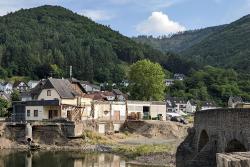
The extreme summer flood of 2021 in the Ahr Valley caused catastrophic damage.
Photo: Physical Geography working group, Leipzig University
Floods are one of the most critical environmental threats in Central Europe. In Germany they are responsible for more than half of the economic damage caused by environmental hazards. The magnitude of the 2021 Ahr flood far exceeded what was forecast in previous flood hazard assessments. This was due to significant underestimation of hazards, as the former hydrological models considered instrumental discharge records exclusively. Because the recording period only began in the second half of the 20th century, flood hazard assessments did not consider high-magnitude flood events prior to that period.
For the first time, geographers and geophysicists show the importance of sedimentological records from the Ahr floodplain for reconstructing past high-magnitude flood events. Professor Christoph Zielhofer, head of the study and physical geographer at Leipzig University, explains: "Our investigation shows that centennial- to millennial-scale high-energy flood events are not the exception but the rule in the Ahr Valley. The investigated sediments record the catastrophic flood of 2021 and the two historical floods of 1804 and 1910, as well as a previously unidentified flood event dated approximately to the end of the 5th century A.D."
Dr Ulrike Werban, geophysicist at the UFZ, adds: "The sedimentological analysis in combination with near-surface geophysical prospection shows that the Ahr floodplain is dominated by high-energy flood deposits, and that low to medium-magnitude flood events are not preserved in the floodplain."
The sedimentological record proves that the 2021 flood event is not an exception in the flood history of the Ahr. In fact, at least three other flood events have been identified in the last 1,500 years that, based on sedimentological parameters, had a comparable magnitude. The results document the high potential of floodplain sediments for reconstructing high-magnitude flood events, allowing a reassessment in terms of the occurrence and frequency of such events.
Dr Martin Bauch also participated in the study. He is an environmental historian at the Leibniz Institute for the History and Culture of Eastern Europe (GWZO) in Leipzig and compared the sedimentologically verifiable flood events with historically documented flood events from the Ahr Valley, which date back to the medieval period. He explains: "The occurrence of the severe floods in the Ahr Valley does not show any clear coupling with hydroclimatic history in Central Europe. However, what is noticeable is that the historically documented high-magnitude Ahr floods occur particularly during the summer season." The summer months, in turn, are associated with high atmospheric moisture loads, which increases the probability of extreme flooding events in summer.
The study complements the ongoing German Research Foundation (DFG) Priority Programme 2361, "On the Way to the Fluvial Anthroposphere". The research has been made possible by the local support of the municipality of Mayschoß and close interdisciplinary collaboration between geographers, geophysicists, historians and archaeologists.
Publication:
Christoph Zielhofer, Johannes Rabiger-Völlmer, Henriette Westermann, Markus Lothar Fischer, Birgit Schneider, Susanne Lindauer, Azra Khosravichenar, Martin Bauch, Marco Pohle, Ulrike Werban: "Fluvial deposits of the Ahr river (western Germany) reveal recurring high-magnitude flood events over the last 1500 years", Earth Surface Processes and Landforms, https://doi.org/10.1002/esp.70219
Further information
Dr Ulrike Werban
UFZ-Department Monitoring & Exploration Technologies
ulrike.werban@ufz.de
Prof Dr Christoph Zielhofer
Physical Geography, Leipzig University
zielhofer@uni-leipzig.de
UFZ press office
Susanne Hufe
Phone: +49 341 6025-1630
presse@ufz.de
In the Helmholtz Centre for Environmental Research (UFZ), scientists conduct research into the causes and consequences of far-reaching environmental changes. Their areas of study cover water resources, ecosystems of the future, environmental technologies and biotechnologies, the effects of chemicals in the environment, modelling and social-scientific issues. The UFZ employs more than 1,100 staff at its sites in Leipzig, Halle and Magdeburg. It is funded by the Federal Government, Saxony and Saxony-Anhalt.
www.ufz.deThe Helmholtz Association contributes to solving major challenges facing society, science and the economy with top scientific achievements in six research fields: Energy; Earth and Environment; Health; Key Technologies; Matter; and Aeronautics, Space and Transport. With some 39,000 employees in 19 research centres, the Helmholtz Association is Germany’s largest scientific organisation.
www.helmholtz.de