
Working Group “Geomatics”
The scientific focus of the Geomatics working group is on studies of the spatio-temporal dynamics of urban development processes in particular. Research aims at a sustainable (urban) development. To do so, the WG uses quantitative analyses by means of mixed methods. They include remote sensing (RS), geographic information systems (GIS), environmental measurements and cartographic modelling.
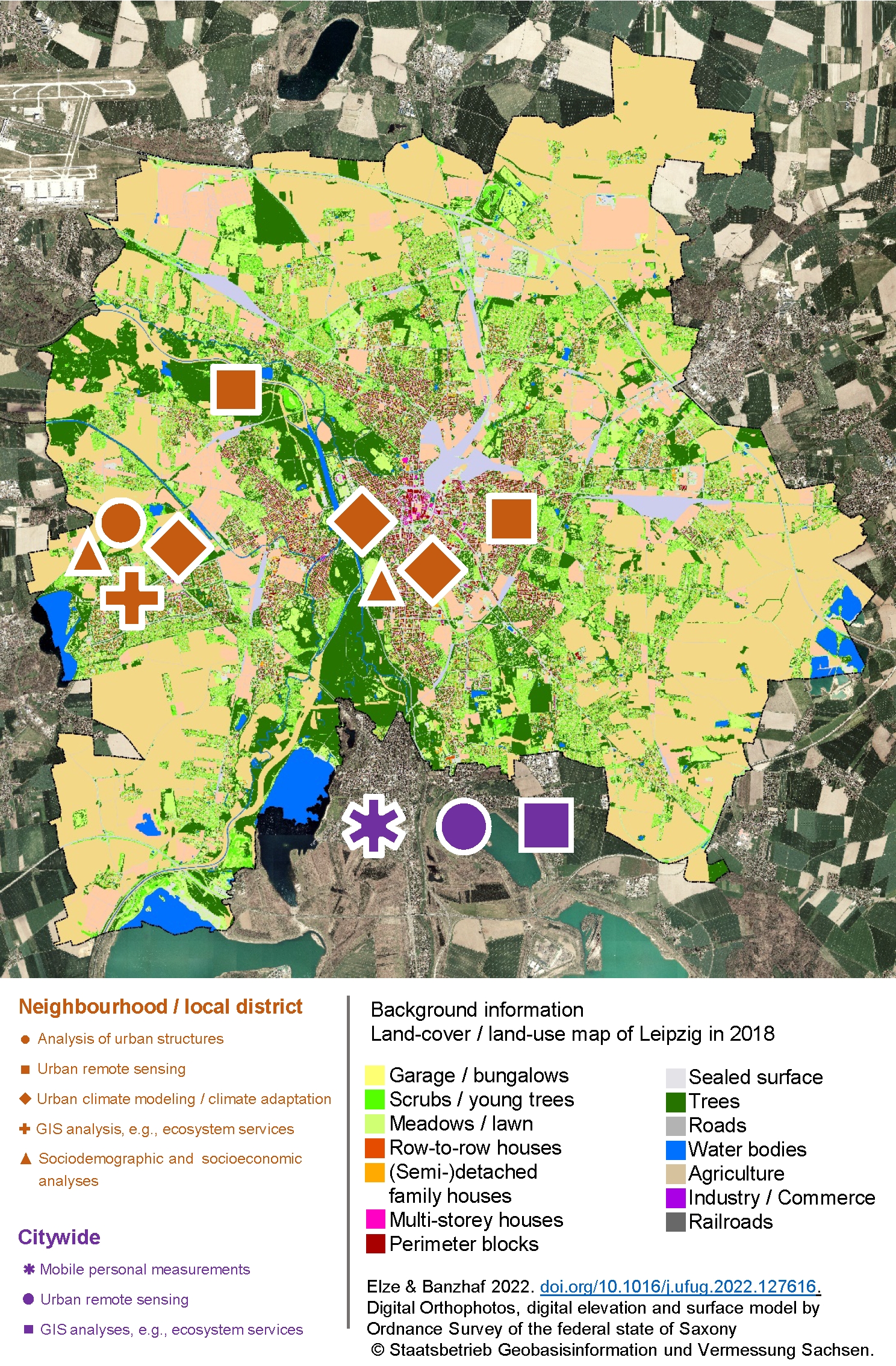
Focus: Analysis of urban structures
The monitoring system investigates the natural, built and social environment. The spatial analysis includes land-cover/land-use mapping over time, socio-demographic indicators, ecosystem service modelling, as well as co-benefits of societal and ecological spheres. Spatially defined characteristics such as urban structure types, urban morphology, green infrastructure and sealing intensity are quantified. Such area-related indicators are derived for spatial differentiation of the natural and built environment. Urban-rural interactions are investigated in the frame of watershed-natureshed-airshed-peopleshed.
Scientific approach:
- Monitoring of land-use dynamics in urban to peri-urban spaces regarding open space development and inner urban densification using high and very high-resolution RS data
- Evaluation of various RS data for structural analysis of urban morphology
- Use of both pixel-based and object-based image analysis
- Spatial derivation of indicators to determine features of environmental pressures and potential ecosystem services (e.g. characteristics of the surface material in terms of its sealing and potential surface runoff / infiltration rate
- Monitoring of socio-spatial changes on the basis of vital statistics at different scales
- Creation of land-use scenarios
- Visualisation techniques to support municipal decision-makers
Focus: Mobile personal measurements
Urban areas are hotspots for environmental stressors such as noise, air pollution and heat. These stressors affect the health of people in the city and are highly contextually distributed in space and time. Mobile, personal sensors (so-called wearables) enable the measurement of these stressors for individuals. There are two aspects to wearables, I. a person's exposure is recorded; II. the person acts as an explorer of urban space. Such environmental data can be used to improve the resilience of urban regions in relation to health risks. They open up avenues for flexible personal adaptation to a changing urban climate, for identifying hotspots of urban pollutants and for improving urban structures. In particular, personalised stress feedback can be used to raise awareness of health-related stressors and promote health-protective behaviour.
Scientific approach:
- Recording the spatial and temporal distribution of environmental stressors in urban space (also real-time)
- Recording individual stress profiles of cyclists and pedestrians
- Evaluating the measurement data and other urban data (data integration) with the help of visualisation, Virtual Reality and spatial statistics
Focus: Urban Remote Sensing (RS)
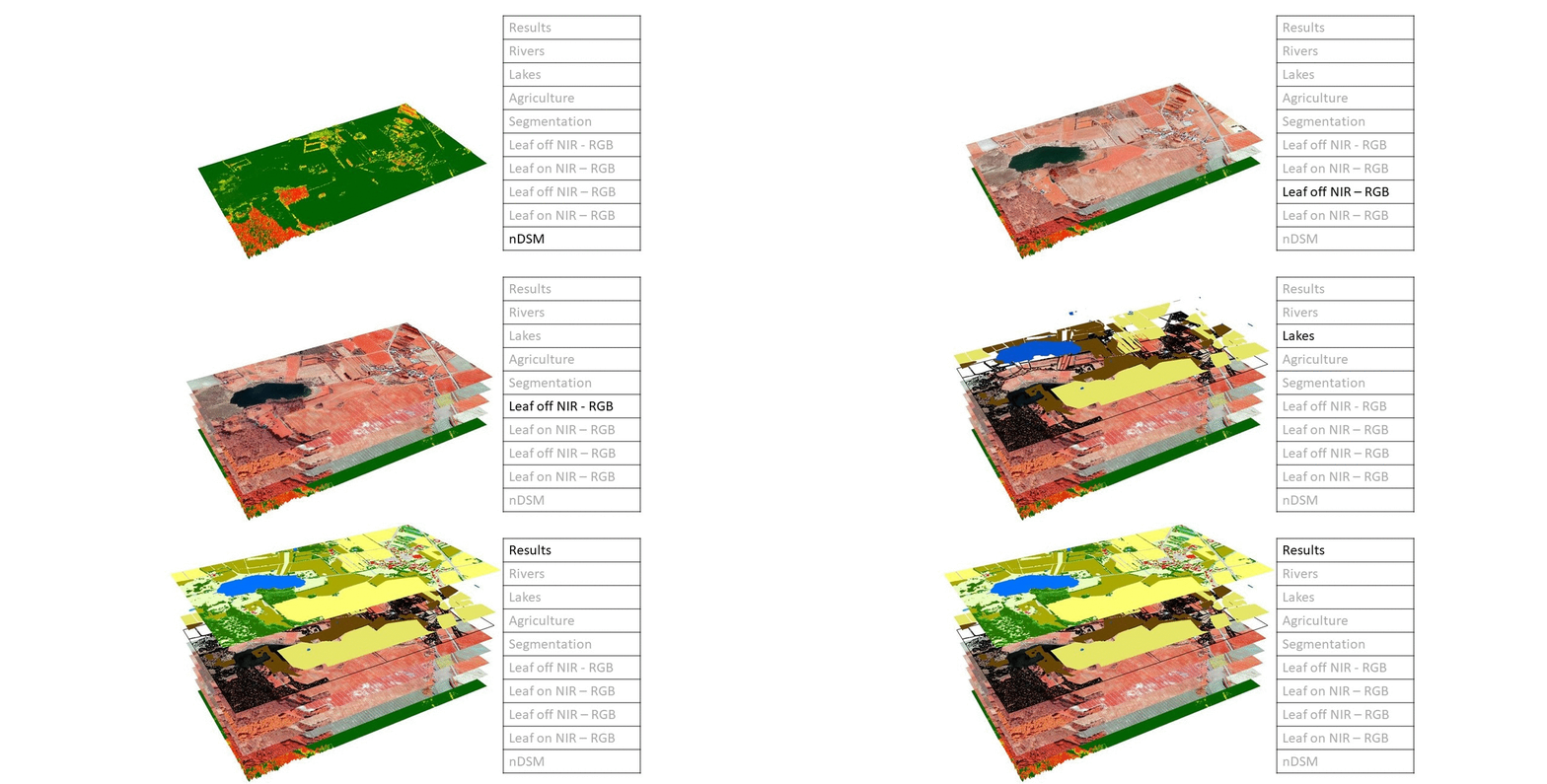
Urban areas are characterised by high heterogeneity in a comparatively small space. The aim of RS methods (satellite data and aerial images) and GIS is to foster spatio-temporal and structural investigations of urban areas. The use of spectral, structural, 3-dimensional and topological information from RS techniques is of great importance on different spatial scales to characterise and model land surface properties.
Scientific approach:
- Object-based evaluation using orthophotos and very high-resolution satellite images. The former are recorded from an aircraft and are free of charge, the latter are globally available but sometimes cost-intensive. Both imaging systems have a spatial resolution of less than one metre, but vary in their spectral properties.
- We apply monitoring techniques to understand LULC changes over time.
- In addition to the spectral properties of surfaces, 3-dimensional information from LiDAR data or photogrammetric procedures are included.
- At the level of objects, shape, size and texture help to delineate qualitative aspects of urban spaces.
Focus: Urban climate modelling and climate adaptation in urban areas
Scientific approach:
- Attribution of causes for urban overheating and interaction of surface heat fluxes (energy balance) with the building structure
- Recommendations for locally tailored climate adaptation measures with focus on neighbourhood level and scenario modelling
- Further development and application of urban climate models, by integrating land-use data and physical as well as thermal surface properties
Focus: GIS analyses of LULC and socio-spatial investigations
Urban areas and their structures are highly complex. In order to do justice to the different dimensions built, natural and societal, we combine different disciplinary approaches. GIS and land-use data are linked with survey results from available human-related studies and municipal vital statistics. Qualitative studies, capturing e.g., perception of the environment, complement coupled analyses.
This approach leads to an additional gain in knowledge, both methodologically and in terms of content. In particular, interactions between different influencing factors in cities and neighbourhoods become recognisable. It can be shown that urban developments are subject to highly dynamic processes on various levels of interaction.
Scientific approach:
- Mixed methods
- Comparative spatial analysis of social science techniques
- Testing interdisciplinary and innovative linkages of various methods
The urban laboratory at the UFZ − LeipzigLab
Access to spatial data and the exchange of data between project partners must be simplified. Achieved results must be made usable across disciplines. To do so, the development of spatial data infrastructures is being pursued. The basis is a web-based metadata information system (MIS) (https://geonetwork.ufz.de) for standard-compliant documentation of geodata in combination with WebGIS technologies for the exchange and visualisation of geoinformation (under development).
The group's research context at UFZ:
Working group "Urban Environmental Research"
Working group "Climate change"
You will find publications of the group's members on their personal homepages.
Members of the Working Group:
Dr. Ellen Banzhaf (head), Sebastian Elze, Volker Grescho, Floris Hermanns, Daniel Hertel, Prof. Dr. Sigrun Kabisch, Dr. Sonja Knapp, Julius Knopp, Dr. Angela Lausch, Janine Pößneck, Prof. Dr. Uwe Schlink, Julius Schmiedt, Thilo Wellmann,