
Department of Economics
Head:
![]()
Prof. Dr. Bernd Hansjürgens
Deputies:
![]()
Prof. Dr. Erik Gawel
![]()
PD Dr. Irene Ring
Secretaries:
![]()
Monika Nussbaum
![]()
Heide Scharfe
Tel.: ++49 341 235-1259/1255
Fax: ++49 341 235-1836
Permoserstraße 15
D-04318 Leipzig, Germany
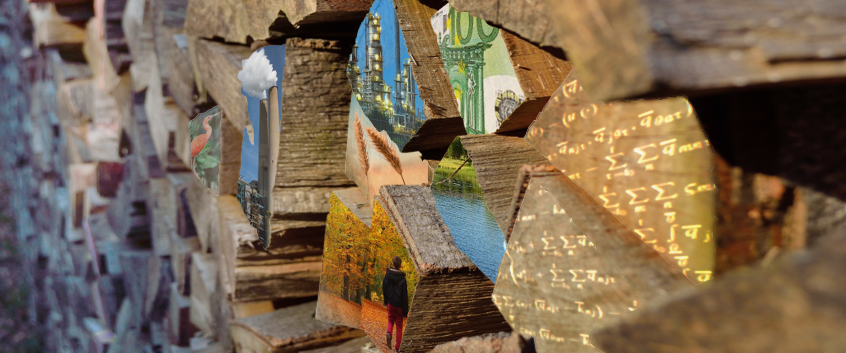
The environment is a scarce good. Research in the field of environmental economics clarifies how one should sustainably use environmental resources and which rules society should abide by to achieve this.
As part of ![]()
the Division of Social Sciences the Department of Economics works together in interdisciplinary groups on current problems in the fields of water, (bio)-energy, nature conservation and biodiversity as well as climate change. Here questions are analysed concerning ![]()
economic valuation, the ![]()
concepts of institutions and decision-making processes as well as the ![]()
instrumentation of environmental and resource policies. Furthermore, the department develops methods for the ![]()
economic and ecological modeling of environmental systems.
News & Highlights
Leading-Edge Cluster Research at Leipzig – UFZ, DBFZ and HHL part of the Leading-Edge Cluster "BioEconomy"

The initiative "BioEconomy" is one out of five winners of the Leading-Edge Cluster competition of the German Federal Ministry of Education and Research (BMBF) which is intended to take Germany to the top of the league of technologically advanced nations. "BioEconomy" focuses primarily on integrated material and energetic use of non-food biomass, especially timber, predominantly in eastern Germany. The Department of Economics is engaged in the scientific evaluation of the cluster's prerequisites as well as its performance. Kick-off was in 2012.
Point of view
Electricity rates and the German Renewable Energies Act: Slowdown or reverse thrust - The art of limiting the costs of energy transition

Following the latest suggestions of the German Federal Environment Minister Altmaier the debate on the future of our energy supply centres on the electricity price once more. Frequently, the Renewable Energies Act is held responsible for the increasing price. But what is the real problem? And how reasonable is the suggested package of measures to hold down the electricity rates? Prof. Erik Gawel, environmental and energy economist at the UFZ and head of the Institute for Infrastructure and Resources Management at Leipzig University provides his view on the recent developments.![]()
to the point of view (in German)
![]()
further points of view from the department of economics (in German)
Research
Climate Adaptation Strategies for Europe: New EU project started with UFZ involvement

For four years (2012−2016) will the challenges of climate adaptation be focus of the project ‘BASE − Bottom-Up Climate Adaptation Strategies for Europe’. With the aim to support sustainable and cost effective adaptation measures in Europe, practical experiences and scientific information about adaptation will be made visible, transferable and easily accessible to decision-makers at all levels.
The Departments of Economics and of Environmental Politics will mainly address questions arising from the use of knowledge and policy integration; and from the assessment of impacts, costs, benefits and the effectiveness of adaptation strategies and measures. A case study will be carried out for the urban area of Jena.![]()
More information on the project
Projects
The Department of Economics belongs to the departments at the UFZ with the most third-party funding.
![]()
to an overview of the projects
Main points of research
The Department of Economics plays a part in numerous interdisciplinary research topics at the UFZ.
![]()
to the main points of research
Staff
The Department of Economics plays a part in numerous interdisciplinary research topics at the UFZ.
![]()
to an overview of the staff
Working groups
The Department of Economics is involved in the interdisciplinary working groups ![]()
social science water research, ![]()
nature conservation, ![]()
climate change as well as ![]()
governance and institutions .
