
Research for the Environment

Molecular mechanisms of VOC's effects on human cells

Indoor air quality gained in imortance in the past decades, because modern civilization spends 90% of the lifetime indoors. Since 1970, an increasing incidence of the sick-building syndrome was observed. The disease is characterized by chronic headache, sleep disorders, infections of the airways, irritations of eyes, nose and throat culminating in depressions. To our present understanding it is caused by long-lasting exposure to volatile organic compounds (VOCs). The main reason for a up to 10 times increased concentration of pollutants in indoor environments compared to outdoors are renovation activities. The so called VOCs show a pretty low boiling point, that's why they easily evaporate from materials like glues, paintings and furniture as well as cleaning products and are enriched in living rooms. There is only little information about the molecular mechanism that causes the sick-building syndrome. As cellular effectors act proteins either as receptors or as mediators. But it is not clear if VOCs interact directly with specific target proteins or if they affect the activity of cellular proteins in a more global way. Thus, the aim of this project is to identify and quantify changes in protein expression following exposure of human lung cell cultures to volatile organic compounds.
modell


Figure 1:
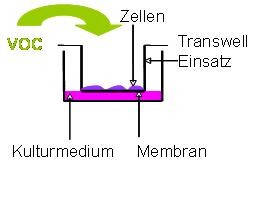
Model of exposure of lung epithelial cells to volatile organic compounds (Fischäder 2006, Dept.of Environmental Immunology)


In the department of Environmental Immunology at the Helmholtz-Centre for Environmental Research immun-modulating effects of VOC exposure in cell culture models were studied. A differential expression of cytokines and chemokines of lung epithelial cells was observed. This indicated for the first time an inflammatory mechanism of immune reactions in eposed subjects.
In cooperation with the department of Environmental Immunology we try to identify more differentially expressed proteins following exposure to VOCs, that could be involved in the developement of the sick-building syndrome. Human lung epithelial cells are cultivated on membrane inserts and are exposed to the contaminants via the gas phase (Figure 1).
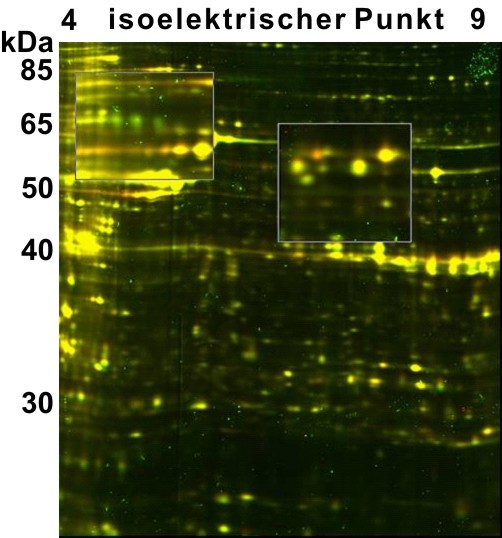
Cellular proteins are analyzed using Two-Dimensional Electrophoresis and differentially expressed proteins (Bild 2) are finally identified using mass spectrometry.
2D Gel

Figure 2: The usage of fluorescence dyes allows the separation of several samples in one protein gel. Both pictures can be merged together. Differences in protein expression of the two samples can be easily observed in red and green.

publications

Kliemt S, Lange C, Otto W, Hintze V, Möller S, von Bergen M, Hempel U, Kalkhof S.
Sulfated hyaluronan containing collagen matrices enhance cell-matrix-interaction, endocytosis, and osteogenic differentiation of human mesenchymal stromal cells.
J Proteome Res. 2012 Nov 21. [Epub ahead of print] PMID:23170904

Haange SB, Oberbach A, Schlichting N, Hugenholtz F, Smidt H, von Bergen M, Till H, Seifert J.
Metaproteome analysis and molecular genetics of rat intestinal microbiota reveals section and localisation resolved species distribution and enzymatic functionalities.
J Proteome Res. 2012 Nov 2;11(11):5406-17. PMID: 23016992

Müller SA, van der Smissen A, von Feilitzsch M, Anderegg U, Kalkhof S, von Bergen M.
Quantitative proteomics reveals altered expression of extracellular matrix related proteins of human primary dermal fibroblasts in response to sulfated hyaluronan and collagen applied as artificial extracellular matrix.
J Mater Sci Mater Med. 2012 Dec;23(12):3053-65. PMID: 22990618

Goettsch C, Kliemt S, Sinningen K, von Bergen M, Hofbauer LC, Kalkhof S.
Quantitative proteomics reveals novel functions of osteoclast-associated receptor in STAT signaling and cell adhesion in human endothelial cells.
J Mol Cell Cardiol. 2012 Dec;53(6):829-37. PMID: 22985931

Salbach J, Kliemt S, Rauner M, Rachner TD, Goettsch C, Kalkhof S, von Bergen M, Möller S, Schnabelrauch M, Hintze V, Scharnweber D, Hofbauer LC.
The effect of the degree of sulfation of glycosaminoglycans on osteoclast function and signaling pathways.
Biomaterials 2012 Nov;33(33):8418-29. PMID: 22954516

Guazzaroni ME, Herbst FA, Lores I, Tamames J, Peláez AI, López-Cortés N, Alcaide M, Del Pozo MV, Vieites JM, von Bergen M, Gallego JL, Bargiela R, López-López A, Pieper DH, Rosselló-Móra R, Sánchez J, Seifert J, Ferrer M.
Metaproteogenomic insights beyond bacterial response to naphthalene exposure and bio-stimulation.
ISME J. 2012 Jul 26. doi: 10.1038/ismej.2012.82.[Epub ahead of print] PMID: 22832345

Taubert M, Vogt C, Wubet T, Kleinsteuber S, Tarkka MT, Harms H, Buscot F, Richnow HH, von Bergen M, Seifert J
Protein-SIP enables time-resolved analysis of the carbon flux in a sulfate-reducing, benzene-degrading microbial consortium.
ISME J. 2012 Jul 12. doi: 10.1038/ismej.2012.68. [Epub ahead of print] PMID: 22791237.


Boll K, Reiche K, Kasack K, Mörbt N, Kretzschmar AK, Tomm JM, Verhaegh G, Schalken J, von Bergen M, Horn F, Hackermüller J.
MiR-130a, miR-203 and miR-205 jointly repress key oncogenic pathways and are downregulated in prostate carcinoma.
Oncogene. 2012 Mar 5. doi: 10.1038/onc.2012.55. [Epub ahead of print] PubMed PMID: 22391564.


Haas S, Jahnke HG, Moerbt N, von Bergen M, Aharinejad S, Andrukhova O, Robitzki AA
DIGE proteome analysis reveals suitability of ischemic cardiac in vitro model for studying cellular response to acute ischemia and regeneration.
PLoS One. 2012;7(2):e31669. Epub 2012 Feb 22. PubMed PMID: 22384053