In4Nile: Advancing Water Quality Information in the Nile River Basin
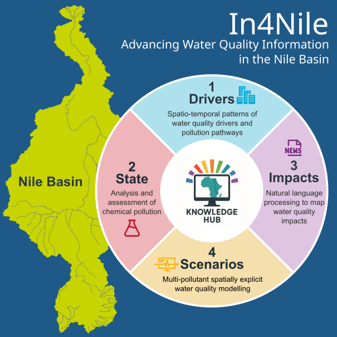
With its novel, harmonized, basin‑scale approach, In4NILE addresses the critical lack of water quality information in the Nile River Basin. We combine harmonized basin-scale data integration, tailored monitoring approaches, text-mined information on local impacts, and advanced modelling to inform decision-making and guide investments. (PhD 1) synthesizes spatial data on key pollution drivers, (PhD 2) develops chemical monitoring strategies under low-capacity conditions, (PhD 3) applies natural language processing to map reported risks and impacts, and (PhD 4) integrates these data into spatially explicit multi-pollutant models to identify hotspots and future scenarios. Together, the projects contribute to an integrated Nile Basin Knowledge Hub.
The 4 PhD Projects
Significant knowledge gaps persist regarding pollutant sources and pathways, as data are fragmented, heterogeneous, and incomplete across the Nile Basin. Consequently, methodologies to homogenise, integrate, and extend existing water‑quality and driver information in space and time are needed.
The goal of PhD 1 is to identify the main pollution pathways including pollution hotspots and trends for the Nile River. The hypothesis is that the value of available (including “soft”) data on pollution drivers is yet underexplored and that substantial information can be obtained from existent open data bases, when integrating information relevant to water quality such as urbanization and industry. Thus, the key research question is: Can we identify relevant pollution sources and drivers by leveraging the value of existing data of heterogeneous sources, formats and level of details? More specifically, the PhD will (Goal 1) integrate source and driver data from various sources and heterogenous formats specifically including open geodata, (Goal 2) assess pollution risks along the river network considering hydroclimatic conditions and pollutant-specific sources and properties, and (Goal 3) quantify driver-response relationships between pollution sources, pathways, stream water quality and subsequent impacts leveraging the comprehensive data sets and machine-learning methods.

Monitoring data on chemical pollution, including organic micropollutants, are rarely available for low-income countries. Among the reasons for data scarcity are (i) lack of monitoring programs, and (ii) lack of analytical capacities. While the analysis of organic micropollutants remains challenging (because technical support for the measurement instruments is not available in most countries of the global south), low-budget sampling techniques are available allowing, for instance, water extraction and passive sampling under low-capacity settings followed by analysis at specialized laboratories. Thus, the overarching goal of this PhD is to perform a case study in the Nile Basin, applying low-budget sampling techniques involving local partners and subsequent chemical analysis at the UFZ, to enhance data availability and support initiatives striving for better water quality.
Specifically, the aims of PhD2 are (Goal 1) to test and validate available low-budget sampling techniques in the lab, imitating varying environmental conditions, (Goal 2) to investigate hydrophilic and hydrophobic organic micropollutants in water and silicone samples from the Nile Basin using liquid/gas chromatography coupled to high-resolution mass spectrometry (LC/GC-HRMS), and (Goal 3) to assess risks to environmental and human health.
Our vision for this PhD project is to create extensive data on chemical pollution in the Nile Basin and - together with the Nile Basin Initiative and local authorities and agencies - assess possibilities for establishing time- and space-resolved monitoring programs under low-capacity settings. Such monitoring activities are essential for defining mitigation measures and supporting existing initiatives demanding for social and environmental justice regarding water quality. Through our sampling campaign and the envisioned publications, we aim to raise awareness and support solution-oriented actions at local and governmental levels in the fields of sanitation, water treatment, infrastructure, and other sectors, promoting environmental and public health and well-being.

Traditional monitoring approaches, which rely on sparse in situ measurements, offer limited insight into how citizens perceive pollution impacts. At the same time, a growing volume of unstructured text data from social media, news reports, and institutional documents provides near real-time accounts of pollution as experienced and discussed by local communities.
PhD3 will leverage the increasing amount of text and advances in natural language processing (NLP) and machine learning to extract and spatialize pollution-related knowledge from text data. Specifically, PhD3 will: (Goal 1) map how specific pollutants (e.g. PFAS, microplastics, nitrates) are perceived and studied in the region; (Goal 2) investigate how this perception differ across space and stakeholder groups; and (Goal 3) and support disseminating knowledge on water pollution in the Nile River Basin. By triangulating these diverse signals, PhD3 will produce a bottom-up layer of perceived water pollution risk, complementing physical monitoring and modeling efforts.
Pollution from diffuse runoff and insufficient wastewater treatment is degrading ecosystems, threatening human health, and undermining water security. Limited and fragmented monitoring further hampers efforts to identify pollution hotspots or anticipate future risks. PhD 4 will address these challenges by developing a scalable water quality modelling framework that tracks the fate and transport of multiple pollutants, including: nutrients, pharmaceuticals, biochemical oxygen demand, faecal coliforms, and other organic contaminants. The project has three aims: (Goal 1) to develop a seamless chain of multi-pollutant modelling framework representing the full source-to-sink pathways for each contaminant class; (Goal 2) to unravel the extent of historical and present-day water pollution, analyzing how hydro-climatic variability, population growth, urbanization, and agricultural practices influence multi-pollutant loads and the evolving risks along the transboundary Nile River; and (Goal 3) to assess how multipollutant dynamics respond to projected changes in hydroclimatic and socioeconomic conditions, as well as explore solutions for adaptation strategies.