

BirdFutures develops model-based scenarios to protect biodiversity:
- Co-design with stakeholders from the business, finance sectors and nature conservation sector
- Provides strategic information for decision-makers to support the development of sustainable nature conservation measures
- Predictive models enable quantitative comparisons of potential measures, e.g. within the framework of the EU Nature Restoration Regulation
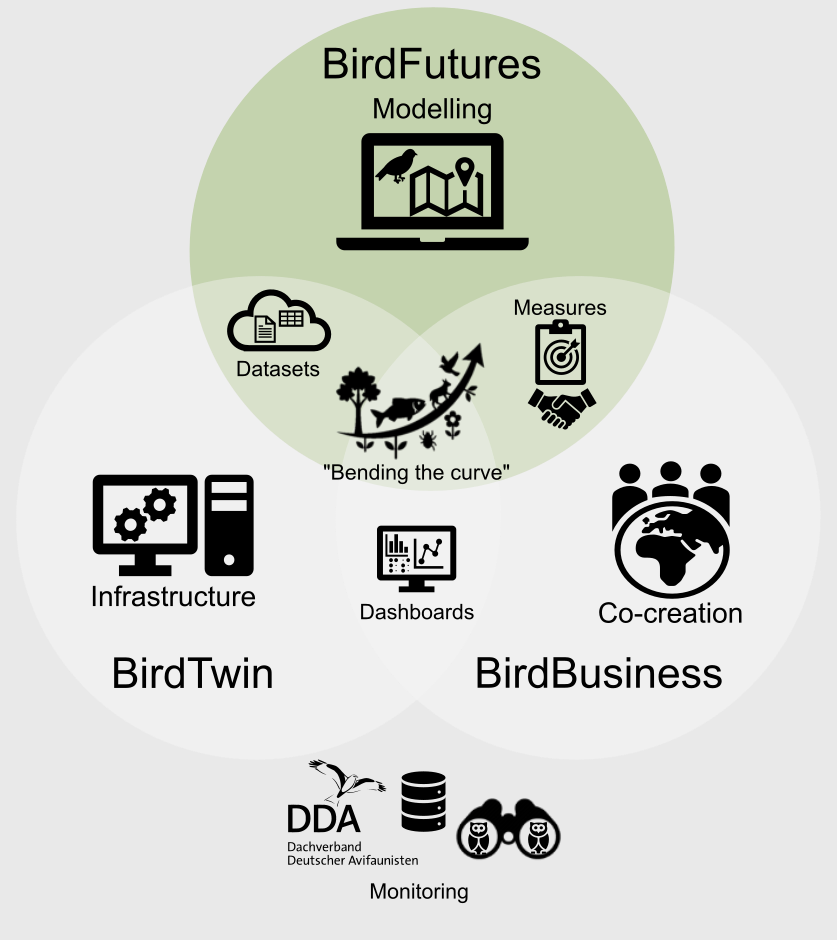
Effective environmental policy requires foresight. BirdFutures provides this crucial capacity by moving beyond the assessment of current biodiversity status to the exploration of potential future pathways. As the scenario analysis and forecasting component of the Triple Bird initiative, BirdFutures is dedicated to providing robust, science-based decision support for policymakers and public agencies.
Our work leverages the high-resolution data foundation of BirdTwin to develop and run sophisticated predictive models. These models enable a quantitative comparison of different policy interventions and management strategies, allowing decision-makers to assess potential long-term consequences of their actions. The core function of BirdFutures is to answer strategic questions essential for the effective implementation of public policy.
Key applications of our scenario analysis include:
- Policy Impact Assessment: Evaluating the potential outcomes of different implementation strategies for the EU Nature Restoration Regulation to identify the most effective approaches for specific ecosystems and regions.
- Strategic Land Use Planning: Modeling the impacts of future land-use change and climate scenarios on avian populations to inform more resilient spatial planning.
- Design of Incentive Mechanisms: Assessing how different designs for programs like Nature Credits or agri-environment schemes could influence biodiversity outcomes, thereby optimizing their environmental effectiveness.
By providing this forward-looking, evidence-based analysis, BirdFutures equips public and private institutions with the strategic intelligence needed to design and implement more effective, efficient, and resilient environmental policies.
The Federal Ministry of Research, Technology, and Space (BMFTR) is funding BirdFutures as part of the “Research for Sustainability” (FONA) strategy www.fona.de. BMFTR grant number: 033L313A-B. Project duration: 01.11.2025 – 31.10.2031