

BlueGreen City Coaching
From Planning to Implementation: Pathways for Blue-Green Infrastructure in Municipalities
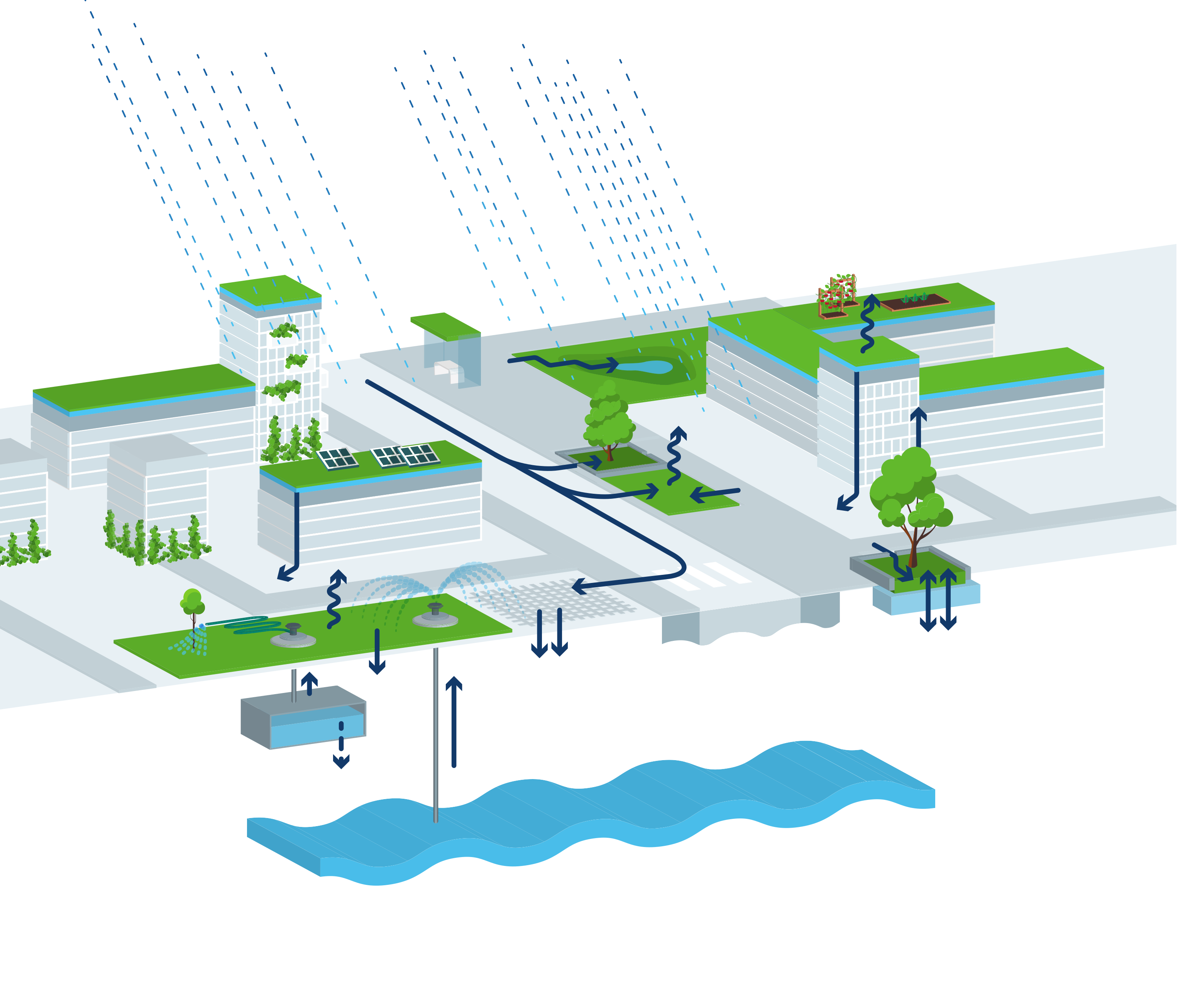 Graphic blue-green infrastructure ©Artkolchose
Cities face immense challenges in the face of climate change: Extreme weather events such as heavy rainfall and droughts are intensifying and affect not only city dwellers but also the infrastructure and urban ecosystems.
Blue-green infrastructures are gaining increasing importance in this context. Whether it's green roofs, neighborhood lakes, street-side greenery, or infiltration systems: blue-green infrastructure provides effective, nature-based solutions against flooding and heat stress. Through it, rainwater can evaporate, infiltrate, and be stored locally; it relieves the sewerage and reduces the risk of flooding. At the same time, the blue-green infrastructure, often referred to as the "sponge city," creates recreational and natural spaces. It ensures that there is sufficient water for vegetation during heatwaves and allows the city to cool down.
If municipalities want to adapt to climate change and rebuild their infrastructure accordingly, they often face a range of challenges: political agreement on the necessary changes must first be established, then administrative processes for planning must be adapted, effective and affordable measures must be identified, and these must be implemented in the complex urban fabric.
This is where the project "BlueGreen City Coaching – Implementation of Blue-Green Infrastructures for Climate Adaptation in Smaller German Cities" (BGCC) intervenes. We support cities with 100,000 to 300,000 inhabitants in planning and implementing climate-adapted urban development – with scientifically grounded solutions that are developed in practice in collaboration with the cities.
As of Spring 2025, after an appeal published by the German Cities Association (Deutscher Städtetag), interested cities could apply for an individually tailored coaching. The ten selected cities will now be supported from fall 2025 to spring 2027 on their journey towards a blue-green infrastructure. Together with the ten coaching cities, our scientists will identify city-specific potentials, limits, and practical solutions for a blue-green infrastructure during this period. The focus of the coaching process will be legal aspects, cost-benefit and financing questions, infrastructure planning, as well as decision-making processes in politics and administration.
The findings of the coaching process with the ten cities will be prepared as model solutions and published for transfer to other municipalities on this website from mid-2027.
The BlueGreen City Coaching project is implemented by the Helmholtz Centre for Environmental Research (UFZ) in cooperation with the German Institute for Urban Planning (Difu) and the policy consulting firm Fresh Thoughts (FT). The German Federal Environment Agency (UBA) supervises the project and it is also supported by the German Cities Association (DST) and the Centre for Climate Adaptation (ZKA). The Federal Ministry for Environment, Nature Conservation, Building and Nuclear Safety (BMUKN) subsidizes the BlueGreen City Coaching from the funding of the Action Programme for Natural Climate Protection (ANK).
Key Elements of Coaching
- Blue-green infrastructure planning
- Law
- Politics and administration
- Costs, benefits, financing
Coaching in ten cities
- One on-site basic workshop each
- Three central expert meetings on key topics
- City-specific coaching sessions
- Ideally, a pilot implementation on-site
Internal reference: FKZ 3723 NK 902 0