Topics
The major theme of this symposium was about “Sustainable Utilization of Geothermal Energy”, which included four topics: (1) Sustainable utilization of shallow geothermal systems; (2) Sustainable utilization of hydrothermal systems; (3) Enhanced Geothermal Systems and (4) Geothermal Reservoir Engineering and Monitoring. In the last section of the symposium, a panel discussion was organized to make a summary on the symposium and discuss next steps of the initiative. On October 28th, the delegates visited the Xiongxian geothermal field during the conference excursion.
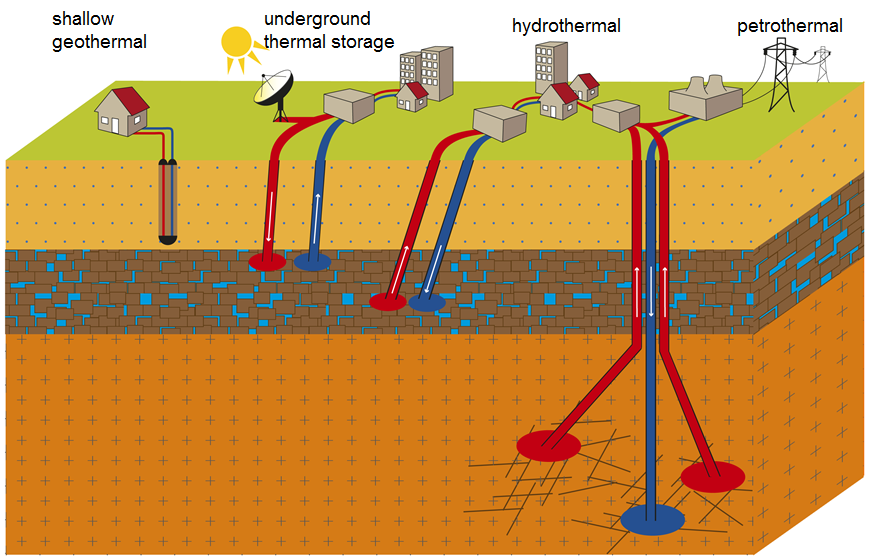
Geothermal systems (Huenges et al. 2013)
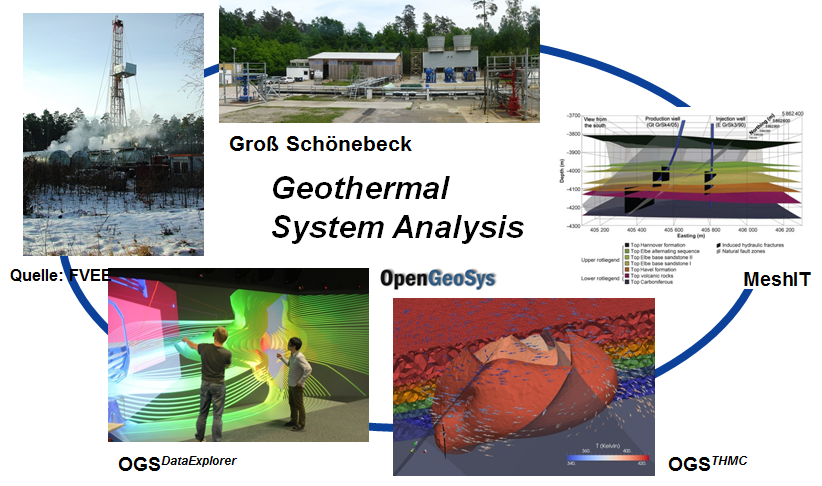
The figure shows a workflow layout of systems analysis for the geothermal research site Groß Schönebeck (north of Berlin, operated by the GFZ). The modelling workflow includes comprehensive data integration from various sources such as structural geology, drilling trajectories, petrophysical, geophysical data etc. The next step in the workflow is setup of the discretised numerical model for which special software for geometrical modelling and meshing has been developed (MeshIT, Blöcher et al. 2010a). The numerical simulation of thermo-hydro-mechanical-chemical processes in fractured-porous media is conducted with the modelling platform OpenGeoSys (www.opengeosys.org, Kolditz et al. 2012b). Accurate and efficient numerical simulations require the use of high-performance-computing platforms for which code parallelisation is necessary (Wang et al. 2014). In order to display comprehensive data sets together with simulation results we use scientific visualisation (Bilke et al. 2014). Visualisation has proven to be an intuitive tool to discuss complex models among scientists and present scientific results to stakeholders and the public in an understandable way.