Functional biomaterials for controlling healing processes in bone and skin – from material science to clinical application
Project description
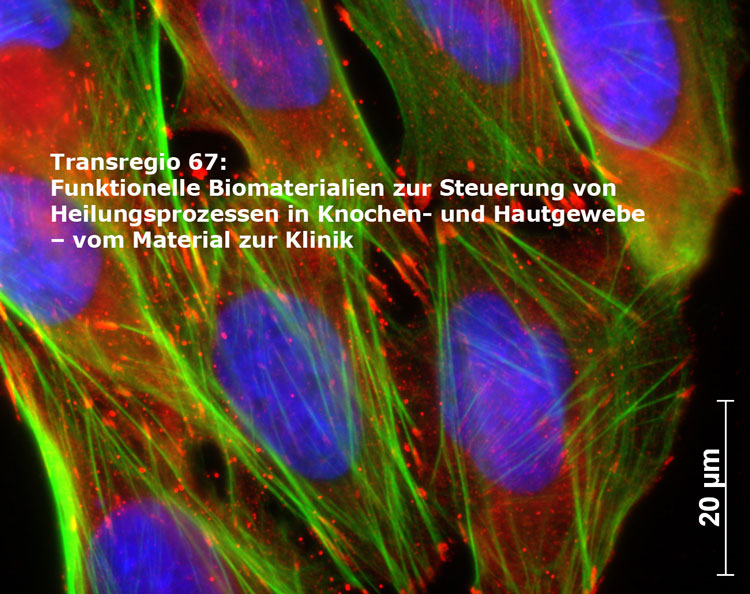
Major successes in the implant and transplantation medicine in recent years are based mainly on know-how. Within the framework of composite project TRR 67 a fundamental change in this situation is sought by origin-oriented research and development of artificial Extracellular matrix (aECM) for wound healing of skin and bone injuries. TRR 67 is focused on the acquisition of knowledge about the importance of the ECM for differentiation of cells and tissue regeneration and strives to promote the development of biological material using this knowledge.
TRR 67 is divided into two project areas
Project-A: matrix engineering project area comprises mainly sub-projects for designing materials of scientific/chemically including analytically oriented sub-projects.
Project-B: biological effect profiles in cellular systems and aECM-based tissue regeneration project area bundles projects with cell biological and clinical orientation. The focus is the systematic cellular and molecular characterization of matrix/cell interactions in complex systems. It examines, in particular cell types, the response to intense matrix in bone and skin contact.
Sub-project 1
As part of our sub-project, the qualitative and quantitative protein analysis for TRR 67 projects have being carried out. To this end, development of methods to be highly sensitive detection for both low molecular weight proteins and highly modified proteins which might be present in cytokines and growth factors, for example.
Small proteins (molecular weight <25kDa) have a variety of important biological functions such as signal transduction, transcriptional regulation and cell communication. One example is the very important group of cytokines. In spite of the biological significance, small proteins are underrepresented in most proteome studies. Small proteins are easily lost with the standard techniques of 2D gel electrophoresis or LC-MS/MS analysis because such techniques are not adapted to low molecular-weight proteins. Furthermore, small proteins are usually in low abundance, additionally, the identification of small proteins is complicated considering a lower number of peptides generated in the proteolytic digestion.
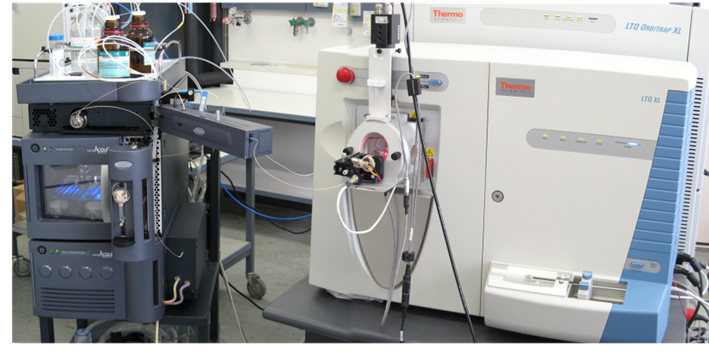
In order to address this question, this project includes identification of low molecular weight proteins through specific customized method development using gel-and LC-based separation followed by mass spectrometric analysis. The developed methods will be applied in samples from DFG project Transregio 67 and qualitative and quantitative proteome analysis in the Department.
The purpose of the developing methods is
• improvement/enrichment of protein separation using 1D/2D-SDS-PAGE or HPLC
• identification and quantification of extracted proteins from microdialysis of injured tissue during the wound healing process by nano-HPLC/nano-ESI-Mass Spectrometry
• enable to analyze the protein expression from different cellular models.
Sub-project 2
This sub-project is focused on a targeted approach with high sensitive detection and quantification of selected proteins using mass spectrometry. For this purpose we have been developing the multiple monitoring reaction (MRM) method. This method allows the accession of proteins that are not detected for common proteomic methods and permit us to establish a robust absolute quantification of the most important mediator proteins.
Responsible persons
Cooperations
Prof. Dr. Daniel Huster
Institut für Medizinische Physik und Biophysik
Medizinische Fakultät
Universität Leipzig
Prof. Dr. Jan-Christoph Simon
Universität Leipzig
Klinik für Dermatologie, Venerologie und Allergologie
Philipp-Rosenthal-Straße 23 – 25
04103 Leipzig
Dr. María Pisabarro
BIOTEC
Technische Universität Dresden
Tatzberg 47 – 51
01307 Dresden
PD Dr. med. Stefan Rammelt
Klinik und Poliklinik für Unfall- und Wiederherstellungschirurgie
Universitätsklinikum "Carl Gustav Carus"
Fetscher Straße 74
01307 Dresden