
Dr. Harald Auge
Kontakt
Dr. Harald Auge
Leiter der Arbeitsgruppe
Experimentelle Ökologie von Populationen und Artengemeinschaften
Department Biozönoseforschung
Helmholtz-Zentrum für
Umweltforschung - UFZ
Theodor-Lieser-Straße 4
06120 Halle (Saale)
Fax: ++49 345 558 5329
harald.auge@ufz.de
 orcid.org/0000-0001-7432-8453
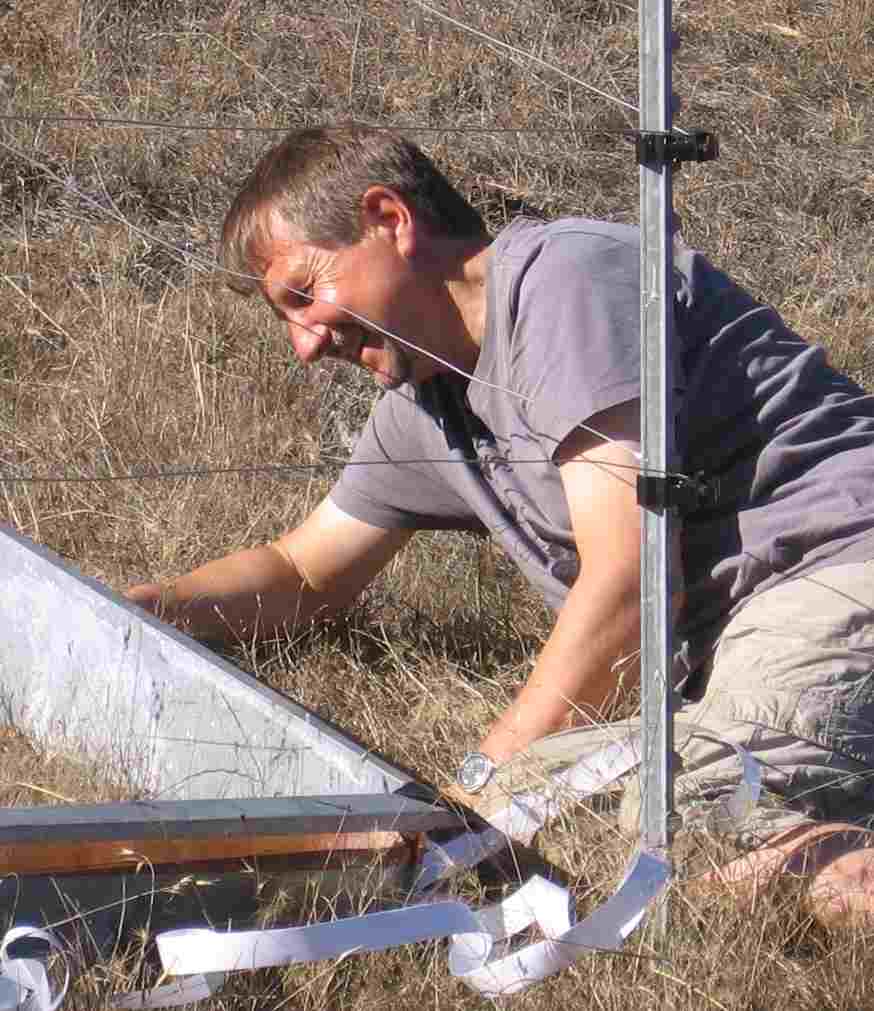
Forschungsschwerpunkte
Ich arbeite auf den Gebieten der Populationsbiologie und der Vegetationsökologie und nutze Experimente, um zu erforschen, welche Rolle die Wechselwirkungen zwischen Arten für die Reaktion von Ökosystemen auf verschiedene Triebkräfte des globalen Wandels (Klimawandel, Landnutzung, biologische Invasionen) spielen.
- Der Einfluss des Klimawandels und der Landnutzung auf Arten-Interaktionen und Ökosystemprozesse
- Bedeutung antagonistischer Interaktionen für die Koexistenz von Pflanzenarten, Pflanzen-Invasionen und das Funktionieren von Ökosystemen
- Die Vernüpfung zwischen ober- und unterirdischen Prozessen: der Einfluss von Baum- und Streudiversität auf Ökosystemfunktionen





Kooperationen
Stan Harpole, Deutsches Zentrum für integrative Biodiversitätsforschung (iDiv) Halle-Jena-Leipzig & Helmholtz-Zentrum für Umweltforschung - UFZ, Leipzig
Nico Eisenhauer, Deutsches Zentrum für integrative Biodiversitätsforschung (iDiv) Halle-Jena-Leipzig
Martin Schädler, Biozönoseforschung, Helmholtz-Zentrum für Umweltforschung - UFZ, Halle
Ingolf Kühn, Biozönoseforschung, Helmholtz-Zentrum für Umweltforschung - UFZ, Halle
Jonathan Chase, Deutsches Zentrum für integrative Biodiversitätsforschung (iDiv) Halle-Jena-Leipzig
Tiffany M. Knight, Deutsches Zentrum für integrative Biodiversitätsforschung (iDiv) Halle-Jena-Leipzig & Helmholtz-Zentrum für Umweltforschung - UFZ, Leipzig
Lotte Korell Lotte Korell, , Deutsches Zentrum für integrative Biodiversitätsforschung (iDiv) Halle-Jena-Leipzig & Helmholtz-Zentrum für Umweltforschung - UFZ, Halle
Charles A. Nock, Department of Renewable Resources, University of Alberta, Edmonton
Isabell Hensen, Institut für Biologie, Martin-Luther-Universität Halle-Wittenberg
Helge Bruelheide, Institut für Biologie, Martin-Luther-Universität Halle-Wittenberg
Holger B. Deising, Institut für Agrar- und Ernährungswissenschaften, Martin-Luther-Universität Halle-Wittenberg
Curriculum vitae
1980 - 1985
Biologiestudium, Martin-Luther-Universität Halle-Wittenberg
1986
Abschluss als Diplom-Biologe
1984 - 1987
Forschungsstipendium, Institut für Geobotanik, Martin-Luther-Universität Halle-Wittenberg
1987 - 1991
Wissenschaftlicher Assistent, Institut für Geobotanik, Martin-Luther-Universität Halle-Wittenberg
1991
Dr. rer. nat., Mathematisch-Naturwissenschaftliche Fakultät, Martin-Luther-Universität Halle-Wittenberg:
"Experimentelle Populationsökologie von Galium aparine L. (Rubiaceae) - Ökotypendifferenzierung und phänotypische Plastizität", Betreuer: Prof. Dr. E.-G. Mahn
1991
Projektkoordinator, Institut für Geographie und Geoökologie, Akademie der Wissenschaften, Leipzig
1992
Projektkoordinator, UFZ Umweltforschungszentrum Leipzig-Halle
1993 - 1997
Wissenschaftlicher Mitarbeiter, Sektion Biozönoseforschung, UFZ Umweltforschungszentrum Leipzig-Halle
seit 1997
Leiter der Arbeitsgruppe Populationsbiologie der Pflanzen & stellvertretender Leiter des Departments Biozönoseforschung, Helmholtz-Zentrum für Umweltforschung - UFZ, Halle
Mitarbeit in Herausgeber-Gremien
- Editorial Board von Basic and Applied Ecology (2004-2018)
- Editorial Board von Flora - Morphology, Distribution, Functional Ecology of Plants (seit 2014)
- Associate Editor von Neobiota (seit 2011)
- Editorial Board von PLoS ONE (seit 2012)
Veröffentlichungen der letzten 5 Jahre
Korell L, Andrzejak M, Berger S, Durka W, Haider S, Isabell H, Herion Y, Hoefner J, Kindermann L, Knight T, Klotz S, Linstädter A, Madaj A-M, Merbach I, Michalski S; Plos C, Roscher C, Schädler M, Welk E, Auge H (2024) Low land-use intensity buffers grasslands against future climate and inter-annual climate variability in a large field experiment. Preprint published in: bioRxiv. https://doi.org/10.1101/2023.12.20.572519
Shovon TA, Auge H, Haase J, Nock CA (2024) Positive effects of species diversity on productivity switch to negative after severe drought mortality in a temperate forest experiment. Global Change Biology 30: e17252. https://doi.org/10.1111/gcb.17252
Smith MD, Wilkins K, ... , Auge H, ... , Zuo X (2024) Extreme drought impacts have been underestimated in grasslands and shrublands globally. Proceedings of the National Academy of Sciences 121: e2309881120. https://doi.org/10.1073/pnas.2309881120
Zheng L, Barry K, Guerrero-Ramírez NR, Craven D, Reich PB, Verheyen K, Scherer-Lorenzen M, Eisenhauer N, Auge H, Barsoum N, Bauhus J, Binkley D, Bruelheide H, Cavender-Bares J, Dolezal J, Zhao Z, Fagundes M, Ferlian O, Fiedler S, Forrester D, Ganade G, Gebauer T, Haase J, Hajek P, Hector A, Hérault B, Hölscher D, Hulvey K, Irawan B, Jactel H, Koricheva J, Kreft H, Lanta V, Leps J, Mereu S, Messier C, Montagnini F, Mörsdorf M, Müller S, Muys B, Nock CA, Paquette A, Parker W, Parker J, Parrotta J, Paterno G, Perring M, Piotto D, Polley H, Ponette Q, Potvin C, Quosh J, Rewald B, van Ruijven J, Standish R, Stefanski A, Sundawati L, Tilman D, Urgoiti J, Williams L, Wilsey B, Yang B, Zhang L, Godbold D, Sandén H, Ebeling A, Schmid B, Fischer M, Hautier Y (2024) Effects of plant diversity on productivity strengthen over time due to trait-dependent shifts in species overyielding. Nature Communications 15: 2078. https://doi.org/10.1038/s41467-024-46355-z
Blondeel H, Guillemot J, Martin N, Druel A, Bilodeau-Gauthier S; Bauhus J, Grossiord C, Hector A, Jactel H, Jensen J, Messier C, Muys B, Serrano-León H, Auge H, Barsoum N, Birhane E, Bruelheide H, Cavender-Bares J, Chu C, Cumming J, Damtew A, Eisenhauer N, Ferlian O, Fiedler S, Ganade G, Godbold D, Gravel D, Hall J, Holscher D, Hulvey K, Koricheva J, Kreft H, Lapadat C, Liang J, Liu X, Meredieu C, Mereu S, Montgomery R, Morillas L, Nock C, Paquette A, Parker J, Parker W, Brant Paterno G, Perring M, Ponette Q, Potvin C, Reich P, Rentch J, Rewald B, Sandén H, Sinacore K, Standish R, Stefanski A, Tobin P, van Breugel IM, Fagundes M, Weih M, Williams L, Zhou M, Scherer-Lorenzen M, Verheyen K, Baeten L (2024) Tree diversity reduces variability in sapling survival under drought. Journal of Ecology: early view. https://doi.org/10.1111/1365-2745.14294
Depauw L, De Lombaerde E, Dhiedt E, Blondeel H, Barsoum N, Bauhus J, Damtew A, Eisenhauer N, Fagundes MV, Ganade G, Godbold D, Guillemot J, Hajek P, Hector A, Hérault B, Jactel H, Koricheva J, Kreft H, Mereu S, Messier C, Muys B, Paquette A, Parker WC, Patterno GB, Perring MP, Ponette Q, Potvin C, Reich P, Rewald B, Scherer-Lorenzen M, Schnabel F, Sousa-Silva R, Weih M, Zemp DC, Auge H, Gravel D, Chu C, Liu X, Verheyen K, Baeten L (2024) Enhancing tree performance through species mixing: review of a quarter-century TreeDivNet experiments revealing research gaps and practical insights. Current Forestry Reports 10: 1-20. https://doi.org/10.1007/s40725-023-00208-y
Proß T, Haider S, Auge H, Bruelheide H (2024) Leaf trait variation within individuals mediates the relationship between tree species richness and productivity. Oikos 2024: e10255. https://doi.org/10.1111/oik.10255
Scherzinger F, Schädler M, Reitz T, Yin R, Auge H, Merbach I, Roscher C, Harpole S, Berger S, Schulz E, Blagodatskaya E, Siebert J, Ciobanu M, Eisenhauer N, Quaas M (2023) Sustainable land management enhances ecological and economic multifunctionality under current and future climate. Preprint published in: Research Square. https://doi.org/10.21203/rs.3.rs-2347333/v1
Jessen M-T, Auge H, Harpole WS, Eskelinen A (2023) Litter accumulation, but not light limitation drives plant recruitment under nutrient enrichment and grazing. Journal of Ecology 111:1174-1187. https://doi.org/10.1111/1365-2745.14099
Gottschall F, Cesarz S, Auge H, Kovach K, Nock C, Eisenhauer N (2023) Tree community composition stabilizes ecosystem functions in response to drought. Ecosphere 14: e4486. https://doi.org/10.1002/ecs2.4486
Desie E, Zuo J, Verheyen K, Djukic I, Van Meerbeek K, Auge H, Barsoum N, Baum C, Bruelheide H, Eisenhauer N, Feldhaar H, Ferlian O, Gravel D, Jactel H, Kappel Schmidt I, Kepfer-Rojas S, Meredieu C, Mereu S, Messier C, Morillas L, Nock C, Paquette A, Ponette Q, Reich PB, Roales J, Scherer-Lorenzen M, Seitz S, Schmidt A, Stefanski A, Trogisch S, Van-Halder I, Weih M, Williams LJ, Yang B, Muys B (2023) Disentangling drivers of litter decomposition in a multi-continent network of tree diversity experiments. Science of the Total Environment 857: 159717.https://doi.org/10.1016/j.scitotenv.2022.159717
Jessen MT, Auge H, Hautier Y, Harpole WS, Eskelinen A (2022) Grazing and light modify Silene latifolia responses to nutrients and future climate. PLoS ONE 17: e0276789. https://doi.org/10.1371/journal.pone.0276789
Cesarz S, Craven D, Auge H, Bruelheide H, Castagneyrol B, Gutknecht J, Hector A, Jactel H, Koricheva J, Messier C, Muys B, O’Brien MJ, Paquette A, Ponette Q, Potvin C, Reich P, Scherer-Lorenzen M, Smith A, Verheyen K, Eisenhauer N (2022) Biotic and abiotic drivers of soil microbial functions across tree diversity experiments. Global Ecology and Biogeography 31: 872-885. https://doi.org/10.1111/geb.13461
Andrzejak M, Korell L, Auge H, Knight T (2022) Effects of climate change and pollen supplementation on the reproductive success of two grassland plant species. Ecology and Evolution 12: e8501. https://doi.org/10.1002/ece3.8501.
Slabbert E, Knight T, Wubet T, Kautzner A, Baeßler C, Auge H, Roscher C, Schweiger O (2022) Abiotic factors are more important than land management and biotic interactions in shaping vascular plant and soil fungal communities. Global Ecology and Conservation 33: e01960. https://doi.org/10.1016/j.gecco.2021.e01960
Gottschall F, Cesarz S, Auge H, Kovach K, Mori A, Nock C, Eisenhauer N (2022) Spatio-temporal dynamics of abiotic and biotic processes explain biodiversity-ecosystem functioning relationships. Ecological Monographs 92: e1490. https://doi.org/10.1002/ecm.1490
Messier C, Bauhus J, Sousa-Silva R, Auge H, Baeten L, Bruelheide H, Caldwell B, Cavender-Bares J, Dhiedt E, Eisenhauer N, Ganade G, Gravel D, Guillemot J, Hall JS, Hector A, Hérault B, Jactel H, Koricheva J, Kreft H, Mereu S, Muys B, Nock CA, Paquette A, Parker JD, Perring MP, Ponette Q, Potvin C, Reich PB, Scherer-Lorenzen M, Schnabel F, Verheyen K, Weih M, Wollni M, Zemp DC (2022) For the sake of resilience and multifunctionality, let’s diversify planted forests! Conservation Letters 14: e12829. https://doi.org/10.1111/conl.12829
Kambach S, Sadlowski C, Peršoh D, Guerreiro M, Auge H, Röhl O, Bruelheide H (2021) Foliar fungal endophytes in a densely planted tree diversity experiment are driven by the identity and composition but not by the diversity of the tree neighborhood. Life 11: 1081. https://doi.org/10.3390/life11101081.
Korell L, Auge H, Chase J, Harpole SW, Knight T (2021) Responses of plant diversity to precipitation change are strongest at local spatial scales and in drylands. Nature Communications 12: 2489. https://doi.org/10.1038/s41467-021-22766-0.
Schmidt R, Deising H, Hensen I, Schädler M, Auge H (2020) Natural enemies do not contribute to negative frequency-dependence in native and exotic grassland plants. Perspectives in Plant Ecology, Evolution and Systematics 46: 125565. https://doi.org/10.1016/j.ppees.2020.125565.
Slabbert EL, Schweiger O, Wubet T, Kautzner A, Baeßler C, Auge H, Roscher C, Knight, TM (2020) Scale-dependent impact of land management on above- and belowground biodiversity. Ecology and Evolution 10: 10139-10149. https://doi.org/10.1002/ece3.6675.
Ladouceur E, Harpole WS, Blowes SA, Roscher C, Auge H, Seabloom EW, Chase JM (2020) Reducing dispersal limitation via seed addition leads to increased species richness but not aboveground biomass. Ecology Letters 23: 1442-1450. https://doi.org/10.1111/ele.13566.
Schmidt R, Auge H, Deising HB, Hensen I, Mangan SA, Schädler M, Stein C, Knight TM (2020) Abundance, origin and phylogeny of plants do not predict community-level patterns of pathogen diversity and infection. Ecology and Evolution 10: 5506-5516. https://doi.org/10.1002/ece3.6292.
Korell L, Auge H, Chase JM, Harpole WS, Knight TM (2020) Understanding plant communities of the future requires filling knowledge gaps. Global Change Biology 26: 328-329. https://doi.org/10.1111/gcb.14920.
Korell L, Auge H, Chase JM, Harpole WS, Knight TM (2020) We need more realistic climate change experiments for understanding ecosystems of the future. Global Change Biology 26: 325-327. https://doi.org/10.1111/gcb.14797.
Weise H, Auge H, Baessler C, Bärlund I, Bennett EM, Berger U, Bohn F, Bonn A, Borchardt D, Brand F, Chatzinotas A, Corstanje R, De Laender F, Dietrich P, Dunker S, Durka W, Fazey I, Groeneveld J, Guilbaud CSE, Harms H, Harpole S, Harris J, Jax K, Jeltsch F, Johst K, Joshi J, Klotz S, Kühn I, Kuhlicke C, Müller B, Radchuk V, Reuter H, Rinke K, Schmitt-Jansen M, Seppelt R, Singer A, Standish RJ., Thulke HH, Tietjen B, Weitere M, Wirth C, Wolf C, Grimm V (2020) Resilience trinity: safeguarding ecosystem functioning and services across different time horizons and decision contexts. Oikos 129: 445-456. https://doi.org/10.1111/oik.07213.
Korell L, Schädler M, Brandl R, Schreiter S, Auge H (2019) Release from above- and belowground insect herbivory mediates invasion dynamics and impact of an exotic plant. Plants 8: 544. https://doi.org/10.3390/plants8120544.
Cáceres Y, Schrieber K, Lachmuth S, Auge H, Argibay D., Renison D, Hensen I (2019) Effects of altitude, land use and microsites on early-life performance of a high mountain tree: insights from an in situ sowing experiment. Diversity and Distributions 25: 1537-1550. https://doi.org/10.1111/ddi.12956.
Gottschall F, Davids S, Newiger-Dous TE, Auge H, Cesarz S, Eisenhauer N (2019) Tree species identity determines wood decomposition via microclimatic effects. Ecology and Evolution 9: 11254-11265. https://doi.org/10.1002/ece3.5665.
Kambach S, Allan E, Bilodeau-Gauthier S, Coomes D, Haase J, Jucker T, Kunstler G, Müller S, Nock C, Paquette A, van der Plas F, Ratcliffe S, Roger F, Ruiz-Benito P, Scherer-Lorenzen M, Auge H, Bouriaud O, Castagneyrol B, Dahlgren J, Gamfeldt L, Jactel H, Kändler G, Koricheva J, Lehtonen A, Muys B, Ponette Q, Setiawan N, Van de Peer T, Verheyen K, Zavala MA, Bruelheide H (2019) How do trees respond to species mixing in experimental compared to observational studies? Ecology and Evolution 9: 11254-11265. https://doi.org/10.1002/ece3.5627.
Schädler M, Buscot F, Klotz S, Reitz T, Durka W, Bumberger J, Merbach I, Michalski S, Kirsch K, Remmler P, Schulz E, Auge H (2019) Investigating the consequences of climate change under different land-use regimes – a novel experimental infrastructure. Ecosphere 10: e02635. https://doi.org/10.1002/ecs2.2635.
Pankoke H, Tewes LJ, Matthies S, Hensen I, Schädler M, Ebeling S, Auge H, Müller C (2019) Pre-adaptations and shifted chemical defences provide Buddleja davidii populations with high resistance against antagonists in the invasive range. Biological Invasions 21: 333-347
Yin R, Eisenhauer N, Auge H, Schmidt A, Schädler M (2019) Additive effects of experimental climate change and land use on faunal contribution to litter decomposition. Soil Biology and Biochemistry 131: 141-148
Siebert J, Sünnemann M, Auge H, Berger S, Cesarz S, Ciobanu M, Guerrero-Ramírez NR, Eisenhauer N (2019) The effects of drought and nutrient addition on soil organisms vary across taxonomic groups, but are constant across seasons. Scientific Reports 9: 639. https://doi.org/10.1038/s41598-018-36777-3.
Vollständige Publikationsliste >>